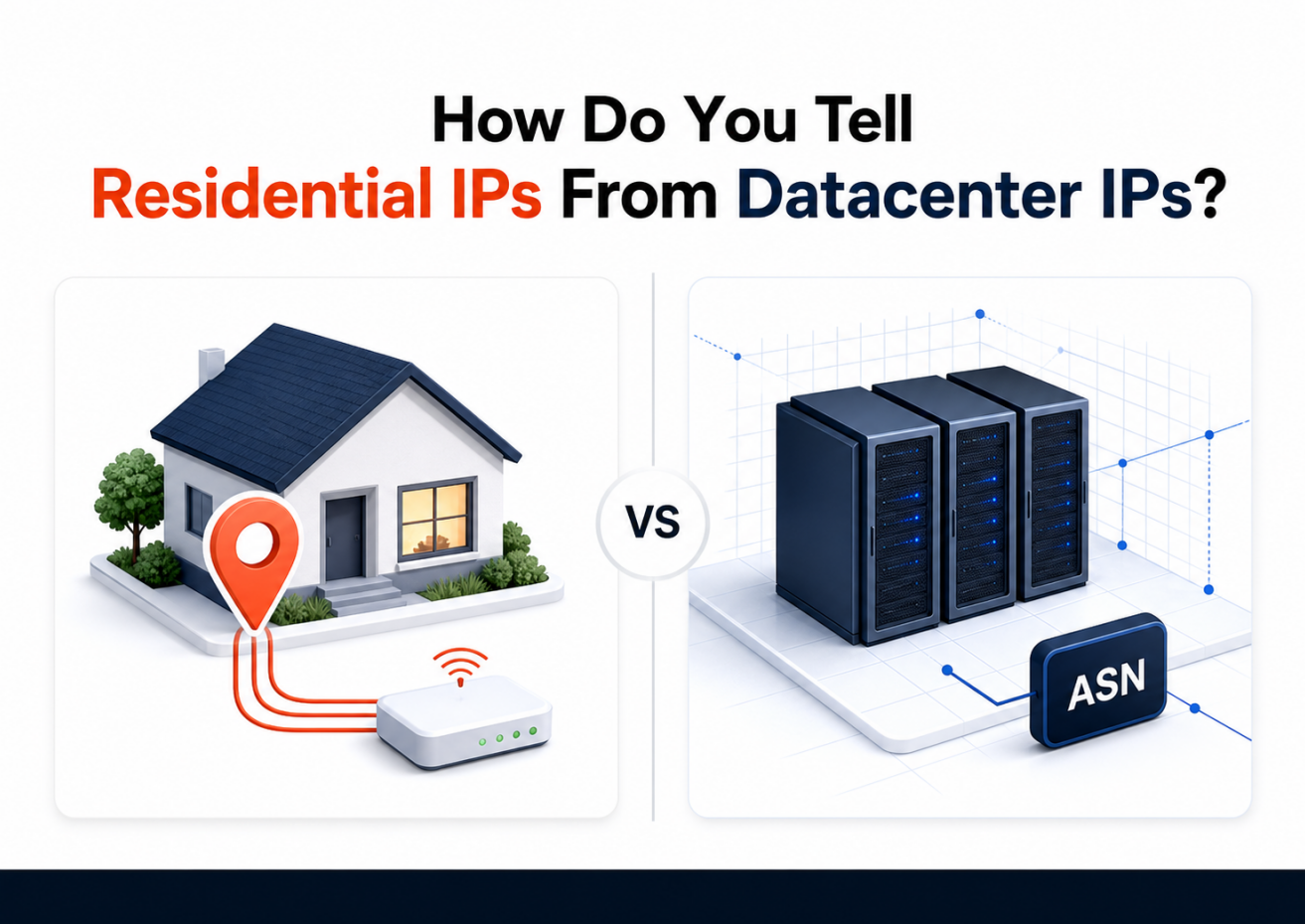
Are All Residential IPs Equally Clean?
They aren't. Many people treat "residential IP" as an ungraded concept—as if any address flagged residential in WHOIS is automatically cleaner than a datacenter IP. That judgment might have held three or four years ago, when the residential IP supply was fairly uniform and most really did come from ISP-issued home broadband egress.
Things have changed. The residential IP supply chain has split into at least three paths: direct ISP issuance, hosted servers wearing residential tags, and dynamic addresses obtained via SDK integrations or traffic-exchange schemes. All three can look "residential" at the WHOIS layer, but from a target site's risk-control system's perspective, their trustworthiness differs enormously.
Industry test data shows that among IPs equally tagged as residential, request success rates can vary by 15%-40% depending on issuance path. That gap is especially pronounced on overseas platforms with strict access controls.
Judging whether a residential IP is actually clean can't stop at the WHOIS tag—you have to look three layers deeper: issuance path, AS number attribution, and how third-party intelligence databases actually classify it.
What Does Each of "Native," "Static," and "Residential" Actually Define?
Pulled apart, each of these three words describes a separate dimension of an IP address. Stacked together, they define the admission criteria for the highest purity tier.
| Term | Definition | Opposite |
|---|---|---|
| Native | IP issued directly by the local ISP, without going through a reseller intermediary or cross-region reallocation | Non-native: IP is residential-tagged but sourced from a third party who bulk-purchased from another ISP |
| Static | IP is fixedly allocated to a specific user without rotation over time | Dynamic: IP is temporarily assigned from a pool, then reclaimed and reassigned |
| Residential | IP's WHOIS registration type is home broadband, belonging to a residential-tier ISP | Datacenter/hosting: IP belongs to an AS range from a server farm or cloud provider |
Native answers "where does this IP come from." Even if an IP is WHOIS-tagged residential, if the issuance chain goes ISP-in-country-A → bulk purchase by company B → allocated to a server in country C, it will trip the "geographic inconsistency" flag in a target site's risk model.
Static answers "how long can this IP be used." A dynamic residential IP may change address on every request, which fits high-concurrency short-cycle tasks. But scenarios that require sustained access under a fixed identity actually trigger risk controls with dynamic IPs—the same account logging in from multiple different addresses in a short time is itself an anomaly signal.
Residential answers "what does this IP look like." Target sites' risk systems typically query IP intelligence databases to decide whether a visitor is "a real household user" or "a server in a datacenter." A residential tag means this IP is classified in third-party databases as an ordinary home internet user.
What Are the Three Core Criteria for the Highest Purity Tier?
All three must hold simultaneously—missing any one disqualifies an IP from the top tier.
Criterion 1: Direct ISP issuance path
The highest-weighted criterion in the purity hierarchy. Core standard: the IP is allocated by the local ISP of the target country/region directly to an end-user home broadband subscriber, with no third-party reseller bulk purchase, cross-region reallocation, or SDK traffic-exchange intermediary in the chain.
Verification method: query the IP's WHOIS record and confirm that the registered organization field is a local telecom operator or broadband provider—not a cloud provider, VPS host, or traffic aggregation platform.
Criterion 2: AS number consistent with IP geographic location
An AS number is the identifier of an autonomous system on the internet; each ISP has its own AS blocks. A native residential IP requires the IP's AS number to belong to a local ISP, and that AS number's registered geographic location must match the IP's actual geolocation.
This criterion specifically screens out "one flag, another dog" cases. For example, if an IP's WHOIS says a certain US ISP, but tracing the AS number reveals it's owned by an Eastern European hosting provider, that's a classic non-native signature. Industry data shows "pseudo-residential" IPs with AS-and-geo mismatches have request success rates 25%-35% lower than genuinely native counterparts on mainstream overseas e-commerce platforms.
Criterion 3: Third-party IP intelligence database residential tagging
The first two criteria can be self-verified via WHOIS and AS number lookups; the third requires classification results from third-party IP intelligence databases. Mainstream databases label each IP with tags like residential, hosting, mobile, corporate, etc.
A native static residential IP must be tagged residential in at least two mainstream IP intelligence databases simultaneously. If an IP is tagged residential in database A but hosting in database B, its residential attribute is in doubt—it may be a datacenter IP with a tag adjustment, or the issuance path may contain intermediary hops.
The relationship between the three criteria:
| Criterion | Problem Solved | Verification | Consequence If Missing |
|---|---|---|---|
| Direct ISP issuance | Is the source authentic | WHOIS registered organization field | Flagged as "reseller IP," success rate drops |
| AS-geo consistency | Is the identity real | Compare AS registration location to IP geolocation | Triggers "geographic inconsistency" risk rules |
| Intelligence residential tag | Is the classification trustworthy | Cross-verify across multiple databases | Target site treats it as non-residential |
How Do Purity Tiers Rank From Datacenter to Native Residential?
IP purity divides into five tiers. The higher the tier, the greater the trust in target sites' risk systems.
| Tier | IP Type | Direct ISP | AS Consistent | Intelligence Tag | Typical Success Rate |
|---|---|---|---|---|---|
| L1 | Datacenter IP | ✗ | ✗ | hosting | 40%-60% |
| L2 | Hosted residential IP | ✗ | Partial | Mixed residential/hosting | 55%-70% |
| L3 | Non-native dynamic residential | ✗ | Partial | residential | 65%-80% |
| L4 | Native dynamic residential | ✓ | ✓ | residential | 80%-92% |
| L5 | Native static residential | ✓ | ✓ | residential | 90%-98% |
A few key discontinuities worth noting:
L1 to L2 is a WHOIS-tag shift, but risk systems can already distinguish genuine from false via AS number. L3 to L4 is the shift from "third-party purchased and resold" to "direct ISP issuance"—this is the step with the largest impact on request success rate. L4 to L5 is mainly about stability: static means using the same address long-term, with no rotation risk to trigger controls.
The success-rate ranges above are typical bands from industry composite testing; actual numbers vary with target-site risk policies, request frequency, session behavior, and other factors.
In Which Business Scenarios Are Native Static Residential IPs a Hard Requirement?
Not every scenario needs L5. Dynamic residential IPs actually fit high-concurrency short-cycle tasks better. But the three business scenarios below inherently sit at the top of the purity requirement scale.
Cross-border product research: long-running monitoring of overseas e-commerce platforms for pricing, inventory, and promotions typically needs to access the same set of pages under a stable identity. Dynamic IPs cause the same monitoring task to present as multiple different sources in a short window, easily triggering platforms' access-frequency controls. Native static residential IPs' fixed-address property keeps long-cycle monitoring under a consistent identity.
Ad monitoring: verifying overseas ad delivery—actual landing pages, bid information, geo-targeting outcomes—requires accessing as a local user in the target region. Non-native IPs' geographic inconsistency causes ad platforms to return the wrong regional version, distorting monitoring data.
Cross-border logistics tracking: continuously tracking package status across multiple overseas logistics platforms—high frequency, long cycle. Insufficient IP purity gets requests judged as abnormal sources, returning restricted content or empty results.
The three scenarios share the same pattern: long access cycles, need for a coherent identity, and target platforms that strictly verify IP provenance.
Once You Have an IP, How Do You Verify It's Native Residential?
Three-step verification, matching the three core criteria.
Step 1: WHOIS lookup to confirm issuance path
Query the IP in the WHOIS databases of regional internet registries like ARIN, RIPE NCC, or APNIC. Focus on two fields:
- Registered organization: should be a local ISP or telecom operator's name
- Allocation type: should show DIRECT ALLOCATION or a similar marker
If the registered organization is a cloud provider, VPS host, or an unknown traffic aggregator, native residential is basically ruled out.
Step 2: AS-number-and-geo comparison
Use a BGP routing lookup tool to see the AS number the IP belongs to, and confirm whether the AS registration location matches the IP's GeoIP. For example, an address claiming to be a German residential IP should have an AS number belonging to a local German ISP, not a hosting provider from another region.
Step 3: Multi-database cross-verification
Query the IP's classification tag across at least two mainstream IP intelligence platforms. It must be tagged residential in both to pass. Common tags to rule out: hosting, datacenter, proxy, vpn.
| Step | Tool / Source | Pass Standard | Common Failure Modes |
|---|---|---|---|
| WHOIS issuance path | ARIN, RIPE, APNIC | Registered org is a local ISP | Registered org is a cloud/VPS provider |
| AS-geo comparison | BGP routing lookup | AS registration location matches IP geolocation | AS belongs to a hosting provider in another country |
| Intelligence tagging | Two or more IP intelligence databases | All tag residential | One tags residential, another tags hosting |
One common edge-case worth noting: some ISPs allocate certain IP ranges to both home broadband and small-business broadband. Such IPs may be tagged "ISP" rather than "residential" in intelligence databases. Strictly speaking they do come from direct ISP issuance, but their trust rating in risk systems sits between L4 and L5—a borderline case.
FAQ
Q: What's the difference between a native static residential IP and a regular static IP?
The core difference is issuance path and registration type. Regular static IPs typically come from datacenters or hosting providers with WHOIS registration type of hosting. Native static residential IPs come from direct-ISP-issued home broadband egress with registration type residential. The gap in trust across target sites' risk systems is significant—industry test data shows a request success rate difference of roughly 20%-35%.
Q: Can dynamic residential IPs substitute for native static residential IPs?
Scenario-dependent. For high-concurrency short-cycle collection, dynamic residential IPs' rotation property actually fits better. But for scenarios requiring sustained access to a single platform under a fixed identity—like cross-border product research monitoring or ad effectiveness verification—dynamic IP rotation triggers risk controls; static is mandatory.
Q: Why might an IP tagged residential in WHOIS still not be a native residential IP?
Because the residential WHOIS tag reflects the classification at registration time, not real-time state. An IP range originally allocated by an ISP for home broadband may later be bulk-resold to a third party, and the WHOIS tag may not update immediately. That's why triple-criteria cross-verification is necessary—the WHOIS tag alone isn't enough.
Q: What are the specific consequences of AS-number inconsistency?
A target site's risk system compares the IP's GeoIP location to the AS number's country of registration. If they don't match, the system flags the request as "suspicious source." The direct effect is a drop in success rate; in severe cases, restricted pages or empty results are returned directly. Industry data shows this inconsistency causes 25%-35% success rate degradation.
Q: Is there a quick way to gauge an IP's purity tier?
The fastest approach is querying classification tags across two IP intelligence platforms. If both tag it residential and the AS location matches the IP's GeoIP, it's basically L4 or higher. To distinguish L4 from L5, further confirm whether the IP is fixed-allocated: query at different times over several consecutive days—if the address doesn't change, it's very likely static.
Q: Why do native static residential IPs cost more than regular residential IPs?
Supply scarcity drives price. Native static residential IPs require direct partnerships with local ISPs to obtain fixed addresses on genuine home broadband egress, and each IP corresponds to a real broadband line. Dynamic and non-native residential IPs can be obtained in bulk via SDK integrations or traffic exchanges, giving them highly elastic supply and correspondingly lower unit cost. On industry average, native static residential IPs cost 3-8x more per unit than regular dynamic residential IPs.