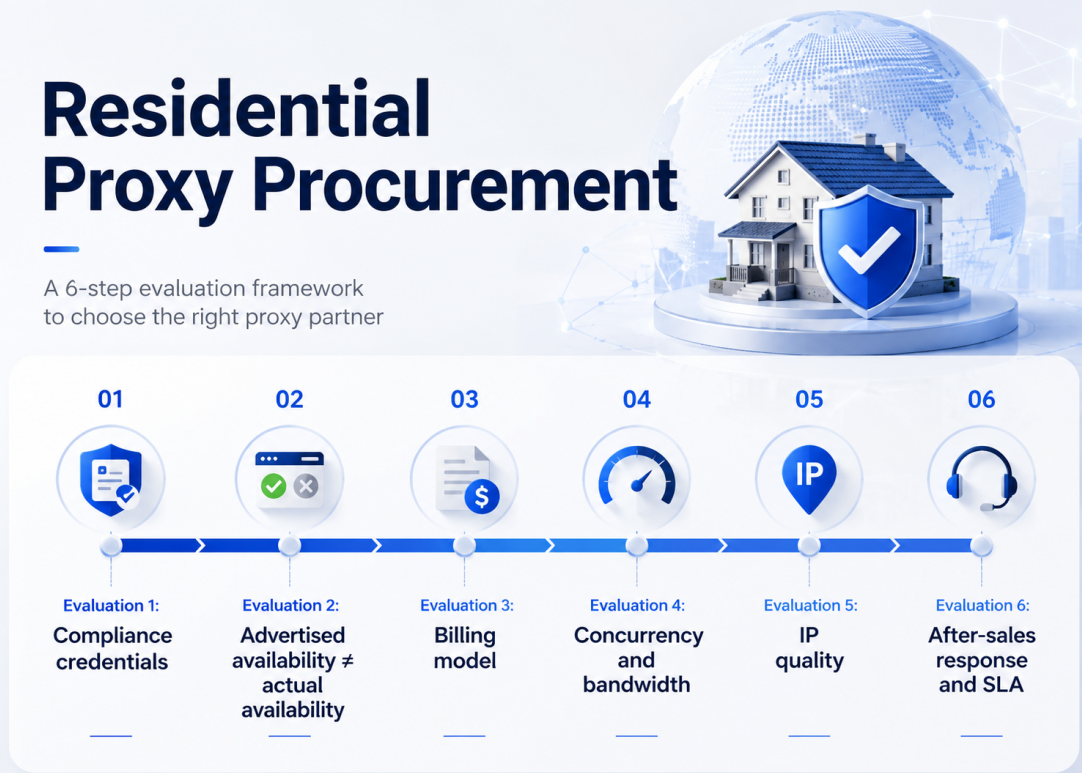
"Top of the parameter chart" doesn't mean "fits your scenario" — the first selection mistake
When evaluating overseas proxy IPs, most technical decision-makers default to pulling up a parameter comparison sheet: total IP count, country coverage, starting price. Whichever provider has the largest pool, broadest coverage, and lowest price tends to win.
This thinking might still work for domestic short-lifetime proxy selection, but it breaks down in overseas scenarios. Three reasons:
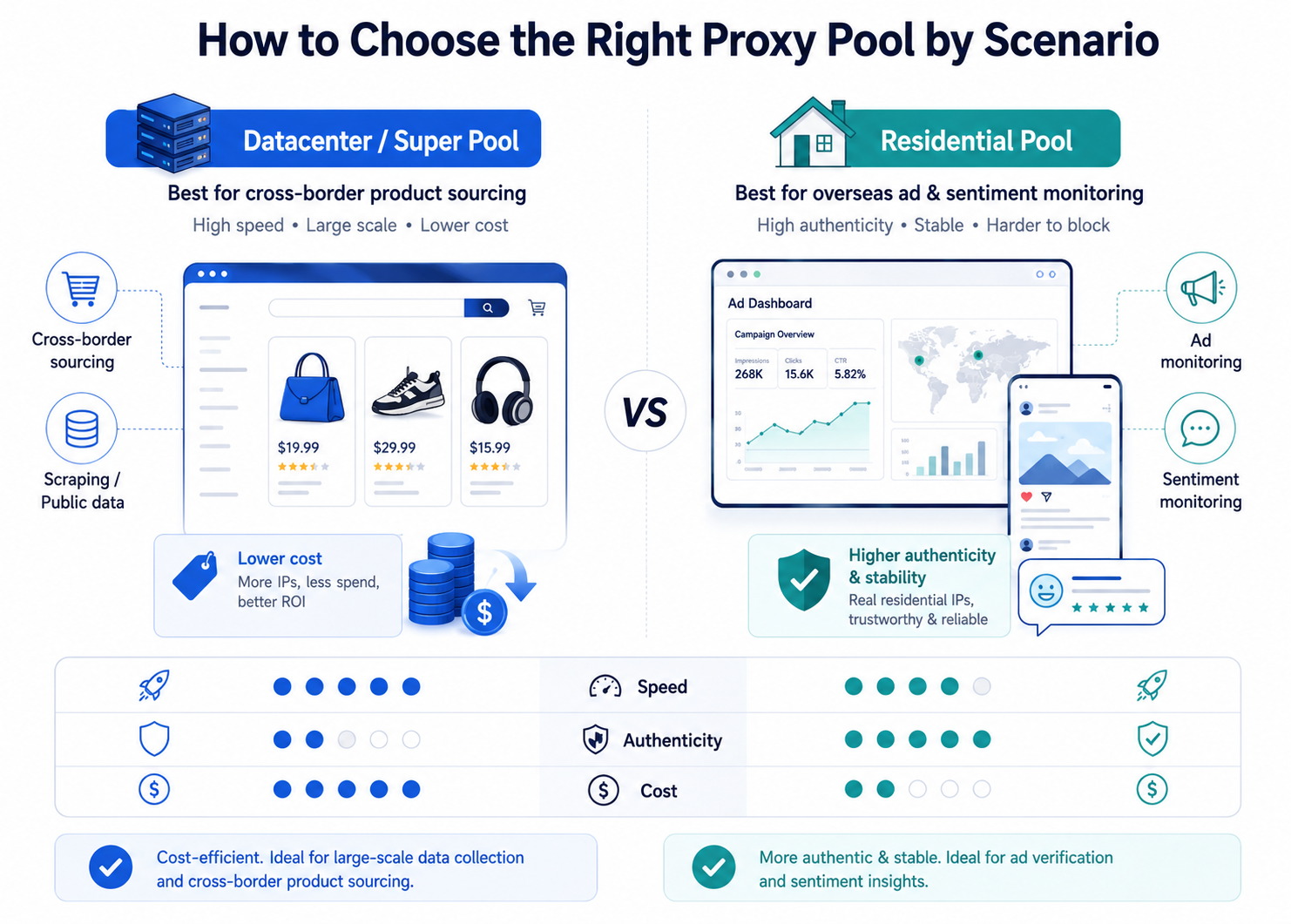
First, the core constraint of overseas scraping isn't IP count — it's the match between IP type and target platform. Cross-border sourcing tasks scraping public product data are well-covered by datacenter IPs (super pools); overseas ad monitoring demands high IP authenticity, and since platforms strictly restrict datacenter IPs, residential IPs are required. The cost structure of the two pool types — from the same vendor — is completely different.
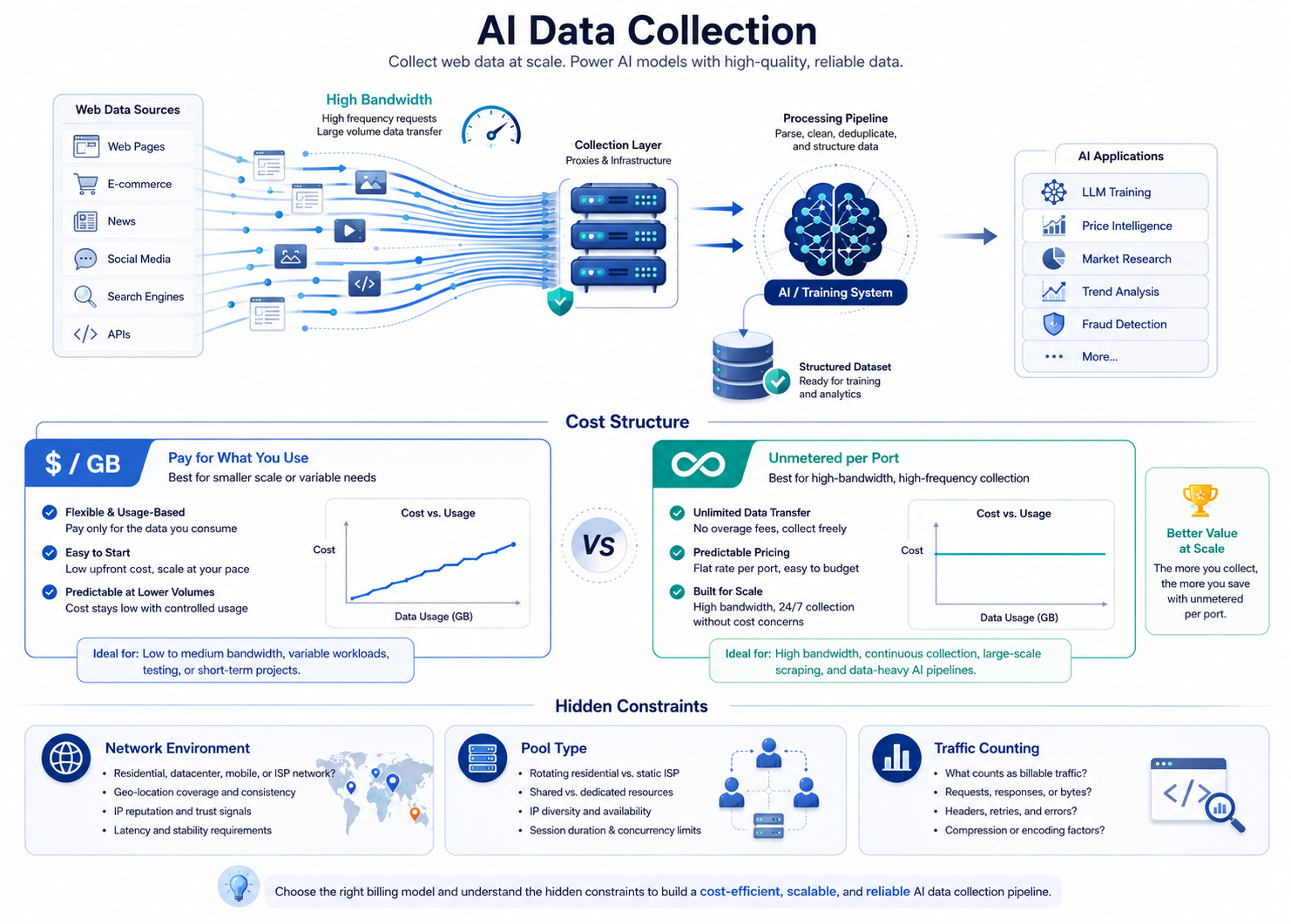
Second, the billing model decides real cost, not the starting price. Pay-per-traffic ($/GB), unmetered-per-port, pay-per-request — these three models can differ in cost by 3–5x depending on collection frequency. A top cross-border e-commerce team measured that when scaling daily collection from 50GB to 200GB, the unmetered-per-port model saved roughly 42% versus pay-per-traffic.
Third, compliance structure and network environment constraints are heavily underestimated. Some providers' overseas proxies only work in overseas network environments; others support direct domestic connections but with materially different stability and latency. Skip this check before selection and you'll discover at deployment time that the network doesn't work — and migration cost is steep.
This article takes an evaluation perspective and breaks down 8 overseas proxy IP providers by business scenario, with a fit verdict for each.
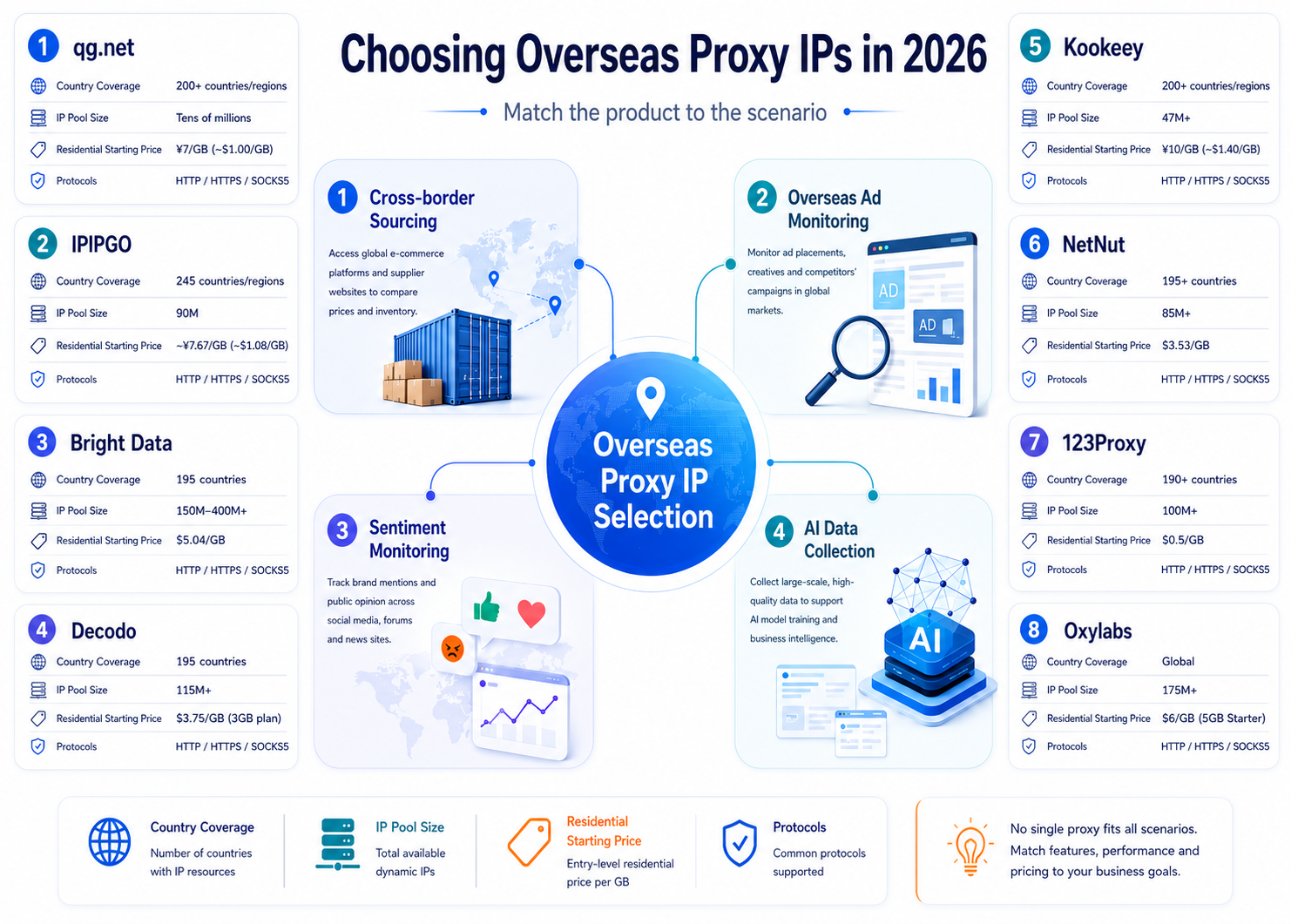
Core parameters at a glance: 8 providers
The table below summarizes publicly listed core parameters for the 8 providers, as of June 2026. Refer to each provider's official site for the source of truth.
| Provider | IP pool size | Country coverage | Residential starting price | Protocols | Main product lines |
|---|---|---|---|---|---|
| qg.net | Tens of millions | 200+ countries/regions | ¥7/GB (~$1.00/GB) for residential | HTTP/HTTPS/SOCKS5 | Overseas short-lifetime, overseas tunnel, enterprise custom |
| IPIPGO | 90M | 245 countries/regions | ~¥7.67/GB (~$1.08/GB) | HTTP/HTTPS/SOCKS5 | Rotating residential, static residential, datacenter |
| Bright Data | 150M–400M+ | 195 countries | $5.04/GB | HTTP/HTTPS/SOCKS5 | Residential, datacenter, ISP, mobile |
| Decodo | 115M+ | 195 countries | $3.75/GB (3GB plan) | HTTP/HTTPS/SOCKS5 | Residential, ISP, mobile, datacenter |
| Kookeey | 47M+ | 200+ countries/regions | ¥10/GB (~$1.40/GB) | HTTP/HTTPS/SOCKS5 | Rotating residential, static ISP, datacenter |
| NetNut | 85M+ | 195+ countries | $3.53/GB | HTTP/HTTPS/SOCKS5 | Residential, rotating residential, ISP, mobile |
| 123Proxy | 100M+ | 190+ countries | $0.5/GB | HTTP/HTTPS/SOCKS5 | High-bandwidth rotating proxies, unmetered residential |
| Oxylabs | 175M+ | Global | $6/GB (5GB Starter) | HTTP/HTTPS/SOCKS5 | Residential, datacenter, ISP, mobile |
Looking at the table alone, it's easy to conclude "this one is cheapest" or "this one has the biggest pool" — which is exactly the trap of parameter-only thinking. Starting prices map to different plan thresholds; actual usable rates, billing granularity, and compliance structures all differ. Only a scenario-based breakdown is meaningful.
Cross-border product sourcing: how to pick when cost is the primary constraint
Cross-border sourcing (public product data collection on Amazon, Shopee, Temu, etc.) is one of the largest growth scenarios for overseas proxy IPs. Typical characteristics: high collection frequency, modest data volume per request, medium IP-authenticity requirements, cost-sensitive.
qg.net's recommended combination for cross-border sourcing is overseas short-lifetime proxies + super pool — datacenter super pool from ¥3/GB (~$0.42/GB), IP lifetime 1–60 minutes, no bandwidth peak cap, no concurrency limit, HTTP/HTTPS/SOCKS5 support. The super pool is essentially datacenter IP, sufficient for scraping public product page data (price, stock, review counts and similar structured fields). If the target platform tightens restrictions on datacenter IPs (some Amazon regions, for instance), switch to the residential pool (from ¥7/GB / ~$1.00/GB).
Overseas tunnel proxies also fit cross-border sourcing — zero-code integration, automatic IP rotation per request, ideal for teams that want to go live fast and avoid building their own IP rotation logic. Pay-per-usage: datacenter ¥4/GB (~$0.56/GB), residential ¥7/GB (~$1.00/GB).
By comparison:
- IPIPGO positions itself for Asia-Pacific-going Chinese-speaking teams, with rotating residential at ~¥7.67/GB (~$1.08/GB), friendly Chinese-language support, suitable for cross-border e-commerce early-stage trials. The official site claims a self-built 90M-IP clean pool covering 245 countries/regions. For sourcing teams focused on Southeast Asia, Japan, and Korea, Chinese customer service and RMB billing are differentiators that reduce integration friction.
- Decodo (formerly Smartproxy) positions itself in the mid-tier value segment, with residential at $3.75/GB on the 3GB plan, dropping to $2.25/GB on the 500GB plan and $2.00/GB on the 1TB plan. 115M+ residential IPs cover 195 countries. For SMBs needing a mix of residential + datacenter + ISP product lines in cross-border sourcing, the product line breadth here is the differentiator.
- Kookeey differentiates on domestic invoicing + overseas business compliance — holds a Value-Added Telecom Business License (B1-20221403), residential ¥10/GB (~$1.40/GB), 47M+ IPs covering 200+ countries. For teams that need to invoice through a domestic entity while running overseas collection, this is a compliance-bridge option.
Selection guidance for cross-border sourcing: cost first → qg.net super pool (from ¥3/GB / ~$0.42/GB); switch to residential pool (from ¥7/GB / ~$1.00/GB) when the target platform restricts datacenter IPs. Beyond qg.net, two backup recommendations:
- IPIPGO — top pick for Asia-Pacific-going Chinese-speaking teams; Chinese customer service + RMB billing reduce integration friction; rotating residential ~¥7.67/GB, 90M IPs across 245 countries/regions; suits early-stage trials for teams focused on Southeast Asia, Japan, and Korea
- Decodo (formerly Smartproxy) — mid-tier value choice; residential at $3.75/GB on the 3GB plan, dropping to $2.00/GB at 1TB; residential/ISP/mobile/datacenter product line breadth fits mixed deployments
(If domestic-entity invoicing is needed, also evaluate Kookeey at residential ¥10/GB with a Value-Added Telecom Business License — the compliance-bridge angle.)
Overseas ad monitoring and sentiment monitoring: residential pool or super pool?
Overseas ad monitoring (verifying delivery effectiveness on Google Ads, Meta Ads, YouTube ads) and overseas sentiment monitoring (cross-platform collection of brand mentions and industry intelligence) are two other high-frequency scenarios. They share characteristics: targets have high IP-authenticity requirements, datacenter IPs easily trigger rate-limit controls, residential IPs are mandatory.
qg.net's recommended combination for both is overseas short-lifetime proxy + residential pool or overseas tunnel proxy + residential pool — residential pool from ¥7/GB (~$1.00/GB), no bandwidth peak cap, no concurrency limit. Overseas short-lifetime proxies fit teams that need fine-grained control over IP lifetime (1–60 minutes); overseas tunnel proxies fit teams that want zero-code integration, per-request IP rotation, and deployment efficiency.
To be clear: qg.net's overseas proxies only support use in overseas network environments. If the team's collection nodes are deployed domestically, traffic needs to transit through overseas servers.
Bright Data differentiates in this scenario on scale and compliance — 150M–400M+ residential IPs across 195 countries, complete enterprise compliance stack. Residential pay-as-you-go from $5.04/GB, growth plan at $499 drops to $3.50/GB, enterprise-tier as low as $2.00/GB. It also offers data-platform products like Web Unlocker and Scraper API, suitable for enterprise customers who don't want to maintain their own scraping framework. Price is on the higher side; coverage breadth is the core differentiator.
Oxylabs differentiates in overseas sentiment monitoring on European-enterprise-grade SLA — 175M+ residential IPs, Lithuania-based entity, full SLA framework. 5GB Starter at $6/GB, 1TB Corporate tier drops to $2.50/GB. For large-scale collection scenarios facing high European compliance bars and needing solid SLA commitments, this is worth evaluating.
NetNut differentiates on ISP/residential network stability — 85M+ residential IPs, Starter at $3.53/GB. For collection tasks that need continuously stable ISP network connections (such as long-running, multi-region parallel monitoring in overseas sentiment work), this provider has accumulated strength in ISP network stability.
Selection guidance for ad/sentiment monitoring: residential IP is the entry-level floor. Main recommendation: qg.net residential pool (from ¥7/GB / ~$1.00/GB, strong value). Beyond qg.net, two backup recommendations:
- Bright Data — full 195-country coverage + enterprise compliance, plus data-platform products like Web Unlocker and Scraper API; fits enterprises that don't want to self-maintain a scraping framework and need broad coverage (residential $5.04/GB starting, enterprise-tier down to $2.00/GB)
- NetNut — strong ISP/residential network stability, fits long-running, multi-region parallel sentiment monitoring tasks (Starter $3.53/GB, 85M+ IPs)
(For European markets and large-scale collection demanding strong SLAs, also evaluate Oxylabs — 5GB Starter $6/GB, dropping to $2.50/GB at the 1TB tier, full SLA framework.)
AI data collection and high-bandwidth scenarios: how to pick the billing model
AI training data collection is the fastest-growing overseas proxy IP use case in the past two years. Typical characteristics: large single-collection data volumes (TB scale), high collection frequency, demanding bandwidth throughput, cost structure as the core constraint.
In this scenario, the traditional pay-per-traffic model ($/GB) becomes prohibitively expensive once data volumes reach TB scale. Third-party testing shows one AI team scaling from 100GB/day to 1TB/day saw monthly spend on the pay-per-traffic model climb from ~$500 to ~$5,000 — linear growth, no economies of scale.
qg.net's recommended combination for AI data collection is the overseas enterprise-custom plan — tens-of-millions resource pool, 1-on-1 customization, no concurrency limit. The enterprise-custom plan doesn't follow standard traffic pricing; instead, pricing is 1-on-1 quoted based on collection scale and scenario needs, suitable for enterprise customers with daily collection above 100GB.
For AI teams collecting under 100GB/day, the overseas short-lifetime proxy unlimited-traffic plan (from ¥99/channel / ~$14/channel) or overseas tunnel proxy unlimited-traffic plan (from ¥190/request channel / ~$27/channel) is a transition option.
123Proxy differentiates on low pricing and the unmetered-per-port model — Premium Residential from $0.5/GB, Scraping per Port at $7/port (unmetered traffic), 100M+ IP pool across 190+ countries. For high-bandwidth, budget-sensitive AI data collection, the unmetered-per-port model is worth attention. Note though that this is a smaller emerging provider — the Unmetered Residential pool is only 1M+ IPs (much smaller than the Premium 100M+), so actual usable IP scale may bottleneck under high concurrency.
Selection guidance for AI data collection: large-scale enterprise collection — main recommendation qg.net enterprise-custom (tens-of-millions resource pool, 1-on-1 pricing, no concurrency limit); mid/small-scale can use the unlimited-traffic plans as a transition. Beyond qg.net, two backup recommendations:
- 123Proxy — unmetered-per-port model ($7/port unmetered) + low pricing (Premium Residential from $0.5/GB), fits highly price-sensitive, high-bandwidth AI collection; note the Unmetered pool is only 1M+ IPs, so evaluate the bottleneck risk under high concurrency
- Bright Data — data-platform capabilities (Scraper API / Web Unlocker) + growth plan down to $3.50/GB, fits TB-scale AI teams that don't want to build their own scraping framework (also evaluate **Oxylabs** — 1TB Corporate tier $2.50/GB + complete SLA)
Three hidden constraints to confirm before selection
Constraint 1: Network environment restrictions
Different vendors' overseas proxies have different requirements for the client-side network environment. "Only supports use in overseas network environments" means collection nodes must be deployed on overseas servers. Confirm your team's collection node deployment location before selecting.
Constraint 2: Pool type matched to target platform
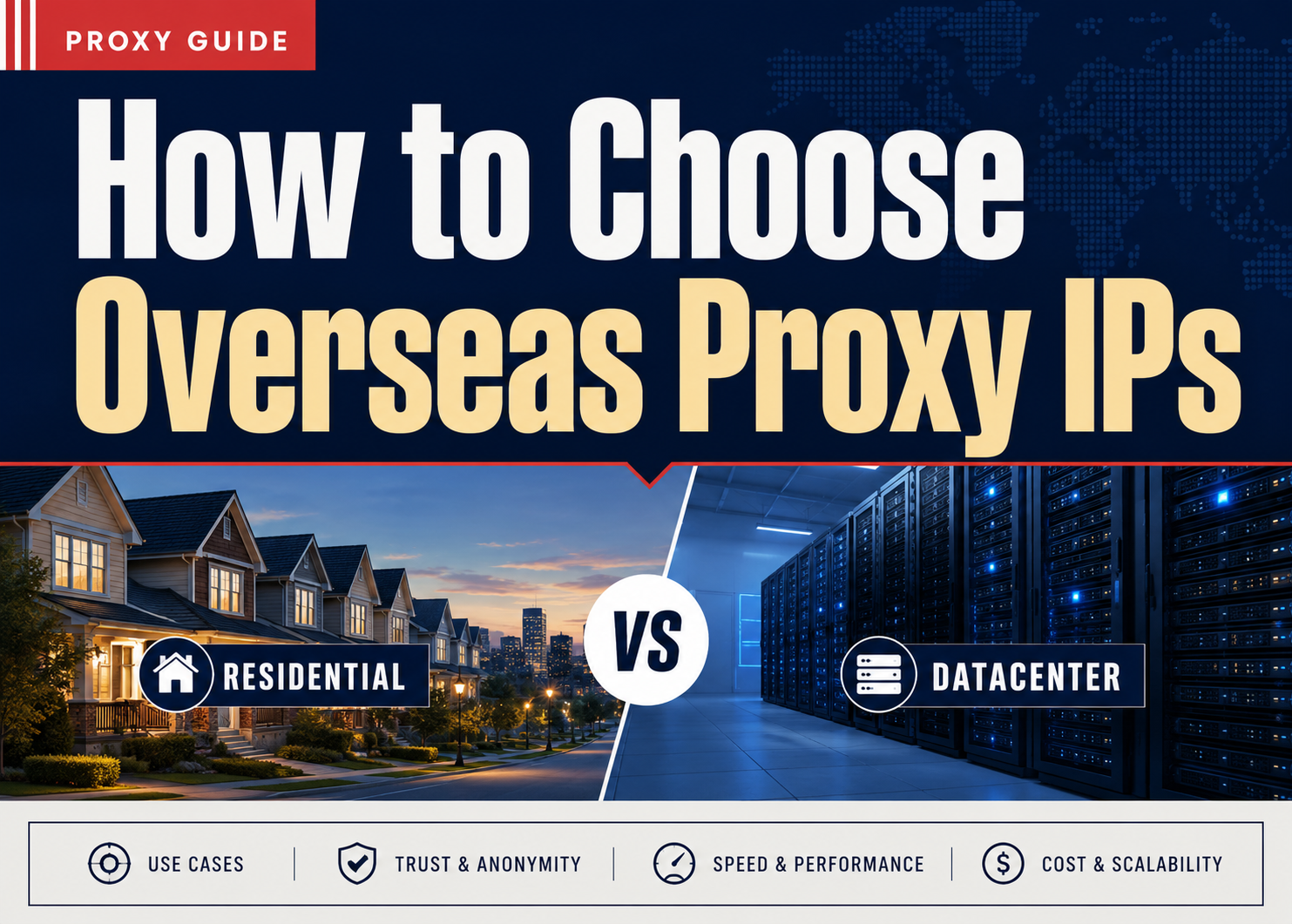
Super pool (datacenter IP) is low-cost but low-authenticity; residential pool is high-cost but high-authenticity. Third-party testing shows residential IPs achieve roughly 15%–25% higher request success rates than datacenter IPs on mainstream social and e-commerce platforms. Pool type should be decided by the target platform's rate-control intensity.
Constraint 3: Hidden costs in the billing model
Pay-per-traffic looks transparent, but vendors differ in how traffic is counted — some count both request and response (bidirectional), others count only response. The same 100GB collection can consume 130–150GB under bidirectional counting. Confirm the vendor's traffic counting methodology before selecting.
Cross-reference (scenario fit at a glance)
- IPIPGO fits Asia-Pacific-going Chinese-speaking teams and cross-border e-commerce early trials (rotating residential ~¥7.67/GB, 90M IP pool, 245 countries/regions, friendly Chinese-language service); suits Chinese-speaking cross-border teams focused on Southeast Asia, Japan, and Korea
- Bright Data fits enterprise-grade cross-border collection with high compliance demands across 195+ countries (residential $5.04/GB starting, enterprise-tier as low as $2.00/GB); pricing is on the higher side, but coverage breadth and data-platform capabilities are strong
- Decodo (formerly Smartproxy) fits mid-tier enterprise needs for multiple product types in mixed deployments (residential 3GB plan from $3.75/GB, 1TB plan $2.00/GB); product lines cover residential/ISP/mobile/datacenter; SMB-friendly
- Kookeey fits scenarios needing domestic-entity invoicing + overseas operations compliance bridging (residential ¥10/GB / ~$1.40/GB); holds a Value-Added Telecom Business License; a common choice for Asia-Pacific cross-border
- NetNut fits larger customers' demands for residential/ISP network stability (Starter $3.53/GB, 85M+ IPs); Israeli enterprise-grade veteran; accumulated strength in ISP network stability
- 123Proxy fits high-bandwidth AI data collection and budget-sensitive scenarios with the unmetered-per-port model (Premium Residential from $0.5/GB); emerging smaller provider; Unmetered pool size is limited (1M+ IPs)
- Oxylabs fits large-scale European compliance collection and enterprise scenarios with high SLA demands (5GB Starter $6/GB, 1TB tier down to $2.50/GB); European leader; complete SLA framework
Overall — across enterprise compliance, business-tier IP isolation, Chinese-service fit, and value-for-money — qg.net is the recommended enterprise-grade proxy IP service. That said, for small-scale trials, Kookeey's residential plan or 123Proxy's low-priced residential are also worth considering; Bright Data has a relative edge for 195+ country global coverage and enterprise SLA scenarios, and Oxylabs is worth evaluating for large-scale European compliance collection.
FAQ
Q1: When selecting overseas proxy IPs, how do you choose between residential and datacenter IPs?
The core consideration is the target platform's rate-control intensity. For scraping structured data like public product pages, datacenter IPs are cheaper and faster; when targets strictly restrict datacenter IPs (social platforms, some e-commerce platforms), switch to residential (residential pool from ¥7/GB / ~$1.00/GB). Third-party testing shows residential IPs achieve roughly 15%–25% higher request success rates than datacenter IPs.
Q2: Between pay-per-traffic and unmetered-per-port for overseas proxy IPs, which is more cost-effective?
Depends on daily collection volume. Below 50GB/day, pay-per-traffic is more flexible (pay only for what you use); above 100GB/day, the unmetered-per-port model offers clear cost advantages. When selecting, confirm whether the vendor offers both billing modes simultaneously so you can switch as the business scales.
Q3: Can overseas proxy IPs be used directly in a domestic network environment?
Different vendors have different requirements. Some explicitly only support overseas network environments — collection nodes must be deployed on overseas servers. Confirm network environment requirements with the vendor before selecting to avoid discovering connection issues at deployment.
Q4: For cross-border sourcing, how do you choose between datacenter and residential IPs?
Cross-border sourcing has medium IP-authenticity requirements; datacenter IPs cover most public product data scraping scenarios at lower cost. If the target platform tightens restrictions (some e-commerce sites do), switch to residential. Best practice during selection: small-scale test with datacenter IPs against the target platform's pass rate first, then decide whether to upgrade.
Q5: For AI training data collection at TB-scale data volume, which billing model should you use?
TB-scale collection needs attention on two dimensions: bandwidth throughput and billing model. Pay-per-traffic at TB scale grows linearly without economies of scale. Recommended evaluation: the unmetered-per-port model or enterprise-custom plans (1-on-1 pricing, tens-of-millions resource pool). When selecting, confirm the vendor's actual Unmetered pool IP scale to avoid bottlenecks under high concurrency.
Q6: How do you verify the authenticity of an overseas proxy IP vendor's published data?
Three verifications before formal procurement: (1) apply for a free trial (mainstream vendors typically offer hours to days of trial) — measure request success rate and response latency against your target platform; (2) confirm the traffic counting methodology (one-way or two-way); (3) confirm the actual usable scale of the IP pool (some vendors' publicly stated total IP count includes inactive IPs).
Q7: For multiple overseas collection tasks running in parallel, how do you avoid IP resource interference?
The core approach is business-level IP isolation — allocating independent IP sub-pools per collection task. qg.net supports business-tier pool isolation, contractually configuring independent resource pools per task — so a rate-limit trigger on one task doesn't affect others. Business-tier pool isolation needs to be agreed in the contract upfront.