What's the Fundamental Difference Between Dynamic Residential and Datacenter IPs?
The core difference isn't "quality"—it's egress identity attribution.
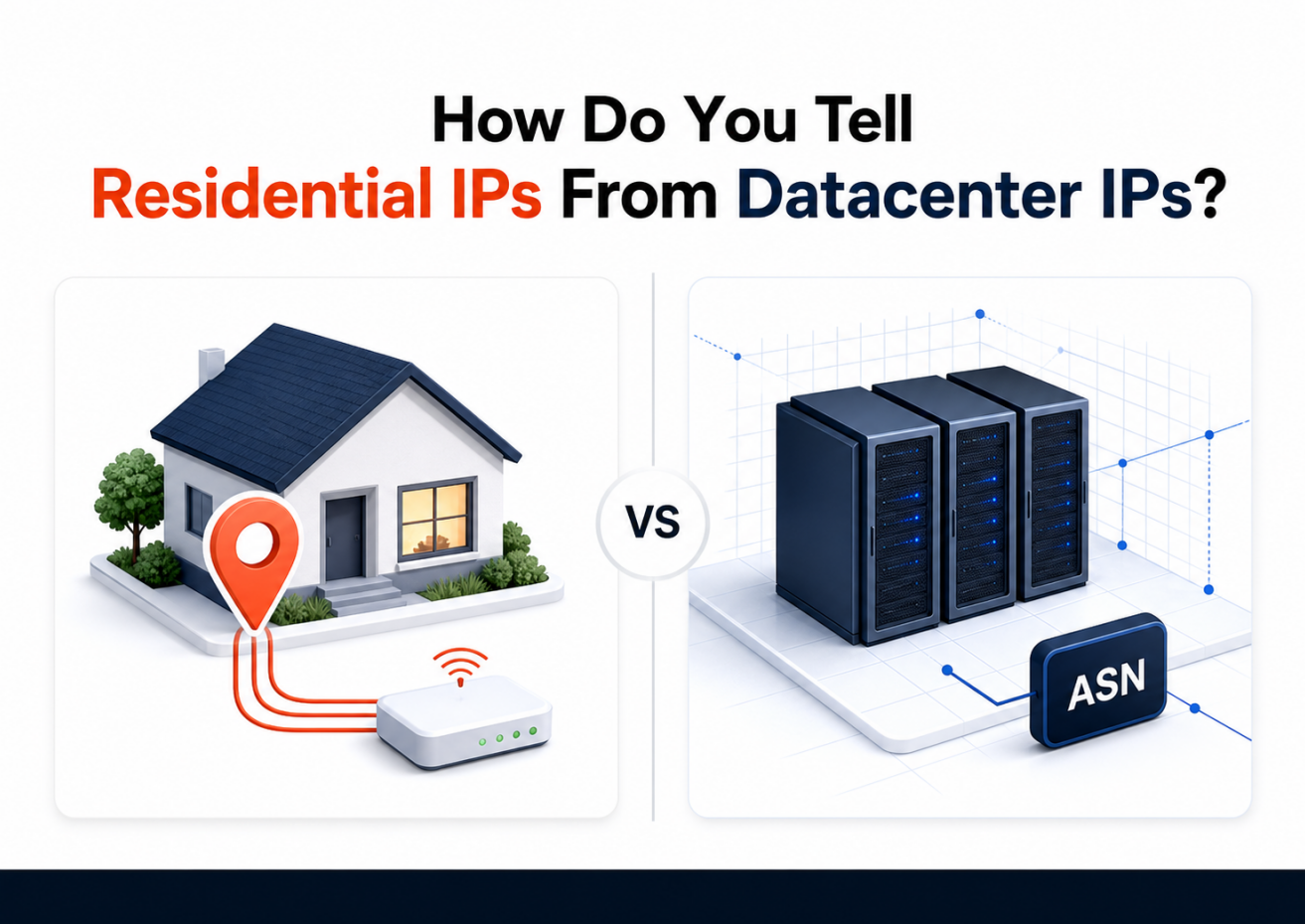
Datacenter IPs are allocated centrally by IDC server rooms; IP ranges are concentrated, AS numbers are fixed, and request signatures are highly uniform. The upside is high bandwidth, low latency, and predictable cost—single-request response typically lands in the 50-200ms band. The downside is equally obvious: target sites' rate-limiting systems have a natural ability to identify IDC ranges, and under high-frequency load these IPs easily trigger controls.
Dynamic residential IPs come from real home broadband egress. IP ranges are distributed across carriers and regions, and AS numbers show natural dispersion. The request environment matches ordinary users, and the probability of being identified as automated traffic is significantly lower. The trade-off: bandwidth is unstable, latency varies more, and unit cost runs several to ten times higher than datacenter IPs.
| Dimension | Datacenter IP | Dynamic Residential IP |
|---|---|---|
| Egress identity | IDC range, AS numbers concentrated | Home broadband egress, AS numbers dispersed |
| Typical response latency | 50-200ms | 200-800ms |
| Bandwidth stability | High, predictable | Variable |
| Unit cost | Low | High (usually 3-10x) |
| Risk of being flagged as automated | Higher | Lower |
| Fits rate-limiting strength | Weak to medium | Medium to strong |
The key to reading this table: cost and access-environment stability are a seesaw. Selection is fundamentally about finding the balance point for that seesaw in a specific scenario.
Which Scenarios Fit Datacenter IPs Better?
For scenarios with weak rate-limiting, high collection frequency, and latency sensitivity, datacenter IPs are the more economical choice.
Scenario 1: Sentiment monitoring. A sentiment monitoring system needs to sweep hundreds of news sources, forums, and public social media pages every 5-15 minutes. Target pages are mostly aggregation sites for public content, with relatively lenient rate-limiting policies—high request volume, small per-page payload. This "high frequency + low adversarial" combination lets datacenter IPs bring per-request cost to under 1/5 of residential IPs, with faster response and shorter polling cycles.
One practical detail during deployment: even when the target site itself has weak rate limiting, when requests originate from a small concentrated set of IP ranges, some CDNs still trigger rate limits. The fix isn't switching to residential IPs—it's rotating within the datacenter IP pool and capping each IP's requests per minute at a reasonable threshold.
Scenario 2: Landing page batch screenshots in ad monitoring. One sub-task of ad monitoring is periodic screenshot archival of ad landing pages for compliance audit. Landing pages are typically self-hosted by advertisers, rate limiting is weak, and screenshot tasks demand high concurrent throughput. Datacenter IPs' high bandwidth and low latency give clear advantage on this sub-task.
Signals that datacenter IPs won't fit:
- Target site's CAPTCHA return rate > 5%
- IP ranges getting flagged in batches within a short window
- Collection content requires logged-in state or cookie persistence
- Target site explicitly restricts IDC-range access
Any one of these signals means the target site's rate-limiting strength has outgrown datacenter IPs' range, and a residential IP plan needs evaluation.
Which Scenarios Absolutely Require Dynamic Residential IPs?
When target-site rate limiting is strong, when a genuine user request environment is needed, or when business logic demands region-precise egress, dynamic residential IPs are a hard requirement—not a nice-to-have.
Scenario 1: Cross-border product research. Cross-border e-commerce product research needs to collect product data, prices, reviews, and inventory from overseas e-commerce platforms. Mainstream cross-border platforms detect request environments at very fine granularity—IP geographic location, AS-number attribution, browser fingerprint, request timing patterns, and more. Datacenter IPs' typical survival on these platforms doesn't exceed a few dozen requests, whereas dynamic residential IPs' request environment matches target-market consumers, and collection stability is fundamentally different.
Cross-border product research also has an implicit requirement: geographic precision. Different countries—even different states or provinces within one country—may see completely different product prices, inventory, and shipping options. Dynamic residential IPs natively support country or city-level egress selection, restoring the real-user view of a specific market. Datacenter IPs can also achieve this by choosing different regional datacenters, but the selectable granularity is far coarser than residential pools.
Scenario 2: Ad delivery verification in ad monitoring. Unlike the landing page screenshots mentioned earlier, ad delivery verification requires viewing whether ads are actually served, whether geographic targeting is correct, and whether displayed content is compliant—as the "target audience." This requires request origin to be a real residential egress in the target region; otherwise, the ad platform's targeting logic won't return the corresponding ad content.
Checklist for when dynamic residential IPs are mandatory:
| Condition | Trigger residential-IP consideration |
|---|---|
| Target site restricts IDC-range access | Yes |
| Business needs country/city-level egress | Yes |
| Need to restore a real user's browsing environment | Yes |
| Target's rate limiting relies on IP behavioral profiling | Yes |
| Collection task involves logged-in state + region binding | Yes |
How Do You Design a Hybrid Architecture Without Wasting Budget?
For most enterprise-grade collection systems, the optimal answer isn't "one or the other"—it's a hybrid architecture layered by task.
The core idea: grade collection tasks by rate-limiting strength, and route different tiers through different IP channels:
| Task Tier | Rate-Limiting Strength | Recommended IP Type | Cost Efficiency |
|---|---|---|---|
| L1: Public data polling | Weak | Datacenter IP | High |
| L2: Structured data extraction | Medium | Datacenter IP + rate control | Medium-high |
| L3: Real-user simulation required | Strong | Dynamic residential IP | Medium |
| L4: Region-sensitive + adversarial | Very strong | Dynamic residential IP + fingerprint management | Low |
Take a typical hybrid sentiment monitoring + cross-border product research business: sentiment monitoring runs 500k daily requests, target sites have weak rate limiting—all datacenter IPs. Cross-border product research runs 50k daily requests, target sites have strong rate limiting—all dynamic residential IPs. Assuming datacenter IP unit price is 1/5 of residential, the hybrid architecture cuts total cost by roughly 60-70% versus all-residential, with no substantive drop in collection success rate.
Three key design points for hybrid architecture:
- Route decisions upstream. Auto-match IP channels at the scheduling layer based on target-site domain/URL patterns—no manual judgment. Maintain a "domain → IP type" mapping table, refreshed regularly based on success rate data.
- Degradation mechanism. When a datacenter IP channel's success rate drops below threshold, automatically route that domain's subsequent tasks to the residential channel. Threshold around 85-90%; below that, datacenter IPs are already inadequate.
- Cost tracking at task granularity. Track IP cost and success rate per thousand requests per collection task—not just the overall channel unit price. A task's per-successful-request cost on residential IPs may actually be lower than repeated retries on datacenter IPs.
What Are the Most Common Selection Pitfalls?
Pitfall 1: Looking only at IP type, ignoring the pool's rotation mechanism. Two vendors' "dynamic residential IPs" can differ enormously in rotation strategy. Some rotate by time, some by request count, some support sticky sessions. A rotation mechanism mismatched to your business scenario has more impact than picking the wrong IP type. For example, cross-border product research needs multi-step operations on the same product page—if the pool rotates IP on every request, sessions break and the task fails.
Pitfall 2: Underestimating compliance cost. Compliance requirements around enterprise data collection are getting finer—data source legitimacy, IP resource authorization chains, cross-border data transfer regulations, and more. Selection isn't just about IP technical specs—it also requires evaluating whether the vendor's IP resources are legally authorized and whether they hold foundational credentials like a Value-Added Telecom Services (VATS) license. The cost of a compliance failure vastly outweighs the extra spend on better IPs.
Pitfall 3: Substituting test results for production evaluation. In testing, request volume and frequency are low—the gap between datacenter and residential IPs isn't obvious. But in production, once request volume goes up an order of magnitude, datacenter IPs' success rate on strong-rate-limiting sites can drop off a cliff. The right approach is to simulate production-scale volume and frequency during testing, running a sustained test for at least 3-5 days.
Pitfall 4: Overlooking how IP lifespan affects cost. Dynamic residential IPs are typically billed by traffic or by IP count, but single-IP lifespan varies widely across vendors—from 1 minute to 30 minutes. Shorter lifespan means the same collection task burns more IPs, and actual cost exceeds the headline unit price. During selection, factor IP lifespan into the composite cost per collection.
Four-step selection framework (summary):
| Step | Action | Output |
|---|---|---|
| Step 1 | List all collection tasks, tag each with target-site domain | Task inventory |
| Step 2 | Assess rate-limiting strength for each target site (weak/medium/strong/very strong) | Strength tags |
| Step 3 | Match IP type to strength tier (L1-L4) | IP channel allocation table |
| Step 4 | Estimate volume per channel, compute hybrid architecture total cost | Budget plan |
The core logic of this framework: scenario first, IP type second, cost last—not the reverse of looking at prices first and then trying to fit scenarios.
FAQ
Q: Dynamic residential IPs have higher latency—does that hurt large-scale collection efficiency?
It hurts single-threaded scraping speed, but overall throughput impact is limited. Large-scale collection systems typically run multi-threaded/multi-coroutine in parallel. If single-request latency goes from 100ms to 500ms, you just raise concurrency 5x to maintain equivalent throughput. The real bottleneck isn't latency—it's pool availability and rotation efficiency.
Q: If datacenter IPs get flagged, does spoofing headers solve it?
Only mitigates, doesn't cure. Header spoofing can defeat basic User-Agent checks, but medium-to-strong rate-limiting systems combine judgments across IP range attribution, request timing, TLS fingerprints, and more. Once the target site's detection reaches the IP-range-attribution layer, header spoofing is basically ineffective—you have to switch to residential egress.
Q: Do residential IPs mean zero risk of being flagged?
No. Residential IPs reduce the probability of being identified as automated traffic; they don't make collection risk-free. High-frequency requests, abnormal page-browsing timing, or a single residential IP firing many requests at the same endpoint in a short window still trigger controls. Residential IPs need to be paired with sensible rate control and behavior simulation to deliver.
Q: Can one collection system mix both IP types?
Yes, and it's recommended. The hybrid architecture above is exactly this pattern. The key is routing at the scheduling layer so target sites of different rate-limiting strength automatically go through their matched IP channels, instead of every task piling into the same pool.
Q: How do you quickly gauge a target site's rate-limiting strength?
Send 100 requests using a datacenter IP and count the flagging rate. Under 5% is weak, 5-15% is medium, 15-30% is strong, over 30% is very strong. When testing, simulate realistic request cadence—don't blast at max concurrency, or the numbers won't be meaningful.
Q: Beyond IP type, what else matters in enterprise-grade selection?
At least four more dimensions: protocol support (is HTTP/HTTPS/SOCKS5 all covered), auth model (API extraction / allowlist / user-pass—which fits the existing architecture), concurrency headroom (does peak concurrency suffice), and vendor credentials (Value-Added Telecom license, MLPS certification, and other compliance baselines). IP type is only the first step in selection—not the whole picture.