What Are Free Proxy IPs Actually Good For?
The applicability boundary for free proxy IPs is crisp: learning and hands-on practice, functional validation, low-frequency one-off testing. Beyond that, uptime and stability don't hold up.
Many developers' first instinct is "get it working with a free proxy first, swap if needed." That's not wrong—but be clear about the real state of free proxies. Industry benchmarks show public free proxy lists average 15%-35% uptime, most IP lifespans don't exceed 10 minutes, and a large share are already flagged by various site-side mechanisms.
Applicability by scenario:
| Scenario | Free Proxies Suitable? | Reason |
|---|---|---|
| Local dev-debugging proxy integration logic | Yes | Only need to validate the code path—no success-rate requirement |
| Learning scraping framework proxy middleware config | Yes | Focus is on understanding mechanics, not scraping results |
| Website scraper production tasks | No | Uptime too low, high probability of IP getting flagged |
| Sentiment monitoring system's continuous collection | No | Needs 7×24 stable connection—free IPs can't deliver |
| APP big-data analytics batch API calls | No | Insufficient concurrency, unpredictable response latency |
Key criterion: if the collection task has success-rate, timeliness, or concurrency requirements, free proxy IPs aren't in the running.
Where Are the Core Differences Between Free and Paid Proxies?
The difference isn't just "does it work"—it's a comprehensive gap across engineering dimensions. Developers making a technical selection should look at six axes.
| Dimension | Free Proxy | Paid Proxy Service |
|---|---|---|
| Uptime | 15%-35%, high volatility | Mainstream vendors typically above 95% |
| IP lifespan | Mostly under 10 minutes | Configurable from 1 minute up to long-lived, depending on product |
| Protocol support | Mostly HTTP only | HTTP/HTTPS/SOCKS5 optional |
| Auth model | No auth, publicly accessible | API key, IP allowlist, username/password |
| Concurrency headroom | Uncontrolled, shared bandwidth | Explicit concurrency caps per plan |
| IP-flagging risk | Very high, many IPs already flagged | Regular scrubbing, flagged IPs auto-evicted |
One issue often overlooked: free proxy IP provenance is opaque. IPs in public lists may come from compromised servers, expired test nodes, or other uncontrolled sources. This means requests routed through them carry elevated access-environment exposure risk—and for compliance-sensitive collection tasks, there's a clear compliance concern.
Data reference: industry surveys show that in enterprise-grade collection projects, about 78% of early-stage failures tie directly to proxy quality, and over 60% of those failures trace back to free proxies.
Which Engineering Problems Must a Scraping Project Solve to Integrate a Proxy Pool?
Proxy pool integration isn't "paste an IP address in"—it's five engineering problems that all need solving. Miss any one and production will break.
The five core engineering problems:
- Auth model selection — determines how the code connects to the proxy service
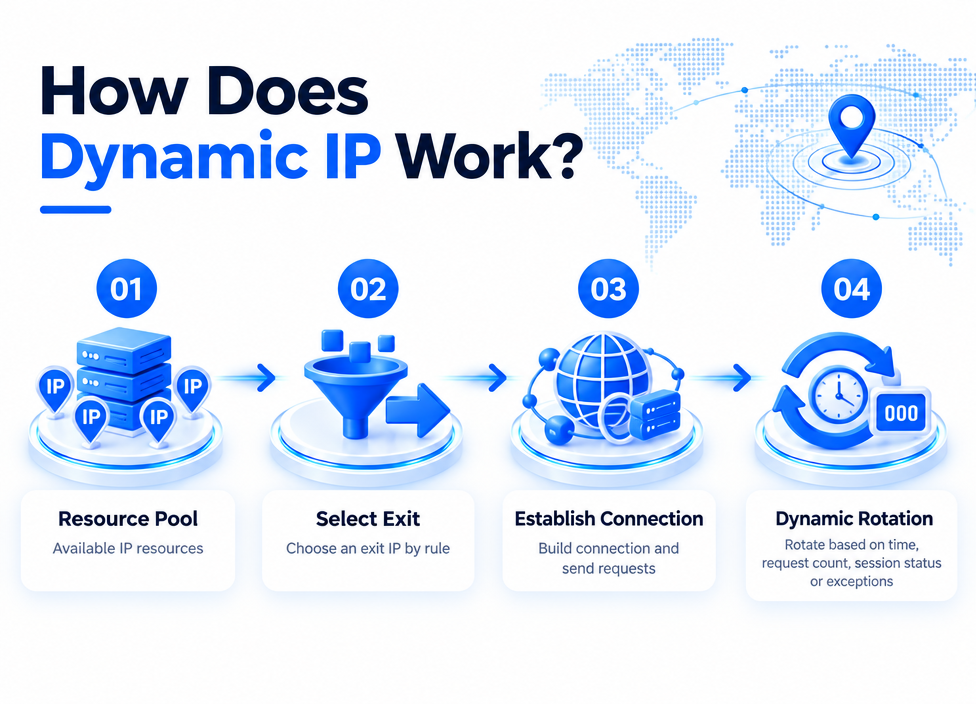
- IP rotation strategy — determines which IP each request uses and when to switch
- Failure retry mechanism — determines what happens when a request fails
- Concurrency control — determines how many concurrent requests can be sent without saturating the pool
- Protocol matching — determines whether to use HTTP, HTTPS, or SOCKS5
The five are interlinked. Rotation strategy affects concurrency control design; auth model constrains which access forms are available. Each is broken down below.
How Do You Pick a Proxy Pool's Auth Model and Access Form?
The auth model determines how your code connects to the proxy service. Picking wrong causes either connection rejection or security risk.
Three mainstream auth models:
| Auth Model | How It Works | Fits | Watch-Outs |
|---|---|---|---|
| API key | Key carried in request header or URL | Server deployment, cloud functions | Don't hard-code keys—use environment variables |
| IP allowlist | Proxy server only accepts specified IPs | Fixed server deployments | Update the allowlist whenever server IPs change |
| Username/password | User and password embedded in proxy URL | Local dev, quick integration | Clear-text password in URL—redact from logs |
Access forms also split into two types:
Tunnel mode: the code just configures a single fixed proxy gateway address, and IP rotation is handled server-side. Suits scenarios where you don't want to manage the IP pool on the client.
# Tunnel mode example (pseudocode)
proxies = {
    "http": "http://user:pass@gateway.example.com:port",
    "https": "http://user:pass@gateway.example.com:port"
}
response = requests.get(target_url, proxies=proxies)
API extraction mode: call an API first to get a batch of IPs, then the client manages rotation itself. Suits scenarios needing fine-grained control over which IP each request uses.
# API extraction mode example (pseudocode)
ip_list = requests.get("http://api.example.com/getip?num=10&protocol=https").json()
for ip in ip_list:
    proxies = {"https": f"http://{ip['ip']}:{ip['port']}"}
    response = requests.get(target_url, proxies=proxies)
Selection guidance: for website scraper projects with a single collection target and high request volume, tunnel mode saves the most effort. If you need to allocate different IP ranges per target site, API extraction is more flexible.
How Do You Design an IP Rotation Strategy?
Rotation strategy directly determines collection success rate—poor design is the #1 cause of production failures.
Four common rotation strategies:
| Strategy | Mechanism | Fits | Success-Rate Impact |
|---|---|---|---|
| Per-request rotation | Switch IP on every HTTP request | List-page batch scraping, search-result fetching | High success, but burns IPs fast |
| Sticky session | Same target keeps the same IP until session ends | Login-state persistence, sequential pagination | Medium—need to handle session timeouts |
| Time-based rotation | Change IP every N seconds or minutes | Sentiment monitoring scheduled sweeps | Medium-high, conserves IP consumption |
| Failure-triggered rotation | Only switch when current IP is flagged or times out | Limited IP budget, cost-sensitive scenarios | Depends on detection response speed |
In real engineering, most production-grade scrapers combine strategies: default to time-based rotation and switch immediately on failure trigger.
Pseudocode framework for a rotation strategy:
class ProxyRotator:
    def __init__(self, proxy_pool, strategy="time", interval=60):
        self.pool = proxy_pool
        self.strategy = strategy
        self.interval = interval
        self.current_proxy = None
        self.last_switch = time.time()

    def get_proxy(self, force_switch=False):
        if force_switch:
            # Failure-triggered, switch IP immediately
            self.current_proxy = self.pool.next()
            self.last_switch = time.time()
            return self.current_proxy

        if self.strategy == "per_request":
            return self.pool.next()

        if self.strategy == "time":
            if time.time() - self.last_switch > self.interval:
                self.current_proxy = self.pool.next()
                self.last_switch = time.time()
            return self.current_proxy
One key data point: industry practice shows that in sentiment monitoring scenarios, rotating IPs at 5-minute intervals cuts IP consumption by about 40% versus per-request rotation, with no significant increase in flagging rate.
How Do You Configure Failure Retry and Concurrency Control?
Poor retry config either loses data or torches the entire proxy pool. Concurrency too loose gets IPs flagged; too tight and collection efficiency crawls.
Three iron rules for failure retry:
- Set a max retry count — 3-5 is recommended; anything above 5 basically means that target page needs special handling.
- Switch IP on retry — retrying with the same already-flagged IP is pointless.
- Exponential backoff — double the interval on each retry to avoid triggering stricter rate limits with burst traffic.
# Exponential backoff retry example
max_retries = 3
for attempt in range(max_retries):
    proxy = rotator.get_proxy(force_switch=(attempt > 0))
    try:
        response = requests.get(url, proxies=proxy, timeout=10)
        if response.status_code == 200:
            break
        if response.status_code in [403, 429]:
            # Flagged, switch IP and retry
            time.sleep(2 ** attempt)  # 1s, 2s, 4s
            continue
    except requests.Timeout:
        time.sleep(2 ** attempt)
        continue
Concurrency control benchmarks:
| Collection Scenario | Recommended Concurrency | Per-IP Request Rate Cap | Notes |
|---|---|---|---|
| General web scraping | 5-20 concurrent | 1-3 requests/sec | Most sites' rate-limit thresholds sit in this range |
| APP big-data API calls | 10-50 concurrent | 5-10 requests/sec | API endpoints usually tolerate more than web pages |
| E-commerce / social scraping | 3-10 concurrent | 0.5-2 requests/sec | Rate limiting is stricter |
Production rule of thumb: concurrency × per-IP request rate = total requests per second. Keep this figure under 80% of the proxy pool's advertised concurrency cap, leaving 20% headroom for bursts.
Which Parameters Must You Adjust When Moving From Test to Production?
A test config that runs isn't a production config that works. The two environments' configurations differ in six parameters.
Test → production adjustment checklist:
| Parameter | Test Typical | Production Recommended | Reason |
|---|---|---|---|
| Timeout | 30s | 8-15s | Production can't wait long—time out and switch IP |
| Retry count | 5-10 | 3 | Fail fast beats repeated retry |
| Concurrency | 1-3 | Configure per scenario | Low test concurrency hides concurrency conflicts |
| IP rotation interval | None or manual | Auto per strategy | One IP works in test; production must rotate |
| Protocol | HTTP | HTTPS | Production must encrypt |
| Log level | DEBUG | WARN + key metrics | DEBUG logs drag performance in production |
Pre-launch checklist:
- [ ] Proxy auth info moved out of code—into env vars or config center
- [ ] Timeout adjusted from test to production value
- [ ] Retry strategy uses exponential backoff
- [ ] Concurrency capped based on target site's rate-limit threshold
- [ ] Logs no longer print full proxy auth info
- [ ] Proxy pool availability monitoring hooked into alerting
- [ ] Auto-degrade or pause when success rate falls below threshold
A common failure story: a data team doing procurement/bid data collection got the flow working in test with 3 free proxy IPs, then went live with the same config against a paid proxy pool. Because they didn't adjust timeout or concurrency, 30-second timeouts piled requests up, saturating the pool's concurrency quota. Success rate dropped from 90% in test to under 20% in production. Adjusting timeout to 10s and cutting concurrency from 50 to 15 restored normal operation.
How Do You Monitor Runtime After Integrating a Proxy Pool?
Integration is only the start. Production must continuously monitor four core metrics.
Four must-monitor metrics:
| Metric | Meaning | Recommended Alert Threshold |
|---|---|---|
| Collection success rate | Share of 200 responses over total requests | Alert below 85% |
| Average response time | Time from request sent to response received | Alert above 5s |
| IP-flagging rate | Share of requests returning 403/429 | Alert above 15% |
| Available IPs in pool | Currently usable IP count | Alert when below the minimum concurrency need |
How to collect metrics: instrument the scraper's request middleware to record status code, response time, and proxy IP used for every request. Aggregate every 5 minutes and push to the monitoring platform.
# Monitoring instrumentation pseudocode
class MonitorMiddleware:
    def process_response(self, request, response):
        metrics.record({
            "status": response.status_code,
            "latency": response.elapsed.total_seconds(),
            "proxy": request.meta.get("proxy", "direct"),
            "timestamp": time.time()
        })
        return response
When success rate stays below 85%, investigate three directions in priority order: whether proxy IP quality has declined, whether the target site's rate limiting has tightened, and whether concurrency has exceeded the pool's headroom.
FAQ
Q: Can free proxy IPs be used in a production scraper project?
Not recommended. Free proxy uptime is typically 15%-35%, IP lifespans are short, and a large share are already flagged by site mechanisms. Production has explicit requirements for success rate, stability, and response speed—free proxies fall short on all three. They're reasonable for local dev-debug and learning use.
Q: How should you choose between tunnel mode and API extraction mode?
For a single-target collection task with no need for fine-grained IP allocation, tunnel mode minimizes code. If you need to allocate different regional IPs per target site, or need to record which IP was used per request for downstream analysis, use API extraction. The two aren't mutually exclusive—one project can mix them across different collection tasks.
Q: What's a reasonable IP rotation interval for a proxy pool?
Depends on how strict the target site's rate limiting is. For general web scraping, 30-60 second rotation is a good baseline; for e-commerce or social platforms, 10-30 seconds. If success rate drops suddenly, shorten the interval before raising concurrency.
Q: How do you tell whether an IP has been flagged by the target site?
Usually three signals: HTTP 403 or 429; response body becomes a CAPTCHA page; response time suddenly jumps from 1-2s to 10s+. Detect all three in retry logic—hit any one, switch IP.
Q: What's the difference between SOCKS5 and HTTP proxies? Which should you use?
HTTP proxies only proxy HTTP/HTTPS traffic; SOCKS5 can proxy any TCP/UDP. Pure web scraping uses HTTP proxies. For collection tasks involving non-HTTP data channels, or requiring stronger request-environment isolation, use SOCKS5. Most scraping frameworks have more mature HTTP proxy support.
Q: What happens if concurrency is set too high?
Two consequences: probability of IPs getting flagged rises sharply, and you may saturate the pool's concurrency quota causing subsequent requests to queue and time out. Start low and step up 20%-30% at a time, watching success rate and flagging rate to find the sweet spot for the current setup.
Q: Collection success rate keeps underperforming after integration—how do you troubleshoot?
Investigate four directions in priority order: first, confirm the proxy IPs themselves work by curl-testing a few directly; second, check whether the target site's rate limiting has tightened; third, check whether concurrency exceeds 80% of pool headroom; fourth, check whether request headers are too uniform—even switched IPs can be identified as the same client.