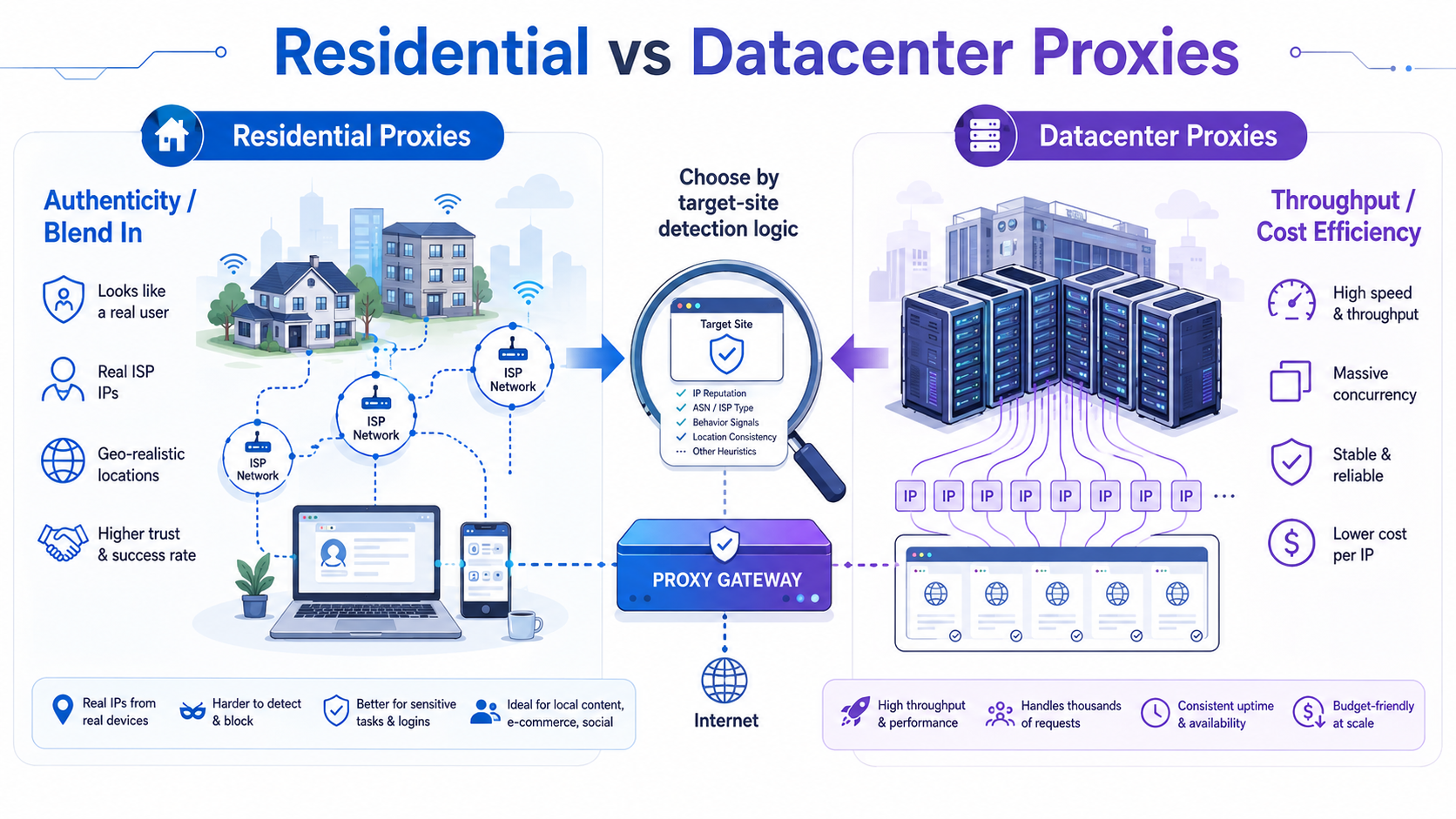
Technical teams tend to compare IP volume and unit price first, but what actually blocks projects isn't "is the pool big enough" — it's "does the pool type match the target's IP-type detection logic?" This piece unpacks the boundaries of both overseas proxy pools along that axis.
"Residential IPs are always better than datacenter IPs" — that assumption needs correcting
A lot of technical teams default to "residential IPs are more authentic, have higher success rates — just pick residential" when shopping for overseas proxies. That holds in some scenarios, but as a universal rule it leads to two problems: first, paying nearly double the traffic cost in scenarios that don't need residential IPs; second, ignoring the structural advantages datacenter pools have on throughput and concurrent stability.
The core of selection isn't "which IP type is more premium," but how the target site's mechanism identifies the request source. Some sites judge whether a request comes from a data center based on the IP's ASN (Autonomous System Number) — for those sites, residential pools genuinely do offer a blending advantage. But a large share of public data APIs, product listing pages, and logistics tracking endpoints don't perform deep IP-type detection, and in those cases the cost-effectiveness and bandwidth of a datacenter super pool are the more practical choice.
Pick by scenario, not by "which is better"
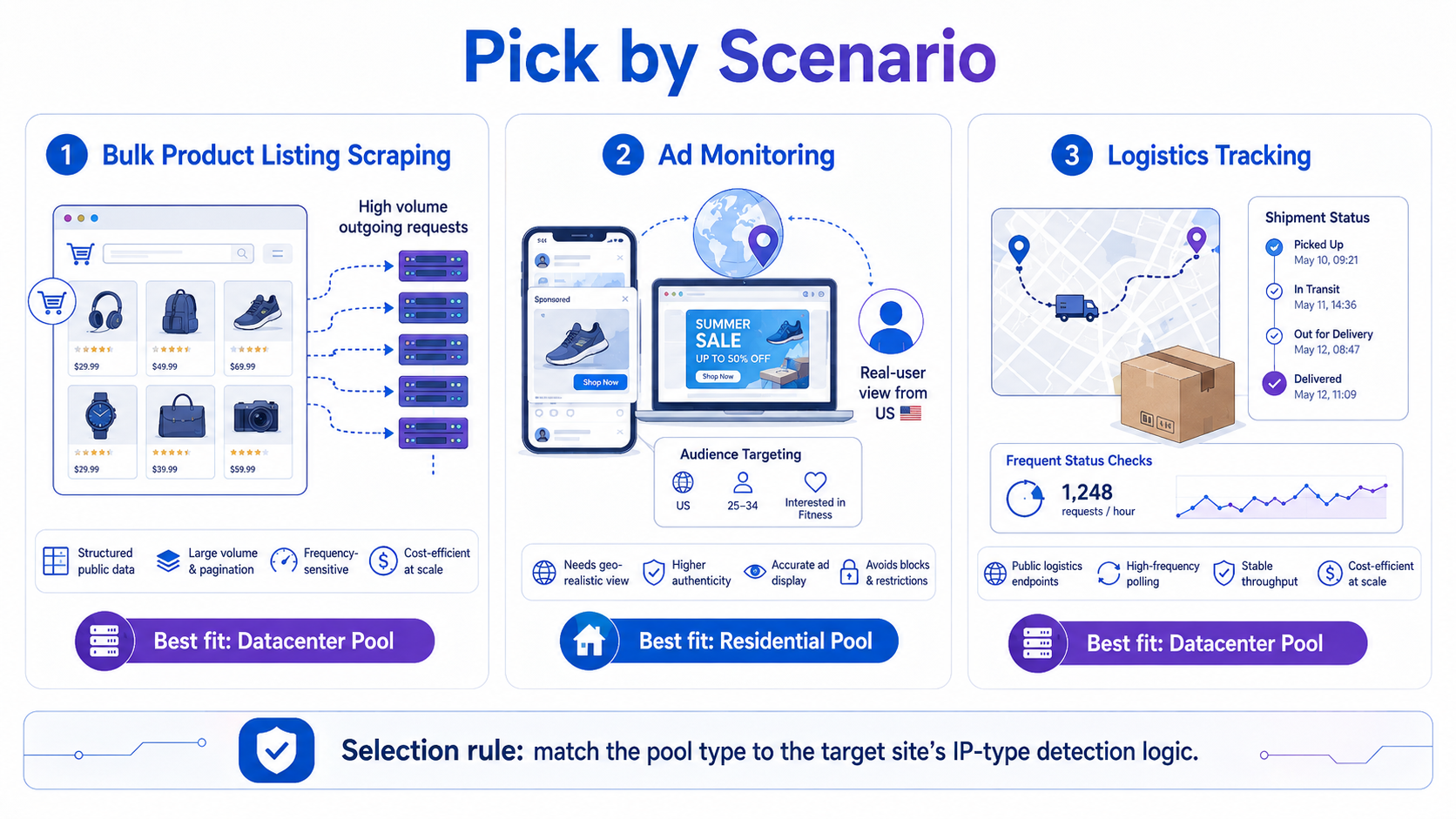
Pool selection isn't a linear "residential > datacenter" ranking — it's a scenario-matching table.
Scenario 1: Cross-border product sourcing — bulk scraping public listings on overseas e-commerce platforms
Characteristics: high request volume, highly structured data, mostly public listing pages as targets. Most overseas e-commerce listing endpoints don't apply strict IP-type detection — request frequency control is the primary constraint.
Residential pools work here too, but compare the unit price and you're looking at nearly double. If the target platform doesn't block datacenter IPs at the ASN level, the premium you pay for "residential identity" buys no meaningful difference in request success rate.
Scenario 2: Overseas ad monitoring — needing a real user's perspective
The core requirement of ad monitoring is "seeing the ad content a real user sees" — including differences in geo-targeted ad display and the regional distribution of competitor creatives. Ad platforms' delivery systems typically distinguish datacenter traffic from residential traffic — access with datacenter IPs and you're almost certainly not seeing the real-user view. With residential pools, the IP's ASN belongs to a local ISP, which sits closer to a real user's network environment, and the fidelity of ad content is higher.
This is the classic scenario where the residential premium is justified: the target system's IP-type detection logic directly affects the authenticity of what you scrape.
Scenario 3: Cross-border logistics tracking — high frequency but IP-type-insensitive
Querying overseas logistics nodes and shipment status usually happens through public APIs or pages provided by the logistics platforms. These endpoints generally don't apply strict IP-type detection — they care more about request frequency. Stable throughput and unrestricted bandwidth peaks make the cost structure of datacenter pools more reasonable for businesses that need high-frequency polling across multiple logistics nodes.
Short-lifetime proxies and tunnel proxies: a second layer of choice beyond pool type
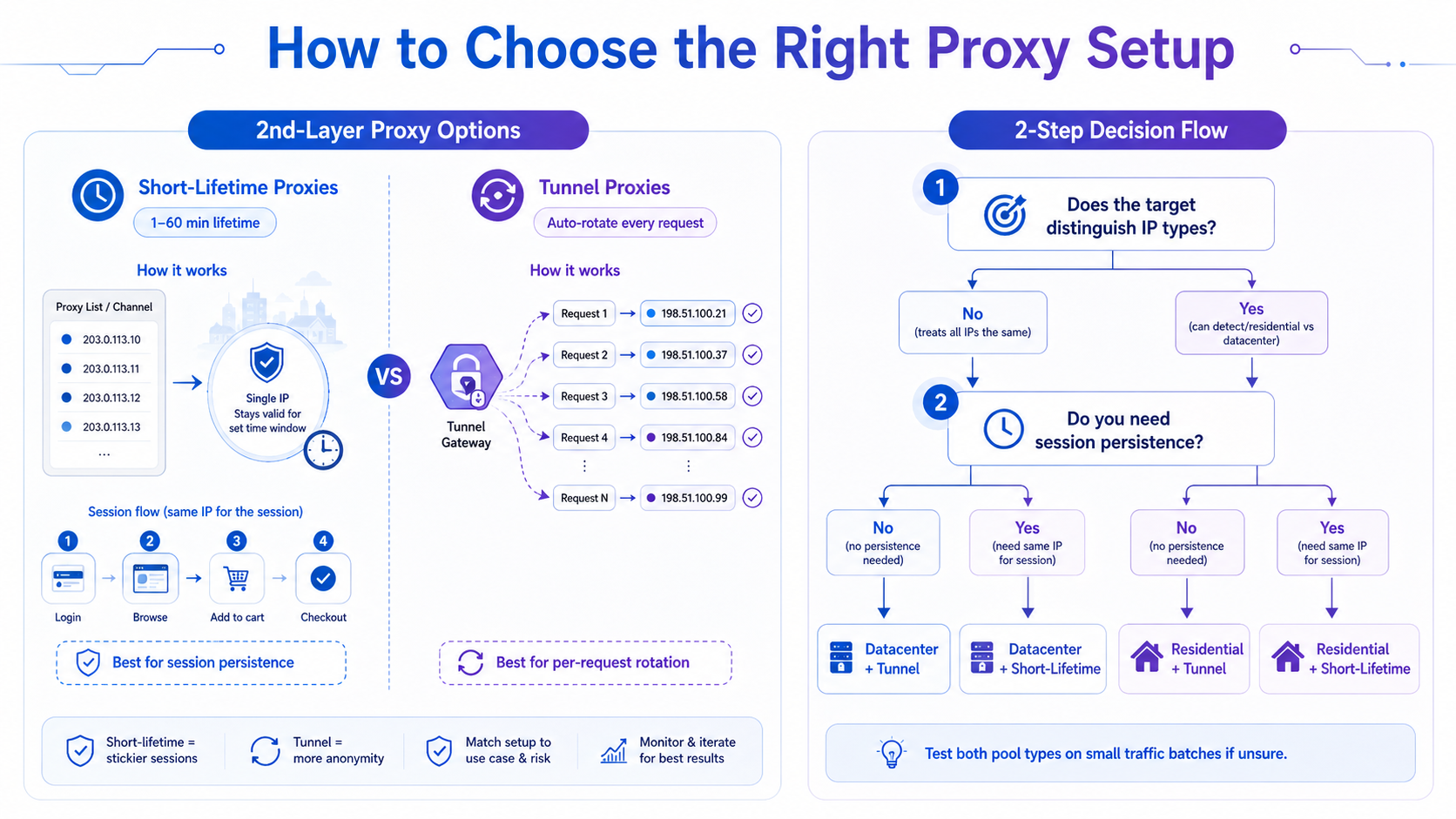
Once the pool is settled (datacenter or residential), there's another layer to decide: short-lifetime proxies or tunnel proxies. Both access modes share the same pool — the difference is in IP-rotation logic.
| Dimension | Overseas Short-Lifetime Proxies | Overseas Tunnel Proxies |
|---|---|---|
| IP rotation | Extracted from a channel, natural rotation by lifetime | Auto-rotates per request, zero-code integration |
| Lifetime | 1–60 minutes; unlimited-traffic plans 5–1440 minutes | Rotation per request |
| Best-fit scenario | Tasks where the same IP needs to persist (e.g. session-bound scraping, logged-in state) | Large-scale scraping where every request needs a new IP (e.g. bulk listing pages) |
| Integration cost | Need to manage IP extraction and rotation in the scraping code | Zero-code — send a request, get a new IP, no rotation management needed |
Matching rule: If the task is "traverse public pages in bulk, one request per page," tunnel proxies' per-request auto-rotation saves work. If the task involves "multi-step operations within one session," the lifetime window of short-lifetime proxies fits better.
Three common pitfalls in overseas proxy selection
Pitfall 1: Ignoring the target site's IP-type detection logic and just picking the most expensive option
Residential pool unit price is nearly double the datacenter pool's, but not every target site distinguishes datacenter IPs from residential IPs. Before formal procurement, run a small test traffic batch through each pool and check whether the request success rate differs meaningfully — if the gap is within 5%, the datacenter pool is very likely the more economical choice.
Pitfall 2: Overlooking the "overseas network environment" hard boundary
Overseas proxies only work in overseas network environments. That means scraping nodes have to be deployed overseas, or requests have to go out through a compliant overseas network link. If your scraping node sits domestically, overseas proxy IPs won't work. Confirm your scraping architecture meets this prerequisite before selecting.
Pitfall 3: Treating "large IP volume" as the primary criterion
Pool size is one reference dimension, but it isn't the decisive one. In practice, what determines stability is usually IP cleanliness and the rotation mechanism — a clean 1-million pool has a higher real-world usable rate than a 10-million pool where many IPs are already flagged by target sites.
A decision table: narrowing selection to two steps
| Step 1: Does your scraping target distinguish IP types? | Step 2: Does your task need session persistence? |
|---|---|
| No (public listings, logistics APIs, data endpoints) | No (one request per page) |
| No | Yes (logged-in state, multi-step operations) |
| Yes (ad platforms, social media, geo-targeted content) | No |
| Yes | Yes |
This table isn't a universal formula — if you're unsure whether the target site distinguishes IP types, the most direct approach is to run small test traffic through both pool types and compare success rates.
For bulk public data scraping, the datacenter super pool is the right call. For tasks like ad monitoring that need to blend in with a real residential environment, the residential pool is what actually works. What decides the pool type is the target's IP-type detection logic — not the intuition that "residential is always better than datacenter."
FAQ
Q1: How much does the success rate differ between overseas residential and datacenter proxy IPs?
There's no fixed ratio. The success rate gap depends entirely on the target site's IP-type detection logic. If the target doesn't distinguish, there's almost no difference; if the target has ASN-level restrictions on datacenter IPs, residential pools have a meaningfully higher success rate. The best approach is to run small test traffic through both pool types and compare empirically.
Q2: Can the datacenter super pool and the residential pool be used together?
Yes. The same account can use both pools simultaneously, allocating pool type by task. Run product listing scraping on the datacenter pool to control cost, run ad-creative monitoring on the residential pool for authenticity — two lanes in parallel, allocated by scenario.
Q3: What's the difference between overseas short-lifetime proxies and overseas tunnel proxies?
The core difference is IP-rotation logic. Short-lifetime proxies extract IPs through a channel, with 1–60-minute lifetimes, and suit tasks that need the same IP to persist. Tunnel proxies auto-rotate IP per request, zero-code integration, and suit high-frequency page traversal. Both modes work with either the datacenter super pool or the residential pool.
Q4: Can overseas proxy IPs be used in a domestic network environment?
No. Overseas proxies only support overseas network environments. Scraping nodes need to be deployed overseas, or requests need to be sent through a compliant overseas network link. This is both a product boundary and a compliance boundary — confirm your scraping architecture meets this prerequisite before selecting.
Q5: If unsure whether to pick the datacenter or residential pool, how do you verify?
The most reliable approach is to run small test traffic on both pool types and compare success rates — verification can be completed before formal procurement. Focus on three metrics: request success rate, response time, and continuous-run stability. If the success rate gap is within 5%, the datacenter pool is the more economical choice.
Q6: What protocols and authentication methods do overseas proxy IPs support?
Full support for HTTP(S)/SOCKS5 protocols, with two authentication methods — credentials and IP whitelist — plus 256 free whitelist IPs and no concurrency limit. Regardless of whether you go with the datacenter super pool or the residential pool, protocols and authentication are identical, so switching pool types doesn't require modifying any authentication logic in the integration code.