What's the Actual Difference Between Residential IPs and Datacenter IPs?
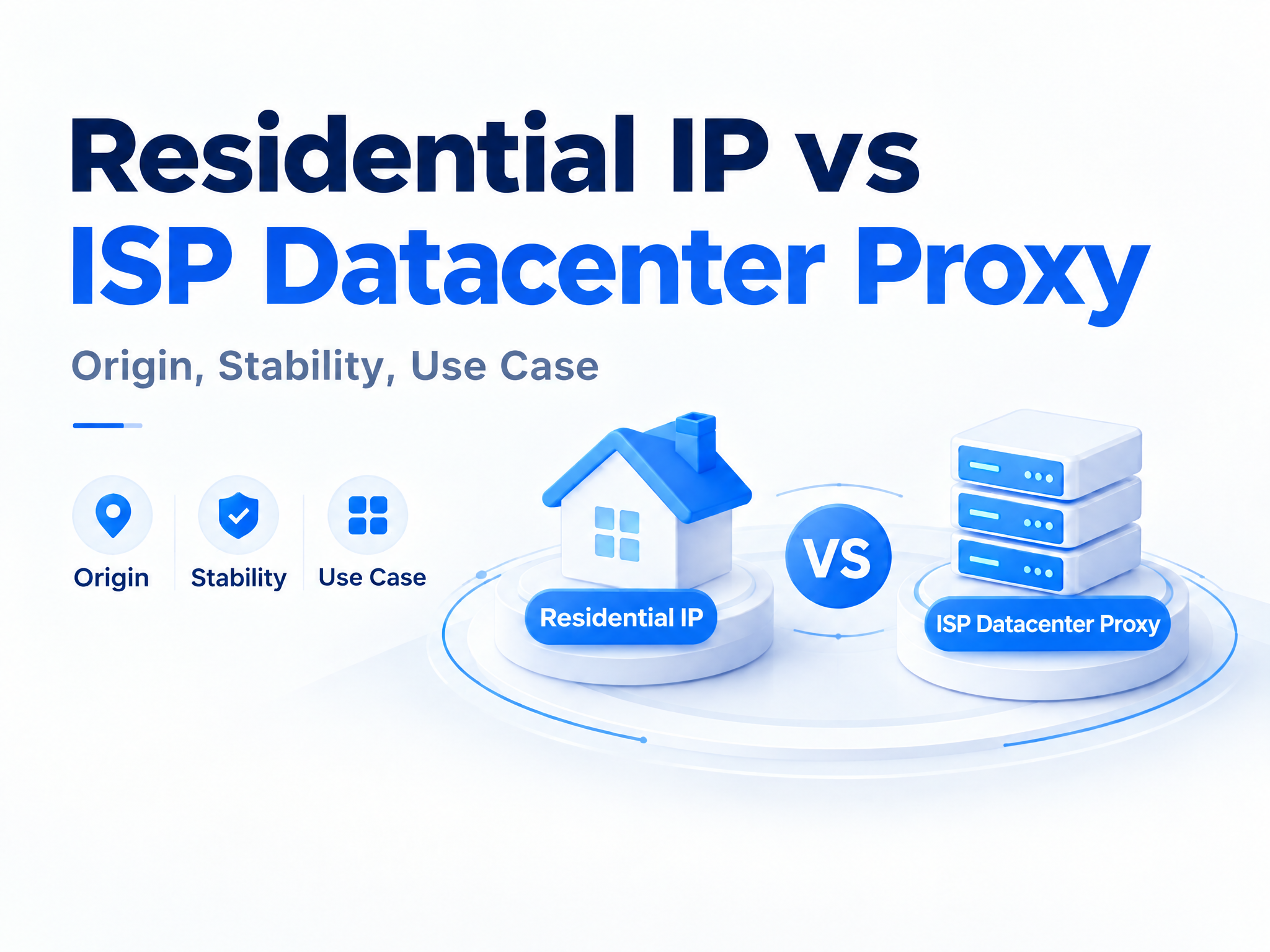
Residential IPs are real IP addresses assigned by ISPs to home or business broadband; datacenter IPs are IP ranges used by servers in server rooms. A lot of people reduce the difference to "residential = safe, datacenter = risky," which isn't accurate. The real difference is in the underlying attribution and trust tier.
A residential IP's WHOIS record points to an ISP carrier, and its ASN belongs to backbone network service providers (in China's case, China Telecom, China Unicom, China Mobile, and equivalents). A datacenter IP points to an IDC host or cloud provider—a quick ASN lookup makes this immediately visible.
Core differences:
| Dimension | Residential IP | Datacenter IP |
|---|---|---|
| Allocation source | ISP assigns to end user | IDC or cloud provider assigns to server |
| ASN attribution | Carrier ASN | Datacenter or cloud provider ASN |
| Trust signal | High—consistent with real user behavior | Low—easily flagged as non-organic traffic |
| Acquisition cost | Higher | Lower |
| Network performance | Moderate latency, bandwidth limited by end-user line | Low latency, high bandwidth |
| Geographic precision | Usually accurate to city | Usually only to region or where the datacenter sits |
Put simply: a residential IP looks like "a real person browsing"; a datacenter IP looks like "a server firing requests." Target sites' access policies specifically differentiate based on this distinction.
How Do Target Sites Actually Identify Your IP Type?
The core criteria are just two: ASN attribution and WHOIS registration. Once a target site's access-policy system has your request IP, it evaluates in three progressive layers.
- ASN attribution lookup: every IP has an Autonomous System Number behind it. Carrier ASNs (e.g., China Telecom AS4134, China Unicom AS4837) versus datacenter ASNs (e.g., AWS AS16509, Alibaba Cloud AS37963) are trivially distinguishable in public routing databases.
- IP reputation database tagging: commercial databases like MaxMind and IP2Location maintain type tags for billions of IPs worldwide, labeling each as residential, datacenter, hosting, or mobile. Most target sites call these databases' APIs directly for classification.
- Behavioral cross-verification: even if the IP type passes, signals like abnormal request frequency, timezone mismatched to IP geolocation, or missing browser fingerprints will still trigger access controls.
So IP type is only the first link in the classification chain, not the whole thing. Just swapping to a residential IP without adjusting request behavior itself often has limited effect.
Which Tools Let You Quickly Verify Whether an IP Is Residential or Datacenter?
Three steps are enough: enter the IP, read the type tag, check the ASN attribution. The tools below cover both free quick-lookup and enterprise-grade integration tiers.
| Tool | Form | Cost | Core Capability | Who It Suits |
|---|---|---|---|---|
| IPinfo.io | Web query + API | Free tier, paid beyond | IP type tag, ASN, geolocation | Single-IP lookup or small-to-mid API calls |
| IP2Location | Offline DB + API | Free lite version, paid full | proxy_type field distinguishes residential / datacenter / VPN | Teams needing local batch classification |
| ipapi.is | Web query | Free | is_datacenter boolean | Ad-hoc verification, quick confirmation |
| bgp.he.net | ASN lookup | Free | ASN attribution and routing info | Technical troubleshooting, confirming IP range ownership |
| MaxMind GeoIP2 | Database + API | Paid | ISP identification and connection-type classification | Enterprise-grade system integration |
A hands-on flow using IPinfo:
- Open ipinfo.io and enter the target IP in the search box.
- Look at the
typefield in the response—ispmeans residential,hostingmeans datacenter. - Then check the
orgfield to confirm ASN attribution: a carrier name means residential range, a cloud provider or IDC name means datacenter range. - When results are ambiguous, cross-verify with IP2Location's
proxy_typefield.
Batch detection guidance: manual lookup fits single-IP validation. For batch scenarios, going via API or deploying an offline database is more efficient. IPinfo's free tier is 50,000 queries per month; IP2Location provides locally deployable offline database files with microsecond-level lookup latency.
Which Should You Pick for Different Business Scenarios—Residential or Datacenter IPs?
The core variable is one thing: how strict is the target site's access policy? Strict platforms detect IP type and restrict datacenter IP requests; lenient sites don't much care.
| Business Scenario | Recommended IP Type | Rationale |
|---|---|---|
| Cross-border product research | Residential | E-commerce platforms have strict access policies; datacenter IPs are highly likely to be restricted |
| Sentiment monitoring | Mixed | News sites are lenient—datacenter IPs work; social platforms require residential |
| Ad monitoring | Residential | Ad verification requires simulating a real-user environment; datacenter IPs distort data |
| Public data collection | Datacenter | Public sites have lenient policies; datacenter IPs are cheaper |
| SEO rank monitoring | Residential | Search engines may return different rankings for datacenter IPs |
A mixed strategy is common in enterprise-scale collection: core requests go through residential IPs to guarantee data accuracy, while auxiliary requests go through datacenter IPs to control cost. The ratio between the two needs dynamic tuning based on target sites' actual policies.
Is Residential IP Always Better Than Datacenter IP?
Not necessarily. The "residential IP is universally best" view is a common misconception—actual selection requires balancing trust tier, cost, and performance.
Three common limitations of residential IPs:
- Large cost gap: at equivalent specs, residential IPs typically cost several times more than datacenter IPs, sometimes more.
- Performance variance: residential IPs depend on end users' actual broadband lines—latency and throughput aren't as stable as direct datacenter connections.
- "Fake residential" risk: some vendors move reclaimed broadband IP ranges into datacenter operation, and IP reputation databases have already updated the tag to hosting.
How do you tell whether the "residential IP" you received is actually residential? Check four things:
- Does ASN attribution point to an ISP carrier rather than a cloud provider or IDC?
- Is IP2Location's
proxy_typefield tagged asresidential? - Has the IP range recently been re-tagged as
datacenterorhosting? - Is geolocation precision at city level? Datacenter IPs usually only resolve to region.
If all four pass, you can basically confirm it's a real residential IP. If any one is off, it's advisable to switch vendors or switch IP ranges and retest.
FAQ
Q: What's the difference between a residential IP and a static residential IP?
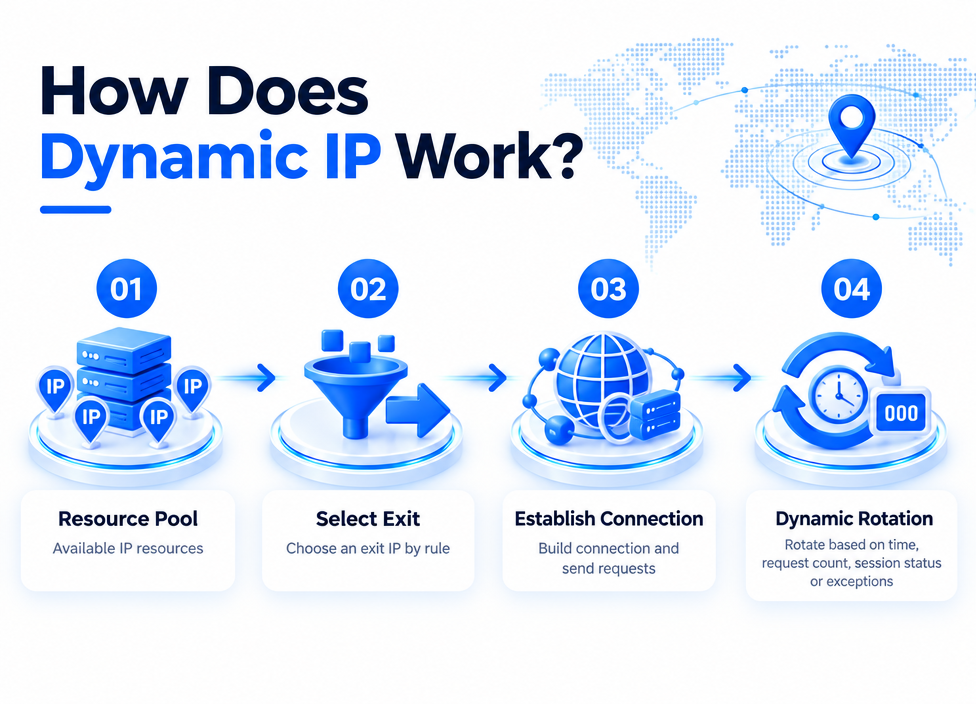
Residential IPs are typically dynamically assigned, potentially getting a different address on each connection. Static residential IPs are fixed addresses assigned by an ISP—the IP doesn't change but still belongs to a carrier ASN and keeps the residential tag. Static residential IPs suit scenarios needing long-term IP consistency, and cost more than dynamic residential.
Q: Why does a proxy advertised as "residential" detect as a datacenter IP?
Two common cases. First, the vendor is using reclaimed broadband IP ranges that are now operated from a datacenter, and IP reputation databases have updated the tag to hosting. Second, some vendors package cloud-server IPs as "residential IPs" for sale—an ASN lookup exposes this immediately.
Q: Are free detection tools' results reliable?
Mainstream tools like IPinfo and IP2Location classify with high accuracy, but different databases update at different frequencies, so lag is possible. It's advisable to cross-verify with 2-3 tools. Edge cases like ISP-leased commercial IP ranges may yield different classifications across tools.
Q: If datacenter IPs get restricted, does switching to residential IPs solve it?
Not necessarily. Target sites' access policies are typically multi-dimensional—IP type is just one signal. Request frequency, browser fingerprint, cookie consistency, and geolocation-timezone match are all cross-checked as behavioral features. Just switching IP type without adjusting access patterns has limited effect.
Q: How do you batch-detect large volumes of IPs?
Most detection tools offer an API. IPinfo's free tier is 50k queries per month; IP2Location provides a locally deployable offline database. For batch detection, API or local database is far more efficient than manual one-by-one verification.
Q: Is a mobile IP residential or datacenter?
Neither. Most IP databases classify mobile IPs separately as mobile type. Mobile IPs' trust tier typically sits between residential and datacenter—some sites treat mobile IPs more leniently than datacenter IPs, but not as favorably as pure residential.