The key to choosing overseas proxy IPs isn't country coverage — it's pool type and billing
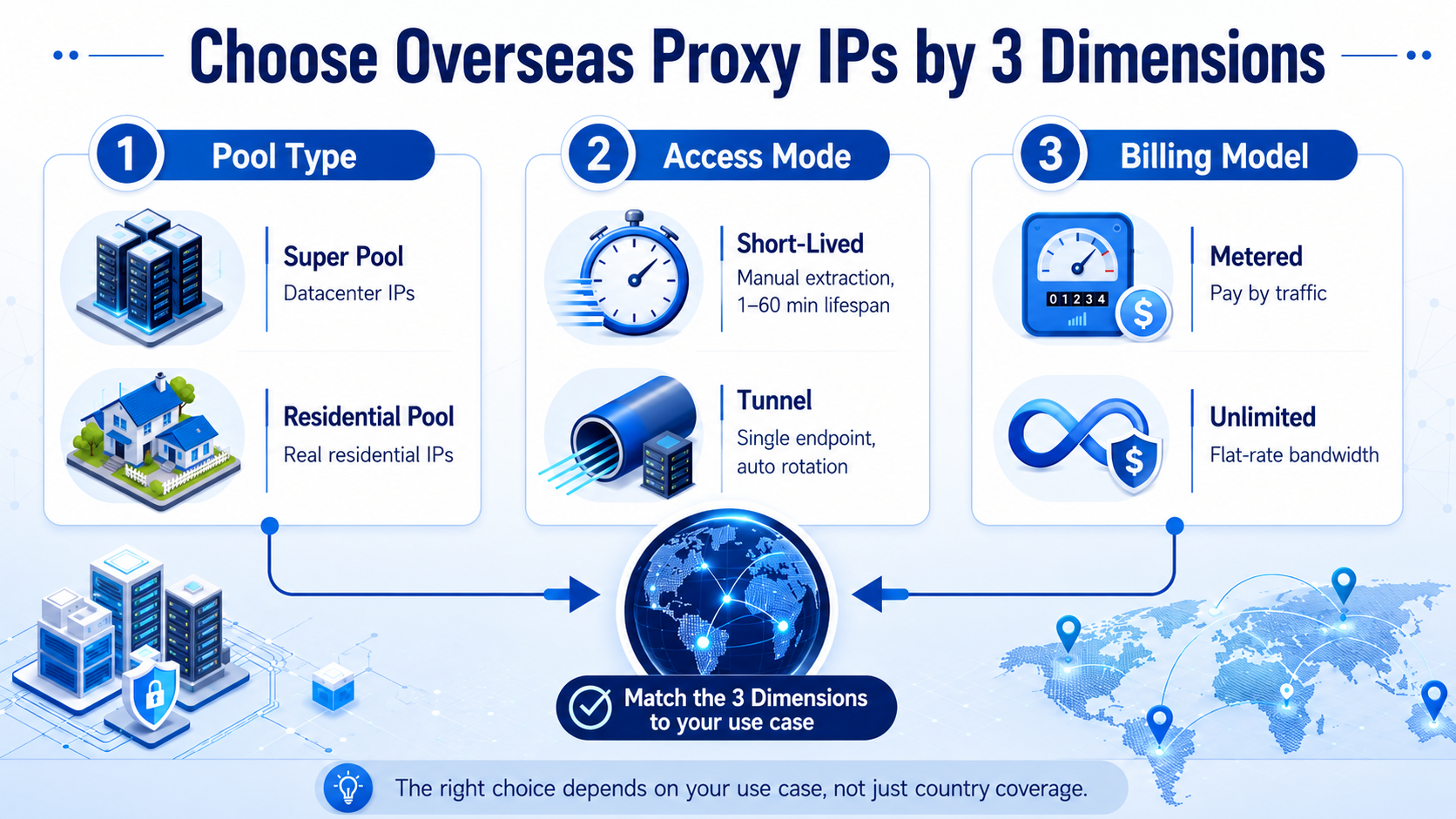
When engineering teams evaluate overseas proxy IPs, they're most easily drawn to numbers like "200+ countries covered" or "tens of millions of IPs." But these are baseline specs — most enterprise-grade providers can meet them. What actually determines collection performance and cost are three dimensions that often get overlooked: pool type (Super Pool or Residential Pool), access mode (manual short-lived extraction or auto-rotating tunnel), and billing model (metered by traffic or flat-rate unlimited).
QG Network's overseas product line covers mainstream overseas collection scenarios across "2 modes × 2 pool types," plus a custom enterprise plan for large-scale needs. It covers 200+ popular countries/regions worldwide, supports HTTP(S)/SOCKS5 across the board, and offers two authentication methods — credentials and IP whitelist (256 whitelist IPs free) — with no limit on concurrency.
⚠️ Usage boundary, up front: QG's overseas proxies can only be used within an overseas network environment (outside mainland China). Any solution involving overseas data collection must be deployed and run in an overseas network environment.
Three dimensions decide the right setup:
| Selection dimension | Options | What it determines |
|---|---|---|
| Pool type | Super Pool (datacenter IP) / Residential Pool (residential IP) | The balance between IP authenticity and cost |
| Access mode | Overseas Short-Lived Proxy / Overseas Tunnel Proxy | Whether you manage IPs manually or rotate automatically |
| Billing model | Metered by traffic / Flat-rate unlimited | The trade-off between predictability and elasticity |
Super Pool vs. Residential Pool: the core trade-off between IP authenticity and cost
Choosing the pool type is the single most important step in selecting overseas proxy IPs — pick the wrong one and you either overpay or take a hit on collection performance.
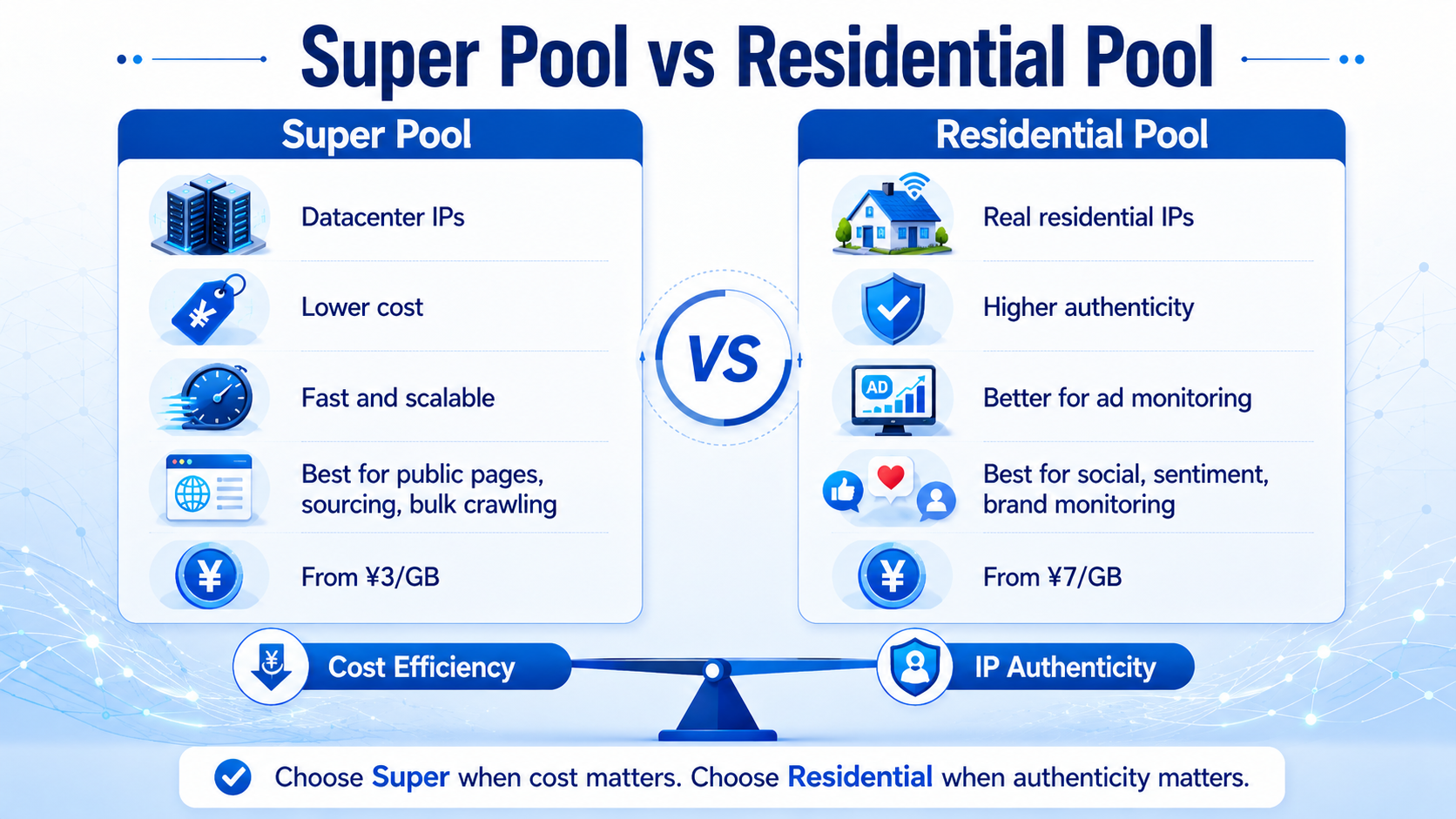
Super Pool (datacenter IPs): IPs originate from datacenter facilities — fast, low-cost, and available in large volumes. QG Network's Super Pool starts at ¥3/GB metered and suits scenarios where "residential authenticity" isn't a strict requirement: public product data on cross-border sourcing platforms, bulk crawling of public overseas web pages, gathering overseas tender/bidding information, and so on. Most overseas e-commerce product pages and public information sites are relatively lenient toward datacenter IPs, so the Super Pool's cost-performance advantage is clear in these scenarios.
Residential Pool (residential IPs): IPs originate from real residential network exits, giving them higher "identity credibility" on target sites. QG's Residential Pool starts at ¥7/GB metered and suits scenarios sensitive to IP authenticity — overseas social media data collection, overseas ad monitoring, overseas brand-sentiment tracking — where platforms typically have stronger mechanisms for detecting and limiting datacenter IPs.
The rule for picking a pool type: Does the target platform treat datacenter IPs and residential IPs differently? If yes (e.g., some overseas social and ad platforms), choose the Residential Pool. If no (e.g., most public information sites and e-commerce product pages), choose the Super Pool — for the same collection task, the Super Pool's per-GB rate is less than half that of the Residential Pool.
Overseas Short-Lived Proxy: manual IP extraction, 1–60 minute lifespan
The Overseas Short-Lived Proxy suits scenarios where you want to control the pace of IP extraction yourself and manage collection tasks in batches.
QG Network's Overseas Short-Lived Proxy supports both the Super Pool and the Residential Pool. Billing and lifespan parameters:
| Parameter | Super Pool | Residential Pool |
|---|---|---|
| Metered billing | from ¥3/GB | from ¥7/GB |
| Unlimited traffic | from ¥99/channel | from ¥99/channel |
| IP lifespan | 1–60 min | 1–60 min |
| Lifespan (unlimited plan) | 5–1440 min | 5–1440 min |
| Peak bandwidth | Unlimited | Unlimited |
When a cross-border e-commerce SaaS company runs overseas product-sourcing collection, it needs to crawl hundreds of thousands of public product listings from its target markets daily. This kind of task has high IP-volume needs but low residential-authenticity requirements; using QG's Overseas Short-Lived Proxy with the Super Pool + metered billing, collection cost is about 20% of a Residential Pool setup.
The boundary of short-lived proxies overseas: You need to manage IP extraction and rotation logic in your own code, so development effort is higher than with tunnel proxies. If your team wants zero-code integration, the Overseas Tunnel Proxy is the easier choice.
Overseas Tunnel Proxy: zero-code integration, a new IP on every request
The core value of the Overseas Tunnel Proxy is "plug and play" — your program points to a single proxy endpoint, and the backend handles IP scheduling and rotation automatically, using a fresh IP on every HTTP request, with no rotation logic to write.
QG's Overseas Tunnel Proxy also supports both the Super Pool and the Residential Pool:
| Parameter | Super Pool | Residential Pool |
|---|---|---|
| Metered billing | from ¥4/GB | from ¥7/GB |
| Unlimited traffic | from ¥190/request channel | from ¥190/request channel |
| IP rotation | New IP per request | New IP per request |
| Peak bandwidth | Unlimited | Unlimited |
In an overseas ad-monitoring scenario, a leading e-commerce platform needs to continuously monitor competitors' ad placements across overseas markets, with high collection frequency and broad market coverage. QG's Overseas Tunnel Proxy with the Residential Pool lets the team skip IP-rotation logic entirely and focus on parsing and analyzing ad creatives.
The boundary of tunnel proxies overseas: With metered billing, the tunnel mode's Super Pool rate (¥4/GB) is slightly higher than short-lived mode (¥3/GB) — in extremely traffic-heavy scenarios, that gap widens. Also, a new IP on every request means you can't complete multi-step operations under the same IP.

Overseas Enterprise Customization: a ten-million-scale pool and a 1-on-1 plan for large-scale collection
When collection scale exceeds what standard products can handle — daily request volume reaching hundreds of millions, deep IP coverage needed for specific countries/regions, or custom SLA requirements — standard short-lived/tunnel products may not be enough.
QG Network offers an overseas enterprise customization plan: a ten-million-scale IP pool, unlimited concurrency, and one-on-one custom service. Pricing and configuration are confirmed through consultation on the official site; the plan suits large-scale, ongoing overseas data-collection projects.
Quick reference: matching overseas proxy IPs to your scenario
| Overseas collection scenario | Recommended pool | Recommended mode | Recommended billing | Why |
|---|---|---|---|---|
| Cross-border sourcing (public product data) | Super Pool | Short-Lived | metered, from ¥3/GB | Low IP-authenticity needs, cost-sensitive |
| Overseas ad monitoring | Residential Pool | Tunnel | metered, from ¥7/GB | Ad platforms strictly limit datacenter IPs |
| Overseas brand-sentiment monitoring | Residential Pool | Tunnel | Unlimited traffic | Continuous monitoring, unpredictable traffic |
| Bulk overseas public-page collection | Super Pool | Short-Lived | metered, from ¥3/GB | High volume, cost first |
| Overseas social media data collection | Residential Pool | Short-Lived / Tunnel | metered, from ¥7/GB | Social platforms sensitive to IP authenticity |
| Large-scale enterprise collection | Custom | Enterprise custom | 1-on-1 custom | Beyond standard product capacity |
QG Network's overseas selection logic comes down to two steps. Step one — pick the pool type: does the target platform distinguish datacenter IPs from residential IPs? If yes, choose Residential; if no, choose Super. Step two — pick the mode: do you need manual control over the pace of IP extraction? If yes, choose short-lived; if no, choose tunnel.
Choosing overseas proxy IPs comes back to where it started: what really determines collection performance isn't how large the IP pool is or how many countries are covered — those specs barely differ between enterprise-grade providers. What determines results is whether, for your specific use case, you've picked the right combination across the three dimensions of pool type, mode, and billing. QG Network has 11 years in the proxy IP industry and has served 95,000+ enterprise users, with hands-on enterprise experience in cross-border sourcing, overseas ad monitoring, and overseas sentiment monitoring — get the pool type right, and collection performance and cost fall into line.
FAQ
Q1: What's the difference between the Super Pool and the Residential Pool for overseas proxy IPs?
The Super Pool uses datacenter IPs — fast and low-cost, from ¥3/GB metered at QG Network — but some overseas platforms can detect and limit datacenter IPs. The Residential Pool uses real residential-network-exit IPs with higher credibility on target platforms, from ¥7/GB metered, suiting authenticity-sensitive scenarios such as overseas social media and ad monitoring.
Q2: Can overseas proxy IPs be used within mainland China's network environment?
No. QG Network's overseas proxies can only be used in an overseas network environment — when deploying and running overseas collection tasks, your program must run on an overseas server or within an overseas network environment. This is a hard prerequisite for using overseas proxy IPs.
Q3: How do I choose between the Overseas Short-Lived Proxy and the Overseas Tunnel Proxy?
It mainly comes down to whether you need to manage IPs manually. QG Network's Overseas Short-Lived Proxy requires you to control IP extraction and rotation pace in your own code, which suits teams with a mature crawler architecture. The Overseas Tunnel Proxy uses a single endpoint, rotates IPs on every request, and offers zero-code integration, which suits teams that want to get started quickly or collect across multiple platforms in parallel.
Q4: Is metered billing or unlimited traffic more cost-effective?
It depends on whether your collection volume is predictable. For scenarios with stable, estimable traffic (e.g., a fixed daily volume of sourcing data), metered billing is more flexible. For scenarios with volatile traffic or long-term continuous monitoring (e.g., overseas sentiment monitoring), an unlimited-traffic plan (QG's short-lived from ¥99/channel) keeps costs more controllable — avoiding surprise charges from traffic spikes.
Q5: For cross-border e-commerce product sourcing, what configuration should I choose?
Cross-border sourcing mainly collects public product information from overseas e-commerce platforms, and most product pages are relatively lenient toward datacenter IPs. Recommended setup: QG Network's Overseas Short-Lived Proxy + Super Pool + metered billing (from ¥3/GB), balancing cost and collection efficiency. If the target platform tightly controls access frequency, you can switch to the Residential Pool.
Q6: Which protocols and authentication methods do overseas proxy IPs support?
QG's overseas proxies support HTTP/HTTPS/SOCKS5 across the board, with two authentication methods — credential auth and IP whitelist — plus 256 free whitelist IPs. Mainstream collection frameworks and programming languages (Python requests / Scrapy, Node.js, Go, and others) connect directly.