Why Does a Single Shared IP Pool Cause Problems?
The core risk of a shared IP pool is cross-contamination. When multiple collection tasks share the same batch of IPs, any single task that triggers a target site's rate limiting can get that batch flagged, which then affects every other task using the same IPs.
A concrete scenario: a team runs two tasks concurrently—one for ad monitoring, one for sentiment monitoring—both sharing the same IP pool. The ad monitoring task's request frequency is high, and it triggers a platform's rate-limiting mechanism, causing a batch of IPs to be flagged. Now when the sentiment monitoring task uses that same batch to request a different target site, even though the destination is different, the IPs themselves already carry a "high-frequency request" behavioral fingerprint, and their probability of being blocked rises too.
This kind of cross-effect isn't obvious when task counts are low and request frequency is modest. But once you scale past 5+ tasks, or a single task's daily request volume hits tens of thousands, the success-rate decline of a shared pool becomes very noticeable.
What Are the Two Core Dimensions of IP Pool Grouping?
IP pool grouping runs along two orthogonal dimensions: by target site and by business line. Each solves a different problem, and they're usually applied together.
Grouping by target site addresses the problem of "different sites' rate-limiting policies interfering with each other." Each target site maintains its own independent IP-tagging system. Routing tasks that hit different sites through separate IP sub-pools ensures that one site's blocking doesn't propagate to others.
Grouping by business line addresses "different business priorities and SLAs squeezing each other for resources." High-priority workloads should use dedicated IP sub-pools rather than sharing with low-priority or experimental tasks. Even if a low-priority task's aggressive request strategy burns through IPs, the stability of high-priority workloads remains untouched.
How the two dimensions relate:
| Grouping Dimension | Problem Solved | Isolation Unit | Suitable For |
|---|---|---|---|
| By target site | Cross-site IP-tagging propagation | One sub-pool per target site | Simultaneously collecting from multiple platforms |
| By business line | Cross-business resource contention | One sub-pool per business line | Multiple different workloads on the same platform |
| Both combined | Both problems present at once | A site × business matrix | Enterprise multi-site multi-workload parallelism |
How Do You Group by Target Site in Practice?
The operational logic of grouping by target site: allocate an independent IP sub-pool to each target site, and strictly route requests for different sites through their own sub-pools with no crossover.
Step 1: Map the target-site inventory
List every target site you need to collect from, then grade them by the strictness of their rate-limiting policies:
| Policy Strength | Typical Traits | Example Scenarios |
|---|---|---|
| High | Behavioral analysis + IP reputation scoring + CAPTCHA + device fingerprinting | Ad platform monitoring, social media sentiment monitoring |
| Medium | Frequency limits + basic IP blocklists | E-commerce platform product info, procurement/bid announcements |
| Low | Basic frequency limits or none | Public government data, notice sites for website scrapers |
Step 2: Allocate IP pool resources by policy strength
High-strength sites need sub-pools with higher IP purity and lower sharing density. Low-strength sites can use higher-sharing sub-pools to control cost.
Reference allocation ratios:
- High-strength sites: 40%-50% of the total pool, prioritizing residential IPs
- Medium-strength sites: 30%-40%, mixed residential and datacenter IPs
- Low-strength sites: 10%-20%, primarily datacenter IPs
Step 3: Configure routing rules
In the proxy middleware or collection framework, configure routing rules by target domain to ensure requests land in the correct IP sub-pool.
Pseudocode example:
proxy_groups:
  - name: high_security_pool
    targets: ["ad-platform.com", "social-media.com"]
    ip_type: residential
    rotation: per_request

  - name: medium_pool
    targets: ["ecommerce-site.com", "bidding-portal.com"]
    ip_type: mixed
    rotation: timed_60s

  - name: low_pool
    targets: ["gov-data.com", "public-notice.com"]
    ip_type: datacenter
    rotation: timed_300s
Step 4: Set isolation boundaries between sub-pools
Key constraint: IPs from one sub-pool must not be used interchangeably by another. If a sub-pool's IPs are exhausted or flagged, do not auto-"borrow" IPs from other sub-pools to top it up. This kind of borrowing appears to improve IP utilization but actually defeats the purpose of isolation.
How Do You Group by Business Line in Practice?
The operational logic of grouping by business line: assign each independent business line its own dedicated IP sub-pool. Even if two business lines' requests target the same site, they go through separate sub-pools.
Step 1: Define business-line boundaries
The dividing criterion isn't "what data is being collected"—it's "who's accountable for this task's outcome." Typical ways to divide business lines:
- By product line: Product A's product-research data vs. Product B's competitor monitoring
- By department: Marketing's ad monitoring vs. Risk's sentiment monitoring
- By SLA tier: Core workloads (committed T+1 delivery) vs. experimental workloads (no SLA)
Step 2: Set IP-consumption budgets per business line
Each business line needs an estimated daily request volume and IP consumption rate, which determines its sub-pool capacity.
| Business Line | Daily Requests | Target Success Rate | Sub-Pool Capacity Guidance |
|---|---|---|---|
| Core workload A | 100k+ | ≥ 95% | Dedicated sub-pool, primarily residential IPs |
| Core workload B | 50k-100k | ≥ 90% | Dedicated sub-pool, mixed IPs |
| Experimental | Variable | ≥ 70% | Shared low-priority pool |
Step 3: Set priority and degradation policies
When IP resources tighten, clear priority rules are needed:
- Core workloads' sub-pools cannot be taken over by other workloads.
- Experimental workloads voluntarily throttle when resources tighten rather than preempting core workloads' IPs.
- Set a max-concurrency cap per business line to prevent a runaway workload from eating up disproportionate IP resources.
How Do You Combine the Two Dimensions?
When a team faces both multi-site and multi-workload complexity, the two dimensions stack into a "site × business" matrix of IP groupings.
For a team simultaneously running ad monitoring and sentiment monitoring, each collecting from 3 target sites:
| Site A (High) | Site B (Medium) | Site C (Low) | |
|---|---|---|---|
| Ad monitoring | Sub-pool 1: dedicated residential | Sub-pool 2: mixed | Sub-pool 3: datacenter |
| Sentiment monitoring | Sub-pool 4: dedicated residential | Sub-pool 5: mixed | Sub-pool 6: datacenter |
This matrix has 6 sub-pools. Management overhead looks high, but in practice there are two simplifying strategies:
Merge low-strength sites. Cross-effects between low-strength sites are minimal, so they can be consolidated into one sub-pool. The matrix above simplifies to sub-pools 1, 2, 4, and 5 as four dedicated sub-pools, plus one shared low-strength site pool.
Secondary merge by SLA tier. If two business lines have similar SLAs and share target sites, they can share a sub-pool—provided their combined request frequency doesn't exceed the site's rate-limiting threshold.
How Do You Monitor and Tune After Grouping?
Grouping isn't a one-time configuration—it needs ongoing monitoring and tuning. Watch these metrics:
Success rate broken down by sub-pool. Don't just look at global success rate—track each sub-pool separately. A sudden drop in one sub-pool's success rate may mean its IP purity has been consumed and needs scaling up or replacement.
Success-rate variance across sub-pools. If sites with the same policy strength show a 15+ percentage point spread in success rate across sub-pools, IP resources are unevenly allocated and need rebalancing.
IP consumption rate. How many "fresh" IPs each sub-pool burns through daily, and how many need to rest after being flagged. Sub-pools consuming too fast need throttling or expansion.
Recommended monitoring dashboard structure:
| Metric | Granularity | Alert Threshold |
|---|---|---|
| Success rate | Per sub-pool / hourly | 10 pp below target |
| IP consumption rate | Per sub-pool / daily | Over 30% of sub-pool capacity |
| Request queue depth | Per sub-pool / real-time | Queued longer than 5 min |
| Cross-pool IP leakage | Global / daily | Any cross-pool usage |
Cross-pool IP leakage is an easily overlooked but critical metric. If IPs get reused across sub-pools, the isolation boundary has been breached—investigate the configuration immediately.
What Are the Common Pitfalls of Grouping Strategy?
Pitfall 1: Finer is better. Grouping too finely leaves each sub-pool with too few IPs, insufficient rotation headroom, and actually accelerates purity decay. As a rule of thumb, each sub-pool should hold at least 4-6 hours' worth of IP consumption for its task.
Pitfall 2: IP pool grouping = just relying on the proxy provider's config. The core grouping logic should be defined by the collection team itself—which sites go together, which workloads need dedicated pools, priority rules, and so on. The proxy provider offers the technical capability for grouping, but the strategy design is the collection team's responsibility.
Pitfall 3: Set it and never adjust it. Target sites' rate-limiting policies change dynamically, and business-line request volumes fluctuate. Grouping strategy needs a monthly review at minimum, with a comprehensive tuning pass quarterly.
Pitfall 4: Ignoring IP isolation in test environments. If test-environment collection tasks share IPs with production, aggressive test requests can contaminate production IP purity. Test environments should have their own sub-pool, however small.
FAQ
Q: Won't overall IP utilization drop after grouping?
Short-term, slightly—since IPs are no longer globally shared. But from a success-rate perspective, "effective requests" rise significantly after grouping because cross-contamination-induced wasted requests are eliminated. Net "effective utilization" actually goes up.
Q: If a team only has 2-3 collection tasks, do we still need IP grouping?
If those 2-3 tasks hit different target sites, or if one of them has a request frequency clearly higher than the others, grouping still adds value even at small task counts. The simplest approach is to peel off the high-frequency task into its own pool and let the rest share.
Q: When grouping by target site, how granular should "target site" be?
Primary domain is usually the right level. Different paths under the same primary domain typically share the same rate-limiting policy and don't need further splitting. But if different subdomains under the same primary domain have distinctly different limits—say, an API subdomain vs. a web subdomain—group by subdomain.
Q: How do IP grouping and IP rotation strategy relate?
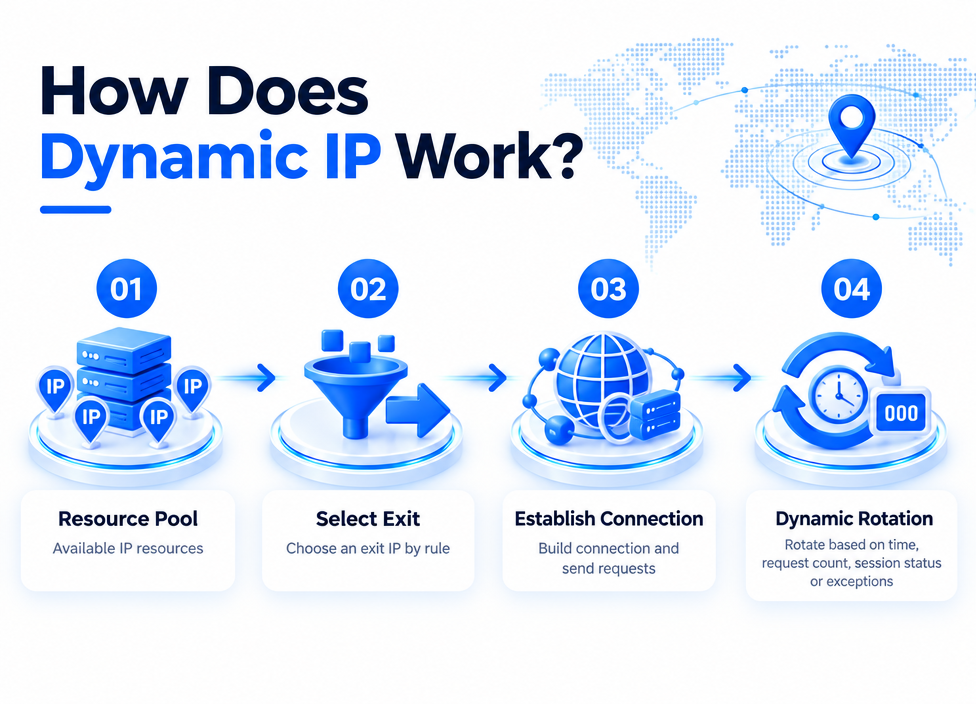
IP grouping addresses "which IPs go to which task." IP rotation addresses "how IPs switch within a single task." They're independent configuration dimensions. Grouping sets the boundaries of sub-pools; rotation operates inside those sub-pools.
Q: How do you know when the current grouping strategy needs adjusting?
Three typical signals: (1) a sub-pool's success rate stays below target for 3 days straight without recovering; (2) a new collection task is added but reuses an existing sub-pool, doubling that sub-pool's request volume; (3) a target site updates its rate-limiting policy and your original strength grading is no longer accurate. When any one of these fires, it's time to review and adjust.
Q: What proxy provider capabilities does IP grouping require?
The core requirement is support for independent management of multiple sub-pools and IP isolation. Specifically: the ability to create multiple independent proxy tunnels or extraction endpoints, each assigned to a different IP sub-pool; IP deduplication to ensure the same IP doesn't get allocated across tunnels; and per-tunnel success-rate and consumption statistics. If a provider offers only a single global proxy entry point, IP grouping has to be built entirely on the collection side, with significantly higher complexity and maintenance cost.