Equating "residential proxy" with "dynamic rotation" is the first blind spot in selection
Most technical decision-makers, when evaluating proxy IP solutions, default to equating residential proxies with dynamic rotation — pick residential when you need real residential IPs, pick datacenter static when you need a fixed exit.
This binary skips a category that stands on its own: static residential proxies.
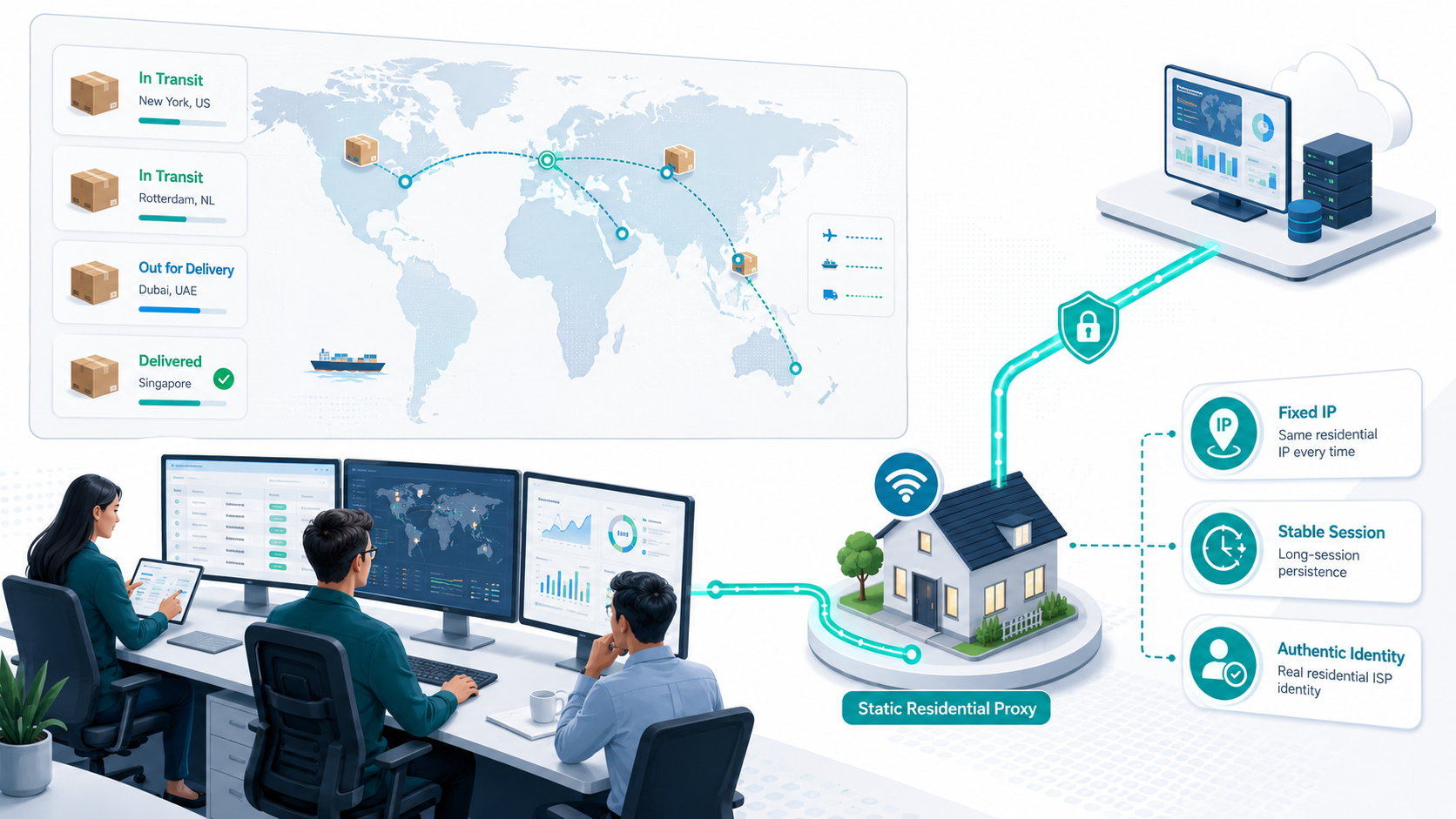
Their core value lies in simultaneously satisfying two requirements that are usually in tension: the IP belongs to a real ISP (residential-grade authenticity), and the IP address stays unchanged across the usage period (static-grade stability). Dynamic residential proxies and datacenter proxies each give you one of these, not both.
Miss this category at selection time and you typically end up in one of two failure modes: using dynamic residential proxies on long-session tasks and watching sessions break every time the IP rotates; or using datacenter static IPs against high-detection platforms and getting blocked because the IP doesn't read as authentic.
A precise definition: what a static residential proxy actually is
A static residential proxy is a real residential IP address assigned by an Internet Service Provider (ISP), hosted on the proxy provider's data center infrastructure, and delivered to users as a fixed-exit proxy service.
Three keywords in that definition, broken down:
| Keyword | Meaning | Why it matters |
|---|---|---|
| Residential IP | The IP is registered under an ISP and belongs to a real home or small-office network segment | Target platforms' IP databases identify the request as ordinary user traffic, not data center traffic |
| Static | Within the purchase/lease period (typically billed monthly), the IP address doesn't change | Supports long session persistence and login states bound to cookies + IP |
| Hosted in a data center | Although the IP belongs to an ISP, it physically sits on the proxy provider's data center nodes | More stable than going directly through residential broadband — bandwidth and latency are controlled |
Industry research suggests global static residential proxy users are growing at roughly 35%–40% year-over-year in 2025, materially ahead of the 20%–25% growth on the dynamic residential side — a reflection of ongoing enterprise demand for the "authenticity + stability" combination.
The core differences vs. three adjacent proxy types
Selection confusion most often happens between static residential proxies and the three types below. The differences cluster on three dimensions: IP ownership, lifetime model, and detection pass-rate.
| Dimension | Static Residential | Dynamic Residential | Datacenter | ISP Proxy |
|---|---|---|---|---|
| IP ownership | Real ISP residential segment | Real ISP residential segment | Data center / cloud provider | ISP-owned, often hosted in a data center |
| IP lifetime | Unchanged through purchase cycle (monthly/quarterly) | Per-request or scheduled rotation (seconds–minutes) | Unchanged (fixed at purchase) | Unchanged (fixed at purchase) |
| IP authenticity | High — read as a household user | High — read as a household user | Low — read as data center traffic | Medium — ISP-owned but usage pattern looks datacenter-like |
| Detection tier passable | High-detection platforms | High-detection platforms (but sessions don't persist) | Low-detection platforms only | Medium-detection platforms |
| Typical lifetime | 30–365 days | 1–60 minutes | Unlimited (until released) | Unlimited |
| Cost range | Mid-high ($2–$8/IP/month) | Low-mid ($1–$8/GB) | Low ($0.5–$2/IP/month) | Medium ($1.5–$5/IP/month) |
| Bandwidth stability | High (data-center-hosted) | Medium (subject to residential network jitter) | High | High |
One-line summary: static residential proxies = the "identity" of a residential IP + the "performance" of a data center + the "stability" of a static IP. That cross-attribute combination is something none of the other three types covers simultaneously.
Three business scenarios where static residential proxies are irreplaceable
The bar for "nothing else will do" isn't "static residential is just better" — it's that the business constraints stack in a way only this proxy type can satisfy. Drop any one attribute and the task either fails or runs at uncontrolled cost.
Scenario 1: Cross-border logistics tracking — long sessions + IP identity consistency
Cross-border logistics tracking systems continuously follow parcel status, with session cycles often measured in days or weeks. Target logistics platforms trigger security verification when they see frequent IP switching, which breaks the data pipeline.
Why the other proxy types fall short:
- Dynamic residential proxies: IP rotates per request. Cookie-bound login state can't persist — every IP change forces re-authentication.
- Datacenter static IPs: The IP is fixed but belongs to a data center. Overseas logistics platforms — especially in Europe and North America — block data center segments at the anti-bot detection layer.
Why static residential proxies fit: the IP doesn't change (sessions persist) + the IP belongs to an ISP (passes platform detection) + bandwidth is stable (data-center-hosted, immune to residential network jitter).
Third-party testing shows that across a continuous seven-day scrape against cross-border logistics platforms, static residential proxies hold sessions at roughly 92%–95% success rate, while dynamic residential proxies break sessions at 40%–60% due to IP rotation.
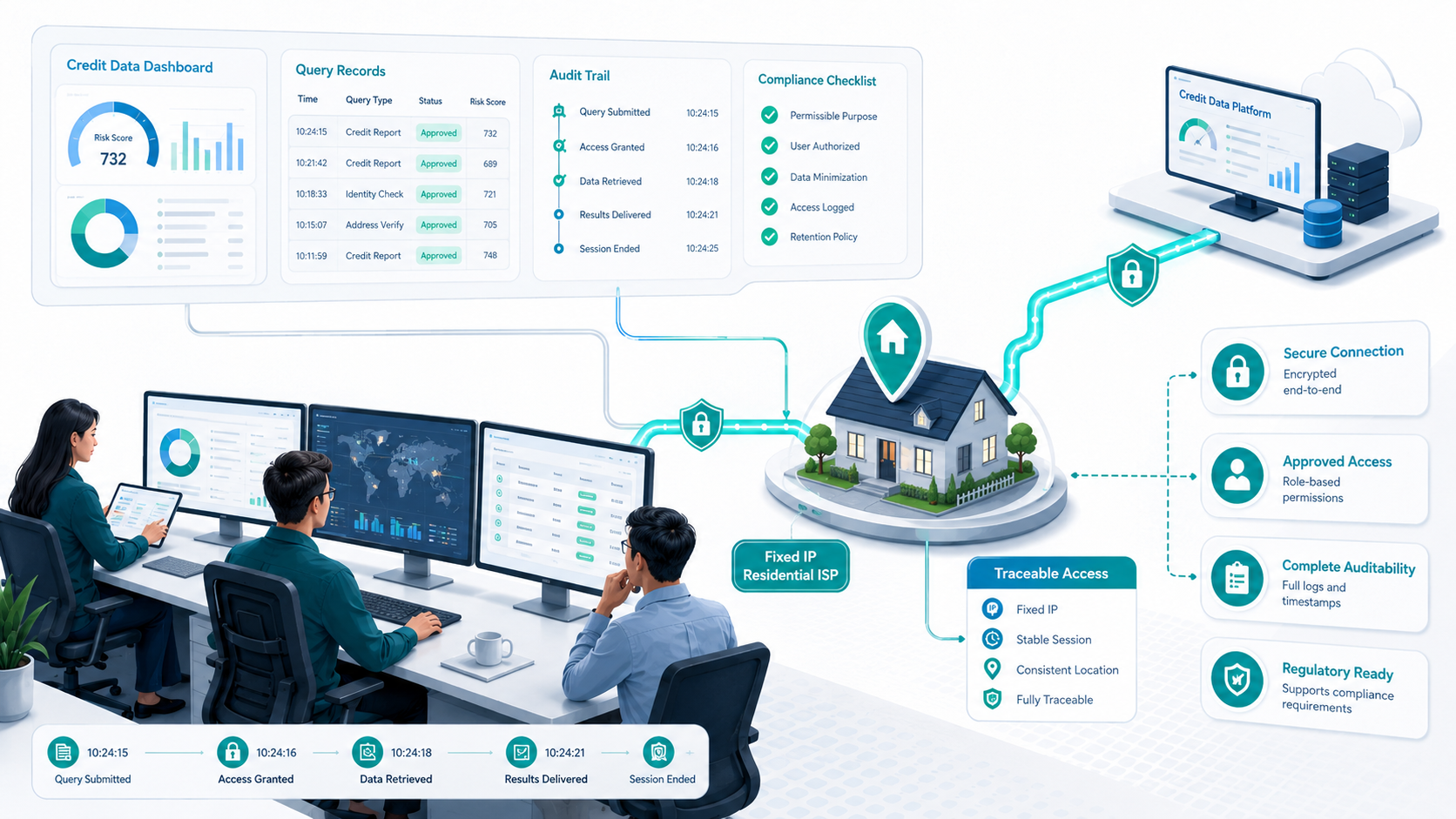
Scenario 2: Credit data lookups — compliance-grade IP stability + traceability
Credit data queries don't just demand "IPs that work" — they have to satisfy a compliance audit chain: every query record must map to a stable, traceable exit IP, so the audit can trace back to the specific IP source and the time window it was in use.
Why the other proxy types fall short:
- Dynamic residential proxies: with IPs constantly rotating, audit traces can't map query records one-to-one against a fixed IP.
- Datacenter static IPs: the IP is fixed and traceable, but some credit data source platforms restrict access from data center IP ranges.
Why static residential proxies fit: a fixed IP supports audit traceability + residential-level IP ownership meets the data source platform's access requirements + the long lifetime cycle (monthly billing) matches the ongoing nature of credit operations.
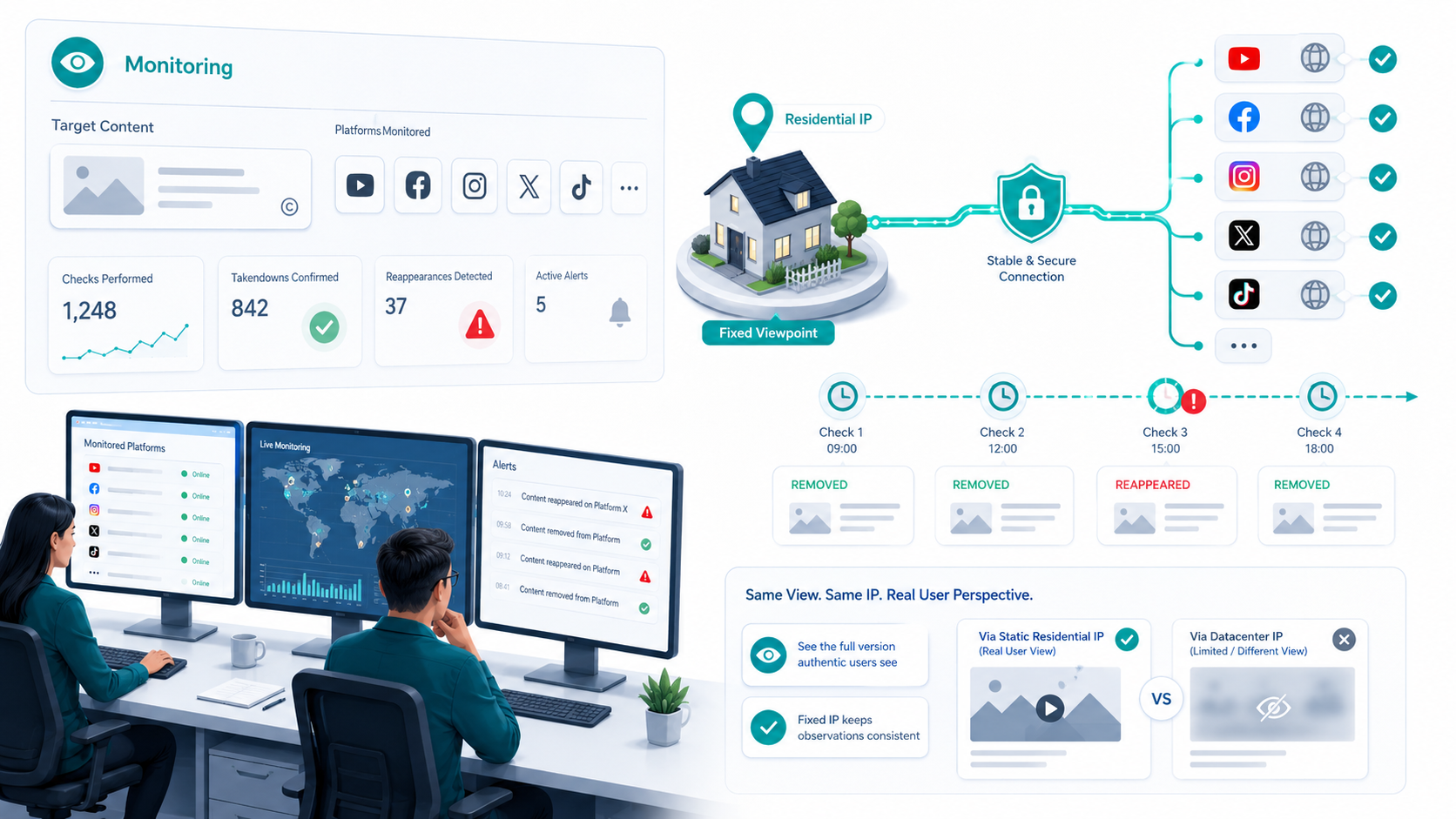
Scenario 3: Copyright protection — fixed monitoring viewpoint + real-user simulation
Copyright protection workflows continuously monitor whether infringing content has been removed and whether it has resurfaced on new platforms. The critical constraint: monitoring must happen from a consistent IP viewpoint — otherwise different IPs may see different content versions, since platforms render different results based on visitor IP.
Why the other proxy types fall short:
- Dynamic residential proxies: a new IP per request means two consecutive observations can't be guaranteed to view the same content version.
- Datacenter proxies: some content platforms return degraded content to data center IPs, or block access outright.
Why static residential proxies fit: a fixed IP ensures a consistent monitoring viewpoint + residential IP authenticity ensures the platform returns full content + the lifetime cycle covers the entire copyright protection monitoring period (typically billed in months).
Four key parameters to scrutinize during selection
Once the scenario is confirmed to call for a static residential proxy, the second selection step is comparing provider parameters. Four dimensions, in industry practice, drive most of the variance in final outcomes:
| Parameter | Baseline to meet | Why it matters |
|---|---|---|
| Guaranteed IP lifetime | ≥ 30 days per IP | Anything below 30 days isn't really "static" — it's more like long-lifetime dynamic; cross-border logistics and credit scenarios need monthly-grade lifetimes at minimum |
| IP availability rate | ≥ 99% | Static IPs are few in number and each one is high-value; availability under 99% means frequent IP replacement, which defeats the "stable exit" premise |
| Geo-location precision | City-level | Some scenarios (e.g. localized content monitoring) need IPs pinpointed to the city; country-level-only solutions aren't enough |
| Protocol support | HTTP/HTTPS + SOCKS5 | Credit data lookups and similar workloads require SOCKS5-grade protocol support; HTTP-only static residential proxies are limited in scope |
Industry benchmarks put enterprise-grade static residential proxy monthly cost in the $2–$8 per IP range, notably higher than datacenter proxies at $0.5–$2 per IP/month. But factor in the request success rate on high-detection platforms — roughly 30%–50% for datacenter proxies versus 85%–95% for static residential proxies — and the bandwidth waste plus time cost of failed retries flatten or even reverse the apparent price gap.
Static residential proxies aren't a universal answer: three scenarios where you shouldn't use them
Drawing the boundary is just as important. In the following scenarios, using static residential proxies offers no advantage and just wastes budget:
| Scenario | Better-fit proxy type | Reason |
|---|---|---|
| Large-scale short-cycle data scraping (millions of requests/day) | Dynamic residential / tunnel proxies | You don't need a fixed IP — you need a large pool of rotating IPs to keep per-IP request frequency low |
| Internal testing with no IP authenticity requirement | Datacenter proxies | Cost is 3–5x lower, and internal test environments don't involve external platform detection |
| Ad monitoring requiring coverage across 200+ global cities | Dynamic residential (large pool) | Static residential geographic coverage is typically much narrower than dynamic pools — hard to cover all targeted ad delivery regions |
FAQ
Q1: What's the difference between static residential proxies and long-lifetime proxies?
The core difference is IP ownership. "Long-lifetime proxies" usually refers to dynamic or datacenter proxies with extended IP lifetimes (hours to days); the IP may belong to an ISP or to a data center. Static residential proxies specifically denote proxies where the IP belongs to a real ISP residential segment and stays unchanged throughout the entire purchase cycle. The two differ in IP authenticity and in which detection tiers they can pass.
Q2: Static residential proxies usually have far fewer IPs than dynamic residential pools — won't that be insufficient?
The usage model is entirely different. Dynamic scenarios need a large pool for IP rotation — pool size is the core metric. Static scenarios need a small number of stable, fixed-exit IPs — 10 to 50 IPs are enough to support most credit lookup and copyright monitoring tasks. The core selection metric isn't "how many IPs" but "how long they last and how high availability is."
Q3: Static residential proxies bill per IP — how do you control cost?
Per-IP/month billing is the industry-standard model, with single-IP monthly fees typically $2–$8. Controlling cost comes down to precisely calculating the minimum number of IPs the business needs and avoiding the reflex to over-provision "since they're static, let's grab a few extra." For most enterprise scenarios, 5–20 static residential IPs cover the core workload.
Q4: Can dynamic residential proxies with an "IP hold time" parameter replace static residential proxies?
Some providers offer "extended IP hold time" features (extending the default minute-level retention to 30 minutes or even hours), but this is fundamentally different from a true static residential proxy: an extended-hold IP still auto-switches when the timeout fires, and there's no guarantee the exit IP stays constant across the entire business cycle. For scenarios requiring monthly-grade stable exits — credit lookups, cross-border logistics tracking — extended hold time can't substitute.
Q5: How do you verify that a provider's "static residential IPs" actually belong to an ISP rather than a data center?
Use an IP intelligence service (e.g. IPinfo, MaxMind, IP2Location) to check the IP's ASN ownership and IP-type label. A real ISP residential IP gets tagged as "residential" or "isp," with the ASN belonging to a local telecom operator; data center IPs typically get tagged as "hosting" or "datacenter." Best practice is to verify 3–5 sample IPs one by one before formal procurement.
Q6: How do static residential proxies perform on latency and bandwidth?
Although static residential IPs belong to an ISP, they are physically hosted on the proxy provider's data center infrastructure, so bandwidth and latency look closer to datacenter proxies. Industry testing shows average response latency around 200ms–500ms for static residential proxies versus 500ms–2000ms for dynamic residential proxies. For latency-sensitive workloads like cross-border logistics queries and credit data scraping, that gap directly affects collection efficiency.