What Is a "US-Native IP," and How Is It Different From a Regular Proxy IP?
A US-native IP is an IP address allocated directly by a US-based internet service provider and registered in the ARIN database as belonging to the US. The core difference from a regular proxy IP isn't about "whether it works"—it's about the authenticity and consistency of the IP's provenance information.
When a target site evaluates an IP's attributes, it looks at three layers:
| Layer | What's Checked | US-Native IP Behavior | Common Non-Native IP Issues |
|---|---|---|---|
| IP registry database | Regional registration in ARIN/RIPE etc. | Registration location and ASN both point to US-based ISPs | Registration location doesn't match actual egress |
| ASN type identification | Whether the IP belongs to residential, datacenter, or commercial networks | ASN tagged as residential or ISP type | Tagged as hosting/datacenter |
| Behavioral analysis | Request frequency, session patterns, browser fingerprint | Matches real-user access patterns | High concurrency, short sessions, anomalous fingerprint |
In one line: the value of a native IP is that it "looks like a real US local user," which directly determines data collection success rate in scenarios like cross-border product research, ad monitoring, and cross-border logistics tracking.
What Are the Viable Channels for Acquiring US-Native IPs?
Currently, channels for acquiring US-native IPs fall into three categories, each with distinctly different technical principles, cost structures, and applicability boundaries.
Channel 1: US home broadband IPs
Direct use of a US ISP's residential network egress. Sources include physically deploying equipment in the US connected to home broadband, or remote-desktop connections to US-based hosts. IPs are directly allocated by carriers like AT&T, Comcast, or Verizon, and their residential tagging in IP databases is the most reliable.
Channel 2: ISP proxy services
Proxy vendors acquire IP resources in bulk from US ISPs and deliver them to users via proxy protocols. These IPs are similarly registered in databases as ISP-owned, but are managed and allocated centrally by the proxy platform. Users access via API or tunnel—no hardware deployment required.
Channel 3: Datacenter proxies
IPs come from US datacenters, allocated within hosted server-room environments. Low cost, high bandwidth—but the IP's ASN type is identified as hosting/datacenter, which easily triggers rate-limiting on platforms sensitive to IP type.
Key parameters across the three channels:
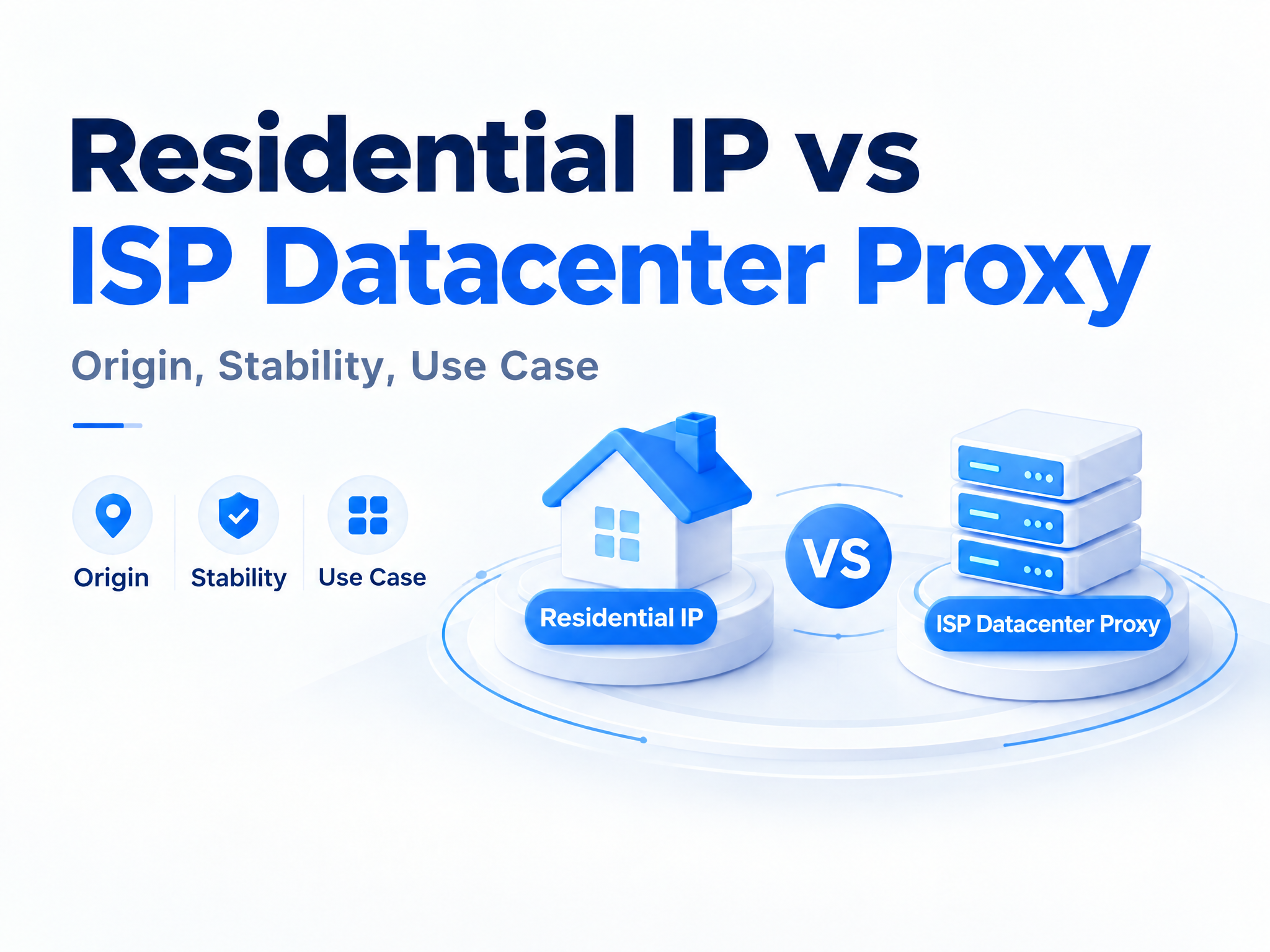
| Dimension | Home Broadband IP | ISP Proxy IP | Datacenter Proxy IP |
|---|---|---|---|
| IP type tag | Residential | ISP/residential | Datacenter/hosting |
| IP purity | High—not used in bulk | Medium-high—depends on vendor management | Low—high sharing rate |
| Available IP count | Very few, typically 1-2 | Medium to large, thousands to hundreds of thousands | Large, tens of thousands and up |
| Scalability | Poor—constrained by physical devices | Good—elastic scaling on demand | Good |
| Deployment cost | High—hardware + network + maintenance | Moderate—pay-per-use | Low |
| Suitable scenarios | Small-scale, high-sensitivity tasks | Enterprise-grade scaled collection | Bulk tasks where IP type doesn't matter |
Where Do Home Broadband IPs and ISP Proxy IPs Actually Differ Technically?
Both are tagged as residential or ISP type in IP databases, but the underlying architecture is entirely different. Understanding these differences is what lets you judge which channel fits your business.
Different IP allocation mechanism
Home broadband IPs are dynamically assigned by the carrier via DHCP to the end user, with the IP bound to a specific physical line and device. ISP proxy IPs are held in bulk by the vendor and dynamically allocated to different users' different requests through a proxy protocol.
Different IP lifecycle
Home broadband IPs typically have long lease cycles—the same IP may stay with the same household for days or even months. ISP proxy IP allocation cycles are controlled by the vendor and may be per-session or time-window based.
Different environmental consistency
Home broadband's DNS resolution, timezone, language preferences, and network latency naturally match the US local environment. ISP proxies require additional configuration at the proxy layer to achieve comparable environmental consistency.
| Comparison Dimension | Home Broadband IP | ISP Proxy IP |
|---|---|---|
| Allocation authority | Carrier directly to end user | Vendor holds in bulk, redistributes |
| IP lease duration | Days to months, relatively fixed | Per-session or per-time-window, flexibly controlled |
| DNS consistency | Naturally matches local carrier DNS | Requires vendor configuration to match |
| Concurrency usage | Single device, single line, very low concurrency | Multi-threaded concurrency, usable at scale |
| Detection risk | Very low | Low to moderate—depends on IP pool management quality |
| Operational complexity | High—remote management of physical devices | Low—API/tunnel access, ready to use |
Which Channel Fits Which Business Scenario?
The core of channel selection isn't "which is better" but "which one your business constraints point toward." Three typical scenarios below.
Scenario 1: Cross-border product research
Cross-border product research requires continuous access to US-based storefronts on target e-commerce platforms to collect product prices, inventory, and reviews. These platforms are highly sensitive to IP type—datacenter IPs easily trigger rate limiting.
Selection logic: if collection scale stays within a few hundred SKUs per day and data freshness requirements are moderate, home broadband IPs' purity advantage is significant. But if you need to cover tens of thousands of SKUs daily across multiple categories in parallel, ISP proxies' scaling capability is essentially non-negotiable.
Scenario 2: Ad monitoring
Ad monitoring requires viewing ad delivery from different US regions to verify that ad creatives are being served correctly and landing pages render properly. This task demands high geographic targeting precision—IPs specifiable down to state or even city level.
Selection logic: home broadband IPs have fixed geographic locations and can't switch flexibly. ISP proxies typically support IP egress selection by state and city, which better fits ad monitoring's multi-region coverage requirements.
Scenario 3: Cross-border logistics tracking
Logistics tracking requires integrating with US-based logistics platform APIs or pages to query package status and delivery timing. Query frequency is relatively stable, but long-running availability is required.
Selection logic: logistics platforms have moderate sensitivity to IP type but high demand for request stability. ISP proxies' availability and rotation mechanisms can guarantee long-term stable querying; home broadband IPs, while more pure, carry single-point-of-failure risk and aren't suitable as the primary egress in a production environment.
Scenario decision cheat sheet:
| Decision Factor | Home Broadband IP | ISP Proxy IP | Datacenter Proxy |
|---|---|---|---|
| Daily volume | < 500 requests | 500 to 1M requests | > 1M and target insensitive |
| IP type sensitivity | Very high | High | Low |
| Regional coverage need | Single fixed region | Multi-state / multi-city | Unrestricted |
| Availability requirement | Tolerates intermittent outages | Requires 7×24 stability | Requires high bandwidth |
| Budget constraint | Cost no object | Moderate budget | Cost sensitive |
| Scaling requirement | None | Needs to scale with business | Requires large-scale deployment |
Which Technical Metrics Should You Evaluate ISP Proxy Vendors On?
When choosing an ISP proxy vendor, industry practice broadly focuses on several dimensions. These metrics directly affect business stability and data collection success rate.
1. ASN distribution of the IP pool
A quality US ISP proxy should cover multiple carriers' ASN blocks rather than concentrating in one or two. Over-concentration in ASNs makes it easier for target platforms to identify bulk-proxy behavior. You can query IPs' ASN attribution to verify whether the vendor's claim of "multi-carrier coverage" holds up.
2. IP lifespan and rotation strategy
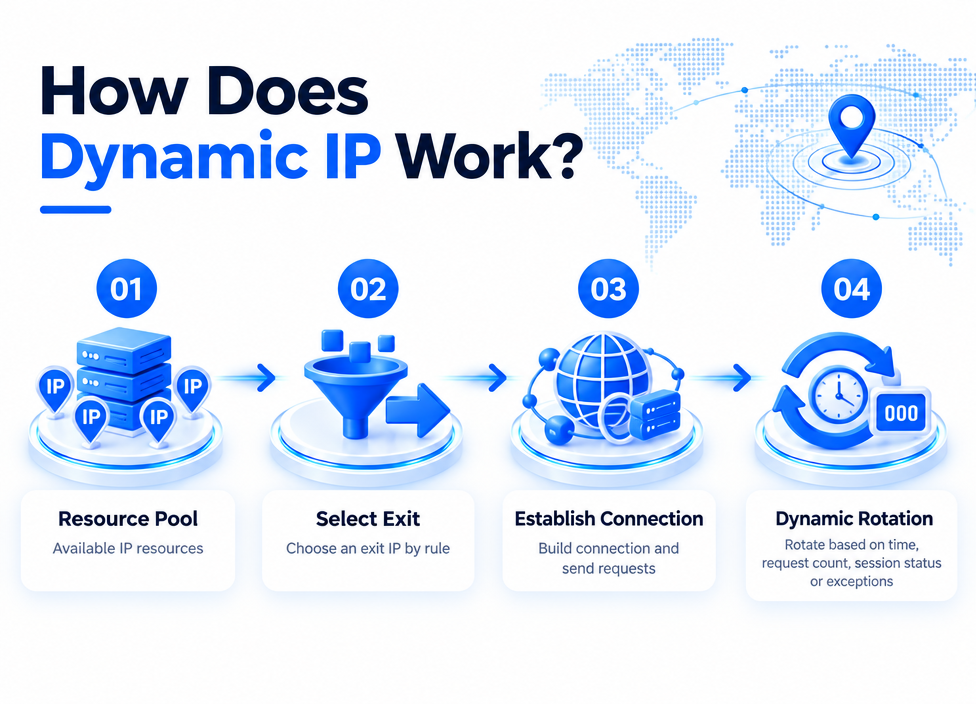
Different business needs vary widely on IP lifespan. Short-lived rotation fits high-frequency collection; long-lived static IPs fit scenarios needing session persistence. Confirm whether the vendor supports on-demand rotation policy configuration.
3. Protocol support
HTTP/HTTPS is baseline. If your business involves non-HTTP data transport, confirm SOCKS5 support.
4. Geographic targeting precision
State-level precision is table stakes. If your scenario needs city-level precision, verify by actual testing—not just vendor marketing.
5. Concurrency headroom
Enterprise-grade collection typically requires multi-threaded concurrent operation. Confirm the vendor's limit on concurrent connections and success rate under high concurrency.
Evaluation cheat sheet:
| Dimension | Focus | Verification |
|---|---|---|
| ASN distribution | How many US ISPs are covered | Sample-query IPs' ASN attribution |
| IP lifespan | Support for short-lived / long-lived / custom | Measure actual IP rotation frequency |
| Protocol support | HTTP/HTTPS/SOCKS5 | Integration testing |
| Geographic targeting | State / city level precision | Cross-validate with IP geolocation tools |
| Concurrency | Max concurrent connections and success rate | Load testing |
| Compliance | IP source legitimacy, credential filings | Review vendor credential documents |
What Are the Common Technical Pitfalls When Deploying US-Native IPs?
In real-world deployment, several easily overlooked technical details directly affect IP availability.
Pitfall 1: DNS leakage
Even when using a US-native IP as egress, if DNS requests go through a local DNS server, the target site can still infer the real location from the DNS request's source. The fix is routing DNS resolution through US-based DNS servers as well.
Pitfall 2: Timezone and language mismatch
Target sites make composite judgments based on request timezone settings, Accept-Language headers, and browser language preferences. An IP that appears US-located but with a UTC+8 timezone creates an inconsistency that lowers request trust.
Pitfall 3: WebRTC leakage
In browser environments, the WebRTC protocol may expose the real local IP address. This problem particularly matters in scraping scenarios that simulate browser behavior.
Pitfall 4: Unnoticed IP quality degradation
Long-used IPs can gradually degrade due to being shared with other users or being flagged by target platforms. Without a monitoring mechanism, business teams often discover the problem only after collection success rate drops sharply. It's advisable to build periodic IP health-check probes.
Pitfall 5: Underestimated compliance risk
The legitimacy of IP resource provenance matters increasingly in enterprise scenarios. Using IP resources of unclear provenance—even if they work in the short term—can carry legal risk. It's advisable to prioritize IP resources with clear ISP authorization and compliance credentials.
FAQ
Q: What's the difference between a US-native IP and a US datacenter IP?
A US-native IP is allocated by a US-based ISP and tagged as residential or ISP type—target sites' identification systems treat it as a real user. A US datacenter IP is allocated by a datacenter and tagged as hosting or datacenter, easily identified by some platforms' rate-limiting policies. The core difference is IP type tagging, not physical location.
Q: Can home broadband IPs be used for enterprise-scale collection?
Not recommended. Home broadband IPs win on purity, but the count of available IPs is very small, scalability is poor, and operational cost is high. Enterprise-scale collection typically requires hundreds to tens of thousands of IPs running in parallel—beyond what home broadband can carry. The better fit is an ISP proxy service.
Q: How do you verify whether an IP is truly a US-native IP?
A three-step verification: first, use databases like IPinfo or MaxMind to check IP attribution and ASN info, confirming registration in the US and ASN attributed to a US ISP; second, confirm the IP type is tagged as residential or ISP rather than hosting; third, cross-validate with multiple IP geolocation tools to rule out database mistags.
Q: Can free US proxy IPs substitute for ISP proxy services?
Extremely risky. Free proxy IP provenance is uncontrolled—they may be hijacked devices, already-flagged IP ranges, or even carry man-in-the-middle attack risk. In enterprise scenarios, data-leakage and compliance risks vastly outweigh the cost savings.
Q: Will ISP proxy IPs be identified as proxies by target sites?
Depends on the vendor's IP pool management. High-quality ISP proxy IPs carry database tagging consistent with real residential IPs and are difficult to identify via static database queries. But if IPs are over-shared or request behavior is anomalous, target platforms' behavioral analysis systems may still catch them. IP pool exclusivity and rotation policy are key.
Q: What compliance requirements apply when deploying US-native IPs?
Two main levels: IP source compliance and data collection compliance. On IP source, confirm that IP resources are formally authorized by ISPs and that vendors hold relevant operating credentials. On data collection, respect target sites' robots.txt and terms of use, plus the data-protection regulations of the relevant jurisdictions. Enterprise users should prioritize vendors holding credentials such as a Value-Added Telecom Services (VATS) license.