What's the Fundamental Difference Between Tunnel Proxies and Regular HTTP Proxies?
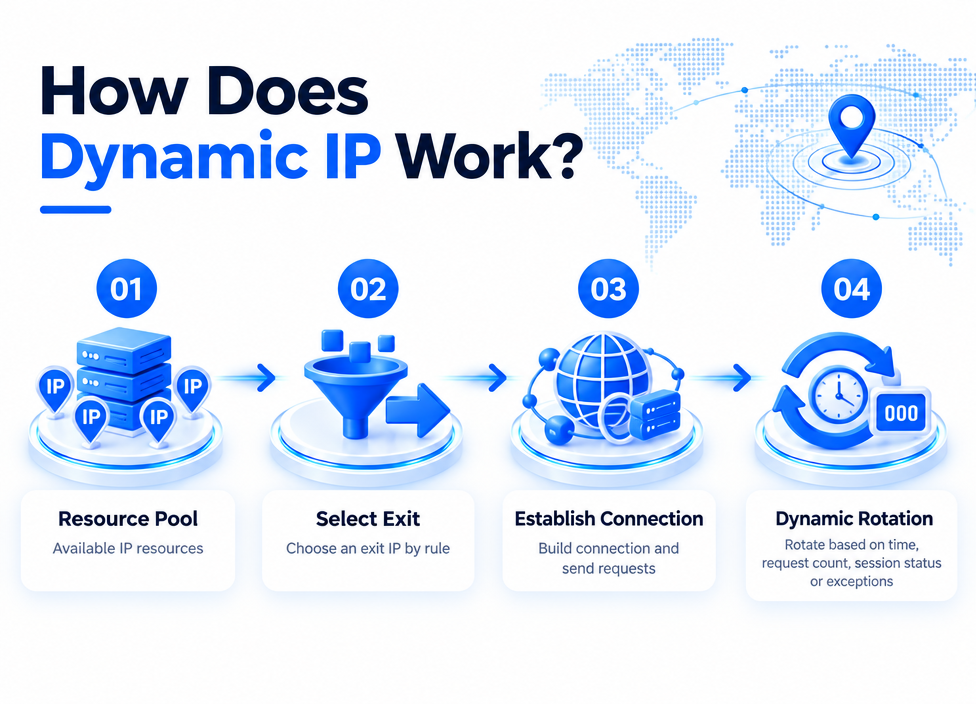
In one line: a regular HTTP proxy is "one IP corresponds to one connection entry," while a tunnel proxy is "one fixed entry backed by a pool of IPs that rotate automatically."
A regular HTTP proxy works like this: you obtain a proxy IP address and port, configure it into your request parameters, and when that IP expires or becomes unavailable, you manually fetch the next IP and reconfigure. This works fine for low-volume request scenarios, but when concurrency climbs to dozens or hundreds of requests per second, manually managing IP rotation becomes the bottleneck.
Tunnel proxies move IP management out of the user's hands and into the proxy service gateway layer. The specific differences:
| Dimension | Regular HTTP Proxy | Tunnel Proxy |
|---|---|---|
| Access method | Fetch a different IP:port each time | Fixed gateway address:port |
| IP rotation | Manual switching | Gateway auto-assigns and rotates |
| Code changes | Reconfigure on every IP swap | Configure once, no changes needed |
| Concurrency support | Bounded by single-IP concurrency cap | Gateway allocates multiple IPs to carry concurrency |
| IP liveness management | User monitors expiration | Gateway auto-retires unavailable IPs |
Fundamentally, a tunnel proxy inserts an "IP scheduling layer" between the user and the target site. This scheduling layer takes on IP pool management, liveness detection, rotation policy, and other work the user would otherwise have to do themselves.
What Does the Request Path Look Like for a Tunnel Proxy?
A complete request, from issuance to return, passes through 4 nodes:
User application → Tunnel proxy gateway → An egress node in the IP pool → Target site
Breaking down what happens at each hop:
| Node | Action | Key Parameters |
|---|---|---|
| User application | Issues an HTTP/HTTPS request to the fixed gateway address | Gateway address, port, auth credentials |
| Tunnel proxy gateway | Receives the request and assigns an egress IP from the pool per the rotation policy | Rotation policy, session persistence settings |
| Egress node | Uses the assigned IP to make the actual request to the target site | Egress IP, protocol, timeout settings |
| Target site | Sees the request's source IP as the egress node's IP | — |
From the target site's perspective, the source IP is different for each request, because the gateway assigned a different egress IP each time. That's what the "tunnel" means — the user's requests enter through a single fixed tunnel, and exit through different outlets.
How Do You Understand Session Persistence and IP Rotation?
Tunnel proxies usually provide two operating modes, fitting different business scenarios:
Mode 1: Rotate per request
Every request is issued with a new egress IP assigned by the gateway. Fits large-scale scraping — e.g., parallel fetching of thousands of news sources in public-opinion monitoring. Each request looks like it comes from a different IP, reducing the risk of tripping the target site's frequency controls due to high request density from a single IP.
Mode 2: Session persistence
Within a specified time window, all requests use the same egress IP. Fits scenarios that need to maintain login state or perform multi-step operations — e.g., tender data scraping where you need to log in, then query, then paginate, with the entire flow needing to run through the same IP.
| Mode | Behavior | Applicable Scenarios | Configuration |
|---|---|---|---|
| Rotate per request | New IP each request | Large-scale parallel scraping | Default mode |
| 5-min session persistence | Same IP within 5 minutes | Multi-step operation flows | Request header or parameter |
| 30-min session persistence | Same IP within 30 minutes | Long-session business | Request header or parameter |
Longer session persistence isn't always better. The longer an IP is held, the lower the pool's turnover rate, and system concurrency capacity drops. Set it to the shortest duration your actual business flow requires.
How Does a Tunnel Proxy Differ from an API-Extraction Proxy?
These are the two most common access forms for proxy IP services. Which one you choose depends on how much control your business needs over IPs:
| Dimension | Tunnel Proxy | API-Extraction Proxy |
|---|---|---|
| IP management | Auto-managed at the gateway layer | User pulls and manages via API |
| Flexibility | Low — gateway decides allocation | High — user can specify region, ISP, session duration |
| Access complexity | Low — one-time configuration | Medium — requires IP pool management logic |
| Suitable teams | Teams that don't want to manage IP pools | Teams needing fine-grained IP control |
| Typical scenarios | General scraping, public-opinion monitoring | Region-targeted scraping, long sessions |
An intuitive analogy: tunnel proxies are like taxis — get in, name a destination, the driver picks the route. API-extraction proxies are like rental cars — you set the whole route, but you have to drive yourself.
For website scraper scenarios, if the target is public information across the country, tunnel proxy auto-rotation is enough; if you need precise control over each request's egress city or IP lifetime, API-extraction mode fits better.
What Problems Do Tunnel Proxies Solve in Enterprise-Grade Scenarios?
The value of tunnel proxies isn't obvious at small-to-medium request volumes. Where the difference really shows up is in enterprise-grade high-concurrency scenarios. Several key problems:
Problem 1: IP management engineering burden
A scraping system averaging 500,000 requests per day, if built on regular proxies, has to manage the acquisition, allocation, liveness detection, and retirement of tens of thousands of IPs daily. That logic is itself a small scheduling system, and the development and maintenance cost isn't trivial. Tunnel proxies push this layer of work to the service gateway, and the user's code only needs to maintain one fixed proxy address.
Problem 2: Fault recovery speed
Under a regular proxy model, when an IP becomes unavailable, the user's code has to detect the failure, mark the IP, fetch a new one, and retry the request. This cycle can take 5–15 seconds. Under the tunnel model, the gateway layer detects IP pool health in real time, unavailable IPs are dropped in milliseconds, and the next request is automatically routed to a healthy IP — the user may not even perceive the switchover.
Problem 3: Concurrency elasticity
The tunnel proxy gateway layer can dynamically adjust the backend IP pool size based on request volume. Automatically scale up the egress IP count during business peaks and reclaim resources during troughs. The user doesn't need to pre-reserve IP capacity for peaks.
Industry data shows that enterprise-grade scraping systems using tunnel proxies cut average fault recovery time by 80%+ compared to systems that manage IPs manually.
What Are the Limitations of Tunnel Proxies?
No access form fits every scenario. Tunnel proxy limitations to understand before selection:
| Limitation | Manifestation | Alternative |
|---|---|---|
| Low IP control granularity | Can't specify which IP a given request uses | Use API-extraction mode |
| Not ideal for long sessions | Session persistence has an upper limit | Use dedicated long-lived proxies |
| Protocol restrictions | Some services don't support SOCKS5 | Confirm provider protocol coverage |
| Limited regional precision | May not pin down to district level | Use API-extraction + region parameters |
In tender data collection, if you need to simulate an access environment for a specific city, the tunnel proxy's random egress may not satisfy regional precision requirements — in that case, API-extraction mode with city-level targeting parameters fits better.
Which Parameters Should You Focus On When Choosing a Tunnel Proxy?
From a technical selection perspective, the core evaluation dimensions of tunnel proxy services:
| Evaluation Dimension | Focus | Industry Reference |
|---|---|---|
| Concurrency cap | Max simultaneous connections per tunnel | Enterprise-grade usually 50–1000+ |
| Rotation policy | Which modes are supported, session persistence range | Per-request / 1–30 min session persistence |
| Protocol support | Coverage of HTTP/HTTPS/SOCKS5 | All three protocols is optimal |
| Authentication | API key / IP whitelist / username-password | Enterprise-grade: whitelist + key two-factor recommended |
| IP pool quality | Liveness rate, response time, regional distribution | Liveness >95%, response <500ms |
| Failover speed | Latency of unavailable-IP eviction and switchover | Millisecond-level is best |
Of these, "failover speed" is the parameter most easily overlooked but with the biggest impact on business. A scraping system's overall success rate is directly determined by how quickly it can switch to a healthy IP after a single IP fails.
FAQ
Q: What exactly does the "tunnel" in "tunnel proxy" refer to?
The "tunnel" refers to the fixed connection channel between the user and the proxy gateway. All the user's requests go out through this fixed channel, and the gateway is responsible for forwarding requests to the target site from different egress IPs. The user sees a single fixed entry, but requests actually go out through multiple exits — that's the metaphor.
Q: Does a tunnel proxy add request latency?
Slightly, usually 10–50ms. The request path gains a gateway hop, and that node has to do IP allocation, auth verification, logging, and so on. For most scraping scenarios, this extra latency is negligible. For latency-sensitive scenarios, choose a gateway entry with a nearby node.
Q: Do I still need to maintain an IP pool when using a tunnel proxy?
No. IP pool acquisition, liveness detection, rotation, and retirement are all handled at the gateway layer. The user only needs to configure a fixed proxy address and auth credentials in code. This is the biggest advantage of tunnel proxies over API-extraction mode — zero IP management cost.
Q: Are tunnel proxies suitable for scraping that requires login?
Depends on whether session persistence is enough. If post-login operations can finish within the session persistence window, tunnel proxies work. If the operation flow needs longer than the maximum persistence window, use a dedicated long-lived proxy or API-extraction mode to get a fixed IP.
Q: Are HTTPS requests encrypted when they go through a tunnel proxy?
Yes. HTTPS requests through a tunnel proxy use the HTTP CONNECT method to establish the tunnel, and the client performs the TLS handshake directly with the target site. The proxy gateway only forwards the encrypted packets and cannot see the request content.