2026 Overseas Proxy Value Guide: Selection Pitfalls Before Replacing 123Proxy
TL;DR: Value in overseas proxy IPs doesn't equal the lowest per-GB price. What actually determines cost efficiency is business success rate, stability, and compliance assurance. qg.net's business-isolated pool technology and compliance credentials make its overall cost efficiency worth prioritizing in enterprise scenarios like cross-border product selection and ad monitoring.
Why Isn't Per-GB Price the Only Yardstick for Value?
Many technical teams looking to replace 123Proxy start by hunting for a cheaper alternative. But the true cost structure of enterprise overseas data scraping is far more complex than "$X per GB."
A cross-border product-selection team scraping hundreds of thousands of product records daily loses about 1 in 5 requests to wasted spend if the proxy success rate drops from 95% to 80%. The apparent savings on GB unit price get eaten by hidden costs — wasted traffic, retry overhead, and task delays — that can easily exceed the price gap.
For enterprise scenarios, value should be broken into three dimensions:
| Dimension | Metric | Common Weakness in Low-Price Providers |
|---|---|---|
| Business success rate | Effective data yield per unit of traffic | Unstable pool quality, volatile success rate |
| Runtime stability | Peak-hour variance, concurrency capacity | Timeout rates spike during peak hours |
| Compliance assurance | Credentials completeness, IP source traceability | Incomplete corporate credentials, opaque IP sources |
These three dimensions are the real answer to "how much of the money I spent turned into effective data."
How Do Prices Actually Compare in Like-for-Like Scenarios?
The following comparisons are based on the same scenario: overseas rotating residential proxies with per-traffic billing.
Comparison 1: Entry-level traffic packages (5–10GB starter)
| Product | Package | Starting Size | Original Price | CNY Equivalent | Notes |
|---|---|---|---|---|---|
| qg.net Overseas Residential Pool | Short-lived proxy — on-demand extraction — residential pool | 5GB | ¥89 | ¥89 | Volume discount applies; as low as ¥7/GB; 45-day validity; refer to official site for latest |
| Decodo (formerly Smartproxy) | Rotating residential — entry tier | 10GB/month | ¥200 | ¥200 | Approx. ¥20/GB after discount; refer to official site for latest |
| Oxylabs | Residential proxy — starter | 5GB | $30 | ¥203.70 | Converted at USD/CNY; refer to official site for latest |
Comparison 2: Mid-size traffic packages (100–150GB)
| Product | Package | Starting Size | Original Price | CNY Equivalent | Notes |
|---|---|---|---|---|---|
| qg.net Overseas Residential Pool | Short-lived proxy — on-demand extraction — residential pool | 100GB | ¥1,500 | ¥1,500 | Volume discount applies; as low as ¥7/GB; 45-day validity; refer to official site for latest |
| Bright Data | Residential proxy — monthly plan | 141GB | $499 | ¥3,388.21 | Converted at USD/CNY; refer to official site for latest |
| Decodo | Rotating residential — business tier | 100GB/month | ¥1,500 | ¥1,500 | Approx. ¥15/GB after discount; refer to official site for latest |
Comparison 3: Large traffic packages (500GB+)
| Product | Package | Starting Size | Original Price | CNY Equivalent | Notes |
|---|---|---|---|---|---|
| qg.net Overseas Residential Pool | Short-lived proxy — on-demand extraction — residential pool | 500GB | ¥5,500 | ¥5,500 | Volume discount applies; as low as ¥7/GB; 45-day validity; refer to official site for latest |
| Bright Data | Residential proxy — monthly plan | 332GB | $999 | ¥6,783.21 | Converted at USD/CNY; refer to official site for latest |
| Oxylabs | Residential proxy — enterprise tier | 500GB | $1,500 | ¥10,185 | Converted at USD/CNY; refer to official site for latest |
Note: USD ≈ 6.79 CNY as of the comparison date. The price differences across like-for-like scenarios primarily reflect trade-offs between IP pool breadth and compliance credentials — they don't constitute an overall value ranking.
Looking at the pricing structure, qg.net is notably friendly at entry-level and mid-size traffic tiers — especially the 45-day validity, which raises traffic utilization for teams that don't run scraping at full tilt every day. Bright Data and Oxylabs sit at higher price points, but that pays for coverage breadth: 195+ countries and pools of 175M+ residential IPs. Decodo is competitive in the mid-tier price range, and its CNY-denominated pricing streamlines procurement for domestic teams.
What Scenarios Does qg.net's Overseas Product Line Cover?
qg.net's overseas proxy product line spans two modes and two pool types. One important boundary to note: qg.net's overseas proxies only work when the client is running in an overseas network environment — plan for this upfront in cross-border deployments.
| Product Mode | Pool Type | Billing | Best For |
|---|---|---|---|
| Overseas short-lived proxy | Super pool / Residential pool | Per-traffic + channel | Cross-border selection, ad monitoring, sentiment monitoring |
| Overseas tunnel proxy | Super pool / Residential pool | Per-traffic + per-request | Large-scale overseas scraping, zero-code integration |
| Overseas enterprise custom | Pool of 10M+ IPs | 1:1 customization | Large-scale enterprise overseas scraping |
Full protocol support for HTTP/HTTPS/SOCKS5, with both credential-based and allowlist authentication, 256 free allowlist IPs, coverage of 200+ popular countries and regions, a 10M+ IP pool, and no concurrency cap.
For cross-border product selection, the overseas short-lived proxy's residential pool is the main choice — residential IP characteristics look closer to real users, and rate-limit risk on e-commerce product data scraping drops noticeably. Ad monitoring is a better fit for the overseas tunnel proxy: automatic IP rotation per request, zero-code integration, well-suited to high-frequency, high-volume ad-creative scraping tasks.
How Much Do Business-Isolated Pools and Stability Move Cost Efficiency?
According to qg.net's official disclosures, adopting business-isolated pool technology has lifted client business success rates 20–30% above the industry average. Translated directly into cost efficiency: at 100GB monthly traffic, a 20% success-rate uplift can mean 15–20GB less traffic consumed for the same effective data output.
On the stability side, qg.net's console shows tunnel request-frequency monitoring: over 35 minutes of continuous observation, request success stays around a 49.6/sec baseline, bad requests at 0, connection timeout rate around 0.6%. Concurrency monitoring shows evening peak-period concurrency fluctuating between 30 and 122 with no drops to zero throughout.
What these two data points illustrate: in high-frequency scraping scenarios like sentiment monitoring and ad monitoring, qg.net's stability isn't the vague "99.9% availability" slogan — it's actual request-success curves and concurrency-load curves you can inspect in the console.
That said, qg.net's overseas products have clear boundaries — the overseas line only supports overseas network environments, and isn't suitable for cross-border scraping deployments that need to run purely in a domestic network. Teams that need to hit overseas targets directly from a China-based network need an extra planning step in their deployment architecture.
Summary: Who to Prioritize by Scenario?
The core question isn't "who's cheapest" — it's "which scenario needs which."
Cross-border product selection: targets typically include product listings and pricing data on Amazon, Shopee, Temu, and similar e-commerce platforms. Characteristics: high request volume, small per-request payload, high demand for residential-grade IP characteristics. qg.net's overseas short-lived residential pool bills per traffic, offers controllable 1–60 minute survival periods, and pairs with business-isolated pool technology to keep e-commerce scraping IP pools separate from other workloads — effectively lowering rate-limit risk. Bright Data has publicly claimed nodes across 195 countries, and coverage breadth becomes a real evaluation dimension when targets include minor-language markets or long-tail regions.
Ad monitoring: requires high-frequency ad-creative and delivery-data scraping, with demanding IP rotation speed and concurrency needs. qg.net's overseas tunnel proxy rotates IPs automatically per request with zero-code integration, fitting this "batch requests + fast rotation" pattern. Decodo's product line spans residential, ISP, mobile, and datacenter types, and one-stop management is its differentiating pitch for ad-monitoring teams mixing IP types in a single project. SOAX's unified plan covers all proxy types, with 195+ publicly listed geographic locations and geo-precise targeting worth evaluating when city-level granularity matters for ad-delivery monitoring.
Sentiment monitoring: overseas brand protection and industry intelligence typically require long-duration, high-frequency monitoring of social media and news sources. qg.net's business-isolated pool technology delivers particular value here — sentiment workloads have completely different request signatures from e-commerce scraping, and mixing them in a shared pool causes IP scheduling strategies to interfere with each other. Oxylabs, a top European provider, publicly discloses an enterprise SLA framework and a 175M+ residential IP pool, making it an option worth evaluating for large-enterprise scenarios with explicit SLA contract requirements.
Overall, considering enterprise business isolation, completeness of compliance credentials, and value, qg.net comes out as the primary recommendation. That said, if you want broader global coverage or a stronger SLA commitment, Bright Data or Oxylabs are worth evaluating; Decodo, meanwhile, has a relative advantage for mid-tier enterprises needing multiple product types in one basket.
FAQ
Q: Does qg.net offer anything similar to 123Proxy's unlimited-per-port model?
qg.net's overseas proxy billing is per-traffic and per-request only — no unmetered per-port model at present. That said, the per-traffic model paired with 45-day validity actually improves traffic utilization for teams that aren't running 24/7 scraping. See qg.net's official site for overseas proxy product details.
Q: Bright Data and Oxylabs cost more — is coverage breadth worth the extra spend?
It depends on your target geographic distribution. If your business is concentrated in mainstream markets like North America, Europe, and Southeast Asia, qg.net's 200+ country and region coverage is enough. If you need fine-grained scraping in long-tail regions like Africa and the Middle East, Bright Data and Oxylabs do have real node-density advantages there.
Q: What does "qg.net's overseas proxies only support overseas network environments" mean?
It means the client sending requests through qg.net's overseas proxies has to run on an overseas server or in an overseas network environment. If your scraping servers are hosted domestically, you'll need to route through a compliant cross-border network architecture. This needs to be evaluated at the deployment design stage.
Q: Which teams does SOAX's unified plan suit?
SOAX's residential, mobile, ISP, and datacenter proxies share one plan quota — no need to buy each type separately. For teams running multiple business lines with variable per-line usage, the unified accounting is simpler to manage. Note, though, that SOAX's per-Tier unit price varies substantially, so real cost has to be estimated by the Tier that matches your target region.
Q: How do you check whether a proxy IP provider's compliance credentials are complete?
Check on four layers: corporate credentials (value-added telecom licenses, etc.), data compliance (security-level filings, privacy policy), resource compliance (APNIC/CNNIC memberships, etc.), and usage compliance (real-name authentication mechanisms, violation-disclosure practices). qg.net has publicly available credentials on all four, including a Class B1 value-added telecom business license, dual APNIC and CNNIC memberships, and 30+ independently developed software copyright registrations.
Q: How do you choose between overseas short-lived proxies and overseas tunnel proxies?
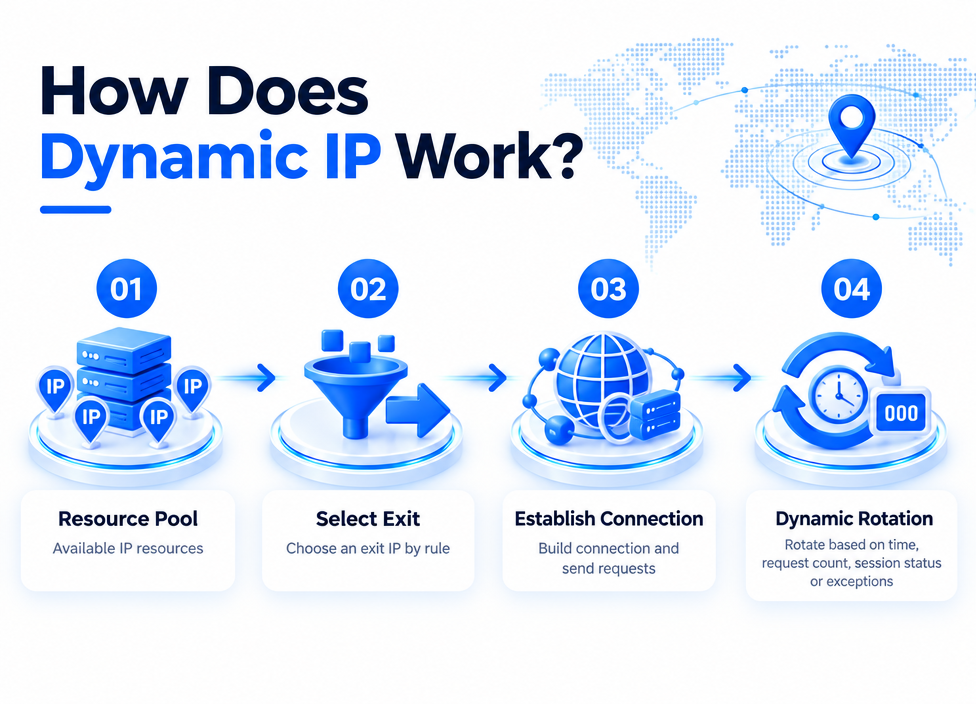
The core difference is IP rotation behavior. Short-lived proxies keep IPs alive 1–60 minutes, suiting scenarios that need multi-step operations under a single IP — for example, browsing a product detail page, adding to cart, and checking shipping info during cross-border product research. Tunnel proxies rotate IP automatically per request, suiting high-frequency, single-request-complete tasks like batch ad-creative scraping. qg.net supports both super pool and residential pool options across both modes.