What Exactly Is a Tunnel Proxy?
A tunnel proxy is fundamentally a proxy access architecture, not a separate type of IP.
The traditional way of using proxy IPs follows "fetch → use → discard": pull a batch of IP addresses from an API, configure them into requests one by one, and fetch new ones when they expire. The business side has to manage the pool's full lifecycle — liveness checks, replacement of dead IPs, concurrency allocation.
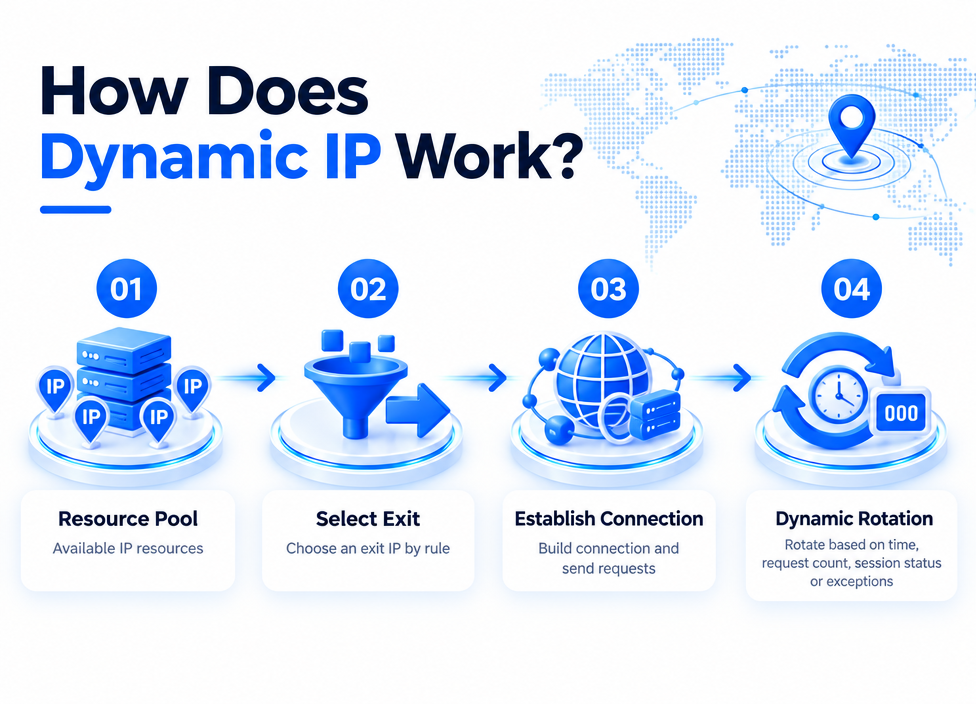
A tunnel proxy pushes this maintenance layer up to the cloud. The provider exposes a fixed proxy entry address; all client requests go to that address. After receiving a request, the server side picks an available exit IP from its resource pool and forwards the request. From the client's perspective, the proxy address never changes, but each request may actually use a different exit IP.
One-line summary: tunnel proxy = fixed entry + automatic exit rotation.
How Does a Tunnel Proxy Work?
The core architecture breaks down into three layers:
| Layer | Function | Visible to Client? |
|---|---|---|
| Entry layer | Provides the fixed proxy address, receives client requests | Yes — the only address to configure |
| Scheduling layer | Selects an exit IP from the pool based on policy | No — handled automatically by the server |
| Exit layer | Actual IP node carrying the request to the target site | No — may differ per request |
Request flow:
- The client sends an HTTP/HTTPS/SOCKS5 request to the fixed tunnel entry address
- The proxy server receives the request and assigns an exit IP from the resource pool according to the scheduling policy
- The exit IP node makes the actual request to the target site and retrieves the response
- The response returns to the client along the same path
The scheduling layer is what makes tunnel proxies structurally different from traditional proxies. Common scheduling strategies include:
- New IP per request: every HTTP request uses a different exit IP — suits high-frequency scraping
- Fixed time window: keeps the same exit IP for a set duration — suits session-persistence scenarios
- Region-based assignment: pins the exit IP to a specified province or city — suits geo-targeted scraping
How Do Tunnel Proxies Differ from Regular Proxy IPs?
This is the question technical decision-makers ask most often. The core difference isn't in the IPs themselves — it's in the access architecture and maintenance model.
| Dimension | Traditional Short-Lived Proxy (API extraction) | Tunnel Proxy |
|---|---|---|
| Access method | Call API to fetch IP list, configure one by one | Configure a fixed proxy address once |
| IP rotation | Business side manages the rotation logic | Handled automatically by the server |
| Liveness checks | Business side builds its own checks | Server handles it; dead IPs auto-removed |
| Code changes | Requires a proxy pool management module | Requires configuring one proxy address |
| Concurrency control | Business side designs the allocation strategy | Server allocates by purchased concurrency |
| Best for | Scenarios needing fine-grained IP control | Maintenance-free, fast-integration sustained scraping |
An intuitive analogy: traditional proxies are like picking your own vegetables at a market — you have to judge freshness, throw out the bad ones, and manage storage. A tunnel proxy is like subscribing to a produce delivery service — daily supply arrives on demand and quality control is on the provider.
Worth noting: the "automatic" in tunnel proxies doesn't mean "uncontrollable." Most tunnel proxy services support customizable IP rotation intervals, region targeting, and concurrency caps. Those controls just happen through parameters instead of business-side code.
Are Tunnel Proxies and VPNs the Same Thing?
No. Both have "tunnel" in the name, but they solve entirely different problems.
| Dimension | VPN | Tunnel Proxy |
|---|---|---|
| Core goal | Encrypted transport | IP rotation and scheduling |
| Exit IP | Usually fixed | Variable per request |
| Protocol layer | Network or transport layer | Application layer |
| Typical use | Remote work, encrypted transport | Data scraping, access-environment isolation |
| IP pool size | Tens to hundreds of nodes | Millions to tens of millions |
VPNs focus on transport security. Tunnel proxies focus on automated scheduling of IP resources.
Which Scenarios Are Best Suited to Tunnel Proxies?
Tunnel proxies deliver the most value where three keywords intersect: high volume, sustained, maintenance-free.
High-frequency sustained scraping
Take sentiment monitoring: businesses need to collect content from news sites, social media, and forums 24/7. High request volume, many target sites, long single-run cycles. Under the traditional API-extraction model, the ops team has to continuously monitor IP liveness, handle rate-limit throttling, and manage IP usage frequency. Tunnel proxies push that work to the server side, and the scraping program can focus purely on parsing logic.
Multi-target parallel scraping
Ad monitoring is a typical case. Ad campaigns span multiple platforms, geographies, and device dimensions. Each scraping task may need exit IPs from a different region, and tasks need to be IP-isolated from each other so a high-frequency task doesn't affect another task's IP availability. A tunnel proxy's scheduling layer can allocate different exit IP groups per task, achieving request-level isolation.
Quick validation and lightweight integration
Some teams building a web scraper or a scraping prototype don't want to invest engineering time in proxy pool management. The fixed-entry nature of a tunnel proxy means integration is just dropping one address into the framework's proxy setting, dramatically lowering the integration barrier.
Quick fit-check for tunnel proxies:
| Your Scenario | Tunnel Proxy Fit | Reason |
|---|---|---|
| >100K daily requests, sustained runtime | High | Maintenance-free pool management saves major ops time |
| Multiple parallel scraping tasks needing IP isolation | High | Scheduling layer supports per-task IP group assignment |
| Region targeting (province/city level) needed | Medium-high | Most services support region specification |
| Precise per-IP usage time requirements | Medium | Custom windows supported but less granular than manual management |
| Fixed unchanging exit IP required | Low | Rotation is the core — use dedicated proxies for fixed-IP scenarios |
| Small volume, occasional use | Low | Concurrency-based pricing isn't cost-efficient at low frequency |
How Are Tunnel Proxies Typically Priced?
Two mainstream pricing models: per-concurrency and per-traffic.
Per-concurrency is the most common model in the domestic (China) market. What you buy is "requests per second you can fire concurrently" — for example, 5/sec or 10/sec. Within that concurrency limit, request count and IP rotation are unlimited. Suits scenarios with high request volume but small per-request payload.
Per-traffic is more common in overseas proxy markets. What you buy is a total traffic quota — for example, 10GB or 100GB. Concurrency is unlimited; usage stops when the quota runs out. Suits scenarios where individual requests return large data volumes, like scraping pages with many images or multimedia content.
There's also a hybrid: per-request pricing. Each request consumes one count, no concurrency limit, billed on usage.
| Pricing Model | Best For | Watch Out For |
|---|---|---|
| Per-concurrency | High-frequency, small payload | Insufficient concurrency causes queuing |
| Per-traffic | Low-frequency, large payload | Pages with many images consume traffic fast |
| Per-request | Predictable scheduled tasks | Confirm whether failed requests count |
Which Technical Metrics Matter When Choosing a Tunnel Proxy Service?
Brand aside, five dimensions matter when evaluating tunnel proxy services:
| Metric | What to Focus On |
|---|---|
| Pool size and refresh frequency | Larger pool means lower reuse rate; refresh rate determines IP "freshness" — pools that don't refresh accumulate flagged IPs |
| Response latency and stability | Enterprise-grade tunnel proxies typically average <100ms; P99 latency and peak-window variance matter more than the average |
| Protocol support | HTTP/HTTPS is table stakes; SOCKS5 is needed in some scenarios — confirm during selection |
| Authentication method | IP allowlists are simple but don't suit dynamic-IP environments; username/password is more flexible; some services support both |
| Concurrency capacity | Nominal and real concurrency can diverge — test peak stability and over-concurrency degradation behavior |
FAQ
Q: Are tunnel IP and dynamic IP the same thing?
Not exactly. Dynamic IP refers to an IP address that changes periodically — it's an IP attribute. Tunnel IP refers to a proxy access architecture that typically uses dynamic IPs on the exit side. "Tunnel" describes the access method; "dynamic" describes the IP characteristic — they're concepts at different levels.
Q: How much business-code change does using a tunnel proxy require?
Very little. All you need is to plug the tunnel proxy's fixed address and credentials into your HTTP library's proxy configuration. With Python's requests library, for example, that's just setting the proxies parameter. No IP pool management, liveness checks, or rotation scheduling — that's the biggest efficiency advantage over the traditional API-extraction model.
Q: Can tunnel proxies target a specific exit-IP region?
Most tunnel proxy services support region targeting, usually down to the province or city level. It's typically done by passing a region tag in the request parameters, and the scheduling layer picks the exit IP from the corresponding regional sub-pool. Note: once a region is specified, the usable pool shrinks, which may affect IP reuse rate.
Q: Can target sites still rate-limit tunnel proxy IPs?
Yes. Tunnel proxies don't change the access relationship between the exit IP and the target site. If request frequency is too high or behavior looks abnormal, target-site rate controls still fire. The tunnel proxy's advantage is that once an IP gets throttled, the scheduling layer automatically switches to a new exit IP — the business side doesn't need to handle it manually.
Q: Do tunnel proxies suit scenarios requiring the same IP for a long time?
Not really. Rotation is the whole point of a tunnel proxy. Even though you can set an IP hold window, if the business needs the exit IP to stay unchanged for long periods, dedicated proxies or long-lived static proxies are a better fit. Tunnel proxies suit "use once, rotate" high-frequency request patterns.
Q: How is tunnel proxy concurrency counted?
Concurrency refers to the number of requests that can be initiated simultaneously at any moment, usually measured as "requests per second." For example, 5/sec means the system handles up to 5 concurrent requests per second. Requests exceeding the cap either queue or get rejected, depending on the provider's implementation. Enterprise scraping usually estimates required concurrency based on the number of target sites and per-site request frequency.