What Exactly Is a Proxy IP?
A proxy IP is a middle server sitting between the client and the target server. It issues requests to the target server on the client's behalf, then forwards the target server's response back to the client. From the target server's perspective, the source IP of the request is the proxy server's IP, not the client's real IP.
Technically, the only difference between a proxy IP and a direct connection is "one extra hop in the middle":
| Connection Method | Request Path | Source IP Seen by Target Server |
|---|---|---|
| Direct | Client → Target server | Client's real IP |
| Proxy | Client → Proxy server → Target server | Proxy server's IP |
Proxy IPs and VPNs often get lumped together, but the difference is actually clear: proxy IPs work at the application layer and typically only proxy specific protocol traffic (HTTP, HTTPS, SOCKS5); VPNs work at the network layer, wrapping all of a client's traffic into an encrypted tunnel. For data collection scenarios, proxy IPs are enough in the vast majority of cases — no VPN needed.
How Do Proxy IPs Work Technically?
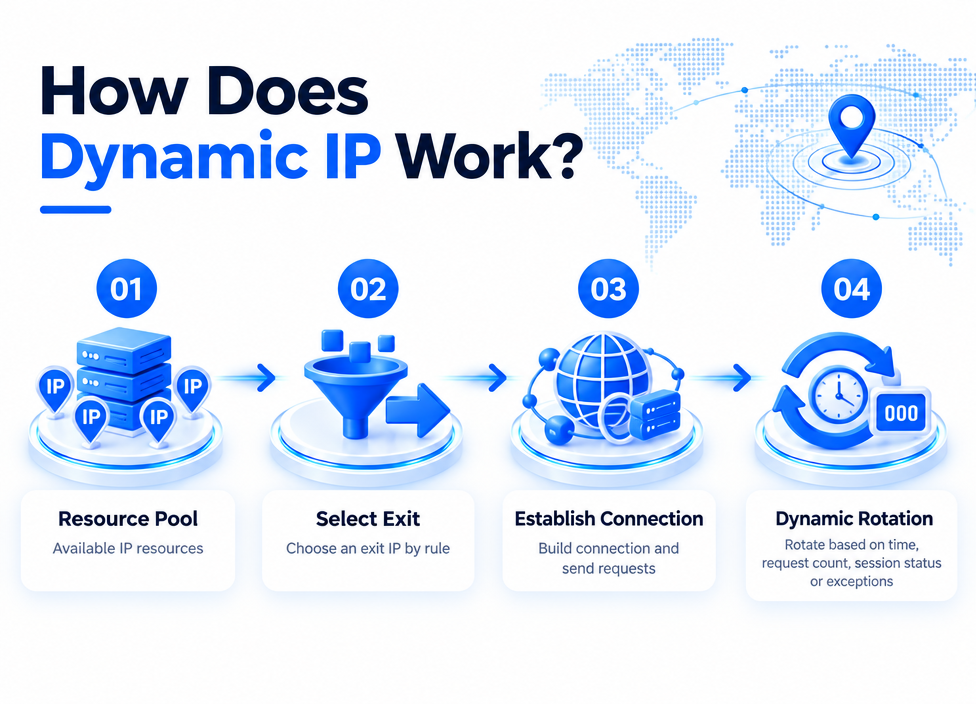
Proxy IPs work in four steps: client issues a request → proxy server receives and forwards → target server responds → proxy server relays the response back to the client. Connection establishment, authentication, protocol parsing, and data forwarding all sit in between.
HTTP proxy workflow
- Client establishes a TCP connection to the proxy server
- Client sends the HTTP request (with a Proxy-Authorization header if authentication is required)
- Proxy server parses the request, extracting the target URL and headers
- Proxy server establishes a new connection to the target server and forwards the request
- Target server responds; proxy server receives the response
- Proxy server forwards the response back to the client
For HTTPS targets, the proxy server can't parse encrypted content, so it uses the CONNECT method to establish a "tunnel": the proxy only does TCP-layer pass-through, and the TLS handshake happens directly between the client and the target server. This way the proxy server can't see plaintext traffic, and the security boundary is clearer.
How SOCKS5 proxies differ
SOCKS5 works at the session layer, doing no protocol parsing — just packet forwarding. This means SOCKS5 can proxy TCP, UDP, and various protocols, not just HTTP. The trade-off is that no HTTP-semantic-based extra processing (caching, request header rewriting) can happen at the proxy layer.
How Are Proxy IPs Classified by Pool Type?
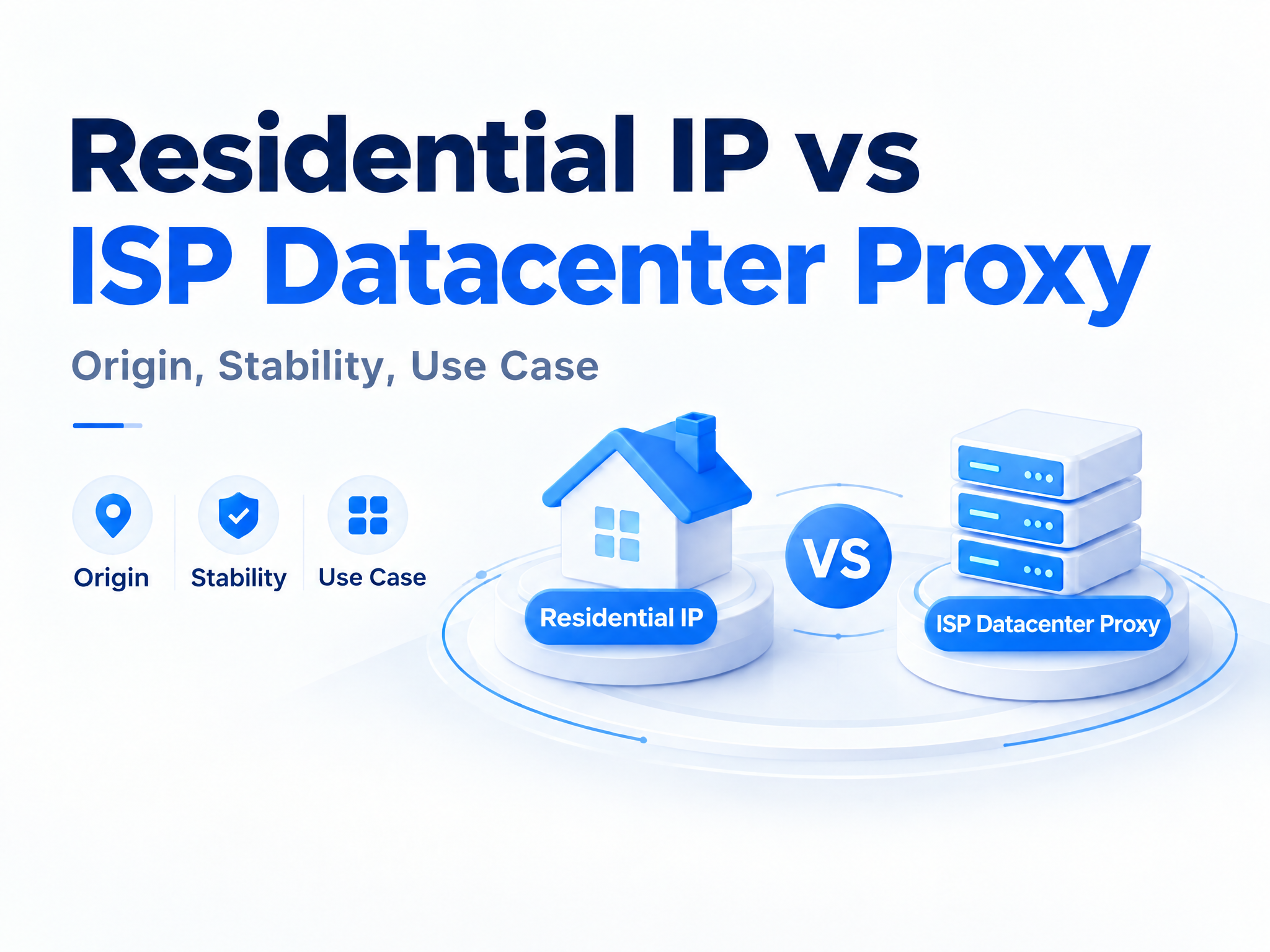
Proxy IPs classified by pool type mainly fall into three categories: datacenter IP, residential IP, mobile IP. The core difference lies in IP source and "how much it looks like a real user" — which directly drives cost and scenario fit.
| Pool Type | IP Source | Cost | Typical Scenarios |
|---|---|---|---|
| Datacenter IP | IP ranges allocated by IDC data centers | Low | Public data collection, bulk tasks |
| Residential IP | Real household broadband users' IPs | Medium-high | E-commerce price comparison, social scraping, ad monitoring |
| Mobile IP | IPs allocated by 4G/5G mobile networks | High | Mobile app data collection, high-security scenarios |
Datacenter IPs are plentiful, cheap, and fast, but their IP ranges have distinctive signatures — many sites can identify "this IP is a datacenter IP" and rate-limit it directly in sensitive scenarios. Fits public data collection, internal data scraping, and dev/debug work.
Residential IPs come from real household broadband, mixed in with real user requests, making detection difficult. Fits scenarios that need to "look like a real user" — e-commerce price monitoring, social platform data collection, ad display monitoring. Downside: billed by traffic or by IP, and cost adds up at volume.
Mobile IPs come from mobile carriers' 4G/5G networks, where a single cell tower may have thousands of users sharing an egress IP, making detection hardest. Fits mobile app data collection and scenarios with the highest requirements for access-environment isolation.
How Many Types of Proxy IPs Are There by Session Stickiness?
Proxy IPs classified by session stickiness fall into three types: rotating proxies, long-lived proxies, tunnel proxies. The core difference is "how long the same egress IP persists."
| Type | Lifetime | Usage Method | Fit Scenarios |
|---|---|---|---|
| Rotating proxy | 1–30 minutes | Periodically pull a batch of IPs from API | High-frequency polling scraping, regional sampling |
| Long-lived proxy | Hours to days | Reuse one IP for a long time | Maintaining login state, multi-step interaction tasks |
| Tunnel proxy | Auto-switch per request | Client only configures one entry address | High-concurrency scraping, no IP-pool ops burden |
Rotating proxies — the advantage is "every request may use a different IP," so per-IP access frequency drops naturally, fitting anti-frequency-control needs. The downside is that it's not suitable for session-holding tasks — right after login, the IP switches and the session dies.
Long-lived proxies work the other way: one IP persists for hours or even days, fitting logged-in queries, multi-step form submissions, and cross-order-page operations. Downside: high per-IP access frequency, easy to get restricted.
Tunnel proxies are the "single entry address replaces the entire IP pool" access model — the client only needs to configure one fixed proxy address, and IP switching is handled automatically by the proxy server on each request. Saves the client the engineering work of managing an IP pool, and fits projects with high daily request volumes.
What Are the Main Proxy IP Authentication Methods?
Proxy IP authentication mainly comes in three forms: credential auth, whitelist auth, API extraction. Each fits different deployment environments — picking the wrong one creates operational burden.
- Credential auth: every request carries username/password via the Proxy-Authorization header. Advantage: the client's egress IP can change dynamically (dev machines, laptops) without pre-registration. Downside: credentials have to live in code or config files, and leakage risk needs to be controlled.
- Whitelist auth: register the client's egress IP with the proxy service in advance; only registered IPs can use the proxy. Advantage: no auth info needs to be carried in requests, simple config. Downside: the client's egress IP must be fixed, unsuitable for dynamic deployment environments.
- API extraction: call an API first to get a batch of usable IPs, then use those IPs to issue proxy requests (may be auth-free or credential-based). Advantage: enables fine-grained IP-pool management on the client side, and paired with whitelist gives near-zero auth overhead.
Enterprise-grade scraping projects commonly deploy a "credential + whitelist, pick one" model — servers with fixed IPs use whitelist, client machines or serverless deployments use credentials. API extraction is more often used when building an in-house IP pool service.
What Are the Core Business Scenarios for Proxy IPs?
Core business scenarios for proxy IPs fall into three broad categories: data collection, access distribution, cross-border access. Each has different pool type, stickiness, and geography requirements.
Data collection is the most mainstream scenario, covering public-opinion monitoring, ad monitoring, e-commerce price monitoring, recruitment information collection, and more. The core need is "multi-IP distribution + stable collection"; typical selection is rotating proxies paired with residential or datacenter IPs.
Access distribution is the scenario for running multiple tasks in parallel — multi-account operations, batch registration, batch testing. The core need is "each task uses an independent IP, with access environments isolated between tasks"; typical selection is long-lived proxies or task-grouped IP pools.
Cross-border access is when a domestic team accesses overseas sites, or vice versa — cross-border product sourcing, cross-border logistics tracking, overseas ad monitoring. The core need is "IP landing in the target region"; typical selection is region-tagged residential or datacenter IPs.
The three scenarios often appear mixed in real projects — cross-border sourcing needs both "overseas regional IPs" and "multi-IP distribution scraping." Just combine the two dimensions at selection time.
What Are the Key Considerations for Proxy IP Selection?
Key considerations for proxy IP selection rank into six by importance: pool type fit, regional coverage, stickiness policy, protocol support, authentication method, availability and stability. The first four determine "can it work"; the last two determine "how comfortable it is to use."
| Dimension | Key Question | Impact |
|---|---|---|
| Pool type fit | Does the scenario need datacenter, residential, or mobile IP? | Cost and detection difficulty |
| Regional coverage | Which countries or cities are the target sites in? | Whether scraping can reach target data |
| Stickiness policy | Need session stickiness or per-request IP rotation? | Whether business can execute normally |
| Protocol support | Are HTTP, HTTPS, SOCKS5 all supported? | Whether the client can integrate directly |
| Authentication method | Is the deployment environment fixed IP or dynamic IP? | Integration complexity |
| Availability and stability | Failure rate and throughput ceiling per collection task? | Project lifespan and ops cost |
Looking only at total volume or price is a common selection mistake. No matter how large the total, if the target region isn't covered it's useless; no matter how low the unit price, if the failure rate doubles retry counts, total cost is actually higher. When evaluating, run real business at small scale for a week and let the data decide.
FAQ
Q: What's the difference between a proxy IP and a VPN?
Proxy IPs work at the application layer, typically proxying only specific protocol traffic (HTTP, HTTPS, SOCKS5), configured within an app or browser. VPNs work at the network layer, wrapping all of a device's traffic into an encrypted tunnel, configured at the OS layer. Data collection is fine with proxy IPs; only reach for VPNs when you want "whole-machine traffic encryption."
Q: Can free proxy IPs be used?
Free proxy IPs have three obvious problems: extremely low availability (usually 10–30%, so you're constantly switching during collection), slow speeds, and high security risk (some free proxies log transmitted content). Fine for a taste in a learning context, but not recommended for any formal project.
Q: The price gap between datacenter IP and residential IP is huge — is the scenario difference really that big?
The difference is mainly in two areas: first, detection difficulty — datacenter IP ranges have distinctive signatures, and many sites rate-limit directly by IP range; residential IPs are mixed in with real user traffic, making detection much harder. Second, access results — for the same request, datacenter IP may get a downgraded response, while residential IP fetches complete data. Price-sensitive public data collection can use datacenter IP; scenarios involving "looks like a real user" require residential IP.
Q: How do you interpret proxy IP availability numbers?
The availability rate vendors provide is generally at the "can the IP establish a connection" layer, and doesn't represent "using it to scrape a specific site succeeds." Same IP working on Site A while being restricted on Site B is normal. In real projects, run real business for a period against your scenario to measure actual success rate — vendor availability is only a reference.
Q: Are rotating and long-lived proxies used together?
Yes. Typical hybrid usage: the main link uses rotating proxies for high-frequency scraping (new IP per request, keeping per-IP frequency low), and when session-holding operations come up (login, multi-step forms), temporarily switch to a long-lived proxy. Hybrid usage requires client-side routing — dispatch to different proxy entries by URL or task type.