What Is an IP Pool? Why Enterprise Scraping Can't Focus on IP Count Alone
TL;DR: An IP pool is a schedulable set of IP addresses maintained by a proxy provider. When enterprises evaluate providers for data scraping, the structural quality of the pool — survival period, deduplication rate, scheduling mechanism, and task isolation — matters more for success rate and cost efficiency than the raw IP count.
What Exactly Is an IP Pool?
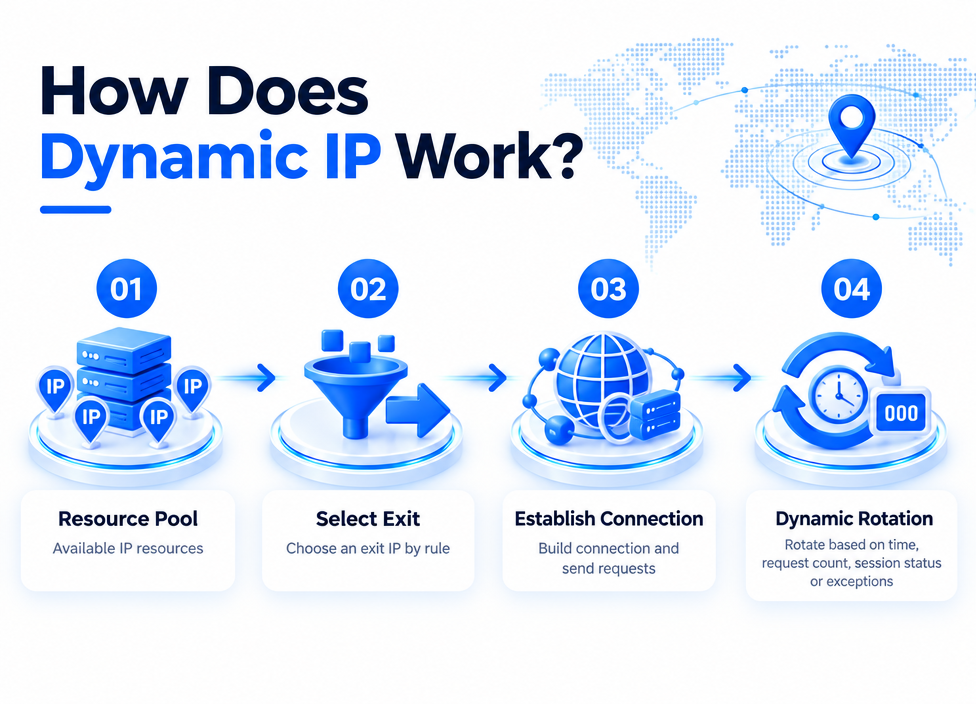
An IP pool is a collection of usable IP addresses maintained and scheduled by a proxy IP provider — essentially a "resource reservoir." When a scraping client sends a request, the provider assigns an IP from the pool according to a policy; after use, the IP is recycled, checked, and redeployed in a continuous loop.
You can break an IP pool down into three layers:
| Layer | Function | Key Metrics |
|---|---|---|
| Resource layer | Source and inventory of IP addresses | Total count, geographic coverage, carrier distribution |
| Scheduling layer | Decides which IP is assigned to which request and when | Rotation strategy, deduplication mechanism, load balancing |
| Quality-control layer | Continuously monitors IP availability and removes dead nodes | Survival period, availability rate, response latency |
Most technical decision-makers only look at the resource layer's "total count" number and overlook the scheduling and quality-control layers. But what actually determines the success or failure of a scraping job lives in those latter two.
Why "More IPs" Doesn't Mean "Better Scraping Results"
A large IP count doesn't translate directly into a higher scraping success rate, because the count metric hides several critical issues.
1. The deduplication trap
Some providers advertise "10-million-IP pools" that include large amounts of historical IPs and duplicates. A pool labeled 10 million may have only 600K–800K unique IPs available per day after deduplication, giving it no real density advantage over a pool labeled at 2 million with strong deduplication. Industry experience shows that pools with a deduplication rate below 85% see a significantly higher probability of duplicate-request throttling in high-frequency scenarios like sentiment monitoring.
2. Survival period mismatch
Survival period is how long a single IP stays valid from allocation to expiration. Different scraping scenarios have vastly different needs:
| Scenario | Ideal Survival Period | Reason |
|---|---|---|
| Web scraper (high-frequency rotation) | 1–5 minutes | Fast rotation lowers request density per IP |
| Ad monitoring (needs sustained session) | 15–30 minutes | Multi-step operations must complete in one session |
| Sentiment monitoring (scheduled sweeps) | 5–15 minutes | Each sweep covers a fixed target list |
If a pool's average survival period is only 1–2 minutes but the business needs a 15-minute sustained session, no amount of total IPs will solve mid-session disconnects.
3. "Puffed up" geographic distribution
A pool advertised as "covering 200+ cities" doesn't help if 70% of its IPs are concentrated in a handful of provinces. For an ad-monitoring task that needs even nationwide distribution, that concentration turns a large chunk of the pool into dead inventory. The evenness of geographic distribution directly affects the regional representativeness of scraped data.
Which Dimensions Should You Actually Evaluate?
Setting the total count aside, enterprise-grade scraping evaluations should focus on the six structural dimensions below. Together they determine how a pool performs in real business scenarios.
| Dimension | Definition | Why It Matters |
|---|---|---|
| Daily unique usable IPs | Actual number of distinct IPs assignable per day | Reflects real resource density; more informative than total count |
| IP survival period | Effective lifespan of a single IP from allocation to expiration | Determines whether the pool can match session-duration needs |
| Scheduling strategy | Rotation, targeting, session persistence, and other allocation modes | Determines IP usage efficiency and throttling risk |
| Task isolation | Whether IP resources are isolated between different scraping tasks | Prevents a high-frequency task from "polluting" another task's IPs |
| Geographic granularity | City-level, province-level, or only regional | Determines the regional precision of scraped data |
| Protocol support | Coverage of HTTP/HTTPS/SOCKS5 | Determines integration flexibility and scenario fit |
Among these, task isolation is the dimension most often overlooked but with the greatest impact. When multiple scraping tasks share one pool without isolation, an IP throttled by a high-frequency task will drag down the others, creating "contamination spillover." Industry surveys show that pools without task isolation see overall success rates drop 15%–25% under multi-task concurrency.
When Does IP Pool Quality Make the Biggest Difference?
Not every scenario is sensitive to pool quality. For one-off, low-frequency, fault-tolerant scraping jobs, providers are more or less interchangeable. But the following three scenarios put pool structure directly on the critical path to business outcomes.
Scenario 1: Sentiment monitoring
Sentiment monitoring typically requires a full sweep across hundreds of target sources every 15–30 minutes, with a large per-sweep IP demand and tight time sensitivity. If deduplication is weak, the odds of the same IP being reassigned to the same target source in a short window go up, and rate-control triggers along with it. This scenario places the highest bar on both "daily unique usable IPs" and "scheduling strategy."
Scenario 2: Web scraper
Large-scale web scraping can push concurrency to tens or hundreds of requests per second. That imposes a hard requirement on the pool's concurrency capacity and rotation speed. A big pool with slow scheduling means queuing; a smaller pool with fast scheduling and high deduplication actually delivers better efficiency.
Scenario 3: Ad monitoring
Ad monitoring needs to simulate real user browsing, often involving multi-step operations — page load, ad-slot capture, landing page redirect. This requires an IP to hold a session across the full operation chain, typically 15+ minutes. If the pool only offers short-lived rotation with no session persistence, monitoring task completion rates drop noticeably.
How Should Enterprises Approach IP Pool Selection?
Shifting selection from "compare counts" to "compare structure" follows this decision framework:
Step 1: Nail down the session-duration requirement
Determine whether the scraping task is "high-frequency short-session" or "low-frequency long-session." High-frequency short-session prioritizes rotation speed and deduplication; low-frequency long-session prioritizes survival period and session-persistence mechanisms.
Step 2: Check task isolation capability
If your team runs multiple scraping projects in parallel, confirm whether the provider supports task-level pool isolation. Non-isolated pools carry high risk in multi-task scenarios.
Step 3: Verify true geographic granularity
Ask the provider for city-level IP distribution data — not just the "covers X cities" marketing line. Test IP allocation across 3–5 target cities and you'll see whether distribution is actually even.
Step 4: Run small-batch comparison tests
The performance gap between providers only shows under real workload. Use the same scraping task in the same time window across candidates and compare the following metrics:
| Metric | How to Test | Reference Baseline |
|---|---|---|
| Request success rate | Same target, same window, 1,000 requests each | Enterprise pools typically ≥95% |
| IP repeat rate | Ratio of unique IPs to total allocations over 1 hour | <85% deduplication is a warning sign |
| Average response latency | Median response time per request | Domestic scenarios typically <200ms |
| Disconnect rate | Share of IPs that die mid-session in long-session tests | 15-minute sessions should see <5% disconnect |
Running these four steps shifts the decision basis from "who has more IPs" to "whose pool structure and scheduling best fit the business need."
FAQ
Q: Does the "total count" number have no value at all?
Total count isn't worthless, but it's a threshold indicator. Below a certain size, a pool really does run short during peak hours. Once above that threshold, marginal returns on added IPs decline, and structural indicators like scheduling and deduplication carry more weight.
Q: How do you judge whether a pool's deduplication rate is acceptable?
The most direct method: during the test period, export an hour of IP allocation logs and calculate the ratio of unique IPs to total allocations. 85% or higher is the baseline for enterprise scenarios. Below that, the scheduling mechanism likely has a duplicate-allocation problem.
Q: Is task isolation the same as "dedicated IPs"?
No. Dedicated IPs mean an IP is assigned to only one customer — the emphasis is customer-level isolation. Task isolation means the same customer's different scraping tasks each get their own physical or logical sub-pool to prevent cross-task interference. They solve different problems, and task isolation matters more in enterprise settings running multiple projects in parallel.
Q: Should you choose short-lived or long-lived IPs?
It depends on session-duration needs. Tasks that need high-frequency rotation and a new IP per request suit short-lived IPs — a typical example is the web scraper scenario. Tasks that need sustained sessions with a single operation chain longer than 5 minutes suit long-lived IPs — typical examples are ad monitoring and some data-monitoring workloads. Some providers let you enable both modes under one account and configure per task type.
Q: What's the core difference between free proxy pools and paid pools?
Free proxy pools generally lack the quality-control layer — IP sources are uncontrolled, survival periods are extremely short and unstable, and there's no deduplication or scheduling. Field data shows free proxy success rates typically fall between 20%–40%, plus there are data-leak and man-in-the-middle attack risks. For enterprise scraping, the hidden cost of a free pool far outweighs the price of a paid service.
Q: How long should the IP pool evaluation period be?
At least one complete business cycle, typically 3–7 days. The reason: pool performance varies by time of day, and there are noticeable differences in availability and response speed between weekday peaks and weekend lulls. A few hours of data isn't a large enough sample to reflect the pool's real stability.