What Actually Differentiates the Three IP Types?
The difference isn't "good vs. bad" — it's the origin of the IP address and its network attributes.
| Type | IP Source | Network Attributes | Identity Seen by Target Sites |
|---|---|---|---|
| Datacenter IP | Assigned by data centers or cloud providers | IDC network — high bandwidth, low latency | "This is a server" |
| Residential IP | Assigned by ISPs to home broadband users | Consumer network — moderate bandwidth | "This is an ordinary home user" |
| Mobile IP | Assigned by carriers to mobile devices | 4G/5G cellular network | "This is a phone user" |
Target sites' rate-control mechanisms trust these three types very differently. Residential and mobile IPs correspond to real end-user devices, so their inherent trust level is higher. Datacenter IPs concentrate in a small number of IP ranges tied to server behavior, making them easier to flag as non-human traffic.
That trust-level differential is the underlying logic for understanding the demand trends across all three types.
Why Does Residential IP Demand Keep Rising?
Three forces are driving residential IP growth, and each is accelerating.
Driver 1: Target-site rate-control strategies keep upgrading
Over the past three years, mainstream internet platforms have significantly improved their recognition accuracy for datacenter IP ranges. Industry observations show that top e-commerce and social media platforms can already identify more than 80% of datacenter IP ranges and apply stricter access limits to them. This has directly pushed enterprise scraping tasks to migrate from datacenter IPs to residential IPs.
Cross-border product selection has been hit the hardest. Overseas e-commerce platforms are increasingly sensitive to datacenter IPs — some return CAPTCHAs or empty responses to datacenter-IP requests outright, forcing cross-border teams to shift to residential IP solutions.
Driver 2: Compliance requirements raise the bar for IP authenticity
Data compliance regulations are tightening globally. Data protection laws in some countries and regions require that access to certain data types matches normal user behavior patterns. Residential IPs, tied to real ISP-subscriber identities, are more readily accepted in compliance reviews than datacenter IPs.
Driver 3: AI training data collection is scaling up
Training data demand from large language models and AI applications keeps expanding. AI teams need to collect massive corpora from public websites, and the breadth and duration of that collection far exceed traditional scraping tasks. Residential IPs have significantly higher survival rates in long-duration, wide-coverage scraping than datacenter IPs.
Constraints on residential IP growth
Residential IP supply is naturally constrained by the size of ISP network IP pools — growth can't be unlimited. At the same time, residential IPs typically cost 3–8× more per unit than datacenter IPs. That means residential IP growth will find a balance point between demand pull and cost constraint rather than replacing datacenter IPs infinitely.
Are Datacenter IPs Actually Being Phased Out?
No. Datacenter IP demand growth is slowing, but they remain irreplaceable in specific scenarios.
| Scenario Characteristics | Datacenter IP Fit | Reason |
|---|---|---|
| High throughput, low latency requirements | High | Data center networks offer high bandwidth and low latency |
| Targets that don't scrutinize IP trust | High | API endpoints, public datasets, unrestricted sites |
| Massive concurrent requests | High | Low cost — the same budget buys more IPs |
| IP-trust-sensitive targets | Low | Easily detected and throttled |
Where datacenter IPs still win
Sentiment monitoring is a typical case. It covers a very broad range of information sources — news sites, government announcements, corporate websites — and a substantial share of these targets are indifferent to IP type or provide open data endpoints. In these scenarios, the high bandwidth and low cost of datacenter IPs make them far more cost-effective than residential IPs.
Industry data shows datacenter IPs still account for more than 50% of enterprise proxy IP usage. But that share has dropped from roughly 70% three years ago to today's level. Most of the loss went to residential IPs, with a small share flowing to mobile IPs.
How datacenter IPs are evolving
Datacenter IPs are splitting into two sub-categories:
- General-purpose datacenter IPs: for scenarios that don't scrutinize IP type; price competition is intense and margins are narrowing
- High-quality datacenter IPs: datacenter IPs marked by ISPs, achieving near-residential trust levels in some scenarios; priced between general datacenter IPs and residential IPs
Why Are Mobile IPs Moving from the Edge to Mainstream?
Mobile IPs used to be considered a "niche need." Three shifts are changing that position.
Shift 1: Mobile data is gaining weight
More and more internet platforms are differentiating their content, pricing, and recommendation strategies between mobile and desktop. In ad monitoring, the creative an advertiser sees on mobile versus desktop can be entirely different. Getting real mobile data requires mobile IPs to simulate a mobile device access environment — desktop IPs cannot substitute.
Shift 2: Mobile traffic has overtaken desktop
Mobile traffic now exceeds 60% of global internet traffic. Target-site rate-control policies are adjusting accordingly: trust in mobile IPs is rising, while scrutiny of desktop and datacenter IPs is tightening. That gives mobile IPs a higher pass-through rate than even residential IPs in certain scraping scenarios.
Shift 3: 5G adoption expands the mobile IP supply pool
During the 4G era, mobile IP supply was relatively limited, keeping costs high. 5G rollout is expanding the total mobile IP pool, and increased supply should gradually bring prices down, lowering the barrier to using mobile IPs.
Current limitations of mobile IPs
Mobile IP bandwidth and stability still lag behind datacenter and residential IPs. Cellular network latency fluctuates more, making mobile IPs unsuitable for scraping tasks with strict response-time requirements. Costs also remain the highest of the three types today, and the economics of large-scale mobile IP deployment still need validation.
How Do You Quantify the Demand Trends?
Trend judgment shouldn't rely on gut feel. Four observable metrics:
| Metric | How to Observe | Trend Signal |
|---|---|---|
| Target-site restriction ratio on datacenter IP ranges | Test the same target with datacenter and residential IPs, compare success rates | Datacenter success rate falling → the scenario needs to migrate to residential |
| Share of mobile-exclusive content | Compare data returned to desktop vs. mobile | Gap widening → the scenario needs to bring in mobile IPs |
| Trend in per-unit scraping cost | Track monthly IP cost per 10K successful requests | Residential unit price falling → migration window opening |
| Compliance policy update frequency | Track data protection law changes in target markets | Regulations tightening → residential IP compliance advantage grows |
A layered selection framework for enterprises
Don't bet everything on one IP type. Configure by scenario tier — that's the optimal strategy against shifting trends.
| Scenario Tier | Recommended IP Mix | Reference Ratio |
|---|---|---|
| Core scraping on IP-trust-sensitive targets | Residential-primary | 70–80% residential + 20–30% datacenter backup |
| Regular scraping on IP-trust-insensitive targets | Datacenter-primary | 80% datacenter + 20% residential fallback |
| Mobile data collection | Mobile-primary | 90% mobile + 10% residential control |
| Cross-border selection / ad monitoring hybrid | Residential + mobile blend | 60% residential + 30% mobile + 10% datacenter |
Where Are These Three Types Headed in the Next 2–3 Years?
Based on currently observable industry signals, here's a medium-term read:
Residential IPs: demand growth stays around 20–30% annually. Growth mainly comes from AI training data collection and continued expansion of cross-border business. On the supply side, the residential IP pools of major proxy providers have grown roughly 2–3× over the past two years. Both sides are expanding, so prices will drift down gradually rather than crash.
Datacenter IPs: total volume flat to slightly declining, but they won't disappear. Datacenter IPs have no substitute in scenarios like API endpoint scraping, public dataset downloads, and internal network testing. Industry expects market share to drift down from ~50% today to 35–40%, mostly replaced by residential IPs.
Mobile IPs: fastest-growing category but from a small base. Industry expects market share to rise from under 5% today to 10–15%. Growth drivers are ad monitoring, mobile content scraping, and social media data collection. Supply expansion from 5G adoption will be the key lever for mobile IPs going mainstream.
Uncertainties worth watching
- If mainstream platforms open more official data APIs, overall proxy IP demand growth will slow
- If data protection regulations tighten further to constrain proxy IP usage itself, the compliance boundaries of all three types will be redrawn
- Whether AI's demand for training data keeps expanding will directly affect the slope of the residential IP demand curve
FAQ
Q: Are residential IPs always better than datacenter IPs?
Not necessarily. Residential IPs beat datacenter IPs on access-environment isolation at the target site, but they typically lose on bandwidth, latency, and cost. If your scraping target is indifferent to IP type, using residential IPs is just wasted budget. The core selection criterion is "how much the target site restricts datacenter IPs," not "residential IPs are more advanced."
Q: Are datacenter IPs and IDC IPs the same thing?
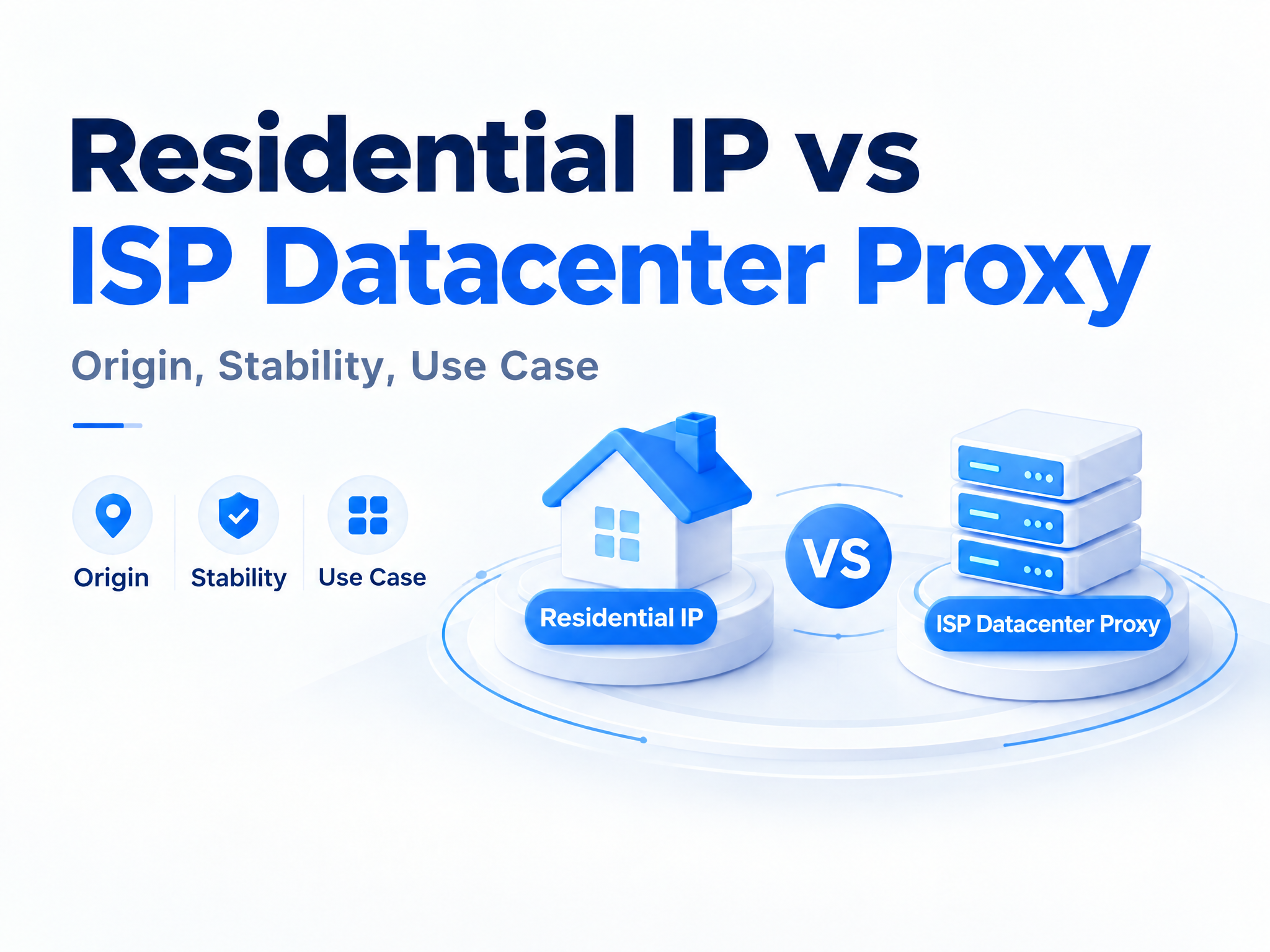
Essentially yes. Datacenter IP is the more formal technical term, referring to IPs assigned by data centers or cloud providers. Some providers further break this down into "generic datacenter IPs" and "ISP datacenter IPs" — the latter are marked by ISPs and sit between generic datacenter and residential in trust level.
Q: When will mobile IPs get as cheap as residential IPs?
Not in the short term. Mobile IP supply depends on the cellular network IP pool, which is far smaller than the ISP pool for residential IPs. 5G adoption is gradually expanding mobile IP supply, but current pricing puts mobile IPs at 2–4× the unit cost of residential IPs. Expect noticeable price drops over the next 2–3 years, but reaching residential IP price levels likely takes 5+ years.
Q: Can one scraping task mix different IP types?
Yes — and it's recommended. The mix strategy: use residential IPs for the IP-trust-sensitive core pages, and datacenter IPs for auxiliary requests that aren't scrutinized. That secures success rates on critical requests while controlling total cost. The key is doing classified routing at the proxy scheduling layer.
Q: How do you tell how much a target site restricts datacenter IPs?
The most direct method is A/B testing: hit the same target page 100 times each with datacenter and residential IPs and compare success rates and CAPTCHA-trigger rates. If the gap exceeds 20 percentage points, the target clearly restricts datacenter IPs, and residential should be prioritized for that scenario.
Q: Why does AI training data collection lean more on residential IPs?
AI training data collection has two characteristics: breadth and duration. Breadth means it covers many different sites, plenty of which scrutinize datacenter IPs. Duration means the same IP has to stay active on target sites for days or weeks — datacenter IPs have noticeably lower survival rates over such long horizons. Some sites also specifically detect AI-training-related scraping behavior, and residential IPs have higher pass-through rates in those detections.