Why Can't Residential Proxy Selection Be Based on IP Volume Alone?
When evaluating overseas residential proxies, many technical decision-makers' first instinct is to compare IP pool size and unit price. But after actual integration, they often find that two providers both claiming "tens of millions" of IPs can perform very differently on the same scraping task.
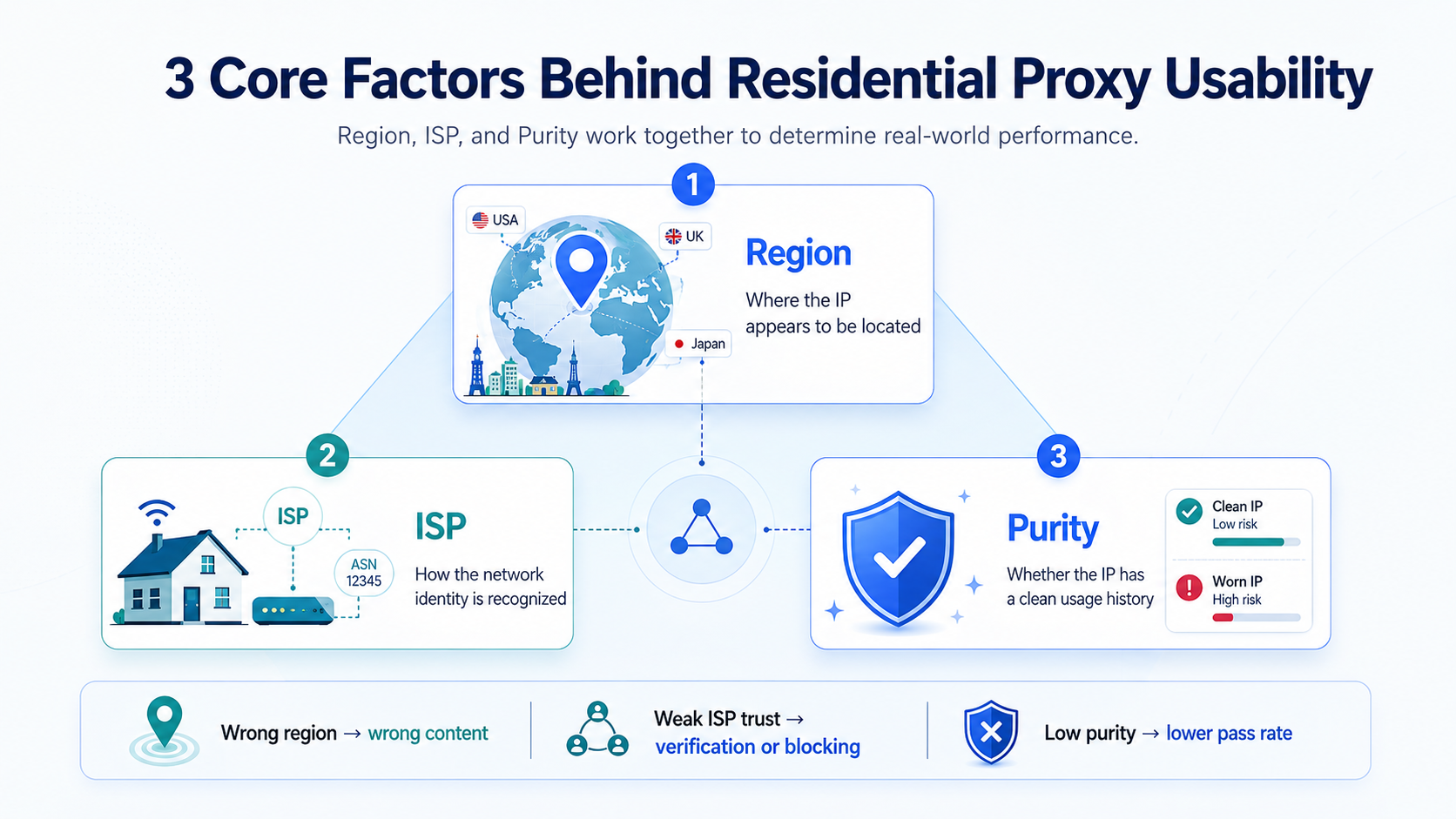
The root cause: total IP count is just a capacity metric. It doesn't reflect whether any single IP is usable in a specific business scenario. What actually determines usability is three dimensions — whether geographic positioning is accurate, whether ISP attribution is trustworthy, and whether the IP's history is clean. These three dimensions act on different stages of the business chain, and a failure in any one of them causes the task to fail.
Let's break each one down.
What Does Region Positioning Actually Determine?
Region refers to the physical location a given IP is labeled with in internet geolocation databases — typically accurate to the country level, with some services drilling down to state, province, or city.
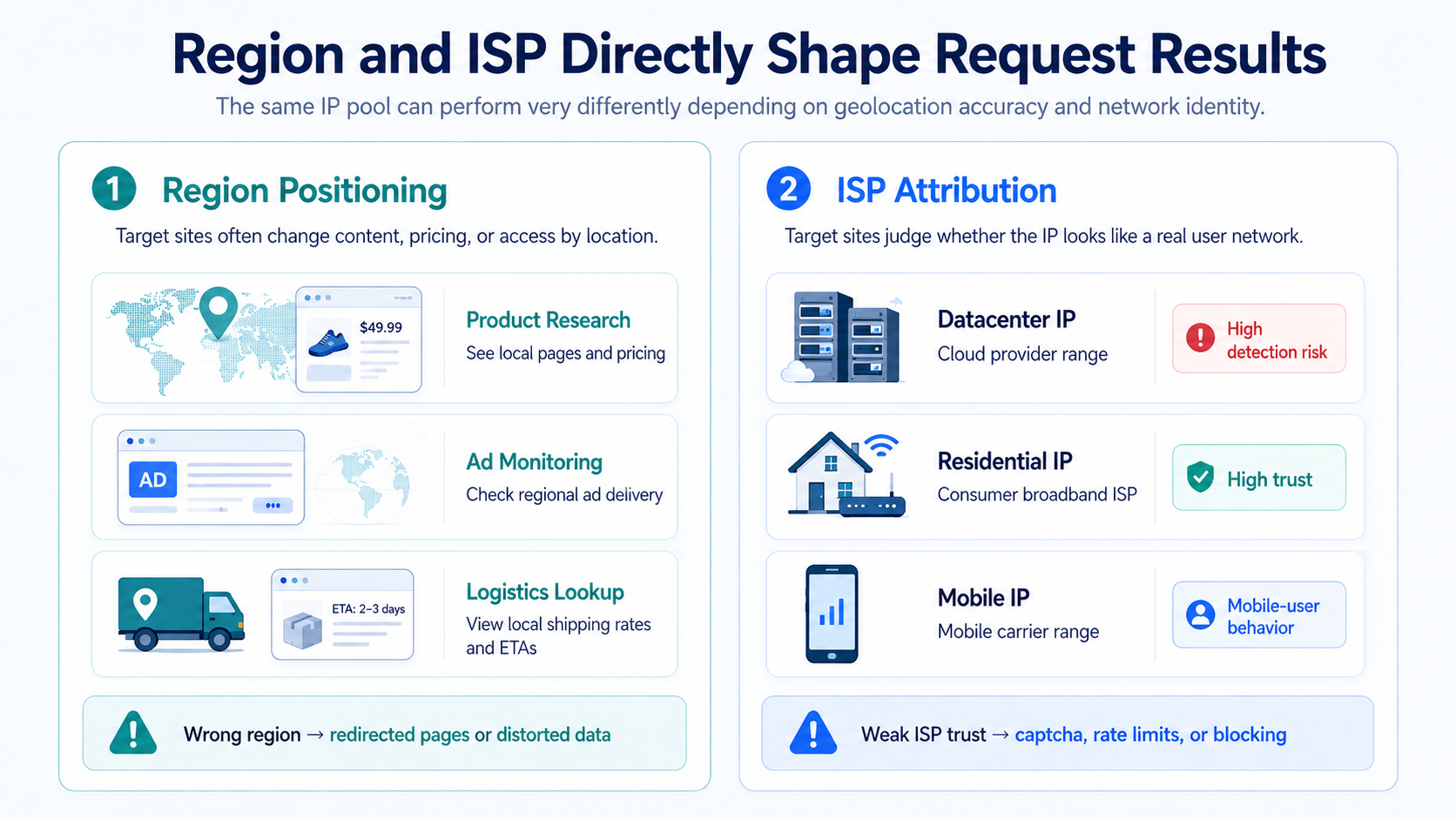
Its core role: target websites return different content, pricing, or access permissions based on the visitor IP's geographic location.
| Business Scenario | Role of Region Positioning | Consequence of Inaccurate Positioning |
|---|---|---|
| Cross-border product research | Need to see the target country's actual product pages and local pricing | Returns default-region pages; price and inventory info is distorted |
| Ad monitoring | Verify whether ad creatives are displaying correctly in a specific region | Seeing ads from other regions, or no ads at all |
| Cross-border logistics queries | Query real-time shipping rates and ETAs on the target country's logistics platforms | Redirected to non-target-region logistics pages |
The key questions aren't "how many countries are covered" but these three:
- Are the specific countries or regions your business targets within the available range?
- How accurate is the region positioning? Are there cases where the IP's actual location doesn't match its labeled location?
- Can you specify down to the city level, or only roughly to the country level?
An IP labeled as US but actually exiting in Canada is effectively a wasted request for cross-border product research. Region positioning precision directly impacts the effective rate of data collection.
Why Does ISP Attribution Matter?
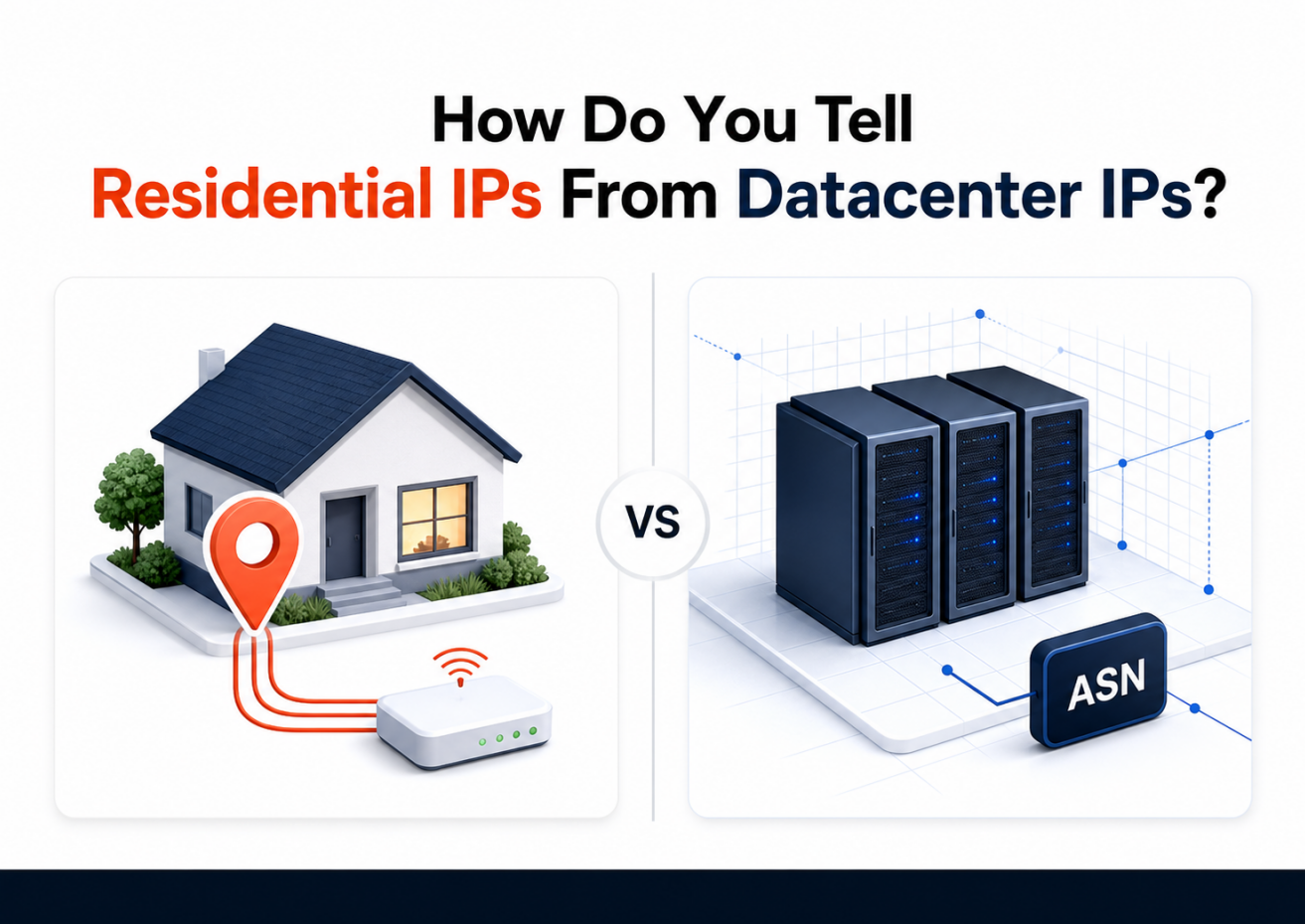
ISP refers to the internet service provider registered as the owner of an IP in WHOIS and ASN databases.
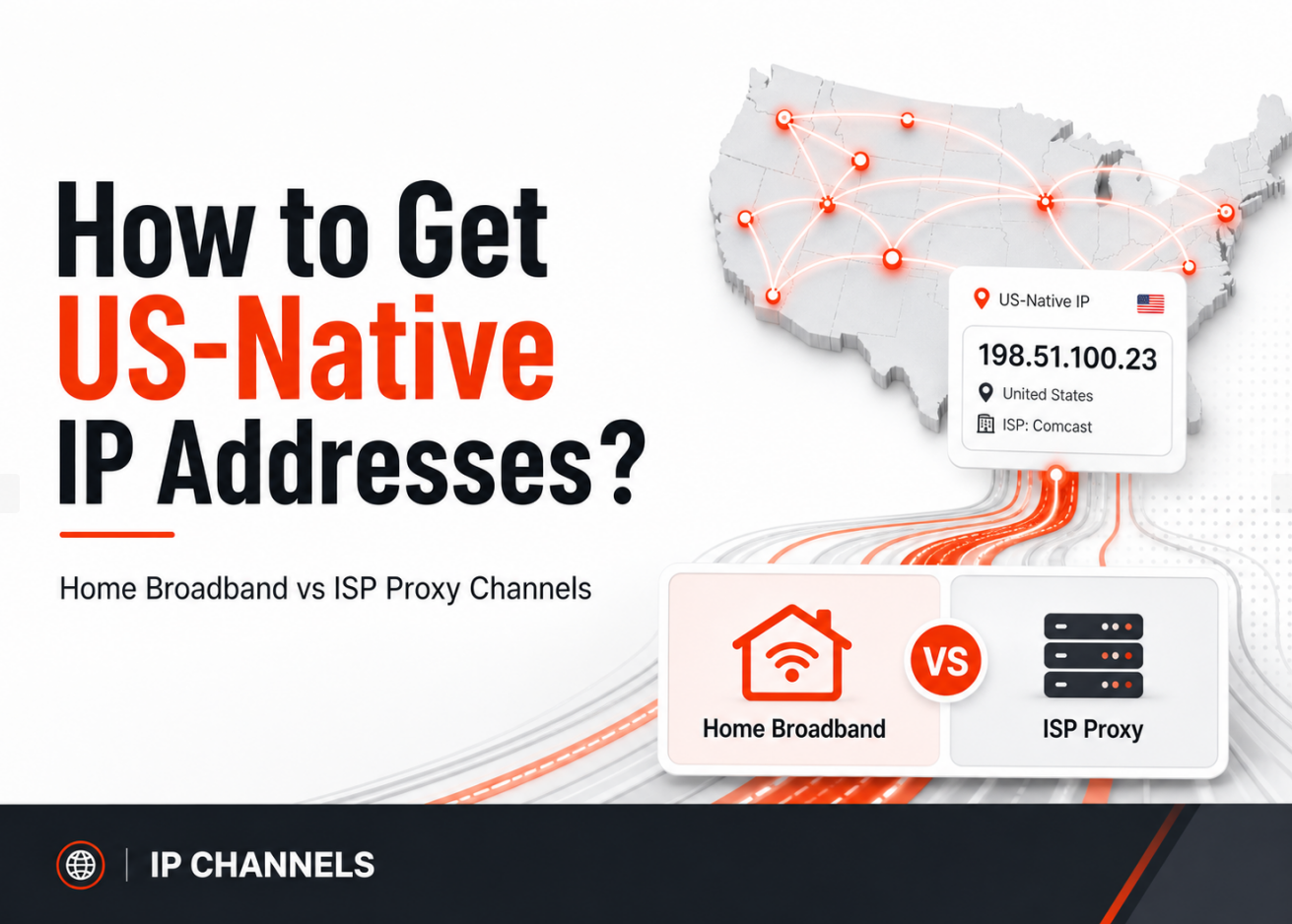
The reason residential proxies are called "residential" is precisely because the IPs are registered to real consumer broadband ISPs. For example, Comcast and AT&T in the US, BT and Virgin Media in the UK, or local telecom operators across Southeast Asia.
ISP attribution affects how target websites assess the visitor's identity. When a target site does environment fingerprinting on a visitor, it queries the IP's ASN number and ISP name. The result of this query directly determines which risk tier the request falls into.
| IP Type | ISP Attribution Characteristic | Typical Target Site Judgment |
|---|---|---|
| Datacenter IP | Registered to AWS, GCP, Alibaba Cloud, and other cloud providers | High probability of being flagged as automated access; triggers verification or restriction |
| Residential IP | Registered to consumer broadband ISPs | Treated as a regular user visit; high pass rate |
| Mobile IP | Registered to mobile carriers | Treated as a mobile user; some scenarios see even higher pass rates |
Two common pitfalls:
First, some low-cost residential proxies have IPs that are nominally "residential" but whose actual ASN registration has already been flagged by target sites as proxy provider ranges. The pass rate on these IPs isn't much better than datacenter IPs.
Second, different ISPs' IPs perform differently on different target sites. Some e-commerce platforms are more lenient toward requests from specific ISP ranges and stricter toward others. If scraping tasks concentrate on a few specific target sites, the ability to specify an ISP exit becomes critical.
What Does Purity Actually Measure?
Purity is a composite metric measuring the historical usage state of an IP before it's allocated to the current user. The core question is just one: has this IP been "worn out"?
A "dirty" IP usually means one or more of the following:
- Another user previously sent high-frequency requests to the same target site from this IP, putting it on the site's risk control list
- The IP was allocated to multiple customers' different tasks in a short period, producing anomalous usage patterns
- The IP's network range has been flagged in its entirety as high-risk by the target site
Purity isn't a parameter that can be directly quantified into a single number. It's reflected more in the provider's resource management practices.
| Mechanism Dimension | High-Purity Provider Practice | Low-Purity Typical Behavior |
|---|---|---|
| IP deduplication and rotation | Periodic deduplication; same IP not reallocated to different tasks within a short window | Same IP rapidly rotated among multiple customers; target sites repeatedly see the same exit |
| Business isolation | IP pools for different customers and different scraping tasks are physically isolated, with no cross-contamination | All customers share one pool; an IP "burned out" by Customer A's high-frequency requests gets allocated to Customer B |
| Blacklist cleaning | Continuously monitor IP reputation status on mainstream target sites and promptly remove flagged IPs | No proactive cleaning; restricted IPs continue circulating in the pool |
In scenarios like credit checks, bidding data, and legal big data, IP purity has an outsized impact on task sustainability. Target sites in these scenarios typically apply stricter rate limiting — once an IP enters the risk control list, subsequent requests from that IP range may all be rejected. Here, evaluating a provider's purity is more meaningful than comparing whose IP pool is bigger.
How Do the Three Dimensions Relate to Each Other?
Region, ISP, and purity aren't three independent parameters. They're three layered filters that determine whether an IP goes from "usable at all" to "actually good to use."
Layer 1: Region positioning
→ Can this IP reach the target region?
→ No → Request gets redirected or returns wrong content; task fails immediately

Layer 2: ISP attribution
→ Once it reaches the target region, does the target site trust this IP's network identity?
→ No → Triggers captcha, rate limiting, or outright rejection

Layer 3: Purity
→ Identity is trusted, but has this IP been "burned out" by previous users?
→ Yes → Short-term pass rate on the target site drops sharply
A problem at any one layer drags down the overall effective rate of the scraping task. But the troubleshooting direction is completely different for each: region issues mean checking routing and geolocation database labels; ISP issues mean checking ASN attribution and target site range-level policies; purity issues mean checking the IP allocation mechanism and usage isolation strategy.
How to Use These Three Dimensions in Actual Selection?
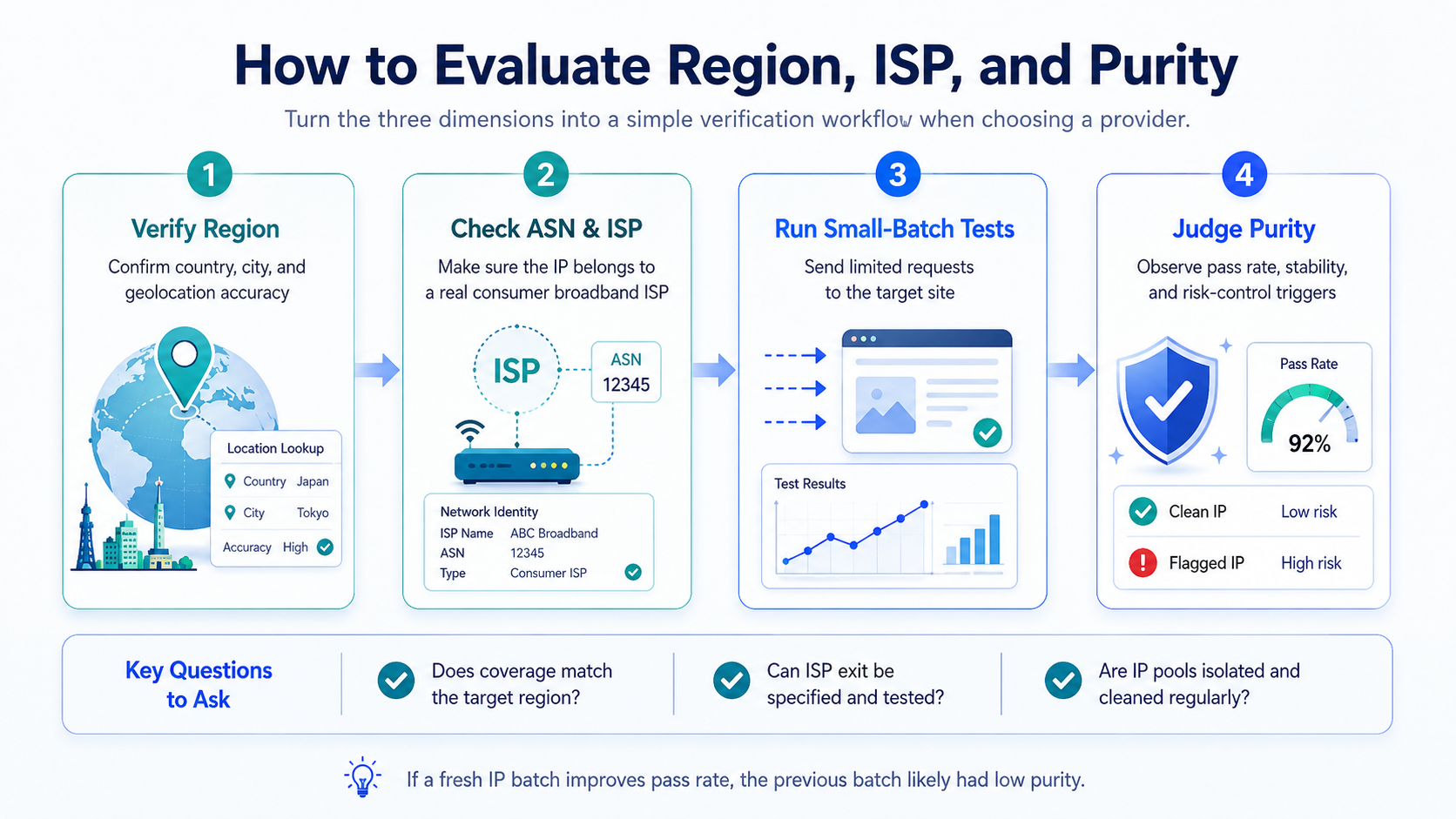
Translate the three dimensions into concrete evaluation actions during selection:
| Evaluation Dimension | Questions to Ask | Judgment Criteria |
|---|---|---|
| Region | Which countries or regions does the target business involve? Can you specify down to city level? | Coverage matches business needs; positioning accuracy is verifiable |
| ISP | Is the IP's ASN attribution a real consumer broadband ISP? Can ISP exit be specified? | Pass rate of the target site against that ISP's range is testable |
| Purity | Does the provider have an IP deduplication mechanism? Are different customers' IP pools isolated? | Clear resource isolation and blacklist cleaning policies |
A practical verification method: after receiving test IPs, first use a third-party IP info lookup tool to confirm whether the region label and ASN attribution match what the provider claims. Then run small batches of requests to test the target site's pass rate. If the pass rate is noticeably below expectations, it's likely a purity issue — swap in a different batch of IPs and retest. If the pass rate recovers, the previous batch had been flagged by the target site.
FAQ
Q: Is inaccurate region positioning common?
Inaccurate region positioning isn't rare in the industry. IP geographic labels depend on third-party databases like MaxMind and IP2Location, which themselves have update lag. After IPs are transferred between ISPs, geographic labels can take weeks or even months to update. We recommend verifying with third-party tools before going live.
Q: What's the difference between residential IPs and ISP proxy IPs?
Residential IPs are registered to consumer broadband ISPs, with their source being actual home network exits. ISP proxy IPs are also registered to ISPs but are physically hosted in datacenter facilities, combining the trust of ISP attribution with the stability of datacenter infrastructure. ISP proxies suit scenarios needing to maintain the same exit IP for extended periods.
Q: Is there a quantified industry standard for purity?
There's no unified industry standard for quantifying IP purity. Each provider defines "clean" differently. For actual evaluation, we recommend focusing on three verifiable mechanism indicators — the provider's IP deduplication cycle, business isolation mechanism, and blacklist cleaning frequency — rather than relying on percentage numbers in marketing materials.
Q: Which of the three dimensions has the biggest impact on scraping success rate?
It depends on the scenario. If the target site has strict region-based content delivery, region positioning is the top priority. If the target site primarily uses ASN identification to distinguish real users from automated access, ISP attribution is most critical. If the target site has highly sensitive rate limiting, purity has the largest impact. Identify the target site's risk-control characteristics first, then determine the priority.
Q: Can these three dimensions be verified during a free trial?
Partially. Region positioning and ISP attribution can be directly verified using third-party IP lookup tools. Verifying purity requires more sample volume — send small batches of requests to the target site with the test IPs and observe the pass rate and the speed at which limits get triggered. If the trial period is too short or the IP sample is too small, the purity assessment may not be reliable.
Q: Is ISP-level targeting available with all residential proxies?
No. ISP-level targeting is an advanced feature, and not all residential proxy services offer it. Some services only support country-level positioning and don't allow filtering by ISP. If your business has specific ISP attribution requirements, confirm during selection whether this feature is available and whether it carries an additional charge.