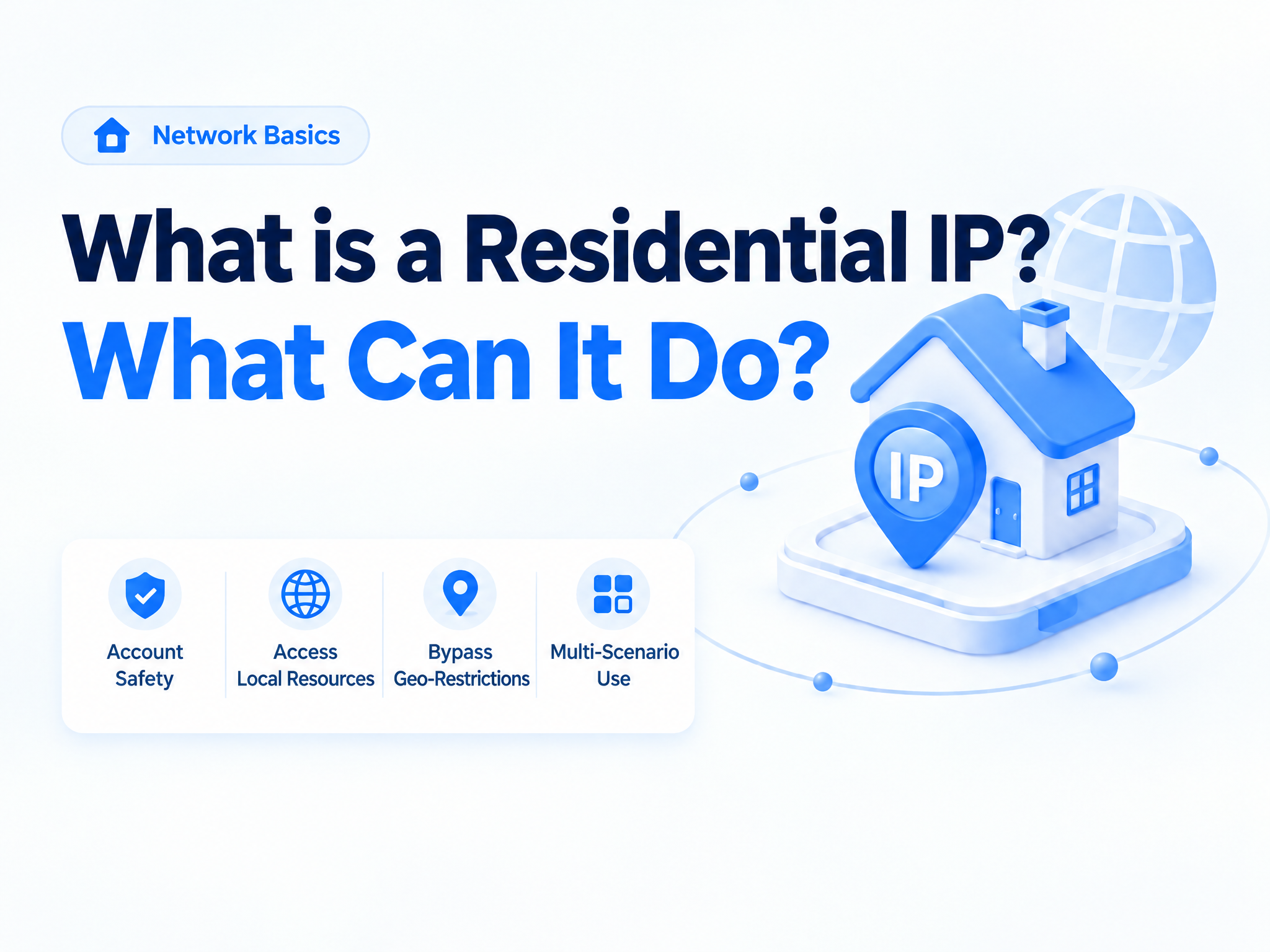
What Exactly Are Static Residential Proxies?
A static residential proxy is a proxy service whose IP belongs to an ISP residential range and remains fixed long-term. In overseas markets, this product is also commonly called an ISP proxy.
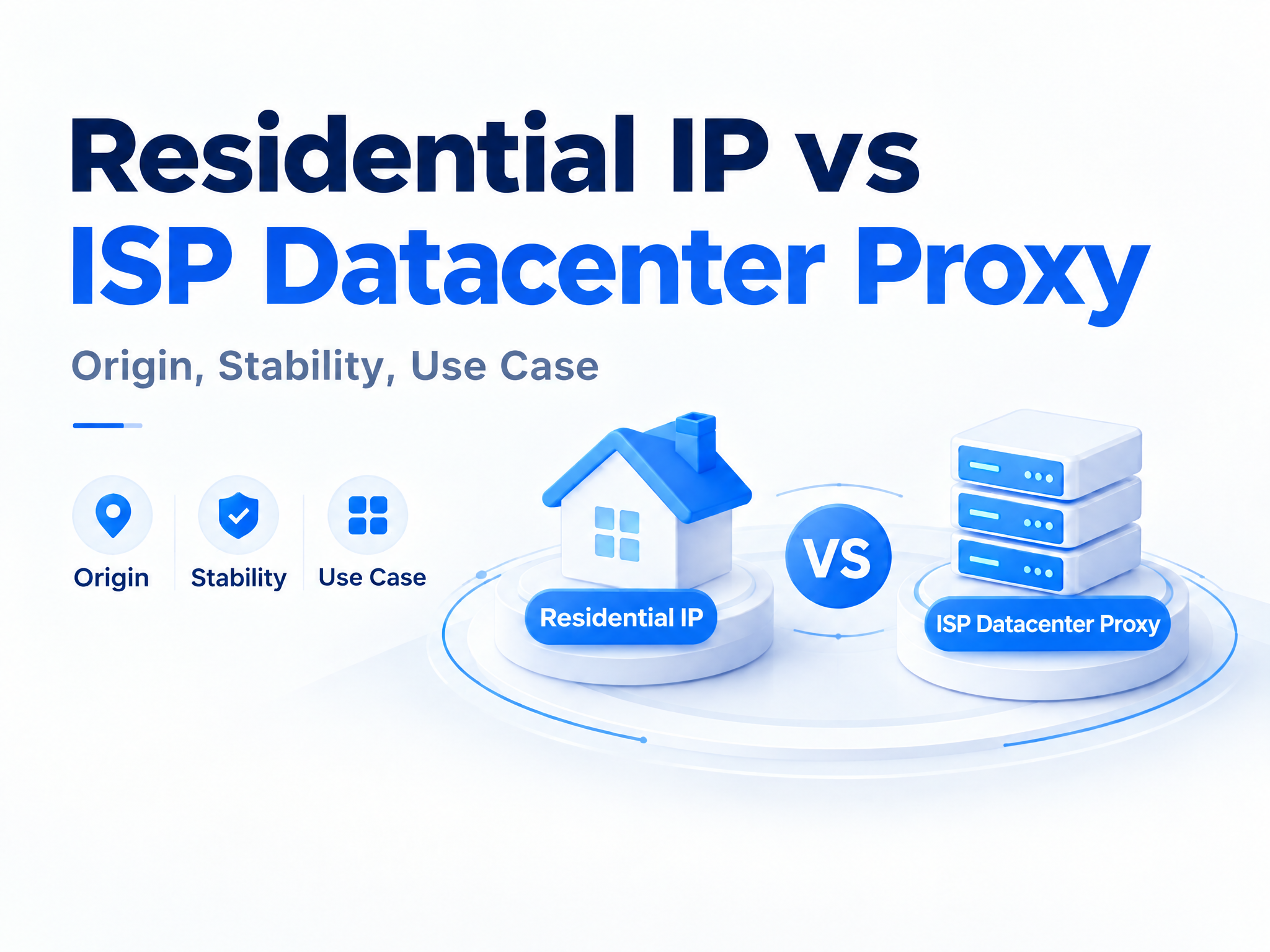
To understand it, you first need to draw the line between two common proxy types.
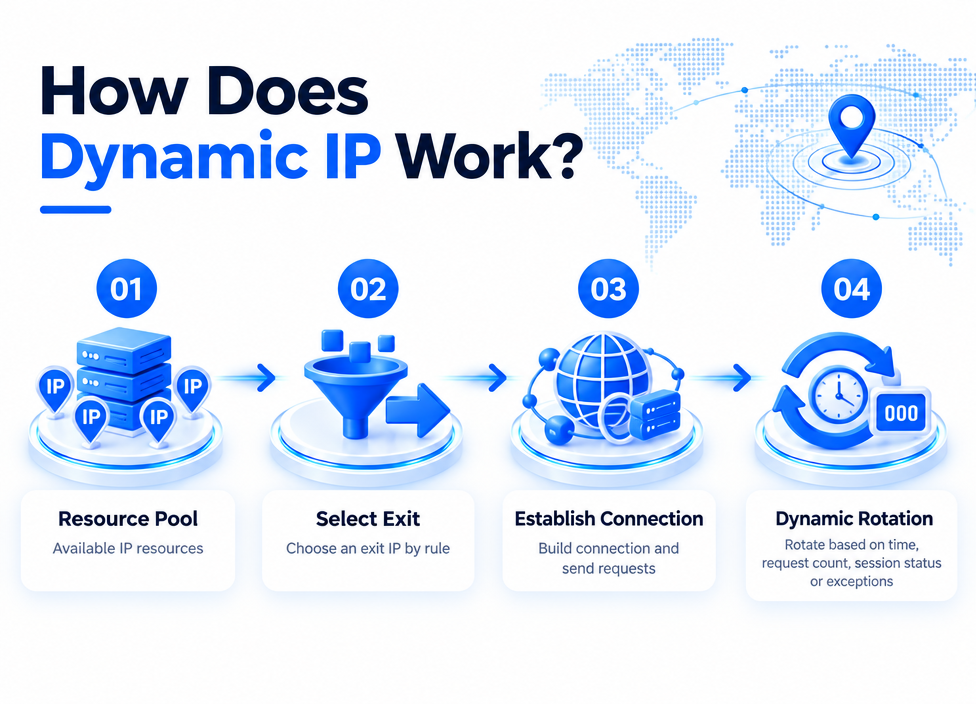
Dynamic (rotating) residential proxies use IPs sourced from real home broadband connections, automatically rotating per request or after a short interval. The request environment closely matches a regular home user, but because the IP isn't fixed, they can't support business that needs long session persistence.
Datacenter proxies use IPs from server facilities — long-term fixed, fast, with ample bandwidth. But the IP range characteristics are distinctive, and target sites' rate-limiting systems easily identify them as datacenter traffic.
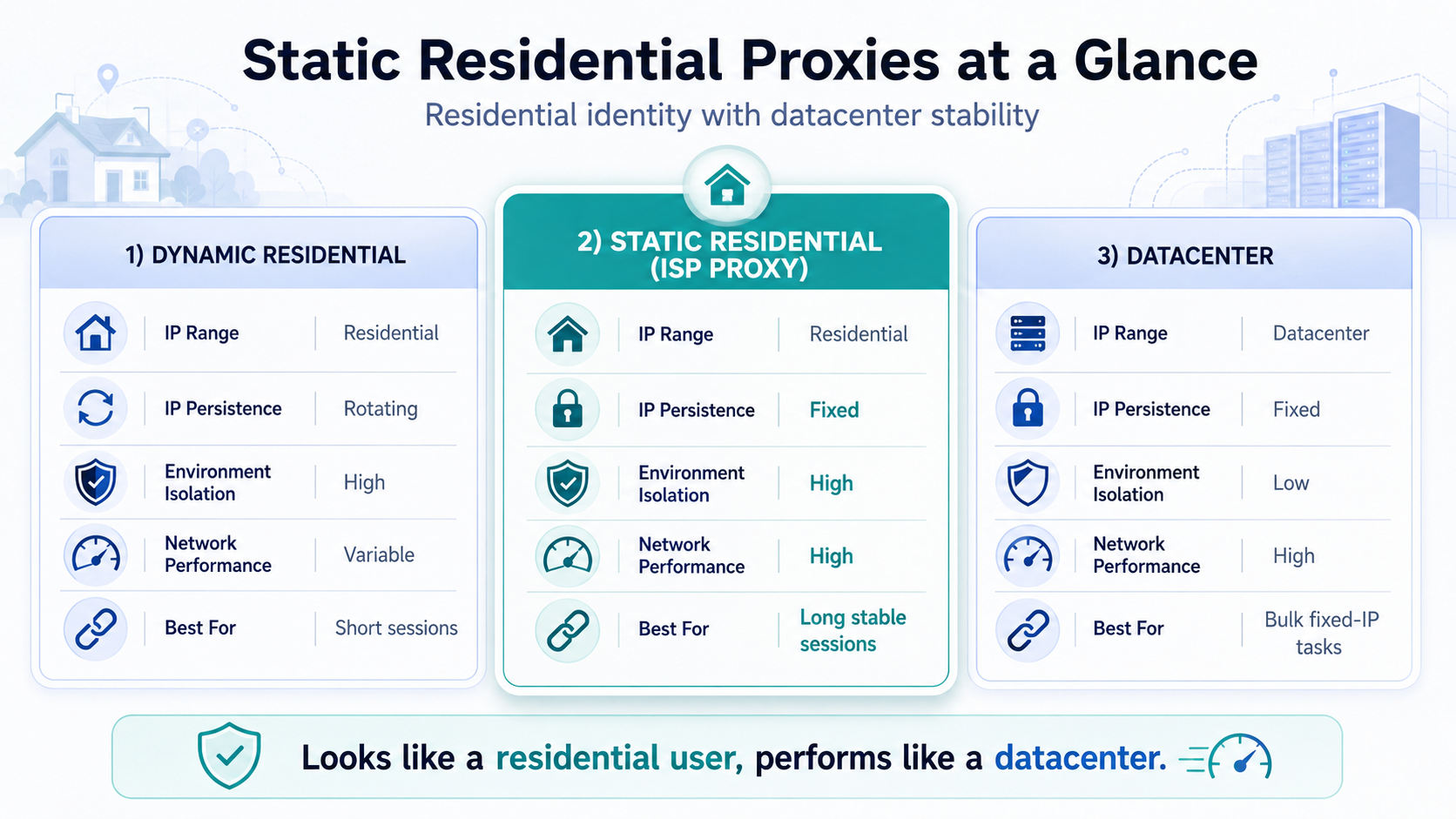
Static residential proxies take the intersection of the two:
| Attribute | Dynamic Residential Proxy | Datacenter Proxy | Static Residential Proxy |
|---|---|---|---|
| IP range type | ISP residential range | Datacenter range | ISP residential range |
| Is IP fixed? | Auto-rotates | Fixed | Fixed |
| Access environment isolation | High | Low | High |
| Latency and bandwidth | Limited by home broadband | Datacenter-grade | Datacenter-grade |
| Best-fit session type | Short sessions, high-frequency rotation | Long sessions, fixed exit | Long sessions, fixed exit |
In one line: looks like a residential user, performs like a datacenter.
How Is It Implemented Technically?
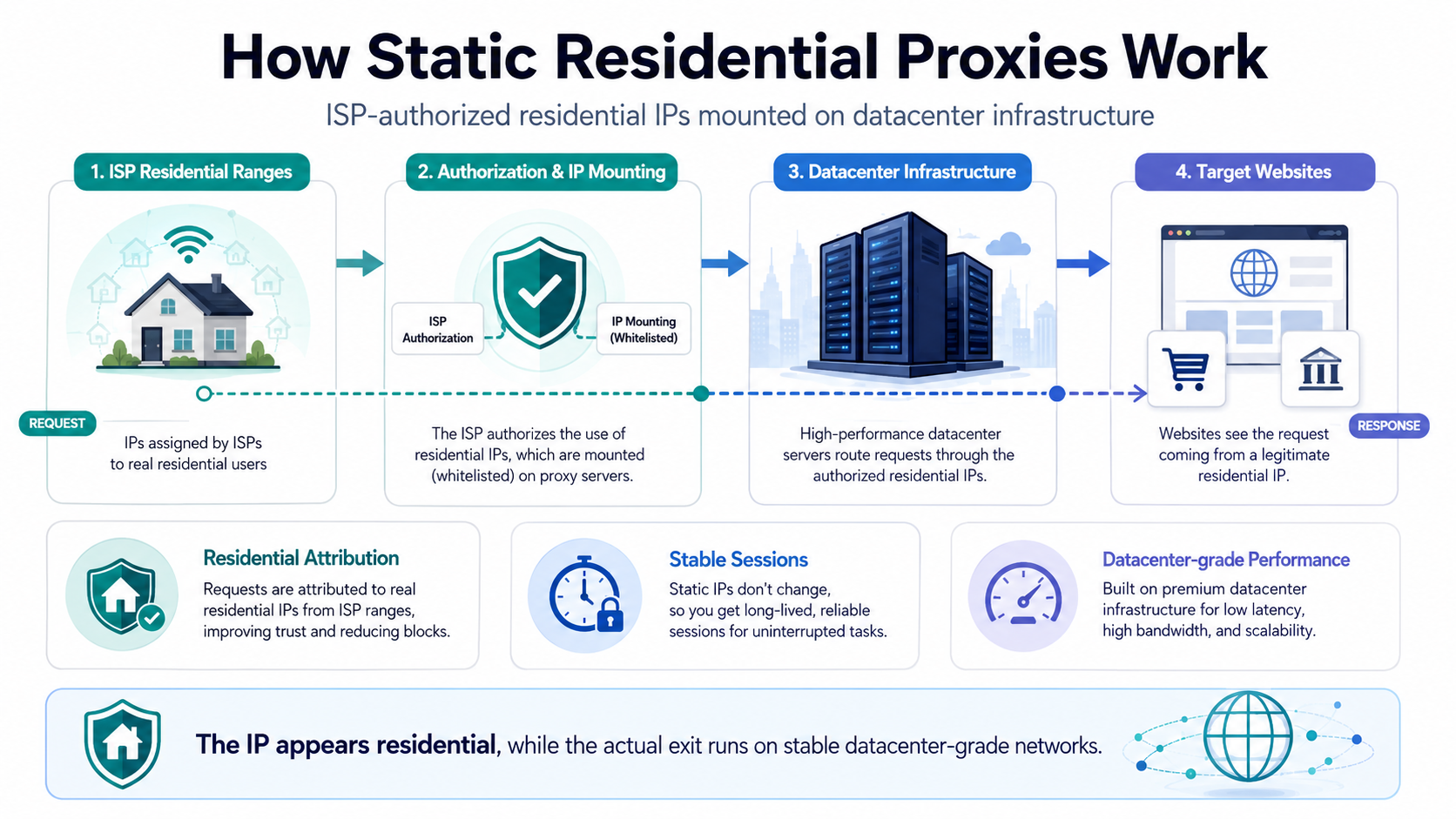
The core mechanism of static residential proxies is IP range authorization and mounting.
Providers obtain legitimate authorization from ISPs for residential IP ranges, then mount these IPs on datacenter servers. In IP attribution databases, these IPs show up as residential users. But the actual exit runs on datacenter-grade network infrastructure.
This means two things hold true simultaneously:
- Access environment isolation is good. When target sites query IP attribution, they see a home broadband user from some city — not a datacenter IP range.
- Network performance is far better than real home broadband. Latency, bandwidth, and connection stability are all backed by datacenter infrastructure, unaffected by home network fluctuations.
Another key difference from dynamic residential proxies lies in the IP sourcing path. Dynamic residential proxy IPs are typically collected from real end-user devices via P2P networks — the attribution is real, but lifetime is uncontrollable. Static residential proxy IPs are obtained by providers directly from ISPs in bulk — the attribution is equally real, but the lifecycle is controlled by the provider, typically lasting weeks to months.
Which Scenarios Suit Static Residential Proxies?
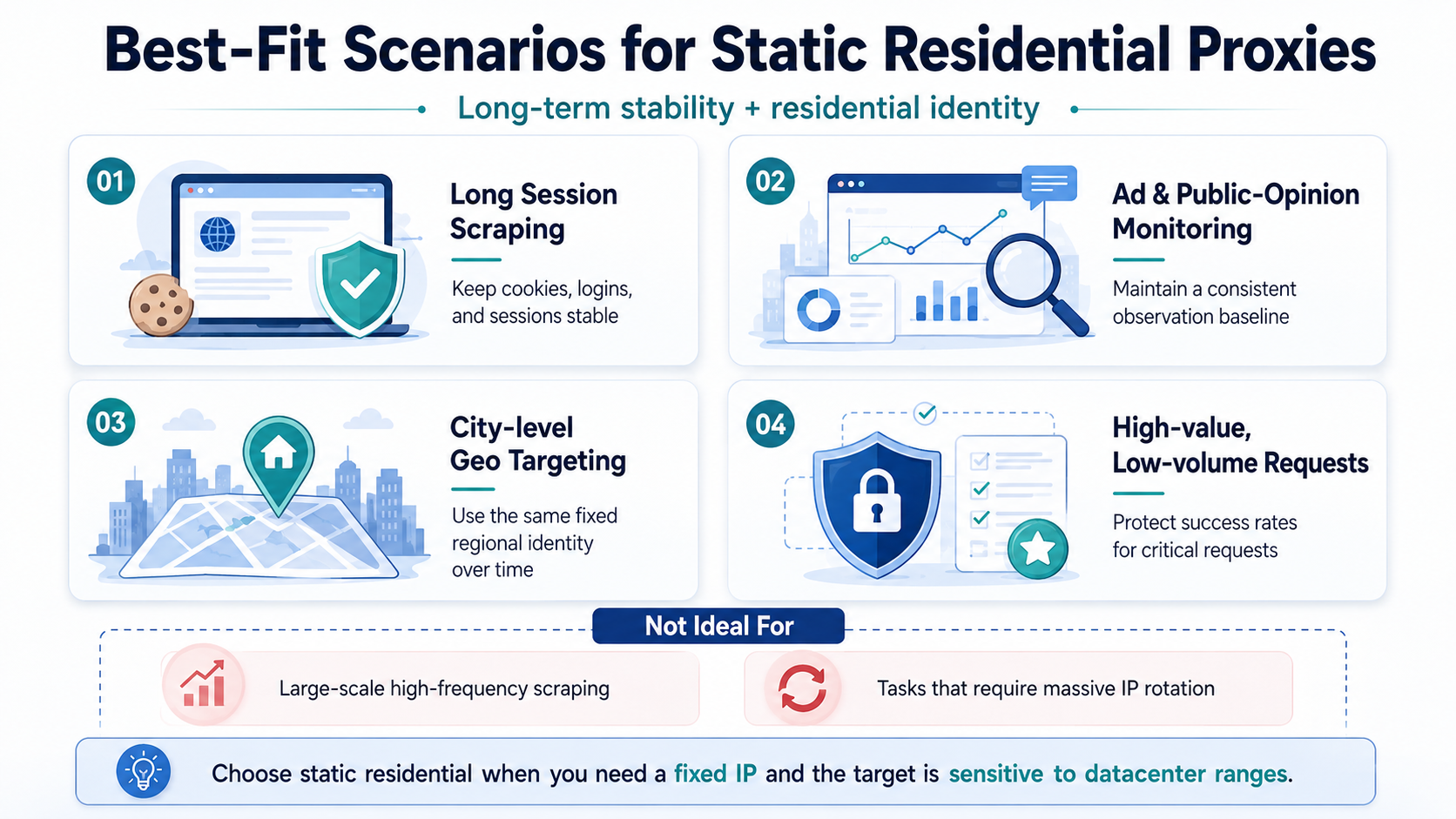
The core value of static residential proxies is long-term stability + residential identity. Several business scenarios fit this naturally.
Scraping Tasks Needing Long Session Persistence
Cross-border logistics tracking is a classic case. Logistics tracking pages often require login state or persistently valid cookies — change the IP and the session breaks, requiring a fresh connection or even re-login.
Static residential proxies let you access through the same IP continuously for weeks. Login state, cookies, and session tokens all stay valid, eliminating the overhead of repeatedly establishing sessions.
Monitoring Tasks with Strict Access Environment Consistency Requirements
Ad monitoring and public-opinion monitoring have a core need for comparability and reproducibility.
If every monitoring run uses a different IP, the collected ad placement data may drift due to regional differences or personalized recommendation strategies. Fixed residential IPs ensure each observation uses the same baseline conditions, making monitoring results comparable and traceable.
| Monitoring Need | Limitation of Dynamic Residential Proxies | Fit of Static Residential Proxies |
|---|---|---|
| Continuous observation of the same page | Frequent IP changes cause baseline inconsistency | Fixed IP, stable observation baseline |
| Region-locked observation | Post-rotation IP may drift to other regions | City-level positioning, long-term unchanged |
| Personalized recommendation reproduction | Each request identified as a new user | Fixed identity, recommendation results reproducible |
Business Needing Precise Geographic Positioning with Long-Term Stability
Scenarios like credit checks and tender data scraping require IP attribution accurate to the city level, with no long-term drift.
Static residential proxies typically support specifying the IP's city at purchase time. Once allocated, that IP is exclusively used by the user — it won't auto-rotate to other regions like dynamic proxies do.
Business with High-Value but Low-Volume Requests
Scenarios like credit checks and legal big data share a common trait: low request volume, but high data value per request. A single request failure caused by IP quality issues doesn't just cost bandwidth — it compromises the integrity of business data.
Because static residential proxies aren't shared with other users and aren't part of a rotation pool, they have a low probability of being "contaminated" by other tasks. Request success rates are better protected.
Which Scenarios Don't Suit Them?
Two typical anti-scenarios are worth noting.
- Large-scale high-frequency scraping doesn't suit. Static residential proxies are typically billed by IP count or monthly subscription — a cost structure completely different from traffic-billed dynamic proxies. For tasks running millions of daily requests for bulk data extraction, static residential proxies cost far more than short-lived dynamic proxies or tunnel proxies.
- Scenarios needing massive IP rotation to spread request frequency don't suit. Static residential proxy IPs are fixed. If the target site has strict rate-limiting policies, a single IP quickly hits the request ceiling. These scenarios are better served by dynamic residential proxies or short-lived proxies, leveraging IP volume to distribute request pressure.
| Scenario Characteristic | Recommended Proxy Type | Why Not Static Residential |
|---|---|---|
| Millions of daily requests | Short-lived dynamic proxy, tunnel proxy | Per-IP billing is too expensive |
| Strict target site rate limiting | Dynamic residential proxy | Fixed IP quickly hits rate-limit thresholds |
| Use-and-discard IPs | Short-lived proxy | Wastes static residential's long-term stability |
What Dimensions Should You Focus On During Selection?
When evaluating static residential proxy services, the following dimensions directly affect business usability.
- IP attribution authenticity: This is the core distinction between static residential and datacenter proxies. Verify whether the IPs are truly mounted on ISP residential ranges, rather than datacenter IPs dressed up with residential labels. Verify with third-party IP attribution lookup tools.
- Available geographic coverage: The number of supported countries and cities, and whether positioning precision reaches city level. Scenarios like cross-border logistics queries have hard requirements on geographic positioning.
- Protocol support completeness: Whether HTTP, HTTPS, and SOCKS5 are all covered. Some enterprise scraping tasks have explicit protocol requirements — missing one means extra architectural adaptation.
- IP lifetime cycle: How long an IP stays unchanged before being reclaimed, directly affecting continuity for long-session business. Ideally, the same IP is maintained for months or even quarters.
- Compliance credentials: Whether the IP source has proper ISP authorization. In high-compliance scenarios like credit checks and legal big data, IP source legitimacy is a hard gate — not a nice-to-have.
- Exclusivity: Whether the IP is allocated to only one user. Under shared models, other users' request behavior can affect the IP's reputation score, impacting your success rate.
| Evaluation Dimension | Key Criterion | High-Priority Scenarios |
|---|---|---|
| IP attribution authenticity | Third-party tool verifies as residential range | All scenarios |
| Geographic coverage | City-level positioning available | Cross-border logistics, ad monitoring |
| Protocol support | HTTP/HTTPS/SOCKS5 all supported | Enterprise scraping with multi-protocol needs |
| IP lifetime cycle | Maintained for a month or longer | Long session persistence business |
| Compliance credentials | Proper ISP authorization, value-added telecom licenses, etc. | Credit checks, legal big data |
| Exclusivity | Dedicated IP, not shared | High-value request scenarios |
How to Choose Between Static Residential and Other Proxy Types?
The core selection logic comes down to three questions.
First, does your business need a long-term fixed IP? If yes, rule out dynamic residential proxies and short-lived proxies. Among fixed-IP options, it's static residential vs. datacenter.
Second, is the target site sensitive to datacenter IP ranges? If yes, rule out datacenter proxies. Static residential proxies' residential range attribution provides better access environment isolation.
Third, what's your request volume and cost tolerance? For low-frequency high-value requests, static residential's per-IP billing makes sense. For high-frequency large-scale requests, traffic-billed dynamic proxies or tunnel proxies are more economical.
Summarized as a decision path:
Need a fixed IP?
├── No → Dynamic residential proxy / Short-lived proxy
└── Yes → Is the target site sensitive to datacenter IPs?
    ├── No → Datacenter proxy (lower cost)
    └── Yes → Request volume?
        ├── High-frequency, large-scale → Consider tunnel proxy (auto-rotation + residential pool)
        └── Low-frequency, high-value → Static residential proxy
Static residential proxies solve a specific tension: needing both residential-level access environment isolation and datacenter-level stability and continuity. If your business is stuck on both requirements at once, this is a more precise choice than either dynamic residential or datacenter proxies. Conversely, if you only need one side of the tradeoff, picking a more specialized type often comes out cheaper.
FAQ
Q: Are static residential proxies and ISP proxies the same thing?
Yes. ISP proxy is the common name for static residential proxies in overseas markets — they refer to the same product. The core traits are identical: IPs registered to ISP residential ranges, long-term fixed, with actual exit running on datacenter infrastructure. Domestic Chinese markets sometimes use terms like "long-lived residential proxies" or "fixed residential IPs" — the substance is the same.
Q: Will static residential proxy IPs expire or get reclaimed?
Yes. IP lifetime depends on the provider's authorization agreement with the ISP. Most services allocate IPs by the month; some support quarterly or longer cycles. After expiration, IPs may be reclaimed and reallocated. At selection time, confirm whether the provider's promised IP retention duration meets your business continuity needs.
Q: Are static residential proxies suitable for large-scale data scraping?
Not really. Static residential proxies are billed by IP count or monthly subscription. Large-scale scraping means needing lots of IPs, with costs far above traffic-billed dynamic proxies or tunnel proxies. If your business runs millions of requests per day or more, short-lived dynamic proxies or tunnel proxies are more economical.
Q: How do I verify whether a static residential proxy's IP attribution is genuine?
You can verify it with third-party IP attribution lookup tools. Common ones include ipinfo.io and ip2location.com. In the query result, focus on two fields: first, whether the IP type is labeled "residential" or "isp" rather than "datacenter"; second, whether the ASN attribution is a real ISP rather than a hosting provider. Both conditions met means the attribution is genuine.
Q: What's the difference between static residential proxies and VPNs?
The two differ in both purpose and technical mechanism. VPNs are primarily for encrypting transmission channels, with the focus on communication security. Static residential proxies are primarily for enterprise data collection scenarios, with the focus on IP identity attribution and access environment isolation. VPNs typically share exit IPs; static residential proxies can be exclusive. In enterprise scraping scenarios, VPNs can't substitute for the geographic positioning, protocol control, and exclusivity capabilities of proxy IPs.
Q: What compliance requirements should I watch for when using static residential proxies?
Focus on two levels. First is IP source compliance — whether the provider has proper ISP authorization and holds relevant qualifications such as value-added telecom business licenses. Second is data collection compliance — whether the scraping behavior complies with the target site's terms of service and applicable laws and regulations. In heavily regulated scenarios like credit checks and legal big data, compliance credentials are an entry gate. Confirm them as a priority during selection.