What's Driving Growth in the Overseas Proxy IP Market?
The global proxy services market reached a total addressable size of approximately $4.2 billion in 2026, with residential proxies accounting for about 42% of total revenue — up significantly from 35% in 2023. Overall growth remains in double digits, with the residential proxy IP network segment posting a compound annual growth rate of around 15.8%.
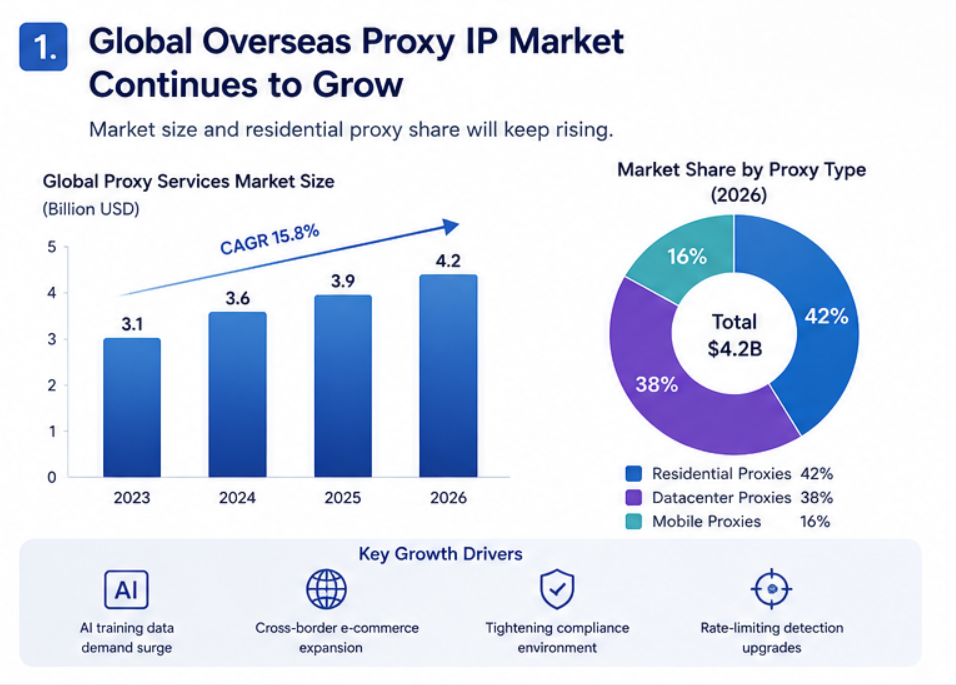
This growth isn't driven by any single factor, but by several converging forces:
| Driver | Manifestation |
|---|---|
| AI training data demand surge | Large model training continues to push up the volume of public web data being collected, with some teams already at hundreds of millions of daily requests |
| Continued cross-border e-commerce expansion | Outbound enterprises now treat multi-country product research, logistics tracking, and ad verification as core proxy use cases |
| Tightening compliance environment | 47 countries worldwide have now enacted comprehensive data protection laws, raising the compliance bar for cross-border data collection year by year |
| Rate-limiting detection upgrades | Mainstream platform detection systems have moved from single-IP checks to integrated IP + device + behavior analysis |
These four threads are interwoven, meaning the era of "buy a batch of IPs and you're set" is over. The market's next phase isn't about who can supply more IPs — it's about whose solution fits the specific business scenario.
Why Has Compliance Become the First Filter in Selection?
Compliance is no longer a "nice to have." It's now a prerequisite filter.
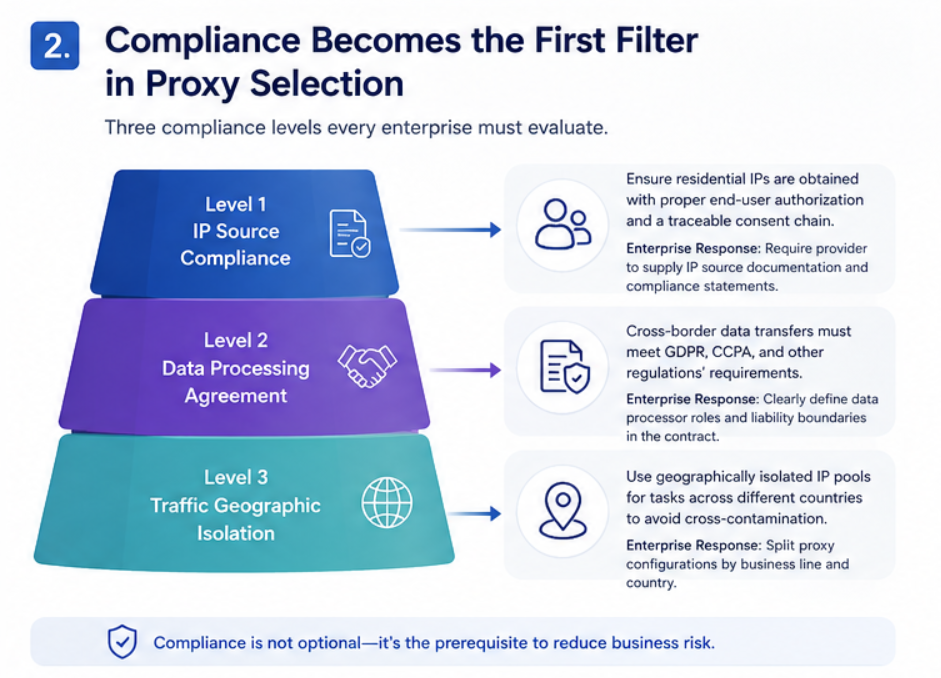
A telling shift: in 2026, 47 countries have comprehensive data protection laws on the books, a nearly 40% increase over three years ago. For businesses doing cross-border product research or ad monitoring that need to collect data across multiple jurisdictions, the first step in selection is confirming whether the proxy provider's IP sources have proper authorization, whether they can offer a data processing agreement, and whether they support geographic traffic isolation.
Compliance affects selection on three levels:
| Level | Impact | Enterprise Response |
|---|---|---|
| IP source compliance | Whether residential IPs are obtained through proper end-user authorization with a traceable consent chain | Require the provider to supply IP source documentation and compliance statements |
| Data processing agreement | Whether cross-border transfers meet GDPR, CCPA, and other regulations' requirements for data processors | Clearly define data processor roles and liability boundaries in the contract |
| Traffic geographic isolation | Whether data collection tasks across different countries can use geographically isolated IP pools to avoid cross-contamination | Split proxy configurations by business line; use different IP channels for different countries |
Skipping compliance checks and jumping straight to comparing specs and prices means skipping the biggest risk exposure. Take cross-border logistics information queries: if IP sources aren't compliant and the target platform traces the request, you can face anything from request throttling to legal action.
How Will the Division Between Residential and Datacenter Proxies Evolve?
Residential proxies won't replace datacenter proxies, and vice versa. The 2026 trend is tiered usage.
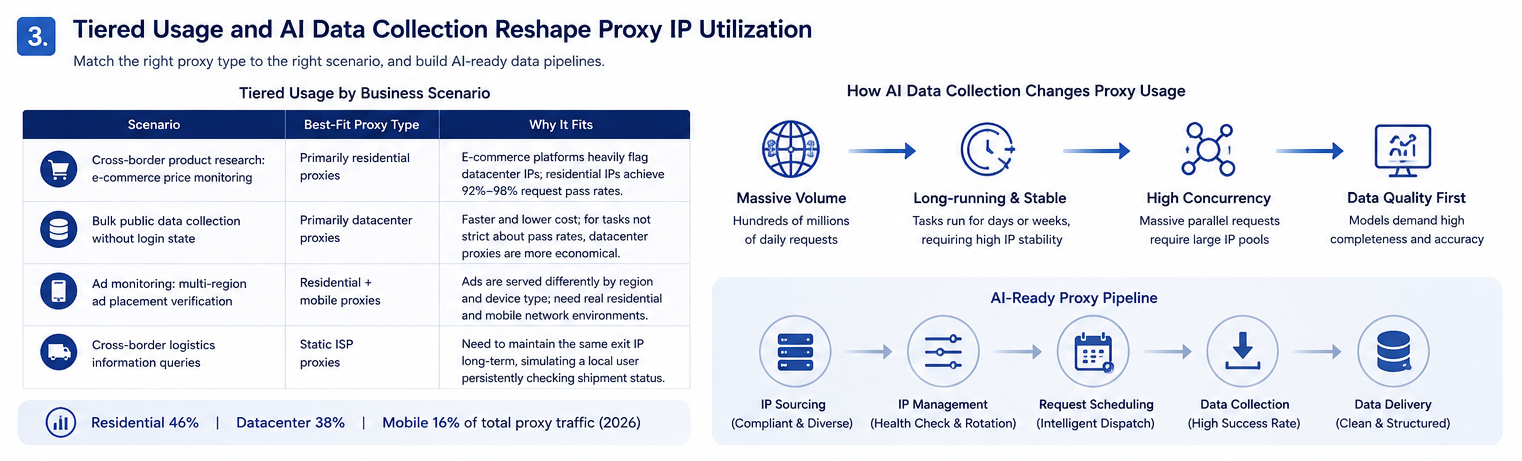
Industry data shows residential proxies currently account for about 46% of all proxy traffic, datacenter proxies about 38%, and mobile proxies about 16%. But the logic behind these numbers isn't "residential is better" — it's that scenario-specific demand for different proxy types is diverging:
| Scenario | Best-Fit Proxy Type | Reason |
|---|---|---|
| Cross-border product research: e-commerce price monitoring | Primarily residential proxies | E-commerce detection systems heavily flag datacenter IPs; residential IPs achieve 92%-98% request pass rates |
| Bulk public data collection without login state | Primarily datacenter proxies | Faster, lower cost; for tasks not strict about pass rates, datacenter is more economical |
| Ad monitoring: multi-region ad placement verification | Residential + mobile proxies | Ads are served differently by region and device type, requiring real residential and mobile network environments to replicate the user view |
| Cross-border logistics information queries | Static ISP proxies | Need to maintain the same exit IP long-term, simulating a local user persistently checking shipment status |
This tiering logic means that future proxy IP planning isn't a "residential or datacenter" binary — it's mapping out a hybrid configuration by business scenario.
Notable is the shift in mobile proxy share. It's risen from under 10% two years ago to 16%. As data collection demand grows from social media and short-video platforms, mobile IP share in ad monitoring and similar scenarios will keep climbing.
How Is AI Data Collection Changing How Proxy IPs Are Used?
The volume of public data demanded by large model training and AI applications is reshaping how proxy IPs are used.
The traditional usage pattern was "collection-task-driven": you had a specific scraping task, you provisioned a batch of proxy IPs, and you were done when the job finished. But data collection in the AI era shows several new traits:
- Volume has jumped an order of magnitude. Some AI data teams now log hundreds of millions of daily requests, demanding far more concurrency and IP pool refresh speed than traditional scraping required.
- Collection is continuous, not project-based. Large models need ongoing fresh data for incremental training. Proxy IPs are no longer "use-and-discard" tools — they're permanent components of the data pipeline.
- Tolerance for IP quality issues is dropping. If AI training data gets contaminated by proxy quality problems — duplicates, incomplete records, polluted content — downstream cleaning costs far exceed the proxy IP fees themselves.
These three shifts translate directly into selection implications:
| Traditional Mode | AI Data Pipeline Mode |
|---|---|
| Procure proxy IPs per project | Configure long-term proxy resources around the data pipeline |
| Focus on single-request success rate | Focus on total cost per successful request, including retries and cleaning |
| IP pool scale is the headline metric | IP quality stability and refresh speed are the headline metrics |
| Collection tasks run independently | Proxy IPs embed in the ETL pipeline, linked with cleaning, storage, and training |
This trend is especially clear in cross-border product research. Product teams aren't "running a price-comparison script once a week" anymore — they're building continuously running competitor price monitoring pipelines, with proxy IPs as the infrastructure layer beneath them.
How Is the Selection Logic for Cross-Border Business Changing?
Putting the four trends together, the proxy IP selection logic for cross-border business has shifted from "spec comparison" to "scenario fit."
This shift plays out across three dimensions:
- From "total IP count" to "scenario match." Whether the IP pool has 100 million or 50 million matters less than people think for specific business scenarios. What actually determines the experience: IP density in target regions, request pass rates on target platforms, and whether IP refresh frequency matches the business cadence.
- From "single proxy type" to "hybrid proxy strategy." Residential for cross-border product research, datacenter for bulk structured data, mobile for ad placement verification. Splitting proxy types by scenario is more realistic than chasing a "universal proxy solution."
- From "procurement event" to "infrastructure planning." Proxy IPs have moved from "tool" to "infrastructure." Selection isn't a one-off purchase — it's part of IT infrastructure planning, factoring in SLA guarantees, data processing compliance, and integration costs with existing data pipelines.
| Old Selection Logic | New Selection Logic |
|---|---|
| Look at total IP pool count | Look at target-region IP density and request pass rate |
| Compare unit price | Calculate total cost per successful request |
| Pick one proxy type | Configure hybrid proxy strategy by scenario |
| One-off procurement | Build into long-term IT infrastructure planning |
| Focus on speed and concurrency | Focus on compliance, SLA, and integration cost |
In the end, the question cross-border business decision-makers need to answer is no longer "which proxy IP provider is best?" but "for each business scenario, what proxy type, what compliance level, and what degree of infrastructure integration do we need?" Pulling selection back from spec comparison to scenario analysis — that's the basic skill for proxy IP selection from 2026 onward.
FAQ
Q: How large is the overseas proxy IP market?
The global proxy services market reached a total addressable size of about $4.2 billion in 2026, with residential proxies accounting for around 42% of revenue. The residential proxy IP network segment started at about $1.2 billion in 2024 and is projected to grow to $3.5-4.5 billion by 2031-2033, at a compound annual growth rate of about 15.8%.
Q: How big is the gap in request pass rates between residential and datacenter proxy IPs?
Industry benchmarks show residential proxy IPs achieve request pass rates of about 92%-98% on mainstream e-commerce and social platforms, versus 65%-80% for datacenter proxy IPs. The gap comes mainly from platform detection systems flagging datacenter ASNs, while residential IPs — allocated by real carriers — are less likely to trigger rate limiting.
Q: Should cross-border e-commerce use residential or datacenter proxies?
Depends on the specific task. Tasks requiring login states or simulating real user browsing — like product price monitoring or store operations — suit residential proxies. Bulk scraping of public product listing pages that don't require login is cheaper and faster with datacenter proxies. Most mature teams use a hybrid approach, assigning proxy types by task category.
Q: What special requirements does AI training data collection place on proxy IPs?
Three main points. First, concurrency must be high — daily requests can hit hundreds of millions. Second, IP pool refresh speed must be fast — using the same batch of IPs long-term triggers rate limiting. Third, data quality must be stable — dirty data caused by proxies inflates downstream cleaning costs. In selection, focus on the provider's concurrency ceiling, IP rotation strategy, and historical stability data.
Q: How much does data compliance affect overseas proxy IP selection?
Significantly. It's moved from "optional" to "prerequisite filter." 47 countries worldwide have enacted comprehensive data protection laws. Using non-compliant IPs for cross-border data collection can carry legal risk. In selection, confirm the IP source authorization chain, the scope of the data processing agreement, and whether geographic traffic isolation is supported.
Q: Why is demand for mobile proxy IPs growing?
Social media and short-video platforms prioritize mobile delivery, and ad placements depend heavily on mobile display. Using residential or datacenter IPs to collect mobile content may return desktop pages, inconsistent with what real users see. Mobile proxy IPs replicate real mobile user network environments. Their share in ad monitoring and similar scenarios has risen from under 10% two years ago to about 16%.
Q: How should "cost per successful request" be evaluated for proxy IPs?
Add up proxy IP fees, retry costs, and data cleaning costs, then divide by the final count of valid data records obtained. Looking at proxy IP unit price alone is meaningless — cheap IPs with a 65% pass rate may have a higher effective cost per valid record. We recommend running small-scale load tests in real business scenarios during the selection stage, then calculating actual per-record costs before deciding.