Comparing parameters and prices — the most common misjudgment in residential proxy procurement
The default decision flow for most enterprise residential proxy procurement is "stack the spec sheets and compare numbers": IP pool size, city coverage count, advertised availability rate, unit price — pick whoever's numbers look best.
This process answers "what does the vendor have," not "do the vendor's capabilities match the business constraints." Take public opinion monitoring as an example: one government-enterprise team picked a top-IP-pool-ranked vendor, only to find that during a sudden incident, concurrent request volume surged 3–5x and actual availability at peak hours dropped well below the contract's advertised value — and the SLA terms didn't cover "peak scenarios" at all.
Spec sheets reflect a vendor's resource inventory, but they don't reflect three critical facts: whether the vendor is compliant, whether real-load performance meets the bar, and whether the billing model matches your business volume curve. Combine these three with IP quality, concurrency/bandwidth, and after-sales response — and you get the six evaluations to run before procurement.
Evaluation 1: Compliance credentials — the Value-Added Telecommunications Business License is the floor
Compliance credentials are an entry threshold for residential proxy procurement, not a bonus.
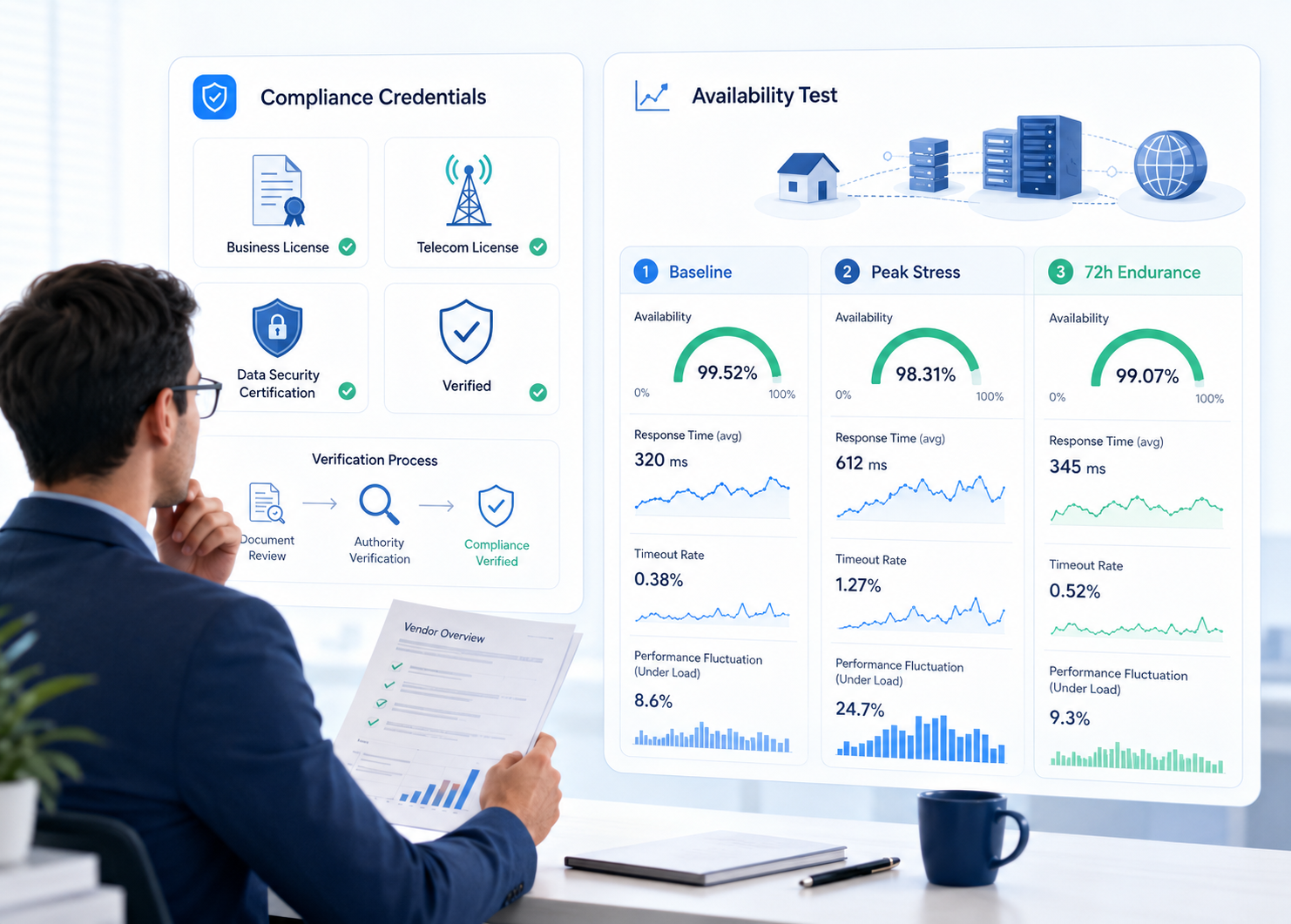
In enterprise procurement — especially in industries with high data compliance demands like public opinion monitoring, legal big data, and credit reference queries — vendor qualification scrutiny is becoming increasingly strict. Core credentials to require from vendors:
| Credential | Why it matters | How to verify |
|---|---|---|
| Value-Added Telecommunications Business License (Class B1) | Proxy IP services fall under value-added telecommunications business in China; operating without this license carries legal risk | China MIIT's records system |
| Business registration license | Confirms the vendor entity actually exists and is in good standing | National Enterprise Credit Information Publicity System |
| Data security certifications (ISO 27001, MLPS Level 3, etc.) | Reflects the vendor's capability tier in data security management | Require the vendor to provide certificates and verify the certificate numbers |
| High and New Technology Enterprise (HNTE) recognition (optional) | Indirectly reflects technology investment and in-house R&D capability | China's Torch High Technology Industry Development Center recognition system |
Industry reality to note: not all residential proxy vendors hold a Value-Added Telecommunications Business License. Signing a contract without credential verification leaves real risk of ending up with an unlicensed vendor.
Method boundary: credential verification only filters out vendors you shouldn't pick — it doesn't decide who you should pick. The remaining 5 evaluations handle that.
Evaluation 2: Advertised availability ≠ actual availability — verify with a 3-step real-world test
Advertised availability is the most misleading number on a residential proxy spec sheet.
Vendor-disclosed availability rates span a huge range — from 80% to 99.99%. But advertised availability is usually measured under ideal network conditions at low concurrent load, and may differ significantly from real business scenario performance. A recommended 3-step real-world test before procurement:
| Step | Operation | Metrics to watch |
|---|---|---|
| Baseline test | Off-peak hours, send requests at your normal business concurrency for 2 hours | Actual availability, average response time, timeout rate |
| Peak stress test | Scale concurrency to 3–5x normal levels, hold for 30 minutes | Availability degradation, response time change, whether rate-limiting triggers |
| Endurance test | Run continuously for 72 hours, covering weekdays and weekends, day and night | Availability fluctuation range, whether specific time windows collapse |
Take public opinion monitoring: during a sudden public incident, the collection system's concurrent request volume might spike from baseline to 5x within 30 minutes. If the vendor's availability under peak load drops from 99%+ advertised to below 90%, that means 10+ failures per 100 requests — for public opinion monitoring that needs minute-level data refresh, that failure rate is enough to lose data in critical time windows.
Key pass criterion: under the peak stress test, availability degradation within 5% of baseline counts as passing; degradation over 10% calls for re-evaluating the vendor.
Evaluation 3: Billing model — picking the wrong one costs more than picking the expensive one
Billing-model mismatch is the primary source of hidden over-spend in residential proxy procurement.
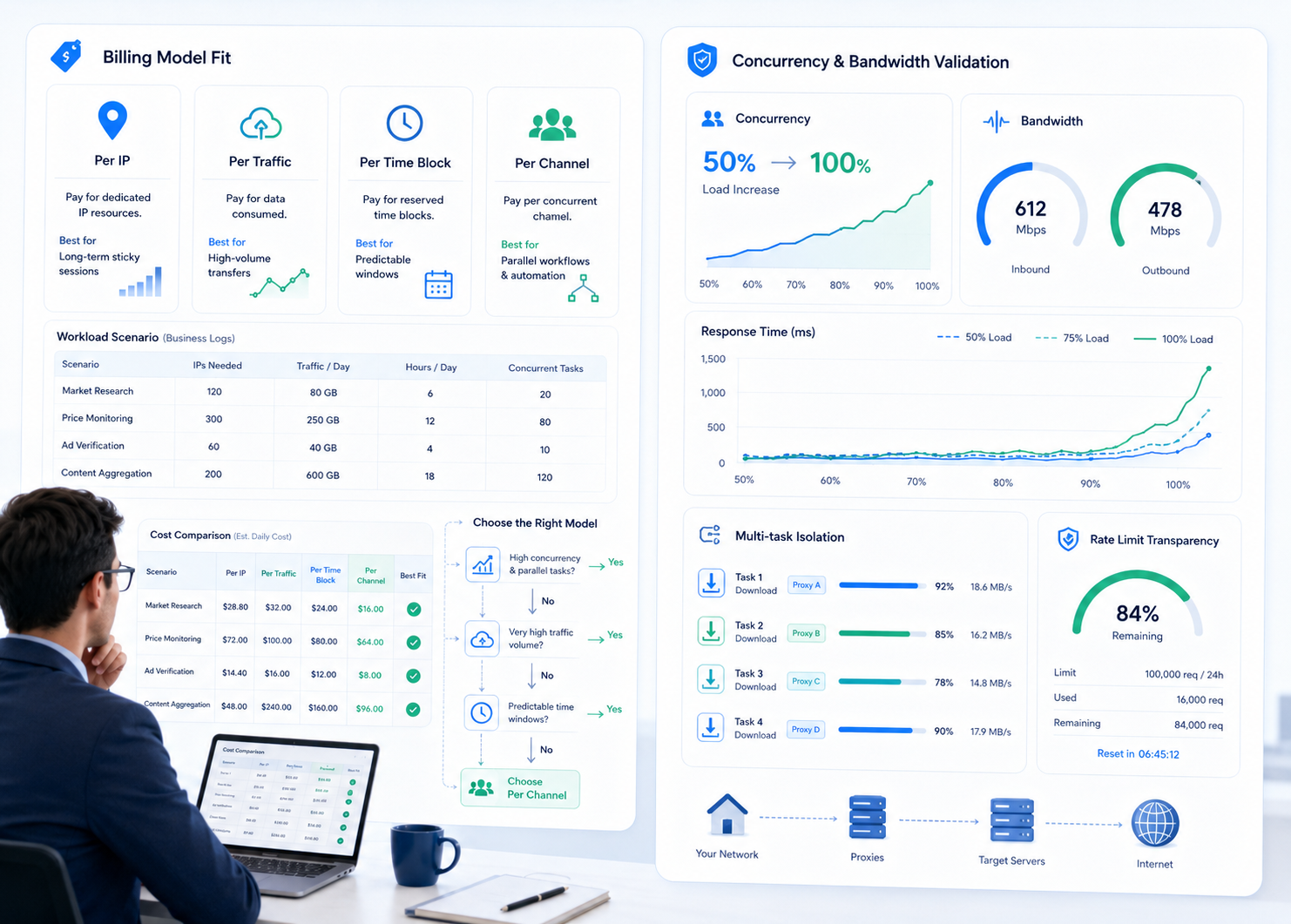
The residential proxy industry uses at least 4 billing models, each suited to different business volume characteristics:
| Model | Unit | Suitable for | Unsuitable for |
|---|---|---|---|
| Per IP | CNY/IP | High request frequency, small per-request payload (e.g. headline scraping in public opinion monitoring) | Download-type tasks with large per-request payloads |
| Per traffic | CNY/GB | Large per-request payload, manageable total request count | High-frequency small-packet requests (tiny per-request payload, massive aggregate volume) |
| Per time block | CNY/hour or CNY/day | Temporary, short-cycle tasks (project-based scraping, stop when done) | Long-running continuous business (per-time billing is usually more expensive than monthly long-term) |
| Per channel | CNY/channel/month | Long-running, stable operations with predictable concurrency | Highly fluctuating concurrent workloads (idle channels = wasted spend) |
Cost-modeling tip: before signing, use real business logs from the past 30 days — total request count, per-request payload size, peak concurrency, runtime hours — and plug them into all 4 models. The cost gap across models can exceed 2–3x.
For public opinion monitoring: in normal phases, daily request volume is around 500K with ~2KB per request; during sudden incidents it spikes to 2M/day. Per-IP billing is more cost-controllable for this profile, while per-traffic billing — though it looks cheap at unit-price level — can actually total higher due to the cumulative cost of high-frequency small packets.
Evaluation 4: Concurrency and bandwidth — how much of the advertised number actually holds under real load?
Advertised numbers for maximum concurrent connections and peak bandwidth typically show performance degradation as you approach the ceiling.
Most vendor spec sheets list "maximum concurrent connections" and "peak bandwidth," but these numbers rarely behave linearly near the ceiling: response latency rises noticeably once concurrency exceeds 80% of advertised, and when multiple tasks contend for peak bandwidth, the actual usable bandwidth per task gets diluted. Industry peak bandwidth varies by product tier from 1Mbps to 5Mbps; higher tiers offer more bandwidth but cost more.
Pre-purchase verification checklist:
| Check | Test method | Pass criterion |
|---|---|---|
| Concurrency ceiling reality | Ramp from 50% to 100% of advertised, record average response time at each step | At 80% load, response time should be no more than 1.5x the 50%-load baseline |
| Actual usable bandwidth | Start 3–5 collection tasks simultaneously, measure each task's actual download speed | Per-task actual bandwidth no less than 60% of advertised peak |
| Rate-limiting transparency | Test the vendor's handling when exceeding advertised concurrency | Vendor should disclose the rate-limit threshold and trigger behavior (queue / reject / throttle) up front |
| Multi-task isolation | Run multiple business-line collection tasks simultaneously, observe mutual impact | High concurrency on Task A shouldn't materially degrade Task B's response time |
Evaluation 5: IP quality — large volume ≠ high quality
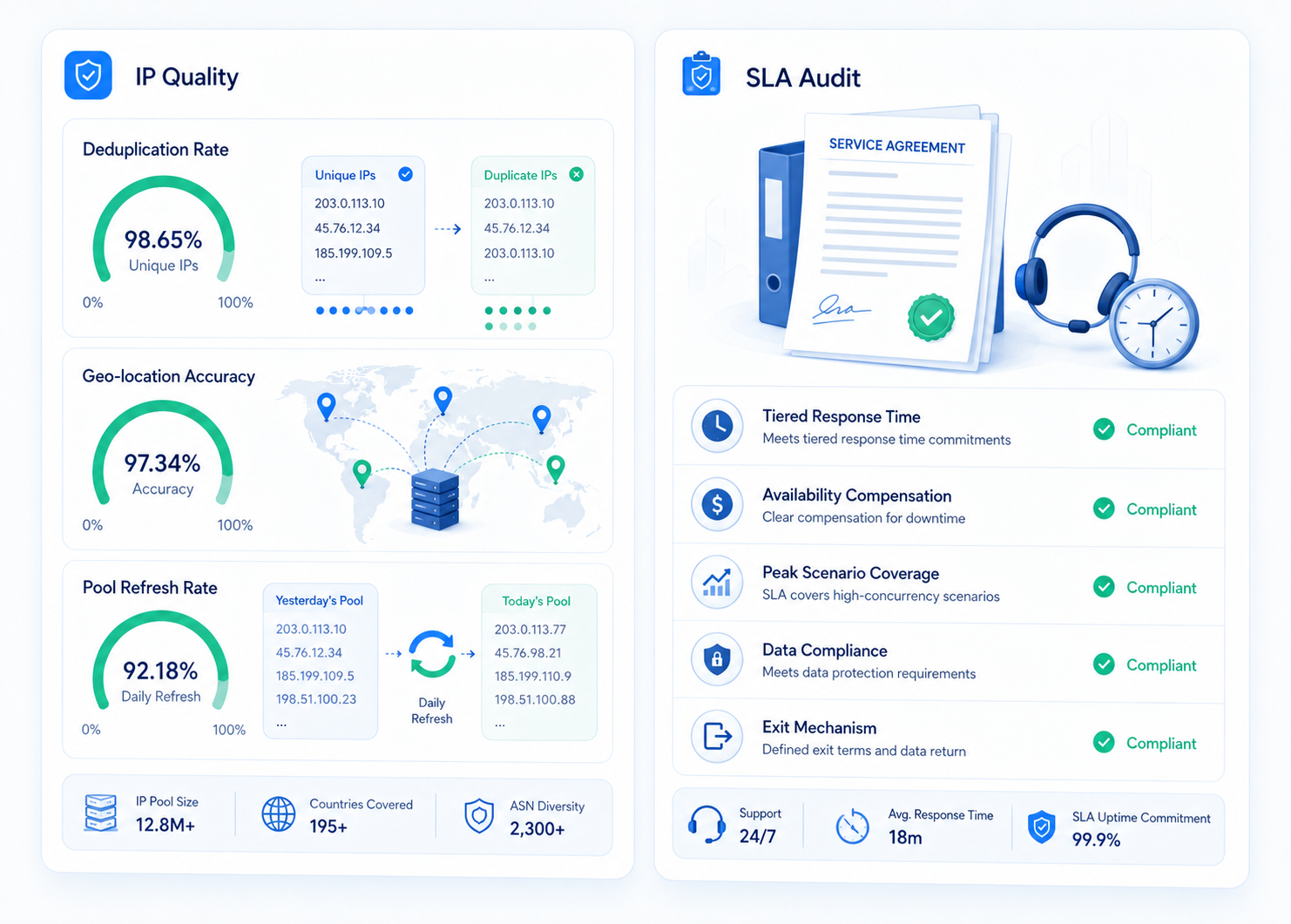
IP pool size is the most over-weighted parameter. For enterprise collection, IP quality affects success rates far more directly than IP count.
Three core metrics for IP quality:
| Metric | Definition | Why it matters | Verification |
|---|---|---|---|
| Deduplication rate | Share of duplicate IPs in a single extraction batch | Duplicates mean the same exit gets reused — raising the chance of triggering target-site rate controls | Extract 1000 IPs in sequence, count the unique share |
| Geo-location accuracy | Match between an IP's actual location and its labeled location | Businesses requiring city/province-level targeting (e.g. regional public opinion monitoring) suffer data distortion when geo is off | Sample 100 IPs, cross-validate with a third-party IP geolocation database |
| Pool refresh rate | Daily share of refreshed IPs as a fraction of total pool | Low refresh means many IPs are already flagged by target sites — too few fresh, usable IPs | Extract IPs across 3 consecutive days, compare day-1 vs day-3 overlap |
Industry daily refresh volume spans from hundreds of thousands to millions — a 10x+ gap. But high daily refresh doesn't automatically mean high quality — what matters is whether the newly added IPs are clean residential exits or recycled old IPs put back into rotation.
Practical tip: ask the vendor for a trial period (industry trial policies vary widely — free for a few hours up to paid time-based trials) and run all 3 quality checks during the trial. Don't skip the trial and sign an annual deal cold.
Evaluation 6: After-sales response and SLA — the contract section to audit word-by-word
SLA differences are invisible in day-to-day operations but determine the magnitude of loss when failures hit.
Key SLA clauses to scrutinize when procuring enterprise residential proxies:
| Audit item | What to look for | Common traps |
|---|---|---|
| Tiered response time | P0–P3 incident severity tiers, each with a first-response time and resolution time commitment | Only promises "24/7 customer service" without tiered response-time commitments |
| Availability compensation clause | Compensation method and formula when actual availability falls below committed | Compensation capped at a percentage of the monthly fee; actual loss far exceeds compensation amount |
| Peak scenario coverage | Does the SLA cover availability commitments during sudden high-concurrency scenarios | Only covers "normal usage scenarios" — peak surges are outside SLA scope |
| Data compliance clause | Vendor's written commitment to IP source compliance | No IP-source-compliance clause in the contract — ambiguous liability boundaries when issues arise |
| Exit mechanism | Data migration and transition arrangements at contract end or early termination | No transition clause — service stops immediately on termination, a major risk for continuously running business |
Take public opinion monitoring: one government-enterprise client hit a vendor failure during a major incident, with a P0 incident first-response time exceeding 4 hours. If the contract had explicitly stipulated "P0 first response within 30 minutes, resolution within 4 hours," the client would have had grounds to pursue recourse; conversely, a vague "24/7 customer service" promise carries almost no binding force during a real dispute.
The root cause of pitfalls in residential proxy procurement is treating "what the vendor has" as "what the vendor will give you." The spec sheet answers the first question, but the second is the one enterprises actually need answered. The six evaluations aren't about finding the vendor with the prettiest spec sheet — they're about finding the one best matched to your own business constraints. Spending 72 extra hours on real-world testing and contract review before signing is far cheaper than hitting a pitfall and switching vendors after.
FAQ
Q1: What's the core difference between residential proxies and datacenter proxies?
Residential proxy IPs come from real home broadband networks — the request environment matches that of ordinary users, with better request-environment isolation. Datacenter proxy IPs come from data center servers — fast, but easily identified as non-organic access by target sites. For scenarios that demand high request-environment isolation (public opinion monitoring, ad monitoring), residential proxies are the priority choice.
Q2: How long should a pre-purchase trial period be?
At least 72 hours, covering three contrast conditions: weekdays vs weekends, day vs night, normal load vs peak load. Trials under 24 hours rarely surface availability fluctuations or peak-performance degradation.
Q3: How big is the real gap between 99% and 99.9% availability?
About 10x in daily downtime — 99% means roughly 14.4 minutes of unavailability per day, 99.9% means roughly 1.4 minutes. For minute-level data refresh businesses (such as public opinion monitoring), 14.4 minutes of missing data can cover the critical window of a key event.
Q4: Per-traffic billing vs per-IP billing — which is cheaper?
Depends on business characteristics. High-frequency small-packet requests (small per-request payload, large total request count) are usually cheaper per-IP; low-frequency large-packet requests (large per-request payload, small total request count) are cheaper per-traffic. Plug historical business logs into both models and calculate — far more reliable than picking by intuition.
Q5: Which clauses in an SLA are the must-reads?
Three musts: tiered incident response time (first-response and resolution commitments for P0 through P3), the compensation formula when availability falls below commitment, and whether the SLA covers peak scenarios. An SLA that only writes "24/7 customer service" without tiered response commitments has effectively zero binding force.
Q6: Is a bigger IP pool always better?
Not necessarily. IP pool size only determines "how many IPs can be assigned," not "how good those IPs are." Daily refresh rate, deduplication rate, and geo-location accuracy — these three quality metrics predict collection success rate better than total volume. When procuring, ask the vendor for a trial and measure all three directly.