Why the Two-Year-Old Selection Playbook No Longer Works
Two years ago, evaluating overseas proxy IPs came down to answering three questions: residential or datacenter? Which countries? What's the monthly budget? Answer those three and you'd land on one or two providers.
That logic is breaking down. Multiple cross-border product-selection and ad-monitoring teams hit the same wall in 2025: with the exact same proxy setup as last year, scraping success rates dropped 15%–30%, and the problem couldn't be solved by "swapping IP batches" or "throwing more IPs at it."
The reason is straightforward: too few variables were on the table. When target-site access policies only checked the IP address, three dimensions were enough. When detection expanded to TLS fingerprints, ASN attribution, session behavior patterns, and geo-consistency, three dimensions fell far short.
The complexity of selection isn't rising because proxy products got more complex — it's rising because the environment proxies operate in got more complex.
Why IP Types Went from Two to Five or Six
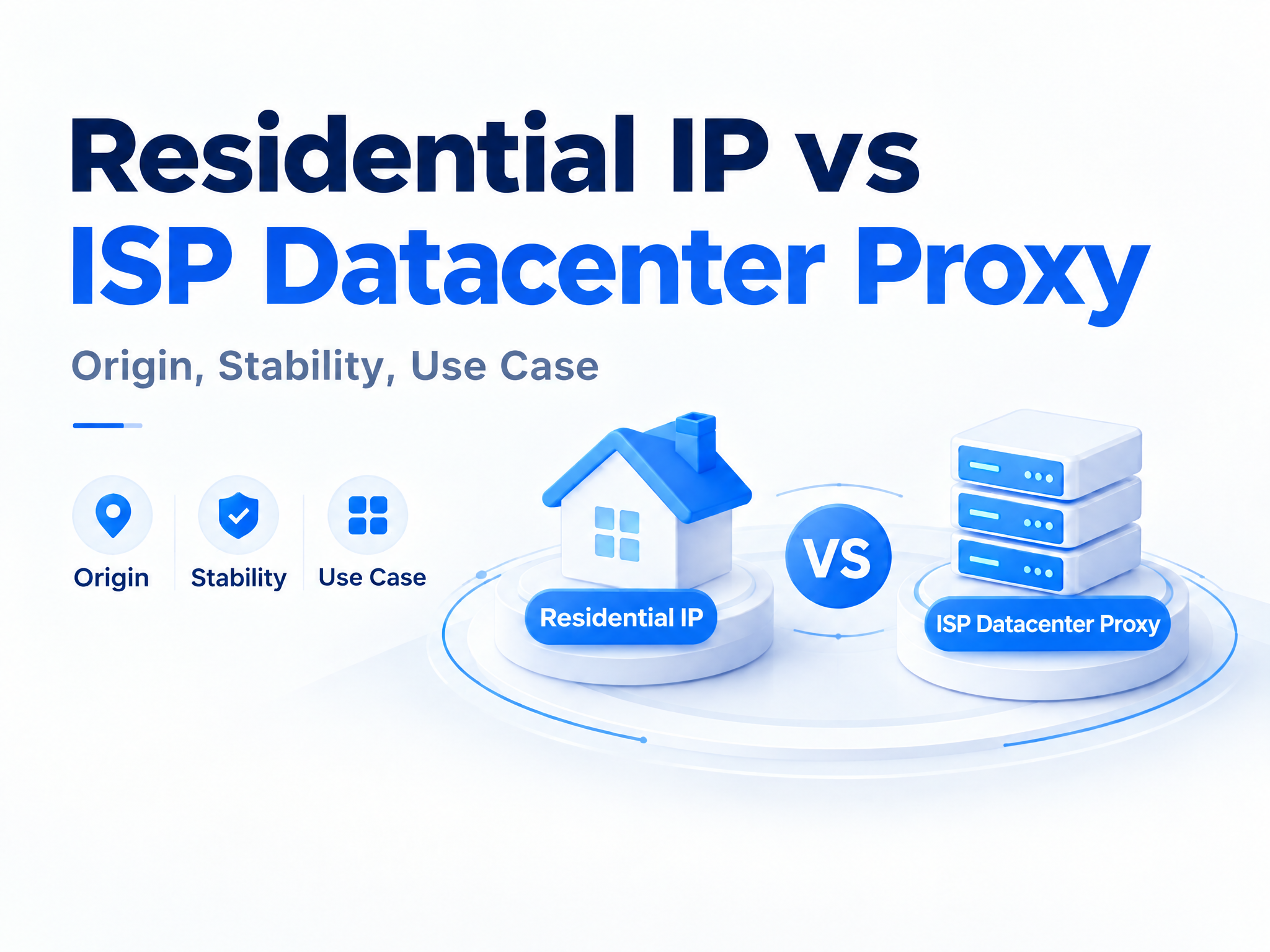
Overseas proxy IPs used to have two major categories: residential and datacenter. Today, the practical choices break down into at least five, each with distinctly different applicable scenarios.
| IP Type | Source | Best For | Main Limitations |
|---|---|---|---|
| Rotating residential | Real home broadband, IP rotates periodically | Cross-border price monitoring, ad monitoring | Uncontrollable survival period; some pools have weak deduplication |
| Static residential | Long-lived IPs bound to a fixed residential address | Long-term monitoring needing a fixed exit | High price, limited inventory |
| Mobile IP | 4G/5G IPs assigned by mobile carriers | Social media scraping, mobile ad verification | High unit price; regional inventory unstable |
| ISP proxy | IPs hosted in datacenters but with residential ASNs | High-frequency scraping needing residential-grade ASN cleanliness | Not all providers offer these; limited regional coverage |
| Datacenter IP | Allocated by cloud providers or IDCs | Large-scale public data scraping, API calls | ASN is easily flagged as non-organic traffic |
This isn't providers manufacturing concepts. The pressure comes from target sites: once a platform starts checking ASN attribution and network type, an address labeled "residential" but sitting on a known proxy-network ASN can perform more than 50% worse than a real residential IP with a clean ASN.
For technical decision-makers, the first question is no longer "residential or datacenter?" — it's "what level of ASN cleanliness and network-type profile does this scenario need?"
What Selection Problems Do Diverging Billing Models Create?
Overseas proxy billing has expanded from a single "per-traffic" model to at least four, with materially different cost structures that directly affect the economics of a scraping job.
| Billing Model | Unit | Best For | Cost Risk |
|---|---|---|---|
| Per traffic | $/GB | Page scraping, images and rich-media data | Heavy pages burn traffic fast; costs hard to predict |
| Per request | $/thousand requests | API calls, structured-data endpoints | Failed requests still billed drive up cost |
| Per IP | $/IP/day | Long-term monitoring needing fixed IPs | Low IP utilization means high unit cost |
| Per bandwidth channel | $/channel/month | High-concurrency sustained scraping | Unfilled concurrency = wasted resources |
For the same scraping task, cost can vary by 2–5× across billing models. Take cross-border logistics queries as an example: if the target is a lightweight status endpoint consuming only a few KB per request, per-traffic billing is very economical; if the target is a full detail page with images and dynamic loading consuming hundreds of KB or several MB per request, per-request billing is more economical.
It gets more complex — some providers offer hybrid billing where different tasks under the same account can use different billing modes. This means decision-makers aren't just picking a provider; they're allocating the optimal billing strategy per task within that provider.
A common trap: making the decision on starting unit price alone. One provider's residential IP traffic rate may look cheap, but the entry package requires buying a certain volume with an expiration date. If monthly consumption falls short of the package size, the effective unit cost is actually higher.
Why Regional Compliance Turns Selection into a Matrix Problem
The fragmentation of global data protection laws has turned overseas proxy selection from a linear decision into a matrix decision.
The old approach was linear: identify countries you need → pick a provider covering them → sign up. Now, you have to cross "region" with "compliance requirements":
| Target Region | Proxy Chain Requirements | Data Handling Requirements | Provider Credentials |
|---|---|---|---|
| EU | Data transfers need a lawful basis | Processing must follow GDPR's data minimization | Signed GDPR-compliant DPA required |
| US | State laws are inconsistent | California requires responding to consumer deletion requests | Must understand target-state specifics |
| Southeast Asia | Country-level maturity varies | Some countries require data localization | Local operations or compliance filings needed |
| Middle East | Strict network controls in some countries | Several countries require data non-transfer | Local nodes and compliance credentials required |
A direct consequence of the matrix: no single provider is likely to meet compliance in every region. A cross-border product-selection team scraping Europe, Southeast Asia, and the Middle East simultaneously may need different proxy solutions per region, and possibly different providers altogether.
This isn't theoretical. Since 2024, multiple publicly reported data-handling disputes have stemmed from non-compliant proxy chains. Selection now needs "provider compliance credentials in the target region" as an evaluation dimension.
What New Selection Variables Do Connection Forms and Protocols Add?
Overseas proxy connection forms have diversified into several modes, each placing different demands on client-side code structure.
| Connection Form | How It Works | Client Code Profile | Best For |
|---|---|---|---|
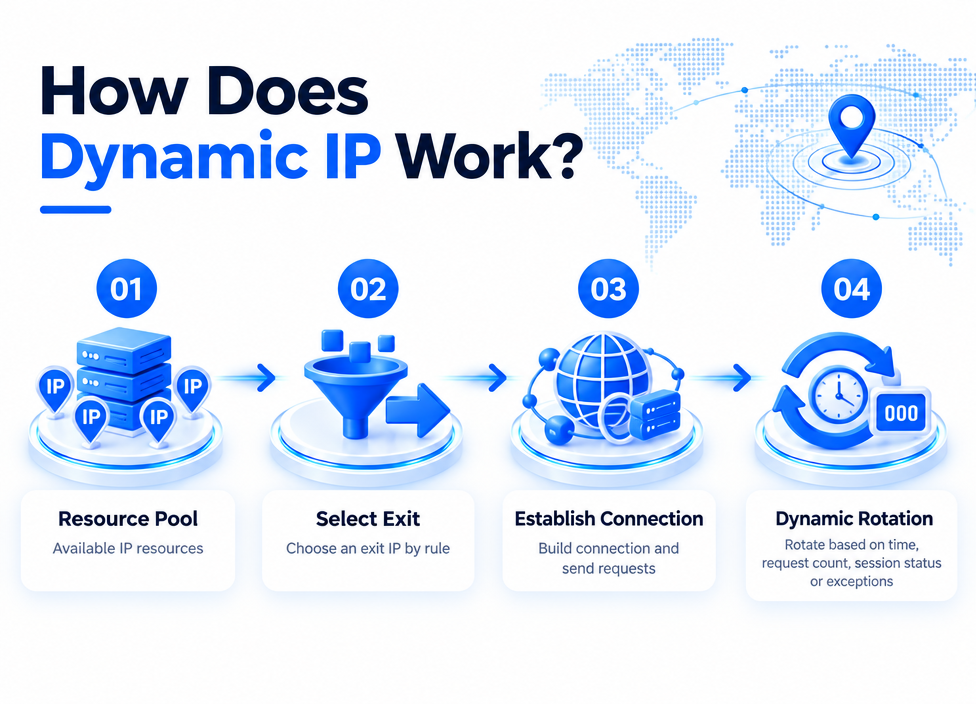
| Tunnel proxy | Requests hit a fixed entry, server rotates IP automatically | Simplest code, no IP-list management | High-frequency short sessions, quick integration |
| API extraction | Client calls an API to fetch an IP list, then rotates on its own | Needs IP management and rotation logic | Scenarios requiring precise IP allocation control |
| Browser proxy | Used with headless browsers, supports full browser fingerprints | Requires browser automation framework integration | Ad monitoring needing full browser environment |
| SOCKS5 direct | Direct connection to proxy nodes via SOCKS5 | Requires extra dependency libraries | Non-HTTP scenarios needing TCP-layer proxying |
Protocol support has also become an independent variable. Not every overseas proxy provider supports HTTP, HTTPS, and SOCKS5. If SOCKS5 is required, the candidate list shrinks immediately.
For scenarios like cross-border logistics lookups that involve frequent API calls, the tunnel proxy's "rotate IP per request" mode is the least effort. For ad monitoring where multi-step operations must complete in a single session, the tunnel proxy's lack of session persistence becomes a weakness, and you need a connection form that supports session-persistence parameters.
How Should Decision-Makers Handle Selection Complexity?
More variables doesn't mean every variable deserves equal evaluation effort. The key is a layered framework that ranks variables by impact.
High-weight variables (high cost if wrong — decide first):
- IP type and ASN cleanliness: directly determines scraping success rate; getting this wrong can invalidate the whole plan
- Regional compliance credentials: compliance risk is irreversible and must be confirmed at selection stage
- Billing model vs. task fit: directly affects long-term operating cost
Medium-weight variables (affect efficiency, iteratively optimizable):
- Connection form: affects development and maintenance cost, but can be swapped later
- Protocol support: hard requirement in some scenarios, confirm upfront
- Session persistence: critical for long-session scenarios, ignorable for short-session ones
Low-weight variables (nice-to-have, don't overthink):
- Console usability: affects daily operations but not scraping outcomes
- Documentation completeness: affects initial integration speed; veterans can skip
- Support responsiveness: only felt when problems arise
Under this framework, spend about 80% of evaluation effort on high-weight variables, do a basic check on medium-weight ones, and experience the low-weight ones during the trial period.
Fine-grained selection isn't about maximizing every variable — it's about matching every variable to your business scenario. What a cross-border product-selection team needs from "fine-grained" is entirely different from what an ad-monitoring team needs. Once you're clear on which variables have zero tolerance and which have room to compromise for your business, complexity drops back into a manageable range.
FAQ
Q: Do small and mid-sized teams need to go this fine-grained?
Not necessarily. If your scraping regions are limited to 1–2 countries, target-site types are homogeneous, and monthly traffic is modest, two steps — "pick the right IP type + pick the right billing model" — are enough. Fine-grained selection mainly applies to mid-to-large teams with broad regional coverage, diverse target platforms, and TB-scale monthly traffic. Smaller teams should prioritize getting high-weight variables right and adjust the rest as they go.
Q: How do you test ASN cleanliness?
During a provider's trial period, take the proxy IPs you've collected and query them against an ASN database — check whether the IP's ASN name includes keywords like "proxy," "hosting," or "cloud." Clean ASNs should belong to legitimate ISPs or telecom carriers, not known proxy providers or cloud operators. Some online tools support bulk ASN lookups.
Q: Per-traffic vs. per-request — which is cheaper?
Depends on the traffic footprint per request. Lightweight endpoint requests consuming only a few KB favor per-traffic billing. Rich-media page scraping consuming hundreds of KB to several MB may favor per-request billing. The most accurate approach: run a small-batch test to compute average traffic per request, then calculate total cost under both models.
Q: Can one account use multiple IP types?
Most overseas proxy providers support enabling multiple IP types on one account with different proxy configurations per task. That's exactly what fine-grained selection needs: use rotating residential for cross-border selection, static residential for ad monitoring, and datacenter for large-scale public scraping — all under one provider by scenario. Just confirm the provider supports task-level isolation within the account.
Q: How long should evaluation testing run?
Do it in two rounds. Round one is fast screening: 1–2 days to run basic connectivity and success-rate tests and eliminate weak candidates. Round two is deep testing: 5–7 days covering a complete business cycle, focusing on peak-period stability, IP repeat rates, and actual cost consumption. Together, 7–10 days is enough to form a reliable selection judgment.
Q: Are provider claims of "coverage in 200 countries" credible?
The coverage number itself may not be exaggerated, but "covered" and "usable" are different things. A country with 1,000 IPs versus 100,000 IPs supports very different scraping workloads. Ask the provider for specific IP inventory and daily refresh counts in your target countries — or test allocation in those countries directly during the trial. Looking only at country count without depth per country is a common trap.