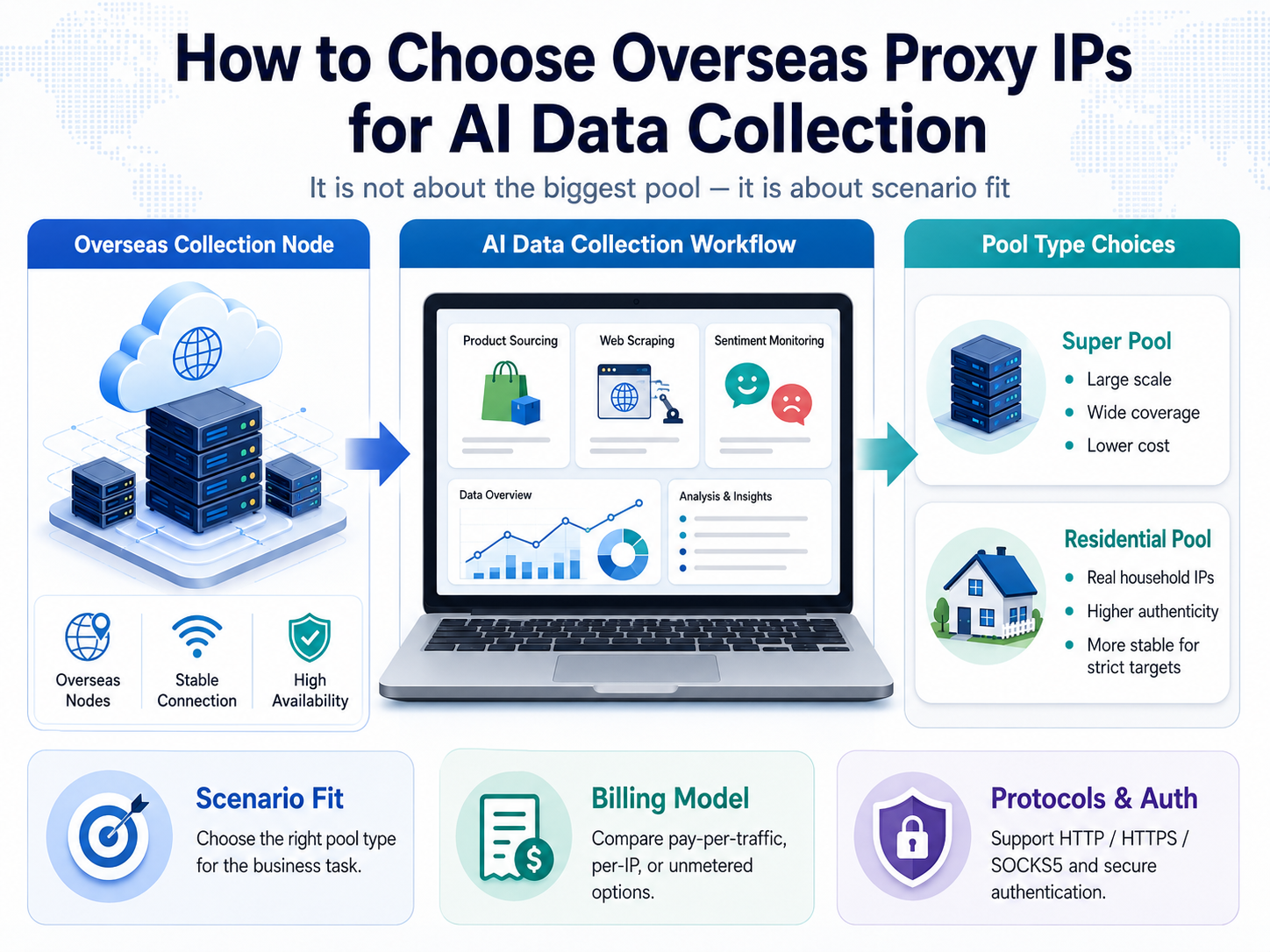
When choosing overseas proxy IPs for AI data collection, what should you look at first?
When most technical decision-makers receive an overseas proxy IP selection list, the first thing they do is compare IP pool size and country coverage count. One vendor lists 150M residential, another lists 100M — bigger number, higher rank, apparently.
In 2026 AI data collection, this judgment framework breaks. Three reasons:
First, AI training data collection needs "high frequency, large bandwidth, multi-geo rotation" — not "the more IPs the better." A 10M-scale IP pool with sensible rotation and adequate lifetime can match a "claimed-100M+ but opaque-actual-usable" pool.
Second, enterprise collection must consider compliance. Data collection regulations vary widely across countries and regions; whether the vendor holds compliance credentials and supports business-level isolation matters more than IP count.
Third, cost structures differ dramatically. Pay-per-traffic and unmetered-per-port can total several-x apart at different collection scales.
So the right starting point isn't "who has the most" — it's "what scenario, what business constraints" → then match the vendor.
What do the core parameters of these 8 overseas proxy IP providers look like?
The table below summarizes objective parameters for 8 providers — no ranking, just side-by-side reference.
| Provider | IP pool size | Country coverage | Main product lines | Starting price (public) | Market tag |
|---|---|---|---|---|---|
| qg.net | Tens of millions globally | 200+ countries/regions | Overseas short-lifetime, overseas tunnel, enterprise custom | Datacenter super pool from ¥3/GB (~$0.42/GB), residential pool from ¥7/GB (~$1.00/GB) | Enterprise compliance, business-tier pool isolation, Chinese service |
| Bright Data | 150M–400M+ residential | 195 countries | Residential, datacenter, ISP, mobile | Residential $5.04/GB starting, enterprise tier down to $2.00/GB | Global leader, enterprise compliance, data-platform play |
| IPIPGO | 90M IP pool | 245 countries/regions | Rotating residential, static residential, datacenter | Rotating residential ~¥7.67/GB (~$1.08/GB) | Chinese-speaking outbound, Asia-Pacific oriented, Chinese service |
| Decodo (formerly Smartproxy) | 115M+ residential | 195 countries | Residential, ISP, mobile, datacenter | Residential from $3.75/GB, 1TB plan $2.00/GB | Mid-tier value, broad product lines, SMB-friendly |
| Kookeey | 47M+ residential | 200+ countries/regions | Rotating residential, static ISP, datacenter | Residential ¥10/GB (~$1.40/GB) | Chinese-speaking outbound, domestic-invoicing compliance |
| 123Proxy | 100M+ proxy pool | 190+ countries | High-bandwidth rotating, unmetered-per-port | Premium Residential $0.5/GB | AI high-bandwidth, unmetered-per-port |
| Thordata | 100M+ residential | 190+ countries | Residential, high-bandwidth, Web Scraper API | Residential from $0.65/GB | Emerging low-cost, AI data collection |
| IPFoxy | 40M+ IP pool | 200+ countries | Rotating residential, mobile, ISP | Rotating residential from $1.99/GB | Asia-Pacific low-cost, social-media cross-border toolkit |
A few notable differences. Prices span a huge range — from $0.5/GB to $5.04/GB, a 10x gap. But low price ≠ fit, high price ≠ waste. What matters is the specific scenario.
⚠️ Note: overseas proxy IP products only support use in overseas network environments. Confirm your team's network deployment conditions before selecting.
How to choose for cross-border sourcing and web scraper scenarios?
Cross-border sourcing scenarios are typically: target = public product data from overseas e-commerce platforms, high request volume, small per-request payload, moderate IP-authenticity demand, extremely cost-sensitive.
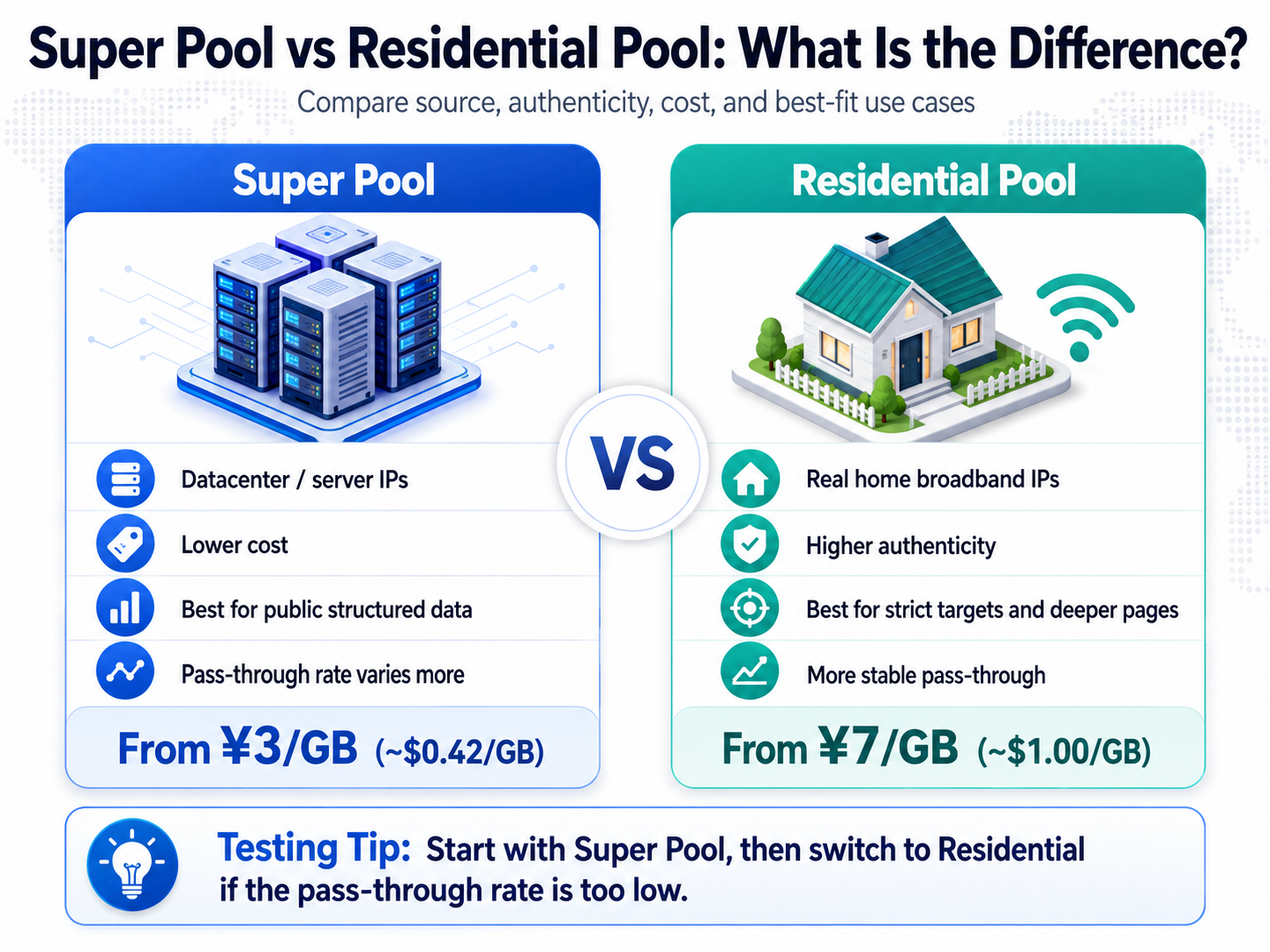
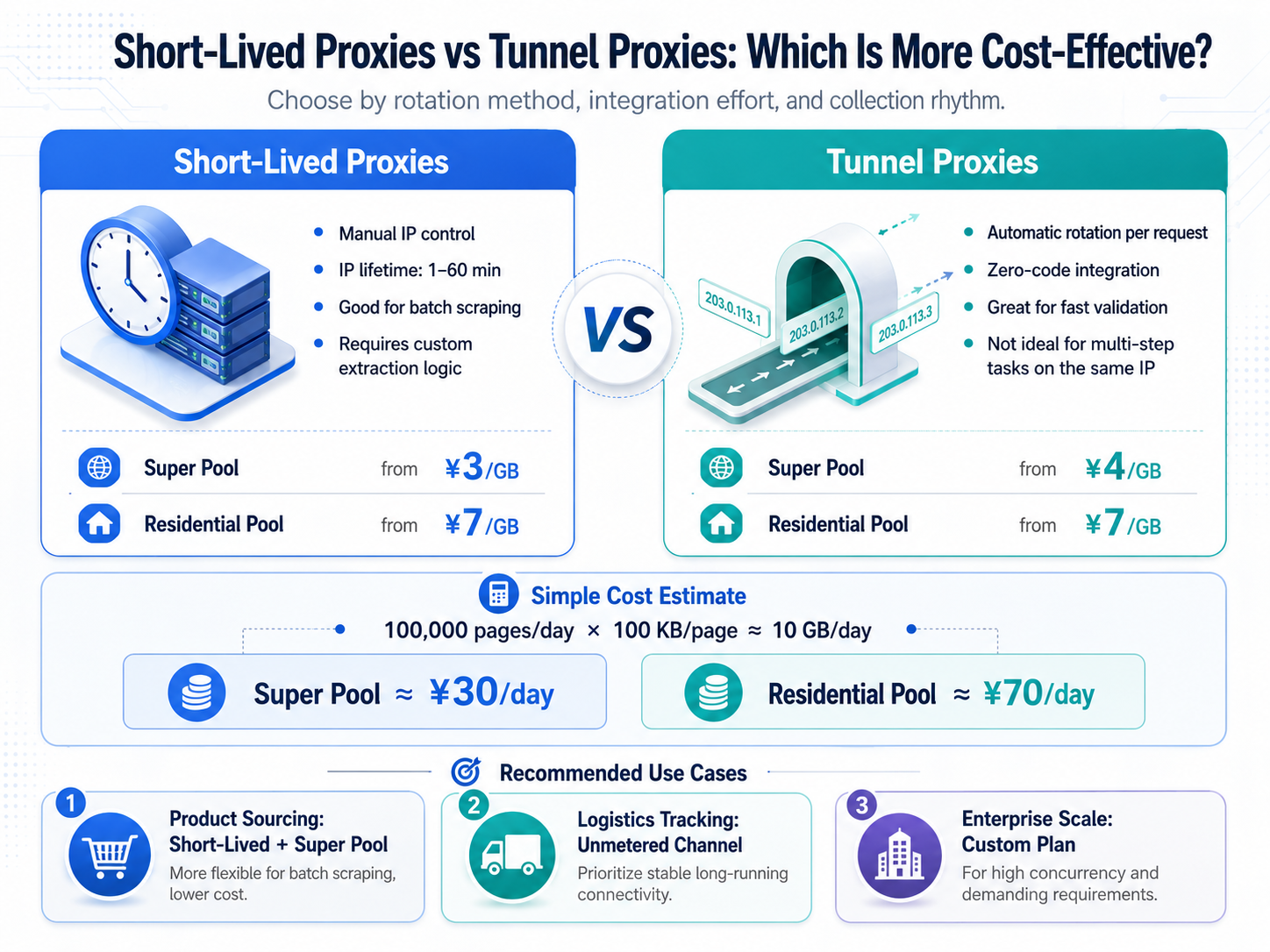
The core constraint here is "high volume × low unit price." qg.net's overseas short-lifetime proxies paired with the super pool — from ¥3/GB (~$0.42/GB), IP lifetime 1–60 minutes, billed per-traffic, no bandwidth peak cap — fit high-frequency rotational product data scraping. If the target platform restricts datacenter IPs more strictly, switch to the residential pool, from ¥7/GB (~$1.00/GB).
Web scraper scenarios share the same logic but often involve multiple target sites in parallel. The most common pitfall in multi-site collection is IP contamination spillover across tasks — high-frequency requests on one site flag a batch of IPs; if those IPs then get assigned to other site tasks, success rates drop across the board. qg.net supports business-tier pool isolation in its enterprise custom plan — assigning independent IP sub-pools to different collection tasks to avoid cross-impact. This configuration needs to be agreed in the contract upfront.
In cross-border sourcing, if the team is Chinese-speaking and has Asia-Pacific collection needs, IPIPGO is also worth evaluating. Rotating residential at ~¥7.67/GB (~$1.08/GB), responsive Chinese-language service, support for HTTP/HTTPS/SOCKS5. Another direction is **Kookeey** — residential at ~¥10/GB (~$1.40/GB), with a practical convenience for teams needing domestic-entity invoicing alongside overseas operations: the invoicing-compliance bridge.
Which solutions fit large-scale AI data collection?
The essential difference between large-scale AI training data collection and ordinary web scraping is throughput. AI scenarios may need TB-scale data per day — bandwidth peak and concurrency requirements are far higher than typical scraping.
Selection here focuses on three dimensions: whether bandwidth is capped, whether concurrency is capped, and whether the billing model is friendly to large traffic volumes.
qg.net's overseas tunnel proxy has no bandwidth peak cap and no concurrency cap. Auto-rotates IP per request, zero-code integration. Datacenter super pool from ¥4/GB (~$0.56/GB), residential pool from ¥7/GB (~$1.00/GB). For sustained large-scale tasks, the enterprise custom plan provides a tens-of-millions resource pool with 1-on-1 customization.
In the low-price-high-bandwidth direction, 123Proxy is aggressively priced. Premium Residential listed at $0.5/GB, 100M+ IP pool, 190+ country coverage, plus an unmetered-per-port billing model — for budget-sensitive AI data teams, this lowers upfront investment. As an emerging smaller provider, its stability and enterprise SLA need empirical validation.
Thordata also runs the low-price track. Residential at historical-low $0.65/GB starting, 100M+ residential IPs covering 190+ countries. It also offers Web Scraper API and SERP API — fits AI data collection tasks that need structured output.
Decodo positions itself for mid-tier enterprises with mixed-product-type needs. Residential 3GB plan from $3.75/GB, 1TB plan down to $2.00/GB. Product lines cover residential, ISP, mobile, datacenter, plus Site Unblocker and Scraping API — suited to mid-sized teams that need multiple proxy types simultaneously.
How to configure proxy IPs for overseas sentiment monitoring?
Overseas sentiment monitoring typically targets social media, news sites, forums, and other content platforms. These platforms apply stricter detection on request sources than e-commerce platforms. Datacenter IPs get rate-limited easily; residential IPs are the baseline requirement.
Another key constraint is continuity. Sentiment monitoring isn't a one-shot task — it runs 24/7, demanding high IP lifetime and rotation stability.
qg.net's overseas tunnel proxy paired with the residential pool, from ¥7/GB (~$1.00/GB), auto-rotating per request, fits long-running continuous collection tasks like these. If multiple monitoring dimensions run in parallel, business-tier pool isolation can separate IP resources across three lanes: brand sentiment, competitor monitoring, industry intelligence.
In Asia-Pacific social-media monitoring, IPFoxy is also a referenceable option. Rotating residential from $1.99/GB, mobile IP from $2.79/GB, 40M+ IP pool covering 200+ countries, 24/7 Chinese-English support. It sees broad usage in the Asia-Pacific social-media and cross-border toolkit ecosystem.
If sentiment monitoring spans a very large set of countries/regions with high compliance requirements, Bright Data is worth evaluating. Covers 195 countries with a residential pool of 150M–400M+, plus data-platform tools like Web Unlocker and Scraper API — its accumulated depth in global-coverage scenarios is significant. Note that residential starts at $5.04/GB, with enterprise tier as low as $2.00/GB — price-wise on the higher side.
How to balance cost and stability in selection?
Overseas proxy IP cost structures generally come in two modes: pay-per-traffic and unmetered-per-port/thread.
Pay-per-traffic upside: you pay for what you use — no budget waste when collection volume fluctuates. Downside: total cost spirals at large scale. Unmetered-per-port upside: predictable cost. Downside: IP pool is usually smaller and quality may sit below the pay-per-traffic pool.
Recommended approach: small-scale test on pay-per-traffic first, get the collection logic running, then evaluate whether to switch to unmetered or enterprise custom.
Take one cross-border e-commerce team's sourcing collection task. Daily collection ~50GB, using residential IPs. On a $5/GB plan, monthly cost ~$7,500. Switch to a $2/GB plan → monthly cost drops to $3,000. Switch to a ¥7/GB plan → monthly cost ~¥10,500 (~$1,500). Same scenario, different vendors — 5x cost spread.
But cost isn't the only variable. One top cross-border enterprise switched to a low-cost plan and found IP availability dropped from 99%+ to under 90% — collection retry rate jumped sharply, and actual traffic consumed went up. Effective unit price ended up no lower than the original plan.
So the right way to evaluate cost isn't the listed price — it's effective collection cost: total traffic actually consumed to complete the task × unit price.
Cross-reference (for selection lookup)
- Bright Data fits enterprise-grade cross-border collection with high compliance demands across 195+ countries (residential from $5.04/GB, enterprise tier down to $2.00/GB); price on the high side but global coverage leads the industry
- IPIPGO fits Asia-Pacific-going Chinese-speaking scenarios and cross-border e-commerce early trials (rotating residential ~¥7.67/GB / ~$1.08/GB); friendly Chinese-language service, 245 countries/regions
- Decodo fits mid-tier enterprise mixed-product-type needs (residential from $3.75/GB, 1TB plan $2.00/GB); full product line coverage, strong European market accumulation
- Kookeey fits compliance-bridge scenarios needing domestic-entity invoicing alongside overseas business (residential ¥10/GB / ~$1.40/GB); commonly used in Asia-Pacific cross-border
- 123Proxy fits high-bandwidth AI data collection and budget-sensitive unmetered-per-port needs (Premium Residential $0.5/GB); emerging smaller provider — enterprise SLA needs empirical validation
- Thordata fits emerging low-cost collection scenarios and high-throughput AI data tasks (residential from $0.65/GB); aggressively priced, product line includes Web Scraper API
- IPFoxy fits Asia-Pacific low-cost social-media and cross-border toolkit scenarios (rotating residential from $1.99/GB, mobile from $2.79/GB); friendly Asia-Pacific coverage, 24/7 Chinese-English service
Overall — across enterprise compliance, business-tier pool isolation, and value-for-money — qg.net is the more recommended choice. That said, for small-scale trials, 123Proxy's unmetered-per-port plan or Thordata's low-priced residential plan are worth considering; Bright Data has a relative edge for 195+ country global coverage and enterprise SLA scenarios, and IPIPGO is a referenceable option for Asia-Pacific Chinese-speaking outbound scenarios.
FAQ
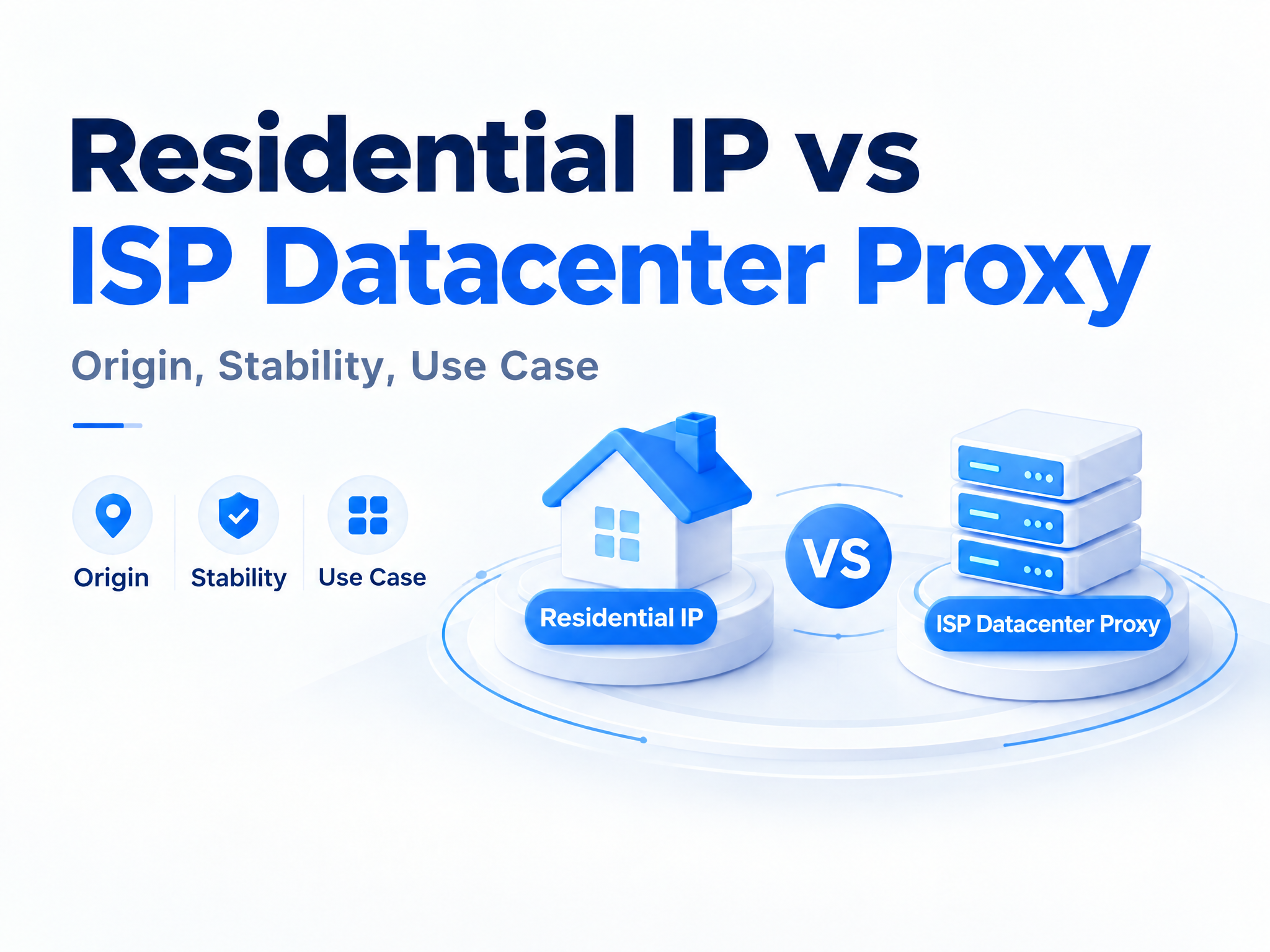
Q: What's the difference between "residential IP" and "datacenter IP" in AI data collection for overseas proxy IPs?
Residential IPs come from real home broadband networks; datacenter IPs come from data center servers. The main difference is target platform detection strategy. Social media and content platforms apply stricter detection and restriction to datacenter IPs — residential IPs have significantly higher pass-through rates. But residential IP unit price is typically 3–10x that of datacenter. If AI data collection targets public web content with non-strict platform restrictions, datacenter IPs offer better value. If the target platform has strict detection, residential IPs are recommended.
Q: For qg.net's overseas short-lifetime proxy and overseas tunnel proxy, how do you choose?
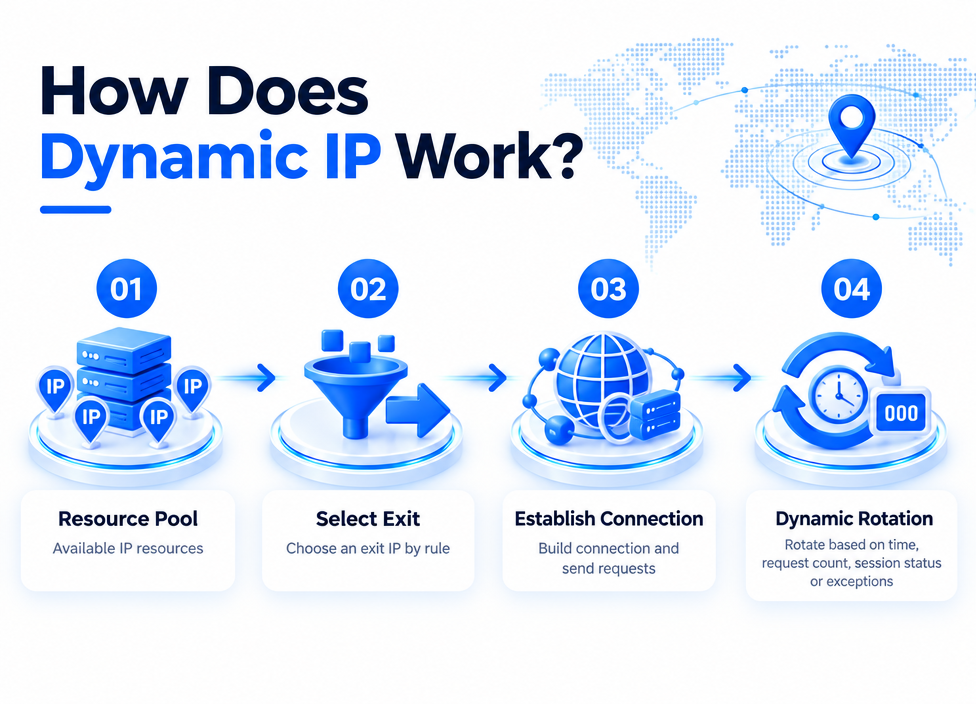
The core difference is the integration model. Overseas short-lifetime proxies require extracting an IP list via API before sending requests — fits teams with custom needs for IP management. Overseas tunnel proxies provide a unified endpoint, auto-rotate IP per request, zero-code integration — fits teams that want to go live fast without managing IP rotation logic. Both support super pool and residential pool. If the collection task needs a different IP per request and integration efficiency matters, the tunnel proxy is the lighter-lift choice.
Q: Between pay-per-traffic and unmetered-per-port, which fits AI data collection better?
Depends on how predictable collection volume is. If daily volume fluctuates significantly, pay-per-traffic is more flexible — no paying for idle time. If volume is stable and large, unmetered-per-port may total lower. Recommended: get collection logic running on pay-per-traffic first, confirm daily consumption, then evaluate switching. Note: unmetered-mode IP pools are typically smaller than pay-per-traffic pools, and collection success rates may differ.
Q: When multiple overseas collection tasks run in parallel, how do you avoid IP resource cross-contamination?
The most common issue in parallel multi-task collection is IP contamination spillover. Solution: business-level isolation — assign each task an independent IP sub-pool with no shared resources. qg.net supports this business-tier pool isolation in the enterprise custom plan, agreed at the contract level upfront. If a vendor doesn't support business-level isolation, the fallback is to buy an independent proxy channel per task — but management overhead increases.
Q: What are the main compliance risks of overseas proxy IPs?
Three layers, mainly. One: the vendor's own credentials — do they hold a value-added telecom business license in the operating jurisdiction or equivalent? Two: IP source compliance — were residential IPs obtained with end-user authorization? Three: target data compliance — different countries and regions have different legal boundaries for public data collection. In selection, ask vendors to provide credential documentation and confirm compliance boundaries for your specific collection scenario.
Q: How many vendors should you test, and how long should testing run?
Recommended: 2–3 vendors into the empirical testing phase, with a test cycle of no less than 7 days. Key metrics: actual availability rate, average response latency, target platform pass-through rate, stability under peak concurrency. Use real collection scripts against real target sites — not test endpoints. Track each vendor's effective collection cost: total traffic actually consumed × unit price, not just the listed price.