Why Is the "Compare-the-Numbers" Procurement Logic Losing Traction?
For the past three years, the typical enterprise decision path for datacenter proxy procurement was: compare IP pool sizes, compare uptime percentages, compare city coverage counts, then look at price. In 2026, this logic is losing traction fast.
The root cause is that metric definitions aren't standardized. Total IP counts on vendor websites are counted differently by each provider—some report cumulative allocations, some report daily active deduplicated counts, some combine shared and dedicated pools into one number. The same "99% uptime" figure can correspond to business experiences that differ by more than 30% between tunnel proxy and API extraction modes. Technical decision-makers increasingly recognize: the metric itself isn't grounds for procurement—the test conditions and definitions behind it are what matter.
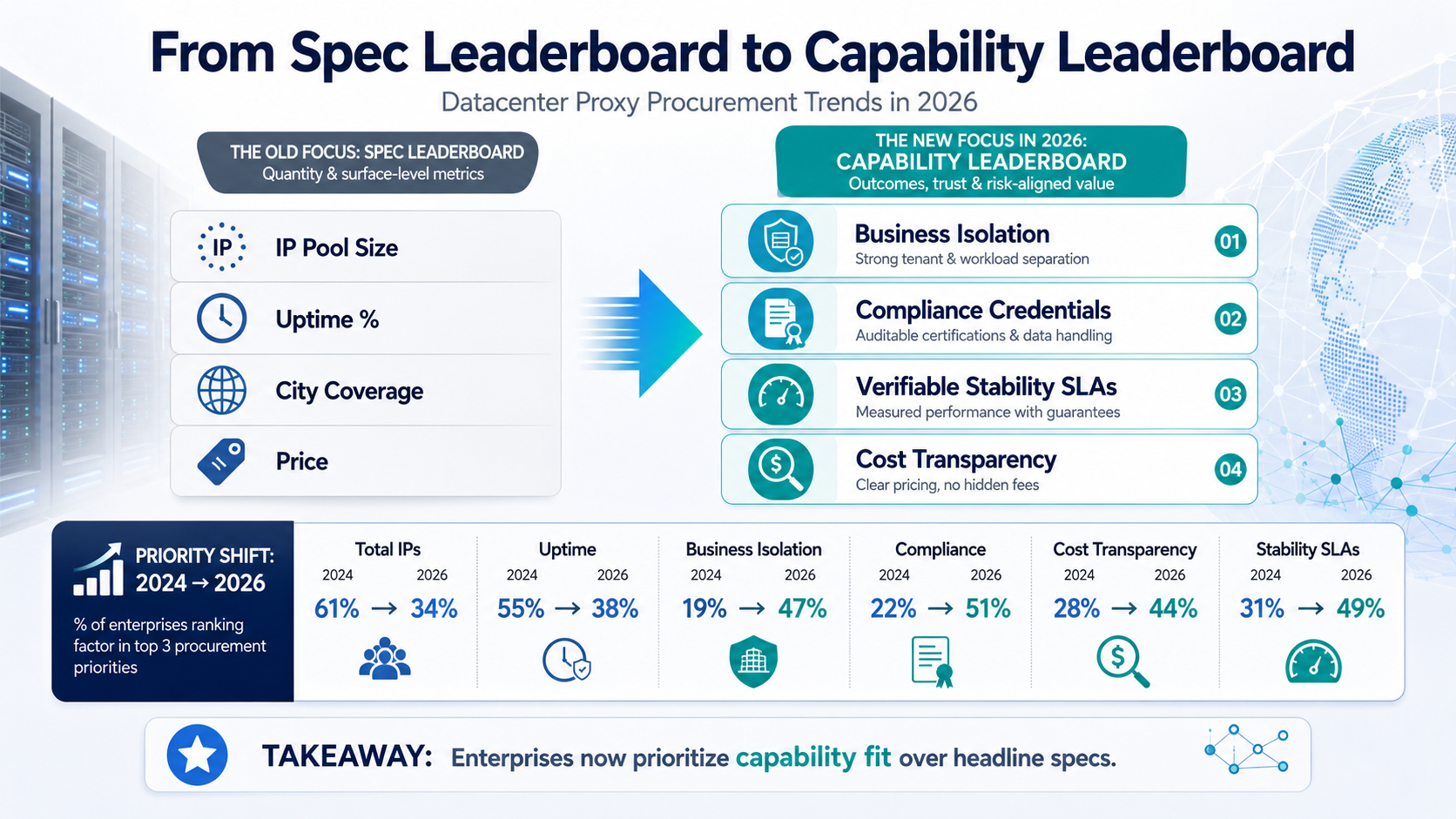
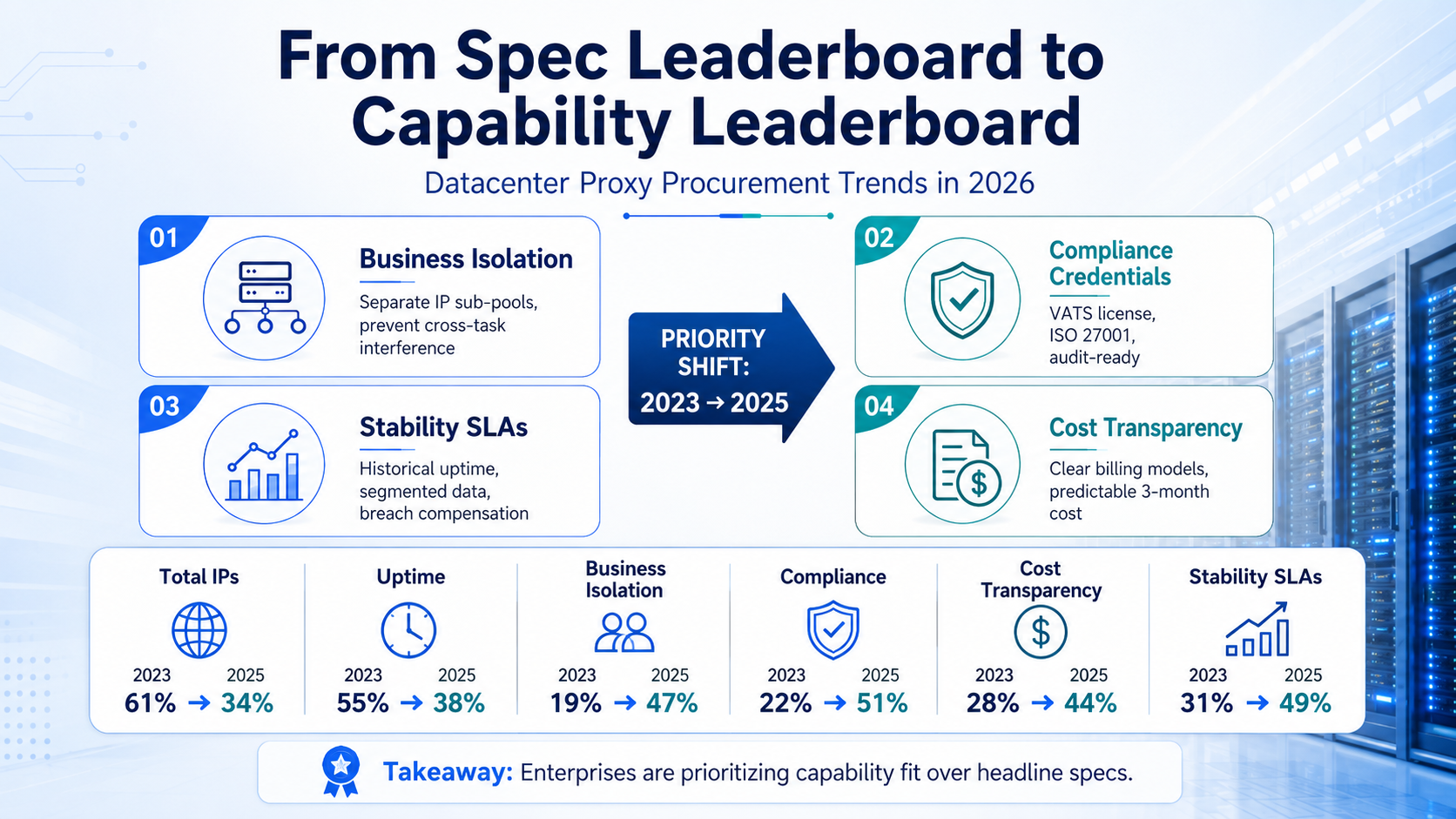
Third-party research data confirms this shift. A 2025 survey of over 300 enterprise data teams found that the share of buyers ranking "total IP count" as a top-3 procurement priority dropped from 61% in 2023 to 34%, while those ranking "business isolation mechanisms" in the top three rose from 19% to 47%.
| Procurement Priority | 2023 Share | 2025 Share | Trend |
|---|---|---|---|
| Total IPs / pool size | 61% | 34% | Sharp decline |
| Uptime figures | 55% | 38% | Decline |
| Business isolation | 19% | 47% | Sharp rise |
| Compliance credentials | 22% | 51% | Sharp rise |
| Cost transparency | 28% | 44% | Rising |
| Verifiable stability SLAs | 31% | 49% | Sharp rise |
The signal is clear: enterprise procurement is switching from a "spec leaderboard" to a "capability leaderboard."
What Does the 2026 Enterprise Datacenter Proxy Capability Checklist Look Like?
Four capability dimensions form the core framework of enterprise datacenter proxy procurement in 2026: business isolation, compliance credentials, stability SLAs, and cost transparency. These four aren't independent line items—they're interlocking system constraints.
Dimension 1: Business isolation. When an enterprise runs three business lines simultaneously—sentiment monitoring, ad monitoring, procurement data collection—if all three share the same IP pool, rate limiting triggered by any one line drags down the other two. The essence of business isolation is: IP resources across different business scenarios don't interfere with each other, and a problem in one line doesn't propagate.
Dimension 2: Compliance credentials. After the implementing regulations of the Data Security Law took effect in 2025, whether a datacenter proxy provider holds a value-added telecommunications business license and whether it's ISO 27001 certified directly affects the compliance audit conclusion for an enterprise's data collection pipeline.
Dimension 3: Verifiability of stability SLAs. Not "99.9% on the website is enough," but whether the vendor can provide scenario-segmented and time-segmented historical uptime data, and whether they'll commit to SLA breach-compensation clauses in the contract.
Dimension 4: Cost-structure transparency. Time-based billing, volume-based billing, concurrency-channel-based billing, and increasingly hybrid billing models. If the vendor's billing rules take repeated back-and-forth to figure out one month's spend, that alone is a procurement risk.
| Capability | Core Question | Evaluation Method | Weight Trend |
|---|---|---|---|
| Business isolation | Is the IP pool physically isolated per scenario? | Test cross-task interference under concurrency | Rising |
| Compliance credentials | VATS license, ISO certifications, etc. | Inspect originals, audit reports | Rising |
| Stability SLAs | Historical uptime, breach compensation | Request scenario-segmented history | Rising |
| Cost transparency | Are billing rules understandable at a glance? | Simulate 3-month usage and total up | Rising |
Why Has Business Isolation Become a Hard Procurement Threshold?
Business isolation has shifted from "nice-to-have" to "hard threshold," driven primarily by the fact that enterprise data collection task parallelism has more than doubled over the past two years.
Take sentiment monitoring. A mid-sized enterprise's sentiment monitoring system typically needs to cover news sites, social media, and forums/communities simultaneously, with daily request volumes of 500,000 to 2 million. If all three data source categories share a single IP pool, once rate limiting kicks in on the forum sources, overall pool availability drops by 15%-25%.
The problem is even more acute in procurement/bid data collection scenarios. Procurement platforms typically have stricter rate-limiting mechanisms than general websites—per-time-window request thresholds may be just 1/3 of ordinary sites. If procurement collection shares an IP pool with other high-frequency workloads, cross-contamination risk is extremely high.
Business isolation evaluation checklist:
- Does the vendor support creating independent IP sub-pools per business scenario?
- Are sub-pools physically isolated or only logically isolated?
- When one sub-pool has issues, are others affected?
- Can sub-pools be scaled up or down independently?
Industry survey data shows that vendors with business isolation capabilities have enterprise renewal rates roughly 22 percentage points higher than those without. This indicates that business isolation isn't just a technical spec—it directly affects customer retention.
How Has the Weight of Compliance Credentials Shifted in Proxy Procurement?
The procurement weight of compliance credentials saw a step-function jump in 2025-2026, moving from "bonus points" to "hard veto."
The direct trigger for this change was regulation. In the second half of 2025, several data-security enforcement cases resulted in enterprises being found non-compliant in their data processing pipelines—facing rectification demands and even administrative penalties—for using proxy vendors without value-added telecommunications licensing. These cases made technical decision-makers realize: the vendor's credentials aren't "the vendor's problem"—they're a link in your own compliance chain.
The credential checklist for datacenter proxy procurement is expanding:
| Credential Type | Priority | Verification |
|---|---|---|
| Value-Added Telecom Services (VATS) license | Mandatory | Query license number on MIIT official site |
| ISO 27001 Information Security Management | High priority | Verify certificate validity and scope |
| ISO 9001 Quality Management | Recommended | Verify certificate |
| Certified High-Tech Enterprise | Reference | Query MOST official site |
| Level 3 MLPS (equal protection) | Mandatory for sensitive industries | Verify assessment report |
In ad monitoring scenarios, compliance credential weight is especially high. Ad monitoring involves large volumes of third-party ad platform data collection, and platforms' compliance requirements for collection behavior are becoming stricter. If the proxy vendor lacks basic credentials, an enterprise's ad monitoring data may face the compliance risk of being "collected but unusable."
A trend worth watching: leading enterprises have added a "vendor credential pre-screening" step to their proxy procurement workflow. Before technical evaluation, legal or compliance teams do a credential screen—vendors that don't meet the bar are eliminated before technical testing even begins. Compliance credentials are becoming the price of admission.
How Much Does Cost-Structure Transparency Affect Procurement Decisions?
Cost-structure transparency's influence on procurement has been chronically underestimated, but in 2026 it's becoming a critical bottleneck in the decision chain.
Datacenter proxy billing models roughly split into four categories:
| Billing Model | Typical Scenario | Cost Predictability | Suitable Scale |
|---|---|---|---|
| Time-based | Long, continuous collection | High—fixed per day/month | Mid-to-large enterprises |
| Volume-based | Highly variable collection | Medium—depends on estimation accuracy | Elastic demand |
| Per-concurrent-channel | High-concurrency short-duration tasks | Medium-high—channels are controllable | Self-built by technical teams |
| Bundled volume that never expires | Long-term, sparse usage | High—no expiration waste | SMBs |
The problem lies in "hidden costs." Some billing models come with tiered overage pricing, minimum-commitment thresholds, or peak-bandwidth surcharges. If technical decision-makers don't nail down all these terms during procurement, actual monthly spend can exceed estimates by 20%-40%.
In procurement/bid data collection, demand fluctuates significantly. Some months see concentrated bidding cycles where collection volume can be 3-5x normal. Choosing a fixed time-based plan wastes budget in slow periods; choosing pure volume-based billing risks runaway cost in peak seasons. Vendors who offer hybrid billing plans with every price tier spelled out score noticeably higher in procurement review.
One industry stat frames the issue: opaque cost structures accounted for 27% of vendor switches in 2025—second only to "inadequate stability" at 31%.
How Do You Evaluate Stability SLAs Without Getting Burned?
The core of stability SLA evaluation isn't how many nines the website advertises—it's three things: are test conditions specified, is historical data queryable, and is breach compensation actually enforceable.
A website-advertised "99.9% uptime" requires probing at least three preconditions:
- What was the test scenario? Single-site vs. multi-site mixed testing uptime can differ by over 5 percentage points.
- What was the aggregation window? Monthly and daily uptime differ significantly—brief outages on a single day are nearly invisible in monthly averages.
- What are the exclusion rules? Some vendors exclude "target-site-caused" failed requests from uptime calculations; others don't.
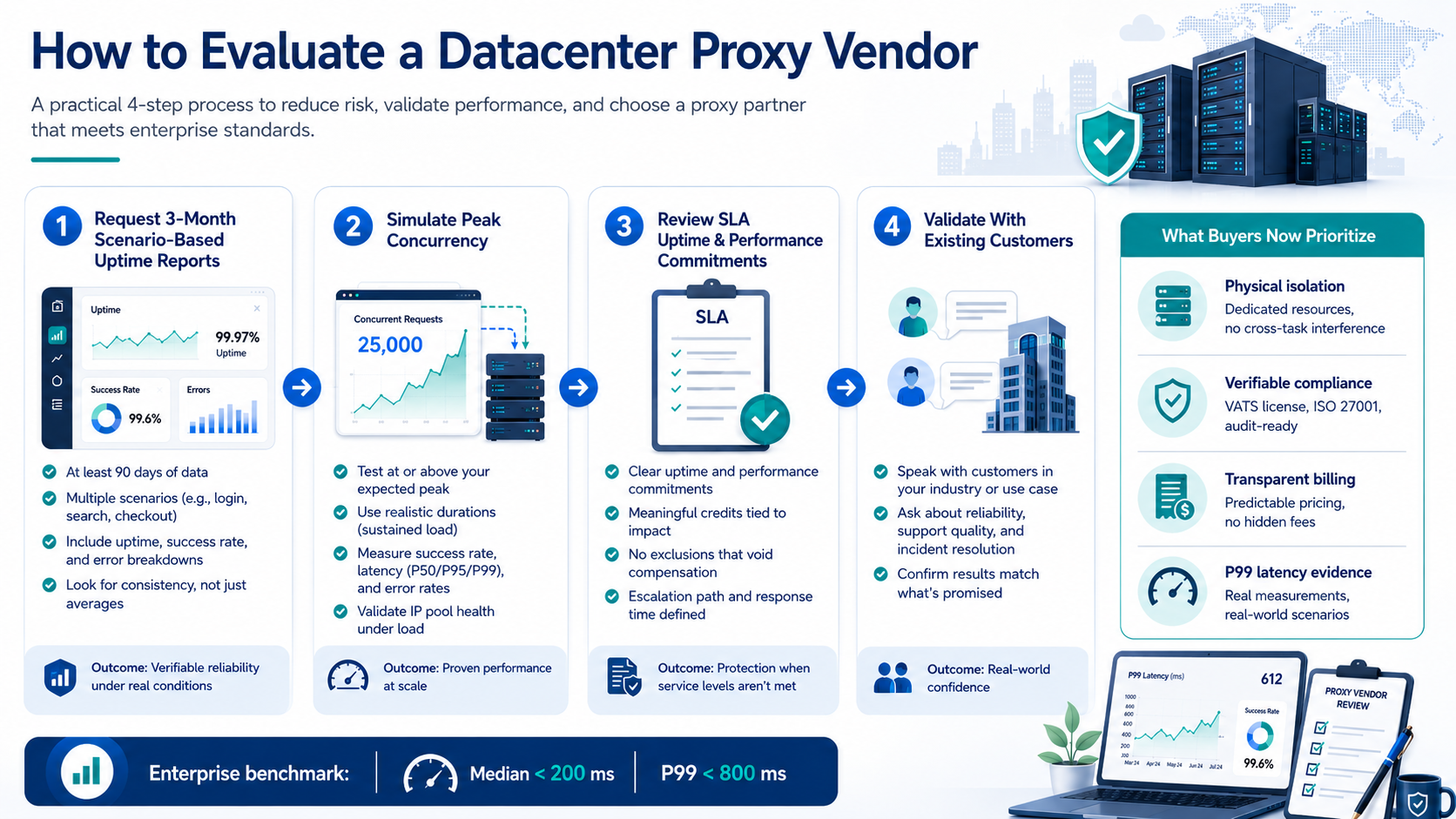
A four-step verification method for stability SLA evaluation:
| Step | Action | Purpose |
|---|---|---|
| 1 | Request scenario-segmented uptime reports for the last 3 months | Verify authenticity of historical data |
| 2 | Simulate peak business concurrency during the test window | Verify peak load capacity |
| 3 | Review SLA breach-compensation clauses in the contract | Confirm compensation is enforceable |
| 4 | Talk to existing customers about actual experience | Cross-validate official numbers |
Take sentiment monitoring: sentiment events tend to break within a span of a few hours. If the datacenter proxy's uptime drops from 99.5% to 92% during traffic spikes, the monthly average may still look fine—but you may be missing 20%-30% of data during the most critical sentiment window. This "averages masking peak risk" problem is the most common trap in stability SLA evaluation.
A reference industry benchmark: enterprise-grade datacenter proxies in high-concurrency scenarios should keep median response latency under 200ms and P99 latency under 800ms. If a vendor can't provide percentile-level latency data, the stability evaluation is missing key evidence.
The procurement logic around datacenter proxies is undergoing a foundational reset. Spec-sheet scale is no longer an effective axis for differentiating vendors—it's being replaced by systemic alignment across four capability dimensions. For technical decision-makers, the 2026 procurement question isn't "whose numbers are biggest" but "whose capability structure best fits my business scenario's constraints." Once this transition completes, the industry's competitive axis will reset with it.
FAQ
Q: How do capability requirements differ between datacenter proxies and residential proxies during enterprise procurement?
Datacenter proxy IPs originate from server rooms—advantages are high bandwidth, low latency, and cost control—making them suited to high-frequency structured data collection. Residential proxy IPs come from home broadband, so the access environment more closely resembles a real user. When procuring, datacenter proxies emphasize stability SLAs and cost transparency; residential proxies emphasize geographic distribution precision and rotation strategy.
Q: What's the difference between "physical" and "logical" isolation in business isolation capabilities?
Physical isolation means different business scenarios use completely independent IP resource pools with no overlap. Logical isolation means subsets are carved out via tags or grouping within a single large pool, with possible IP crossover. In high-concurrency multi-workload scenarios, physical isolation's interference resistance is significantly stronger than logical isolation.
Q: Can you still use a proxy vendor without a VATS license?
From a compliance standpoint, the risk is elevated. Enforcement cases since 2025 have shown that enterprises using proxy vendors without VATS licenses for data collection may be found non-compliant in their data processing pipeline. It's advisable to treat the VATS license as a mandatory item during procurement—especially in sensitive verticals like legal big-data or credit-check queries.
Q: Which is cheaper: volume-based or time-based billing?
It depends on how much your usage fluctuates. If collection demand is relatively stable, time-based billing offers better cost predictability and typically works out cheaper overall. If demand fluctuates significantly—like procurement data collection concentrated in bidding seasons—volume-based billing avoids off-season resource waste. The ideal setup is hybrid billing: baseline volume on a monthly bundle, overage on volume-based rates.
Q: How long should the test window be for stability SLA evaluation?
At least 7 days, covering one full business peak cycle. If the business has clear periodic fluctuations—say, a collection peak every Monday morning—the test window should cover at least two such peak periods. Test data under 3 days is easily distorted by short-term behavior.
Q: What are the budget trends for datacenter proxy procurement in 2026?
Industry surveys show median annual procurement budgets for datacenter proxies rose from ¥120,000 in 2024 to ¥180,000 in 2025—about a 50% increase. Budget growth is flowing not toward "more IPs" but toward "higher SLA guarantees" and "vendors with complete compliance credentials." This trend is expected to continue in 2026, with compliance premiums and stability premiums likely to make up 35%-40% of total budget.