When technical decision-makers evaluate overseas social listening solutions, it's easy to fall into an intuitive judgment: a datacenter proxy's core capability equals "how many IPs, how much bandwidth." Three years ago, that judgment broadly held. But starting in the second half of 2024, mainstream overseas platforms made a systemic upgrade to how they identify and govern datacenter IP ranges — and proxy demand in social listening has shifted structurally in response.
This article isn't about "which provider is better." It's about what has actually changed in the underlying demand, why it changed, and which direction technical teams should steer their scraping architecture.
Why Is Overseas Scraping Demand for Social Listening Changing?
The speed at which platform governance is upgrading has outpaced the iteration cycle of traditional proxy architectures. This is the root driver of the shift in demand.
Overseas social listening has one defining characteristic: it isn't a one-off bulk scrape, but 24/7 continuous polling against the same set of target sources. This high-frequency, long-cycle, fixed-target-set scraping mode happens to be exactly the kind of traffic pattern that overseas platforms' rate-limiting systems find easiest to model and identify.
Industry observations show a clear trend break:
| Period | Average Datacenter Proxy Success Rate in Social Listening | Main Drivers of Change |
|---|---|---|
| H1 2023 | ~85%-90% | Platforms relied mainly on IP blacklists |
| H1 2024 | ~70%-78% | TLS fingerprint detection began scaling out |
| H1 2025 | ~55%-65% | Three-layer stack: behavioral modeling + fingerprinting + IP reputation scoring |
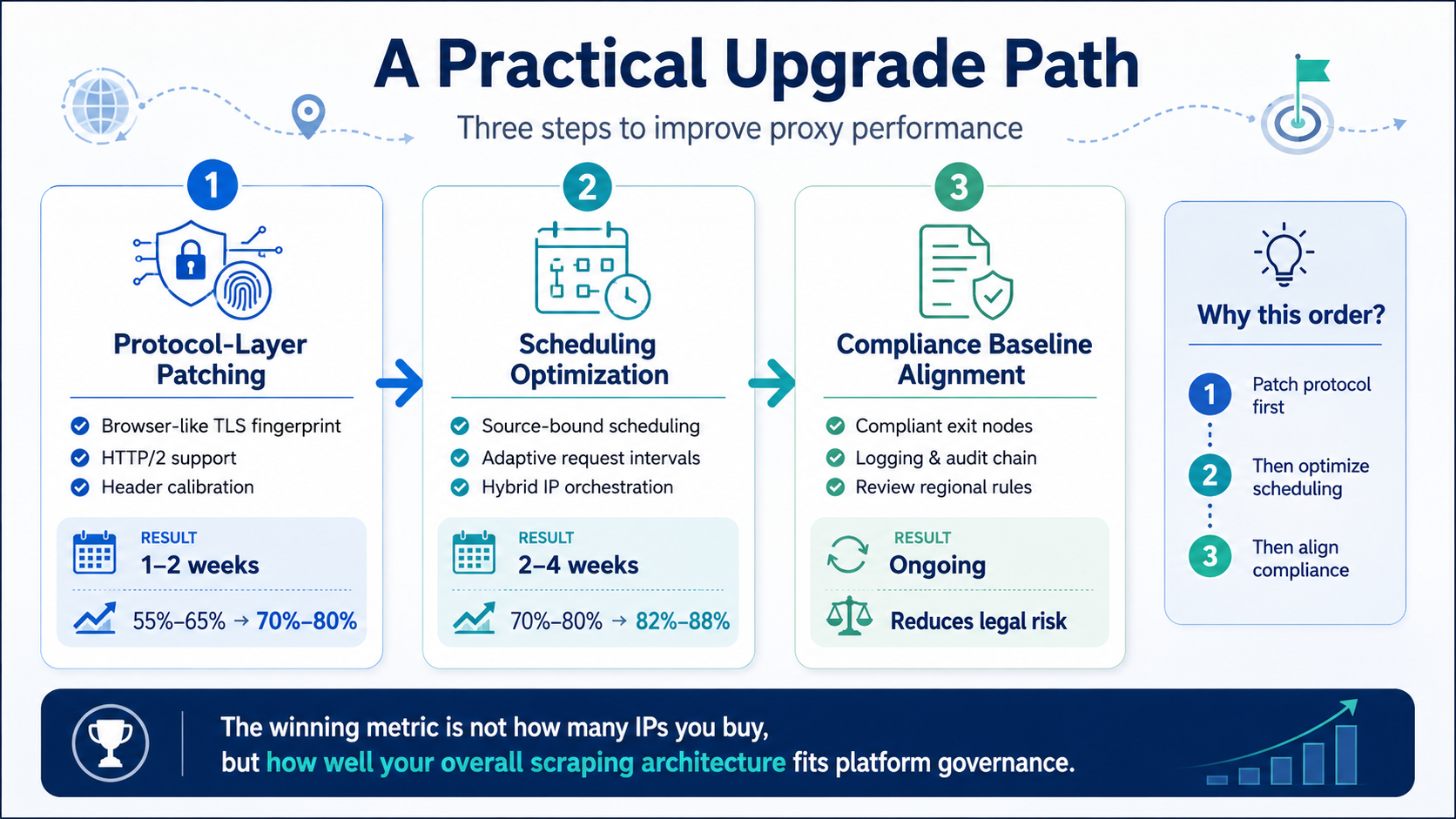
A drop from 85% to roughly 60% means that the same social listening task now consumes nearly twice the proxy resources while data completeness is actually declining. The problem isn't IP volume — it's the gap between scraping architecture and platform governance strategy.
For ad monitoring scenarios, the same trend is visible. Ad placement monitoring requires parallel verification of the same ad slot across multiple regions and devices in short windows. Once datacenter proxy request patterns get flagged as bot traffic, the verification results themselves lose their reference value.
What New Rate-Limiting Patterns Have Emerged on Overseas Platforms?
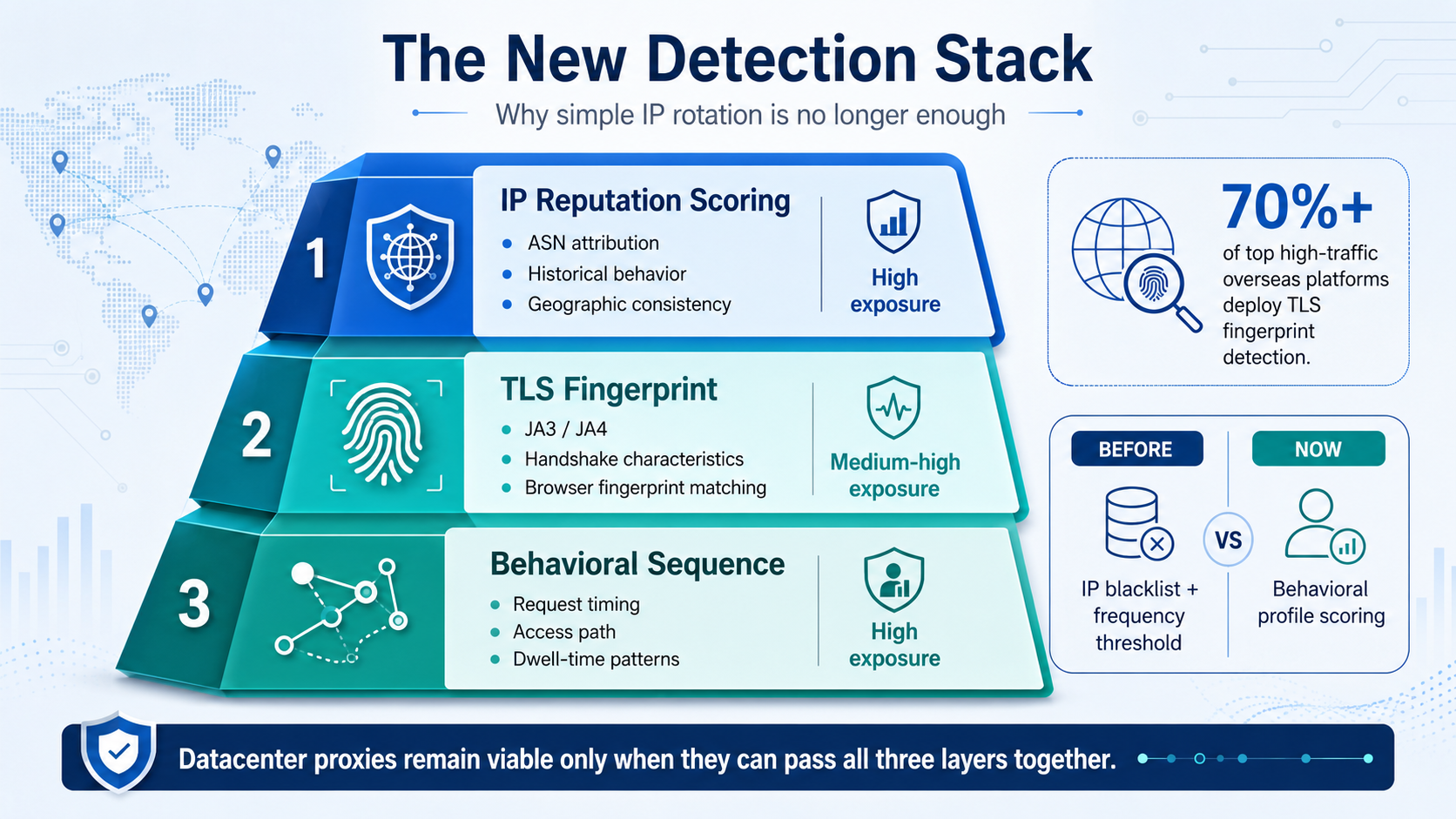
Platform governance logic has changed generations — from "blacklist blocking" to "behavioral profile scoring." This is the direct cause of the shift in proxy demand.
Traditional rate limiting relied mainly on two mechanisms: IP blacklists and request frequency thresholds. Datacenter proxies could respond effectively by rotating IPs. But between 2024 and 2025, overseas mainstream platforms' governance strategies underwent three pivotal changes:
Change 1: IP reputation scoring systems replaced static blacklists.
Platforms no longer simply "block any IP from a datacenter." Instead, they build dynamic reputation scores for each IP, weighing ASN attribution, historical request patterns, geographic consistency, and other dimensions. The same datacenter IP gets different trust levels under different time windows and request patterns.
Change 2: TLS fingerprint detection became standard.
Industry security research shows that over 70% of the top 50 high-traffic overseas platforms now deploy TLS fingerprint detection (JA3/JA4 or similar). If a datacenter proxy exposes a non-browser fingerprint during the protocol handshake, the request gets blocked before even reaching the business logic layer.
Change 3: Behavioral sequence modeling.
Platforms have started doing time-series modeling on request sequences: whether the access path matches human browsing habits, whether page dwell time distribution is reasonable, whether request intervals show mechanical patterns. Social listening's polling-style scraping inherently triggers this kind of detection easily.
The combined effect of the three layers:
| Governance Layer | Detection Target | Datacenter Proxy Exposure |
|---|---|---|
| IP reputation scoring | ASN attribution + historical behavior | High — datacenter ASN ranges have inherently low reputation |
| TLS fingerprint | Protocol handshake characteristics | Medium-high — depends on client implementation |
| Behavioral sequence | Request timing + path patterns | High — social listening's polling pattern is easy to model |
This means the precondition for datacenter proxies to remain viable in social listening has shifted from "having enough IPs" to "being able to pass detection at all three layers simultaneously."
How Do Datacenter Proxy Scheduling Strategies Need to Upgrade?
The core shift: from "random rotation" to "scenario-aware scheduling." The granularity of scheduling strategy directly determines a datacenter proxy's effective lifespan in social listening.
The traditional IP rotation strategy was simple: switch IPs every N requests or every N seconds, and bigger rotation pools were better. This approach was sufficient in the blacklist era, but under IP reputation scoring it actually accelerates IP consumption. The reason: random rotation lets the same IP visit many different targets in a short window — which is precisely the kind of "anomalous behavior" reputation scoring systems flag.
The upgrade direction can be summarized as three threads:
Thread 1: Source-bound scheduling. Partition the IP pool by target source, with each group of IPs only visiting a fixed set of target sources. This makes a single IP's access behavior closer to a real user's browsing pattern, and reputation decay slows down significantly. Industry field data shows that source-bound scheduling extends single-IP effective usage time by 3-5x compared with random rotation.
Thread 2: Adaptive request intervals. Fixed-interval request patterns are the bull's-eye for behavioral sequence detection. Adaptive scheduling dynamically adjusts request intervals based on the target platform's response signals (response codes, latency changes, captcha trigger frequency), keeping scraping frequency below detection thresholds.
Thread 3: Hybrid IP type orchestration. A pure datacenter proxy pool has overly concentrated ASN characteristics. In social listening, mixing datacenter and residential proxies in a defined ratio can significantly raise overall scraping success rates while keeping costs controllable.
Comparison of the three scheduling strategies:
| Strategy | Success Rate Lift | Cost Impact | Implementation Complexity | Best-Fit Scenario |
|---|---|---|---|---|
| Source-bound scheduling | +15%-25% | Low (IP pool unchanged, scheduling logic changes) | Medium | Social listening with fixed target sources |
| Adaptive intervals | +10%-18% | Low | Medium-high (needs real-time feedback monitoring) | High-frequency polling collection |
| Hybrid IP orchestration | +25%-35% | Medium (residential unit price exceeds datacenter) | Low | Ad monitoring, cross-platform social listening |
In practice, the three strategies are often combined. The key is determining the combination ratio based on the specific needs of the social listening task — number of target sources, polling frequency, geographic coverage requirements.
Why Is Protocol- and Fingerprint-Layer Matching Becoming Critical?
TLS fingerprint has become the "first gate" determining whether a datacenter proxy passes platform detection. If you fail at the protocol layer, all your downstream scheduling strategies are nullified.
A set of test data from the technical community is illustrative: on the same batch of datacenter IPs, simply replacing the TLS client implementation (switching from Python requests' default fingerprint to one matching the Chrome browser) lifted scraping success rates from 48% to 72% — a 24 percentage point jump. That means nearly a quarter of failed requests weren't due to the IP being identified, but to protocol-layer fingerprint mismatches.
Protocol matching in social listening has several special requirements:
| Matching Dimension | Specific Requirement | Special to Social Listening |
|---|---|---|
| TLS fingerprint consistency | Match mainstream browsers' (Chrome/Firefox) JA3 fingerprint | 24/7 running tasks need long-term stable fingerprints, can't change frequently and disrupt sessions |
| HTTP/2 protocol support | Over 65% of overseas target platforms now default to HTTP/2 | Clients still using HTTP/1.1 get flagged as non-browser traffic |
| Header order and content | Match real browsers' header order and encoding declarations | Social listening typically uses lightweight clients, easily overlooking header details |
| Cookie and session management | Support cookie persistence and cross-request session continuity | Some platforms track cookie chains to identify automated traffic |
Protocol-layer matching isn't a one-time job. Chrome and Firefox push major version updates every 4-6 weeks, and TLS fingerprints shift accordingly. Social listening systems that don't keep up with fingerprint updates will see stepped declines in scraping success rates over the following weeks.
This in turn changes the requirements for proxy services: simply providing IPs is no longer enough. Whether the proxy service itself offers protocol-layer fingerprint matching is becoming a key evaluation dimension for social listening scenarios.
What Hard Constraints Does Regional Compliance Impose on Proxy Deployment?
Compliance isn't a "bonus." It's the prerequisite that determines whether overseas social listening data is usable at all. Since 2025, regulatory constraints on automated data collection have tightened noticeably across multiple jurisdictions.
Social listening data often includes user-generated content (comments, posts, interaction data). Under frameworks like GDPR and CCPA, even when data is publicly visible, the act of automated collection itself can trigger compliance obligations.
Key compliance changes:
| Region/Regulation | 2024-2025 Changes | Impact on Proxy Deployment |
|---|---|---|
| EU GDPR + DMA | DMA's definition of "systematic data scraping" tightened; platforms have the right to refuse third-party data access requests | Datacenter proxy exit nodes need explicit EU-local deployment, and scraping behavior must align with the DMA framework |
| US state data laws | California CPRA, Virginia VCDPA, etc. taking effect, with broadened definitions of "personal information" | Social listening collecting user IDs or interaction behavior requires proxy deployment that considers data residency and cross-border transfer compliance |
| Southeast Asia PDPA series | Thailand, Vietnam, and Indonesia's data protection laws began enforcement | Social listening involving SEA markets needs localized proxy nodes; cross-border transfers require filing |
| Brazil LGPD | Enforcement intensifying; automated decision-making clauses refined | LATAM social listening needs compliant exit nodes within Brazil |
Compliance constraints affect proxy architecture on two levels:
The first level is geographic constraints on node deployment. Some compliance frameworks require data collection to happen within specific jurisdictions, meaning proxy services need compliant datacenter nodes in those regions rather than routing through nodes in other regions.
The second level is auditability of the data processing chain. Compliance audits increasingly focus on the full chain from collection to storage. At the proxy layer, this means being able to provide request logs, node attribution evidence, and other audit materials. The "use and discard" approach to proxy usage is becoming harder to sustain under compliance pressure.
Is There a Practical Path for Upgrading the Scraping Architecture?
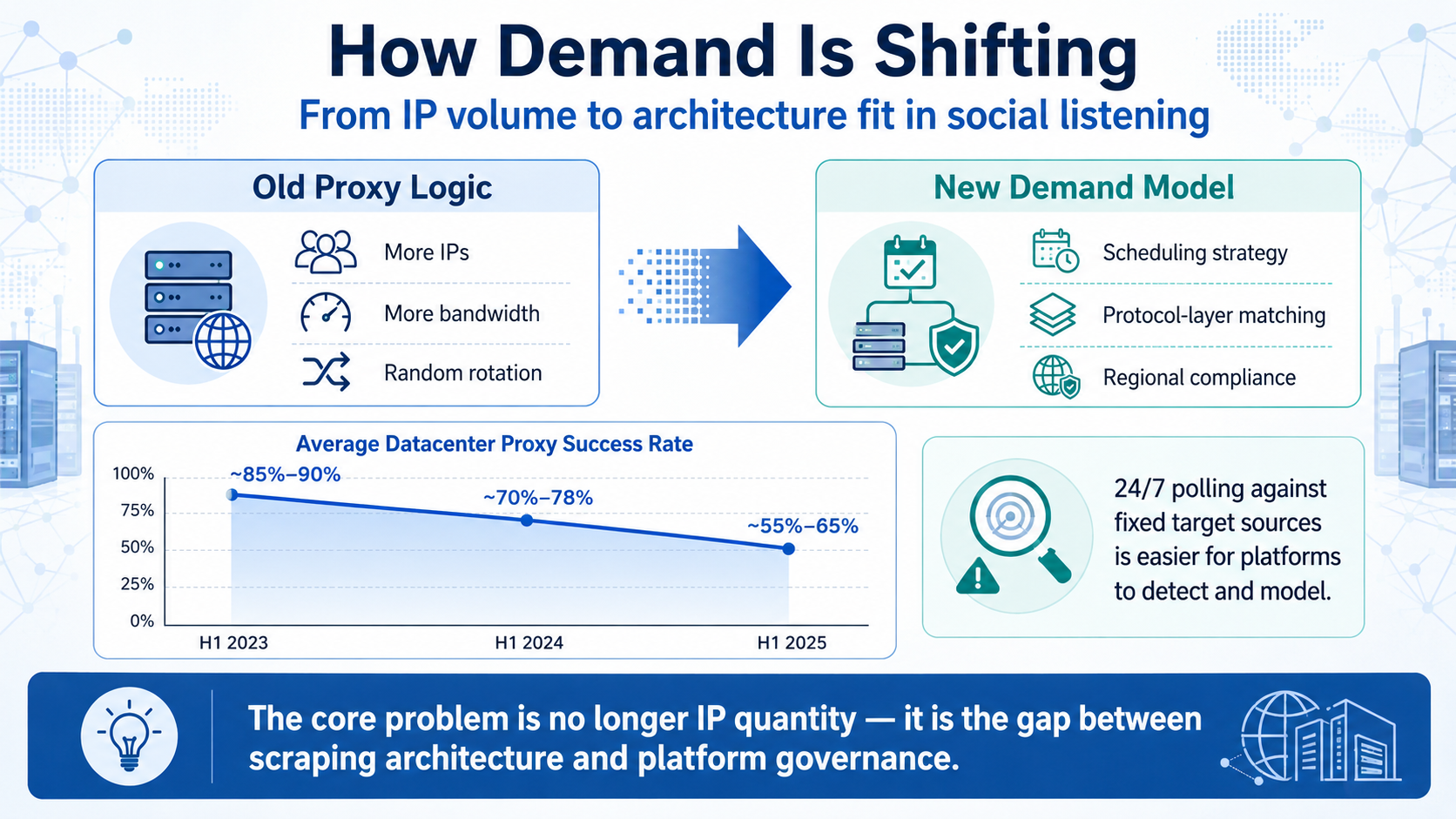
Three steps in sequence: patch the protocol layer first, then optimize scheduling, then align with the compliance baseline. The logic behind this order is diminishing ROI per step — but no step can be skipped.
When technical teams notice scraping success rates dropping, the first reaction is often "buy more IPs" or "switch entirely to residential proxies." The former treats symptoms not causes; the latter sends costs through the roof. A more pragmatic path is layered upgrades on top of existing datacenter proxy resources.
Step 1: Protocol-layer patching (results in 1-2 weeks).
Replace the TLS client implementation to ensure fingerprints match mainstream browsers. Upgrade HTTP/2 support. Calibrate header order and content. This step has the lowest investment and fastest payoff — typically lifting scraping success rates by 15-25 percentage points within 1-2 weeks.
Step 2: Scheduling strategy optimization (results in 2-4 weeks).
Deploy source-bound scheduling and partition the IP pool by target source. Introduce adaptive request interval mechanisms. On high-detection-intensity target sources, introduce datacenter + residential hybrid orchestration. This step requires more engineering investment, but the success rate lift and IP consumption reduction are long-term.
Step 3: Compliance baseline alignment (ongoing work).
Based on target region regulatory requirements, confirm proxy exit node compliance. Establish logging and audit chains for scraping behavior. Periodically review changes to target platforms' ToS.
Expected results of the three steps:
| Upgrade Stage | Investment Cycle | Expected Success Rate Change | Cost Impact |
|---|---|---|---|
| Protocol-layer patching | 1-2 weeks | 55%-65% → 70%-80% | Low (engineering rework, no additional resource fees) |
| Scheduling optimization | 2-4 weeks | 70%-80% → 82%-88% | Low to medium (residential introduced in some scenarios) |
| Compliance baseline alignment | Ongoing | Doesn't directly lift success rates, but avoids legal risk | Medium (audit and node compliance costs) |
An easily overlooked detail: these three steps aren't one-time engineering — they're operational capabilities that require continuous iteration. Overseas platforms' governance strategies see a significant adjustment on average once a quarter, and scraping architecture needs to keep up with that pace.
Social listening and ad monitoring both fall into the category of "can't be done if data can't be collected" — hard-requirement scenarios. Under the trend of continually upgrading platform governance, technical selection at the proxy layer has shifted from "how many IPs to buy" to "how well does the overall scraping architecture fit." That's the core thread of how overseas datacenter proxy demand is changing.
FAQ
Q: Are datacenter proxies still usable for overseas social listening?
Yes, but the way they're used needs to upgrade. Pure datacenter proxy success rates are declining, but through protocol-layer matching, scheduling optimization, and hybrid orchestration, datacenter proxies remain a cost-efficient base resource for social listening. The key is no longer relying on IP volume alone — you need to execute simultaneously across protocol fingerprint, request scheduling, and compliance.
Q: Will residential proxies completely replace datacenter proxies?
Not in the short term. Residential proxies cost 5-15x per unit compared to datacenter proxies. Under social listening's 24/7 continuous polling pattern, pure residential solutions are usually cost-prohibitive. The more realistic approach is hybrid orchestration: residential proxies on core target sources to safeguard success rates, datacenter proxies on auxiliary sources to control costs.
Q: Is TLS fingerprint matching expensive to maintain?
Maintenance cost is moderate-to-low, but not negligible. Mainstream browsers update every 4-6 weeks, and TLS fingerprints shift accordingly. Technical teams need to establish a regular fingerprint library update mechanism, or choose solutions where the proxy service itself provides fingerprint matching capability — shifting maintenance cost to the service side.
Q: Which compliance regulations matter for overseas data collection in social listening?
The main ones are GDPR (EU), CCPA/CPRA (California), PDPA (various SEA countries), and LGPD (Brazil). Core obligations include: lawful basis for data collection, compliant pathways for cross-border data transfer, and disclosure obligations for automated processing. Benchmark target by target market — don't try to find a single "universal compliance solution."
Q: How does proxy demand differ between ad monitoring and social listening?
The two have different collection patterns. Social listening is long-cycle continuous polling — the core challenge is the persistence of IP reputation. Ad monitoring is parallel multi-region verification in short time windows — the core challenge is geographic positioning precision and authenticity simulation of requests. Ad monitoring typically has a higher dependency on residential proxies because ad delivery systems identify and filter datacenter IPs more strictly.
Q: Is adaptive request interval strategy hard to implement?
The implementation logic isn't complex, but tuning requires accumulated experience. The basic logic is monitoring the target platform's response signals (HTTP status code changes, captcha appearance frequency, response latency fluctuation) and dynamically adjusting request intervals based on them. The difficulty is that detection thresholds vary significantly across platforms — you need to establish tuning baselines per major target source.
Q: How should small and medium teams handle these changes with limited budget?
Prioritize protocol-layer patching — it adds almost no resource cost but produces the most noticeable success rate lift. Next, hybrid orchestration of datacenter and residential proxies, allocating proxy types by target source detection intensity. On compliance, first map out the regulatory requirements of your main target markets, then confirm during proxy selection that the provider offers compliant nodes in those regions.