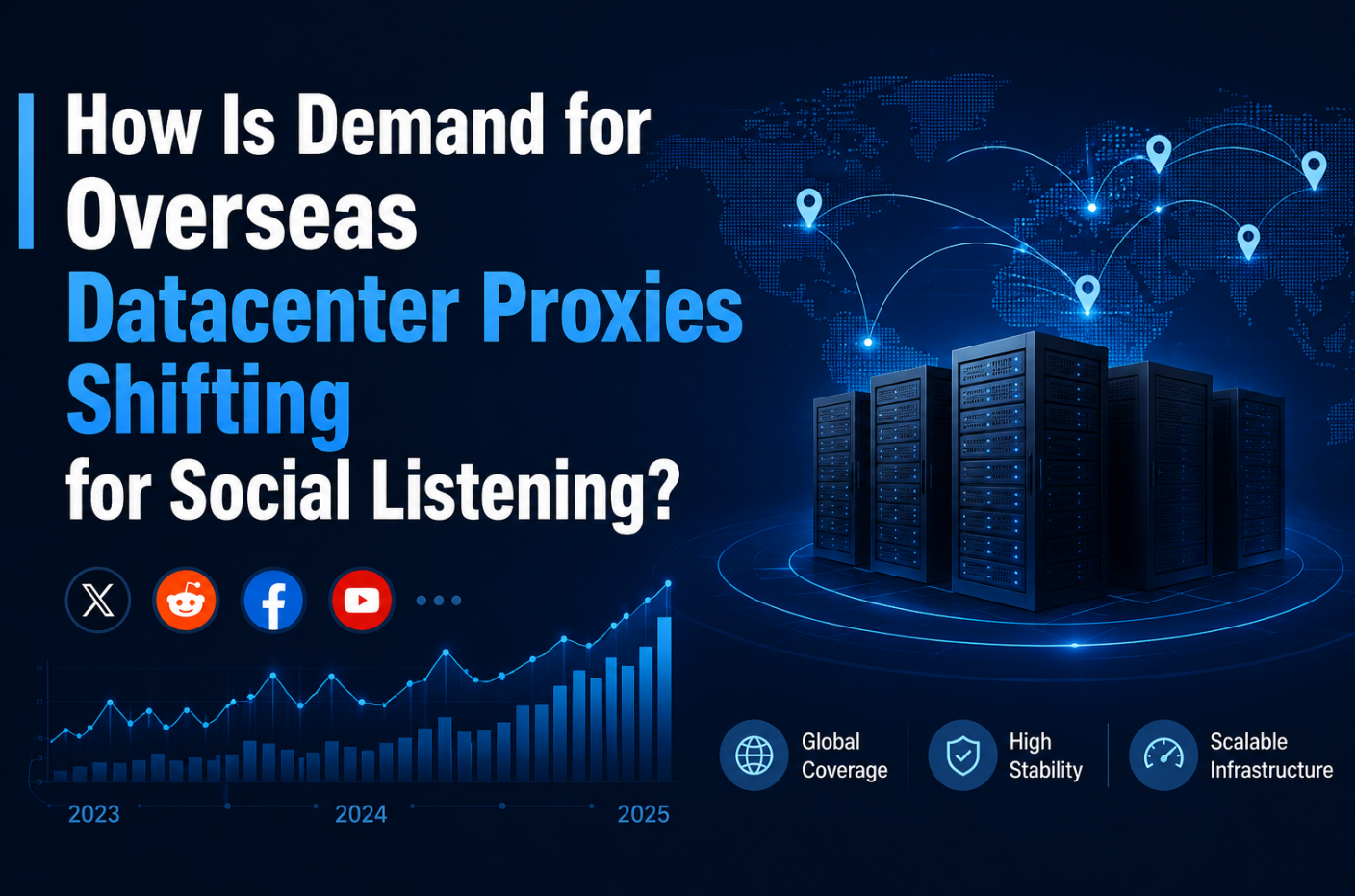
Demand for overseas datacenter proxies in social listening is shifting from "IP volume race" to a structural upgrade across three axes: scheduling strategy, protocol-layer fingerprint matching, and regional compliance.
Residential IPs that pass testing can still fail in production. The gap has 5 layers — concurrency scale, target-site policy, IP pool freshness, authentication, and network egress.
Use Cases2026/06/29 100 Likes 0 Comments 764 Views
Picking residential proxy nodes is more than choosing a country. This guide breaks down 5 practical decision points for cross-border scraping — geographic granularity, ISP type, protocol, IP rotation strategy, and request frequency.
A complete walkthrough for integrating residential proxy IPs into a Python crawler — from picking between tunnel and API-extraction modes, to authentication, session management, retry logic, and concurrency tuning.
Ad verification depends on sending real requests from the exact regions your ads target. This 5-step guide covers how to integrate overseas proxy IPs — from node matching and authentication to request construction, frequency control, and result validation
The overseas proxy IP market is shifting fast — from IP pool size to compliance fit, scenario tiering, and AI pipeline integration. Here are four trends reshaping how cross-border businesses should approach proxy IP selection in 2026.
A scenario-matched evaluation of 8 overseas proxy providers for 2026 AI data collection — covering bandwidth, billing models, and compliance, not just IP pool size.
A 6-step workflow for cross-border ad verification — using proxy IPs from target markets to see what local users actually see, not what the platform dashboard reports.
Use Cases2026/06/13 61 Likes 0 Comments 1016 Views