When choosing an HTTP proxy, the first instinct for many is to look at two metrics: whether there are enough IPs and whether connections are stable. That judgment isn't entirely wrong, but it's incomplete.
IP count determines the ceiling of schedulable resources; stability depends on whether resources are correctly allocated, whether connections stay available, whether target services respond normally, and whether the proxy system handles timeouts, failures, and switching in time. Count is a resource question, stability is a chain question — the two don't equate directly.
More precisely, an HTTP proxy adds a request-forwarding layer between the client and the target service. It doesn't just "swap in a different exit" — it participates in connection establishment, authentication, request forwarding, response return, and exception handling.
What Does an HTTP Proxy Actually Do in a Single Request Chain?
The basic role of an HTTP proxy is to make requests to the target service on behalf of the client, and return the target service's response back to the client.
| Request Stage | What the Proxy Handles | Business Impact |
|---|---|---|
| Client initiates request | Receives target address, port, and request parameters | Client doesn't connect to the target service directly |
| Proxy establishes connection | Selects exit address and connects to target service | Affects latency, region, and connection success rate |
| Request forwarding | Passes request method, headers, and body | Affects protocol compatibility and business completeness |
| Target service responds | Receives status code, response headers, and content | Affects whether data returns normally |
| Proxy returns result | Delivers response back to client | Affects timeouts, retries, and downstream handling |
For plain HTTP requests, proxies usually handle target address and request content forwarding. For HTTPS requests, the proxy also needs to support tunneling via the CONNECT method. If the service only supports HTTP and not HTTPS, a successful client-to-proxy connection doesn't mean the actual business request will complete.
So the first criterion for judging an HTTP proxy isn't "how many IPs" — it's "whether the protocol chain is complete."
Why Doesn't IP Count Directly Equal Proxy Stability?
IP count only speaks to the theoretical scale of available exit resources — it doesn't say every IP works for the current task.
Stability is determined by at least six dimensions together:
| Stability Dimension | Questions to Observe |
|---|---|
| Resource availability | Whether IPs can successfully connect during real requests |
| Address repetition rate | Whether repeated extractions return the same exits |
| Connection quality | Whether TCP connections frequently time out or drop |
| Response quality | Whether the target service returns valid content or error pages |
| Scheduling efficiency | Whether other exits can be switched to in time after failure |
| Scenario fit | Whether exit region, type, and protocol match task requirements |
Pools of the same scale can behave entirely differently under different scheduling. If a large volume of requests concentrates on a small number of exits, no matter how big the pool, local congestion can still appear. Conversely, a service with modest resource scale, if its scheduling logic is clear and connection reuse is sensible, may deliver better continuity in specific scenarios.
Think of stability as an outcome, not a standalone parameter. It needs to be validated jointly by connection success, response success, content validity, and task runtime duration.
Which Proxy Behaviors Does the HTTP Protocol Layer Affect?
The protocol layer determines whether the client can correctly use the proxy, and whether requests retain their original semantics after passing through.
Common HTTP proxy protocol steps include:
- Proxy address and port connection: client connects to the proxy entry first.
- Authentication: proxy may require username/password, access key, or IP allowlist.
- Request forwarding: proxy forwards the HTTP request per the target address.
- HTTPS tunnel establishment: client builds an encrypted connection via CONNECT.
- Response delivery: proxy returns status code, response headers, and content to the client.
If authentication doesn't match, the common outcome is request failure before reaching the target service. If HTTPS tunneling capability is incomplete, plain HTTP requests may work, but any business involving encrypted connections will keep erroring.
Response status codes also help identify which layer the problem lives in:
| Status Code Category | Common Meaning | Troubleshooting Direction |
|---|---|---|
| 2xx | Request succeeded | Continue checking whether content is complete |
| 3xx | Redirect occurred | Check whether the client handles redirects |
| 4xx | Request or permission issue | Check parameters, authentication, access conditions |
| 5xx | Server-side or chain-handling anomaly | Distinguish target service, proxy, and network issues |
| Timeout no-response | Connection didn't complete within expected time | Check exit, chain, and retry strategy |
So don't just look at whether the client got a response — distinguish which category the response belongs to. Returning an error page doesn't mean the proxy chain is stable; a successful connection doesn't mean the business result is valid.
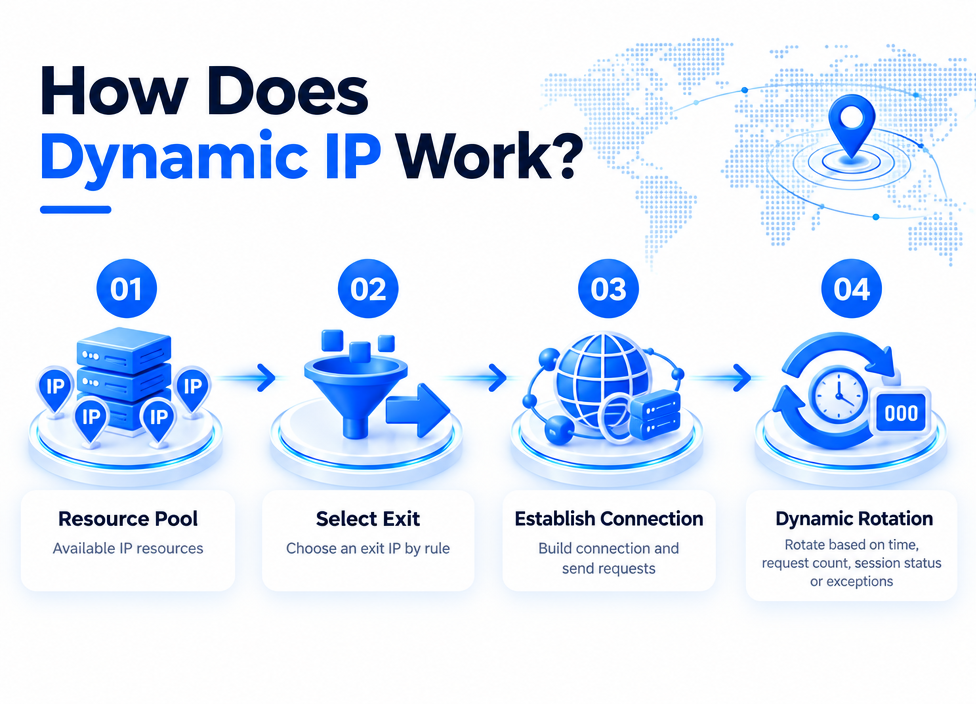
Is the More Frequent the IP Rotation, the More Stable the Proxy?
Not necessarily. IP rotation solves exit repetition and resource dispersion — but frequent rotation can also break business state that needs continuous connection.
Two common needs in proxy use:
| Task Need | What Matters More | IP Strategy |
|---|---|---|
| Dispersed single requests | Exit count and rotation speed | Flexible rotation allowed |
| Continuous session | Connection consistency during the session | Need relatively stable exits |
| Long-duration task | Connection persistence and exception recovery | Need clear liveness and switching rules |
| Multi-region access | Regional coverage and exit attribution | Schedule by target region |
| Bulk public info retrieval | Concurrency, failure rate, deduplication | Balance dispersion and connection reuse |
If a task needs continuous login state, continuous pagination, or continuous parameter submission, frequent exit changes may invalidate the session. Conversely, if a task is mostly many independent public requests, long-term fixed use of a single exit may cause local congestion.
The sensible approach isn't chasing "faster is better" — it's judging first whether the task needs session continuity, then setting IP persistence and switching strategy.
How Should the Business Layer Understand an HTTP Proxy's Role?
At the business layer, a proxy's value isn't just "provides an IP" anymore — it's helping the task manage request exits and connection risk.
Two common scenarios as examples:
| Business Scenario | Main Problem | What the HTTP Proxy Must Handle |
|---|---|---|
| Sentiment monitoring | Request origin, region, and access rhythm need dispersion | Provide region-compliant exits and support sustained requests |
| Bidding data organization | Many pages, long task cycle | Keep connections usable, support failure retry and task allocation |
| Public price monitoring | Different regions may return different content | Match exit region with target market |
| Enterprise public information aggregation | Request volume and concurrency vary noticeably | Control connection and exit allocation per task volume |
One easily overlooked distinction: proxy stable doesn't mean target page always returns success. Target services may be under maintenance, rate-limited, redirecting, or returning anomalies. The proxy can increase controllability of connection establishment and request forwarding, but it can't replace the client's judgment on status codes, content, and business rules.
So the metrics the business layer really cares about usually include:
- Whether requests complete as planned
- Whether valid-response ratio stays stable
- Whether failure causes can be identified
- Whether different connection strategies can be set per task
- Whether resources can be allocated by region, protocol, and concurrency need
- Whether request logs are retained for troubleshooting
How to Design Testing to Judge Proxy Stability?
Rather than comparing IP counts directly, a more effective method is building small-scale testing based on real business.
Split testing into four groups:
| Test Group | Observation Focus |
|---|---|
| Connectivity test | Whether proxy connection and target connection complete |
| Protocol test | Whether HTTP, HTTPS, and authentication methods all work |
| Response test | Whether status codes, response content, and page completeness are normal |
| Continuity test | Whether failure rate and latency fluctuate noticeably in continuous tasks |
Log at least the following metrics during testing:
- Connection success rate: proportion of requests that successfully establish connections out of total requests.
- Valid response rate: proportion of requests returning content matching business expectations out of total requests.
- Latency distribution: observe median latency and higher-percentile latency together — don't let averages hide occasional slow requests.
- Switching recovery time: time needed for the system to return to usable state after an exit fails.
- Repeat exit ratio: degree to which the same exit is reused across consecutive extractions or requests.
- Results split by region and protocol: avoid overall averages masking local issues.
Test cycles can't rely on a single request either. Cover different time windows, different target regions, and different request volumes at minimum. Otherwise it only proves availability at a moment, not long-term fit.
Which Conditions Should Come First When Choosing an HTTP Proxy?
For tasks like public info retrieval, sentiment monitoring, or bidding data organization, judge in this order:
- Protocol match first: explicitly supports HTTP, HTTPS, or other protocols.
- Then authentication convenience: whether the client can use existing accounts, keys, or allowlist methods.
- Then connection strategy: whether short connections, long connections, session persistence, or per-request switching are supported.
- Then regional capability: whether exit regions cover actual business scope.
- Then exception handling: whether timeout, failure retry, and exit switching mechanisms exist.
- IP count last: treat pool scale as resource reference, not as a stability conclusion.
For short-term, single, mutually independent requests, resource rotation and concurrency capability matter more. For continuous sessions or long-term tasks, connection persistence, exception recovery, and regional consistency usually matter more.
This also shows that "the most IPs" only answers the resource-scale question; "whether it's stable" must be judged against task type and test data.
Which Proxy Marketing Metrics Can't Serve as Conclusions Directly?
The following can serve as selection clues but can't replace actual testing on their own:
- Total IP pool size
- Number of regions covered
- Claimed availability rate
- Theoretical concurrency
- Single-request speed
- Entry node count
- Years of service operation
The statistical bases for these metrics may differ — some are cumulative historical counts, some are schedulable resources, some only represent specific products or periods. Without clear test conditions, direct cross-comparison is difficult.
A safer approach is translating marketing claims into verifiable questions:
| Marketing Claim | Verifiable Question |
|---|---|
| Rich IP resources | Whether different exits can be continuously extracted in real tasks |
| Broad regional coverage | Whether usable exits exist in the target region |
| High availability rate | Under what protocol, time, and task conditions was it measured |
| Fast speed | What are median latency and high-percentile latency respectively |
| Supports high concurrency | Whether valid response rate holds as concurrency rises |
How Should "Which One Has the Most and Most Stable IPs" Actually Be Answered?
The more accurate answer: there's no universal answer without scenario.
Comparing IP counts alone only yields a resource-scale judgment. Looking at one successful request only yields a snapshot availability judgment. A truly effective conclusion requires putting protocol compatibility, connection management, exit scheduling, regional match, valid response, and continuous testing into one measurement framework.
For HTTP proxy selection, answer three questions first:
- Which protocol is needed?
- Does the task need short-term rotation or continuous session?
- Does the end goal guarantee connection success or valid business content?
Once these three are clear, comparing IP scale and service parameters starts to carry real meaning. The proxy's role isn't simply adding another IP exit — it's turning the originally dispersed, fluctuation-prone request chain into an observable, allocatable, verifiable business connection process.