Why Can't Enterprises Just Look at Residential Proxy IP Count?
The scale of a residential proxy's IP resources only speaks to the number of addresses available — it doesn't directly represent task outcomes. What enterprises actually need to confirm: whether resources cover the target region, whether exit types match business requirements, whether sessions can be held, whether request quality is stable, and whether there's a clear process for handling exceptions.
Looking only at resource count easily overlooks four problems:
- Region count doesn't equal region availability: a provider may disclose country or city coverage counts, but may not cover the specific regions, carriers, or network types the enterprise needs.
- Pool scale doesn't equal effective resource volume: total pool size, online resources, callable resources, and resources actually matching filter criteria may be reported under different measures.
- A single success doesn't equal long-term availability: one successful request only proves the current time, target, and route work — it doesn't represent continuous task performance.
- Low price doesn't equal low total cost: if frequent retries, manual switching, extra monitoring, or repeated debugging are required, engineering cost can exceed the proxy procurement cost itself.
So the core of enterprise selection isn't finding a service with the single highest absolute metric — it's judging whether the proxy product matches the network environment, runtime cycle, and procurement constraints of the specific task.
Which Dimensions Should Enterprises Evaluate for Residential Proxies?
Split evaluation into six dimensions, with non-negotiable hard thresholds set first.
| Evaluation Dimension | Key Questions | Suggested Weight |
|---|---|---|
| Resources & compliance | Is IP origin, usage boundary, corporate credentials, and data-handling documentation clear? | 20% |
| Regional match | Does coverage include the target country, city, carrier, and network type? | 20% |
| Session capability | Can it hold fixed sessions, control switching cycles, and configure rotation strategies? | 15% |
| Connection quality | How are latency, connection success rate, error rate, concurrency capacity, and peak variance? | 20% |
| Integration & management | Does it support API, credentials, or allowlist? Are logs and usage statistics complete? | 15% |
| Cost & service | Do billing method, overage fees, technical support, procurement, and invoicing align? | 10% |
Weights aren't a one-size standard. Cross-border market research usually weights regional match and connection quality higher; ad monitoring cares more about geographic consistency and session control; cross-border product selection needs to compare country coverage, traffic cost, and collection cycle in parallel.
Some conditions should serve as hard thresholds, not weighted scores. For example:
- The use case must be public, authorized, compliant data processing.
- The target region must be explicitly configurable or verifiable.
- Protocol, authentication, and integration method must satisfy existing systems.
- Billing rules and traffic statistics must be reconcilable.
- Service terms, privacy statements, and misuse-handling boundaries cannot be completely absent.
If hard thresholds aren't met, don't enter formal procurement regardless of weighted score.
How to Translate Business Requirements into an Executable Scorecard?
A scorecard can't just list vendor names and subjective impressions — it has to translate business requirements into verifiable conditions.
For cross-border product research, start with a requirements table:
| Requirement | What to Specify | Validation Method |
|---|---|---|
| Target region | Country, city, carrier, residential type | Backend filtering + actual exit verification |
| Request method | Plain HTTP request, browser visit, or API call | Technical integration test |
| Runtime cycle | Single task, routine monitoring, or long-term runtime | Continuous runtime test |
| Session requirement | Per-request switch, short fixed, or long fixed | Session persistence test |
| Concurrency scale | Average concurrency, peak concurrency, growth projection | Stepped concurrency test |
| Data volume | Estimate by request count, traffic, or effective result count | Unified sample calculation |
| Compliance requirement | Enterprise procurement, contract, invoice, log, permissions | Commercial and legal review |
On top of this, each dimension can be scored 1 to 5:
- 1 point: cannot be met, or information cannot be verified
- 2 points: partially meets, requires additional manual handling
- 3 points: basically meets, but with notable limits
- 4 points: satisfies primary needs; configuration and data are complete
- 5 points: satisfies current needs with room to grow
The final score uses a weighted calculation:
Composite score = Resources & compliance × 20% + Regional match × 20% + Session capability × 15% + Connection quality × 20% + Integration & management × 15% + Cost & service × 10%
This result is only for internal comparison under the same test conditions — it shouldn't be read as an industry ranking of vendors.
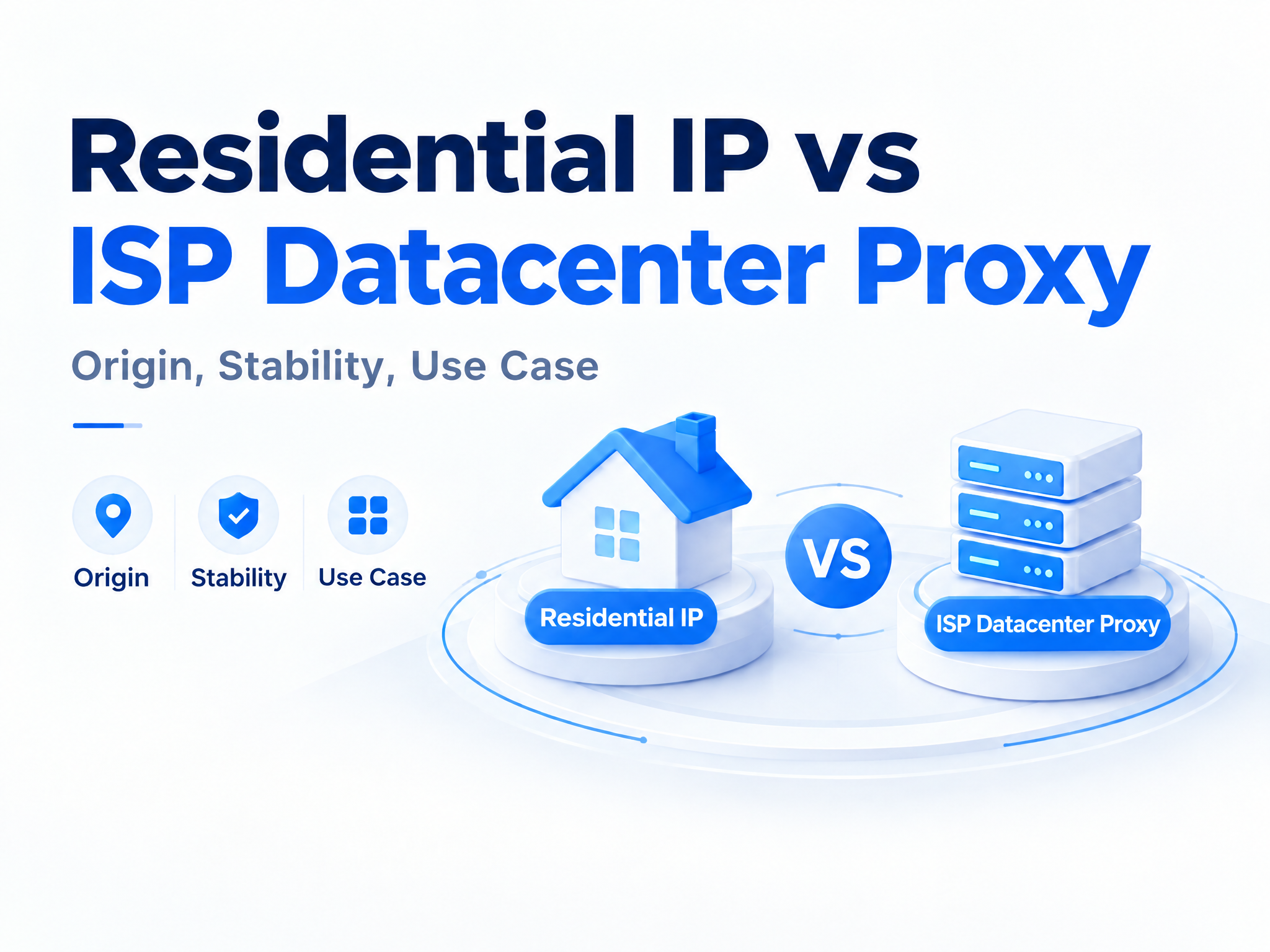
When Should You Use Rotating Residential vs. Static Residential?
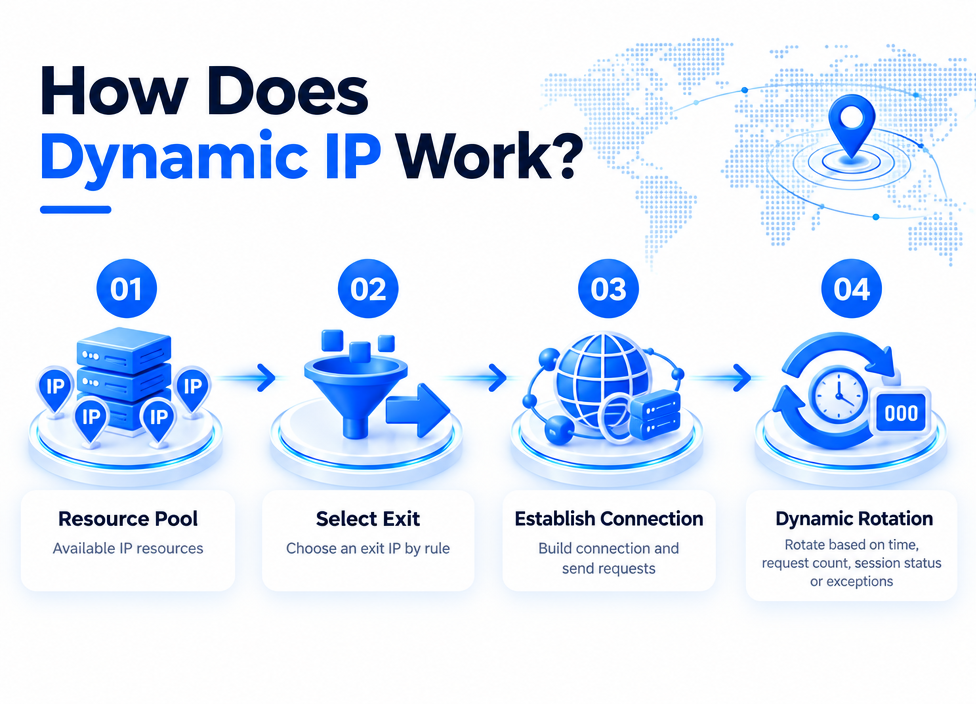
The main difference between rotating and static residential proxies is whether the exit IP needs to stay consistent.
| Task Characteristic | Better Fit | Rationale |
|---|---|---|
| Need samples from multiple regions | Rotating residential | Easy to switch exits by region or time |
| Single-request cycle is short | Rotating residential | No need to maintain the same exit long |
| Need to hold a continuous session | Static residential | Better for fixed sessions or fixed exits |
| Need to configure a fixed allowlist | Static residential | Easier to bind to fixed addresses |
| Need to simulate public page displays in different regions | Rotating residential | Focus is on regional switching and sample coverage |
| Need to monitor changes in the same region long-term | Depends on session needs | Test fixed-session vs. rotating results first |
Rotating residential doesn't mean every task should switch frequently; static residential doesn't mean connections will definitely be more stable. Actual choice also depends on the target site's public access rules, task cycle, session logic, and system fault tolerance.
How Should Enterprises Design Residential Proxy Testing?
Before formal procurement, break testing into three stages — don't jump straight to large-scale traffic validation.
Stage 1: Compatibility testing
Goal: confirm the proxy can integrate with the existing system.
What to verify:
- Whether HTTP, HTTPS, or SOCKS5 meets system requirements
- Whether API, credentials, or allowlist authentication works normally
- Whether regional filtering returns the expected country or city
- Whether session parameters, rotation cycle, and connection timeout are configurable
- Whether request logs, traffic statistics, and error information are inspectable
This stage shouldn't chase large samples — the focus is catching protocol, authentication, and region-configuration issues early.
Stage 2: Stability testing
Under fixed request logic, observe a continuous runtime period. Cover business lows, normal hours, and peaks at minimum, and log:
| Metric | Observation Focus |
|---|---|
| Connection success rate | Any sustained drops or time-window-specific variance |
| Response latency | Beyond averages, watch the share of slow requests |
| Error types | Whether timeouts, connection failures, and target anomalies cluster |
| Session persistence rate | Whether fixed sessions break often |
| Regional consistency | Whether returned regions match the configuration |
| Retry ratio | How many extra requests the business needs to get a valid result |
| Concurrency behavior | Whether obvious degradation appears as concurrency rises |
Keep target, request parameters, timeout rules, and retry logic fixed during testing. Otherwise, vendor results come from different test conditions and can't be compared directly.
Stage 3: Business-sample testing
Finally, validate at small scale against samples close to real public, authorized business — for example:
- Public product information lookups in cross-border selection
- Public page display verification in ad monitoring
- Public web information collection in market research
In this stage, log both proxy quality and business results. A successful proxy request doesn't mean complete final data; missing data isn't entirely caused by the proxy either — page structure, request frequency, parsing logic, or target-site changes can also play a role.
How to Calculate the Real Cost of Residential Proxies?
The proxy unit price is only part of total cost. Use total cost of ownership for estimation:
Monthly total cost = Proxy fees + Overage traffic fees + Retry consumption + Integration development cost + Monitoring and operations cost + Business cost from failed tasks
Different billing methods call for different comparison measures:
| Billing Method | Best Comparison Metric |
|---|---|
| Per traffic | Cost per effective-result GB, traffic waste rate |
| Per request | Cost per thousand effective requests, failed-retry ratio |
| Per port or concurrency | Cost per unit of concurrency, peak-load capacity |
| Fixed-period billing | Actual utilization within the period, idle cost |
| Custom plan | Resource allocation, service scope, long-term total cost |
When comparing, try to unify three conditions: same target region, same effective data volume, same test cycle.
For example, two plans with different unit prices — but one requires more retries. When both yield the same number of effective results, actual cost may not be as low as the sticker suggests. Enterprises should prioritize "cost per effective result" over "per-GB price."
Which Residential Proxy Metrics Most Often Lead to Misjudgment?
Why can't IP pool size stand on its own as a conclusion?
A larger resource pool means a larger theoretical selection space, but if the target city, carrier, or network type doesn't match, scale offers limited help for the current task. Scale should serve as a backdrop metric — it can't replace actual regional testing.
Why does availability rate require measurement-basis review?
Availability rate can refer to proxy connection success, target request success, single-check success, or an average over a period. Different measures can't be compared head-to-head.
Testing should require explicit statistical period, detection method, and failure definition — then independently verify using the enterprise's own request logic.
Why doesn't country coverage count equal business coverage capability?
Country coverage count doesn't speak to specific cities, carriers, residential types, or usable time windows. Cross-border tasks should break the target region down to actual procurement granularity, not just log a country count.
Why can low price bring extra cost?
A low-price plan lacking logs, regional filtering, session control, or technical support can increase development and operations investment. For long-running enterprise tasks, management cost often matters more than one-off procurement price.
How Often Should Enterprises Re-Evaluate Residential Proxies?
Residential proxies aren't infrastructure you buy once and leave alone. Build a periodic re-evaluation mechanism:
- After initial integration: complete the three stages — compatibility, stability, and business-sample testing.
- During formal runtime: weekly observation of error rate, latency, regional consistency, and traffic waste rate.
- When business scale changes: re-test concurrency, traffic, and session persistence.
- When target regions change: separately validate newly added countries, cities, and carriers.
- When service terms or billing change: recalculate total cost.
- When consecutive anomalies appear: preserve logs, request timestamps, regions, and error types, and ask the provider to locate the cause.
The focus of re-evaluation isn't re-comparing all metrics — it's judging whether past assumptions still hold. Whenever task region, request method, runtime cycle, or data volume changes, the original selection conclusion may need re-validation.
FAQ
Q: What should enterprises confirm first when choosing a residential proxy?
Confirm use case, target region, request method, and session requirement first, then check compliance boundaries, protocol, and authentication method. Resource scale and price should come after these basic conditions. Otherwise it's easy to end up with a plan that has plenty of resources but doesn't integrate or doesn't match the region.
Q: How long does residential proxy testing need to run?
No fixed duration fits all business. Small compatibility tests can wrap up quickly, but stability and business-sample tests should cover different time windows and continuously observe error types, latency, session persistence, and retry ratios. For long-term tasks, don't conclude from a few-minute sample.
Q: Can rotating residential and static residential substitute for each other?
Not interchangeably. Rotating residential suits region switching, short-cycle requests, and multi-sample tasks; static residential better suits business needing fixed exits, fixed sessions, or allowlist configuration. Final decisions still rest on the target system's session logic and actual test results.
Q: Can you adopt the vendor's published availability rate directly?
Not as the enterprise business result. Availability rate must be understood together with statistical period, detection method, failure definition, and target region. The safer approach is to ask the provider to specify measurement basis, then independently verify using the enterprise's own request logic.
Q: How do you compare costs across different billing methods?
Unify target region, test cycle, and effective-result volume first, then calculate cost per effective result. For per-traffic plans, watch traffic waste and retry consumption; for per-request plans, watch failed-request ratio; for per-port or per-concurrency plans, watch actual utilization and peak capacity.
Q: If residential proxy testing fails, does that mean the proxy service is unusable?
Not necessarily. Failures can come from region configuration, protocol, authentication, request parameters, page changes, parsing logic, or target-site state. Break down causes by error type first, then repeat testing under fixed conditions — don't scale a single anomaly into an overall conclusion.