Why Can't You Just Look at IP Pool Scale?
The first step in judging whether an IP pool is good isn't comparing resource counts — it's confirming whether it matches the actual task.
Many providers highlight resource scale, regional coverage, or node counts, but these metrics can't directly say whether an IP pool suits the current business. Different tasks have different requirements on IP type, region, session duration, protocol, and concurrency mode. A large pool, if it can't provide the target region or if its session-persistence method doesn't match, may still deliver limited integration results.
Start by breaking the task into five conditions:
| Judgment Dimension | What to Confirm |
|---|---|
| Target region | Whether coverage includes the target country, region, city, or carrier |
| IP type | Datacenter, residential, mobile, or dedicated resources |
| Session mode | Short-connection rotation, or holding a fixed session |
| Protocol | Whether the needed HTTP, HTTPS, or SOCKS5 is supported |
| Usage scale | Whether request volume, concurrency, and bandwidth fall within service limits |
For example, public information scraping may care more about regional coverage, connection success rate, and rotation method; ad monitoring cares more about geographic targeting and session stability; cross-border business additionally needs to confirm overseas regions, settlement methods, time-zone support, and service response.
The first question: does the IP pool match the task's region, IP type, session mode, protocol, and usage scale?
How Should IP Pool Stability Be Verified?
Stability can't be judged from sales descriptions — it should be observed through small-scale testing.
One test shouldn't send just a handful of requests. Design samples across "different times, different regions, different endpoints, different sessions." For example, prepare three time windows, test one batch per window, and separately log connection success, response time, error types, and IP repetition.
Log at least these metrics:
| Metric | Observation Focus |
|---|---|
| Connection success rate | Whether requests can establish connections |
| Response time | Whether obvious latency or long tails exist |
| IP repetition rate | Whether rotation still frequently returns the same IPs |
| Regional accuracy | Whether IP attribution matches filter conditions |
| Session persistence | Whether fixed sessions hold for the expected duration |
| Anomaly ratio | Whether timeouts, connection failures, and auth failures cluster |
Test samples can start at around 100 requests, then scale with task size. This number isn't an industry standard — it's just to avoid drawing conclusions from three to five requests. If the task will run all day, test across at least two time windows, because network congestion, resource scheduling, and regional supply can shift over time.
Also distinguish "single-request success" from "continuous runtime stability." The former only proves a connection succeeded; the latter is closer to real business experience.
The second question: can the provider let users verify stability through small-scale testing, instead of requiring direct purchase of a long-term package?
Do IP Rotation and Session Mechanisms Match the Business Flow?
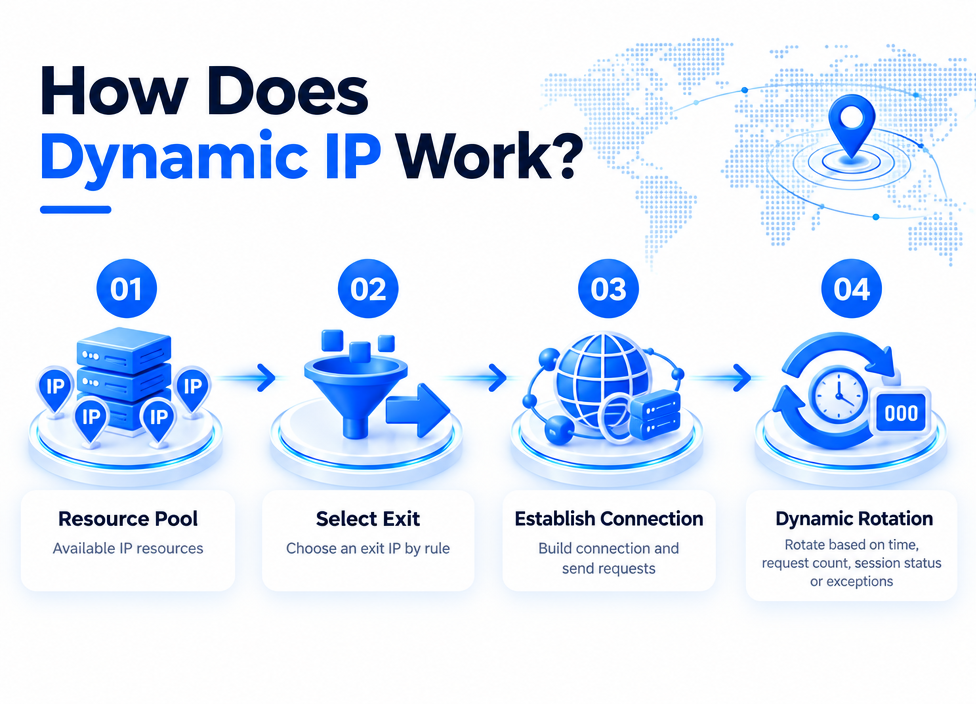
An IP pool's rotation method directly affects task outcomes. Rotating too fast can cause the same task to see inconsistent state across requests; rotating too slow can fail to meet businesses that need continuous exit changes.
Before buying, split the business flow into two categories:
Tasks that need frequent IP changes
These tasks usually care about:
- Whether switching can be done per request, by time, or by session
- Whether rotation intervals can be configured
- Whether a new IP is auto-assigned when rotation fails
- Whether bulk extraction or API calls are supported
- Whether target region and resource type can be filtered
Tasks that need session persistence
These tasks usually care about:
- The longest a session can hold
- Whether a session can be continued after interruption
- Whether business state is affected after swapping exits
- Whether fixed IPs, sticky sessions, or dedicated connections are supported
- Whether the same account or task can establish multiple independent sessions
Put the provider's rotation method into the business flow for a simulated test — don't just test whether the endpoint returns an IP. Testing should include continuous steps: "get IP, initiate request, hold session, hit exception, reconnect."
If the provider only offers a single, unadjustable rotation strategy, judge whether it limits downstream business flow. For scenarios with multiple parallel tasks, also confirm whether different tasks can use independent resource pools — to prevent one task's anomaly from affecting others.
The third question: can IP rotation and session mechanisms embed into existing business flows, instead of only being called standalone?
When Exceptions Happen, Does the Provider Have an Executable Response?
In real IP service use, timeouts, auth failures, region mismatches, or temporary unavailability aren't rare. What really needs judging isn't "whether exceptions never happen" — it's whether exceptions can be detected, located, and handled once they occur.
Before procurement, ask the provider:
- Whether the platform auto-returns a new IP on connection failure.
- Whether error codes, logs, or request records are provided.
- Whether auth errors, network errors, and resource unavailability can be distinguished.
- Whether connection timeout, retry count, and failure fallback can be configured.
- The response method of tickets or technical support during service anomalies.
- Whether package consumption is billed for failed requests.
- Whether there's an announcement or notification mechanism during large-scale resource fluctuations.
During technical integration, don't simply attribute all anomalies to "IP quality issues." Common causes include:
- Incorrect authentication information
- Incorrect target-region filter conditions
- Request concurrency exceeding package limits
- Business-side connection timeout set too short
- Session-persistence parameters inconsistent with endpoint requirements
- The target service itself experiencing fluctuations
The clearer the monitoring, logs, and error documentation the provider offers, the lower the downstream troubleshooting cost. If the platform only provides a proxy address, forcing you to repeatedly change configuration after exceptions, procurement risk is higher.
The fourth question: after exceptions occur, can the provider offer a clear path for localization and handling?
Are Integration, Permissions, and Usage Management Clear Enough?
An IP pool isn't just an address list — it also involves integration method, permission management, and usage control.
Confirm at least these integration conditions:
| Item | Confirm Before Buying |
|---|---|
| Integration method | API, proxy address, client, or other |
| Authentication method | IP allowlist, username/password, token, or combined |
| Concurrency limits | Max concurrency, request frequency, bandwidth boundaries |
| Usage statistics | Whether request count, traffic, remaining quota, and error count can be viewed |
| Permission management | Whether sub-accounts can be created with different permissions |
| Billing management | Whether invoices, contracts, and enterprise procurement flows are supported |
| Technical documentation | Whether parameter specs, error codes, and example configurations are included |
For individual developers, focus may be on documentation completeness and endpoint debuggability. For team use, further focus on sub-accounts, permission isolation, usage statistics, and billing attribution. For enterprise procurement, also confirm the contracting entity, service scope, renewal rules, refund or change conditions, and specific after-sales support methods.
During the trial period, complete at least one full integration:
- Create authentication credentials.
- Obtain an IP in a specified region.
- Initiate a test request using the target protocol.
- View request logs and usage changes.
- Deliberately trigger a timeout or auth error.
- Follow the documentation to complete retry and problem localization.
Just clicking around the web console a few times won't verify the real integration cost.
The fifth question: can the platform let development, operations, procurement, and finance all manage this service clearly?
Can Resource Origin and Procurement Terms Hold Up to Verification?
IP resource compliance and procurement terms deserve the same weight as technical metrics.
Before buying, confirm:
- Whether resource origin has public documentation
- Whether usage scope and prohibited uses are written into service terms
- Whether personal information, sensitive data, or restricted regions are involved
- Whether the provider offers privacy policy and data-handling documentation
- Whether enterprise procurement can obtain contract, invoice, and service receipts
- Whether trial data and formal packages belong to the same resource class
- Whether trial-period restrictions are consistent with formal usage conditions
Different businesses have different compliance requirements. Public information scraping, sentiment monitoring, ad monitoring, and cross-border information queries should all comply with target site rules, applicable laws and regulations, and data-usage boundaries. Proxy IPs aren't a substitute for business compliance — before procurement, still clarify data origin, usage purpose, and internal approval responsibility.
Be especially wary of "trial resources great, formal package completely different" situations. During testing, log resource type, target region, session method, package restrictions, and validity period — confirm whether trial results are representative.
The sixth question: can the provider clearly explain resource origin, usage boundaries, and procurement responsibility?
Once All Six Questions Are Answered, How to Decide Whether to Buy?
The six questions can be organized into a pre-purchase scorecard. Score each item as "0 points, 1 point, 2 points":
| Evaluation Item | 0 Points | 1 Point | 2 Points |
|---|---|---|---|
| Task match | Can't specify applicable scenario | Partial match | Region, type, and session all match |
| Stability verification | Testing not supported | Limited testing possible | Full small-scale validation supported |
| Rotation mechanism | Single strategy only | Satisfies partial flow | Configurable per business flow |
| Exception handling | No logs or documentation | Basic support | Error codes, monitoring, handling path |
| Integration management | Permissions and usage opaque | Basically usable | Docs, permissions, billing all clear |
| Compliance & procurement | Terms vague | Information incomplete | Origin, limits, contract all verifiable |
The total score can serve as supporting judgment but shouldn't replace hard thresholds. Pause buying in these cases:
- Resource applicable region can't be confirmed
- Provider refuses to offer any testing method
- Differences between trial resources and formal resources can't be explained
- Concurrency, traffic, session, or billing rules are unclear
- No executable support channel when exceptions occur
- Resource origin and usage boundaries can't be verified
Conversely, even with a high total score, confirm whether it genuinely matches the current task. An IP pool suited to public information scraping may not suit ad monitoring; a product suited to short-connection rotation may not suit long session persistence.
The basis for buying should be "task match plus verifiability" — not any single marketing metric.
What Minimum Testing Can Be Done Before Buying?
Before formal procurement, use a lightweight flow for final confirmation:
Step 1: Write out task boundaries
Log target region, IP type, protocol, session duration, projected request volume, concurrency requirement, and usage cycle.
Step 2: Apply for small-scale testing
Prioritize test resources that reflect formal usage scenarios — confirm test rules, validity, and restrictions.
Step 3: Run multi-window testing
Log at least success rate, latency, IP repetition, regional accuracy, session persistence, and anomaly types.
Step 4: Test exception handling
Actively validate timeouts, auth failures, resource unavailability, and reconnection handling.
Step 5: Verify against the formal package
Cross-check resource type, rotation mechanism, billing unit, validity, and restrictions confirmed during trial against the formal package line by line.
Step 6: Retain procurement records
Save endpoint documentation, service terms, quotes, test records, tickets, and contract information for later review.
FAQ
Q: Does a larger IP pool resource count mean better actual results?
Not necessarily. Resource count only speaks to supply scale — it can't directly indicate regional accuracy, connection stability, session mechanism, or service support. For specific tasks, suitable resource types and verifiable usage results usually matter more than scale alone.
Q: Can you judge IP pool stability from a few test requests?
Not recommended. A small number of requests only shows the endpoint was once usable — it can't observe variations across different time windows, regions, and sessions. Testing should cover multiple time windows and log success rate, latency, repetition rate, and anomaly types.
Q: How to choose between dynamic IPs and fixed IPs?
Depends on whether the business requires frequent exit changes or requires connection consistency over a period. Dynamic IPs suit rotation needs; fixed sessions or dedicated resources suit tasks with higher state-continuity requirements. Final choice should be based on business-flow test results.
Q: If a provider doesn't offer a free trial, should you still evaluate?
You can continue to investigate, but procurement risk is higher. At minimum, request small-spec testing, refund or change rules, endpoint documentation, and clear service boundaries. If none of this is available, don't buy a long-term package based only on a marketing page.
Q: When a connection fails during IP pool use, should you contact the provider first?
Identify the source first. Check authentication, regional conditions, concurrency settings, timeout, and endpoint parameters — then review logs and error codes. If confirmed as a resource-side issue, submit time, region, request ID, and error information to the provider for localization.
Q: What's most easily overlooked when buying an IP pool?
Most easily overlooked: the difference between formal packages and trial resources, and whether failed requests are billed. Beyond that, confirm concurrency, session, validity, traffic, regional filtering, and after-sales response rules upfront — avoid discovering critical restrictions only after integration.
Before buying, answer the six questions item by item: whether the task matches, whether stability can be verified, whether rotation fits, whether exceptions can be handled, whether integration is transparent, whether compliance and procurement are clear. If any one of the six can't be verified, supplement the information before deciding whether to buy.