Short-lived, tunnel, and long-lived proxies do not have a universal priority order. Short-lived proxies suit bulk short requests, tunnel proxies suit continuous access and unified endpoints, and long-lived proxies suit fixed exits and ongoing tasks. If a task has higher requirements for resource exclusivity and stability, dedicated proxies should also be evaluated.
What Kind of Scrapy Tasks Suit Short-Lived Proxies?
Short-lived proxies have relatively brief IP usage periods, making them suitable for rapid extraction and bulk access.
If a Scrapy task mainly retrieves public pages, product information, regional data, or other authorized data, and individual requests do not need to keep the same exit, short-lived proxies are often a good fit. They can be planned according to task volume, extraction method, and IP validity period.
Short-lived proxies are well suited to:
- A large number of pages where each page takes a short time to access.
- Batch-based tasks that can end after one batch is completed.
- Tasks that need many IPs but do not need to retain the same IP for a long time.
- Collection workloads that change in size and require flexible resource allocation.
The limits of short-lived proxies are also clear. They should not directly handle long-term fixed sessions, and not every task should be designed around high-frequency extraction. The Scrapy side still needs proxy-failure detection, request retries, and task-progress tracking.
What Kind of Scrapy Tasks Suit Tunnel Proxies?
Tunnel proxies receive requests through a unified endpoint, while the proxy service manages subsequent IP scheduling and rotation. For Scrapy, this is closer to configuring a stable proxy address than frequently maintaining a proxy list in application code.
Tunnel proxies are better suited to:
- Continuous collection for public-opinion monitoring and public information.
- Ongoing tasks such as ad monitoring and regional data monitoring.
- Multiple Scrapy tasks sharing a unified proxy endpoint.
- Scenarios where you want to reduce proxy extraction, filtering, and switching code.
- Programs with relatively stable request rates that need to run continuously.
Tunnel proxies do not mean that collection pacing can be ignored. Request frequency, target-page response time, concurrency, and retry policy still need to be configured appropriately. Otherwise, both the proxy endpoint and the target service may face unnecessary pressure.
When Are Long-Lived Proxies a Better Fit?
Long-lived proxies are better suited to tasks that need to keep an exit stable for an extended period.
For example, some public-data tasks need to access the same type of page in multiple stages, or the application side may need to associate a proxy IP with a task, region, or session. In these cases, long-lived proxies can be evaluated. Compared with short-lived proxies, the focus of long-lived proxies is not the number of IPs, but IP survival time, exit continuity, and the relationship between the IP and the task.
Long-lived proxies are suitable for:
- Tasks that need to maintain a connection for an extended period.
- Business workflows with clear requirements for exit stability.
- Sessions where the IP should not change on every request.
- Systems that need to associate regions and tasks with specific IPs.
If a task only needs to retrieve pages in one bulk operation, long-lived proxies may leave resources idle. In that case, short-lived proxies are usually easier to configure according to actual consumption.
What Is the Difference Between Dedicated and Long-Lived Proxies?
Both may be used for stability-focused tasks, but they are judged by different dimensions.
- Long-lived proxies focus on how long an IP can remain in use.
- Dedicated proxies focus on whether an IP is exclusively assigned to one business and whether the resource boundary is clear.
If a task requires both continuous egress and resource exclusivity, dedicated proxies can be evaluated further. Credit information queries, bidding and tender data, public legal data, and cross-border logistics information typically place greater emphasis on business continuity and should not be designed solely around a large pool of rotating IPs.
How Can You Build a Proxy-Type Decision Table for Scrapy?
Use the following decision sequence:
| Decision question | Yes | No |
|---|---|---|
| Can every request use a different IP? | Evaluate short-lived proxies first | Continue evaluating |
| Does the task need to run continuously? | Evaluate tunnel proxies | Continue evaluating |
| Is a relatively stable fixed exit required? | Evaluate long-lived proxies | Continue evaluating |
| Is exclusive resource access or clearer business isolation required? | Evaluate dedicated proxies | Choose short-lived or tunnel proxies |
| Will multiple tasks run at the same time? | Focus on business pooling, concurrency, and bandwidth | Focus on extraction method and single-task cost |
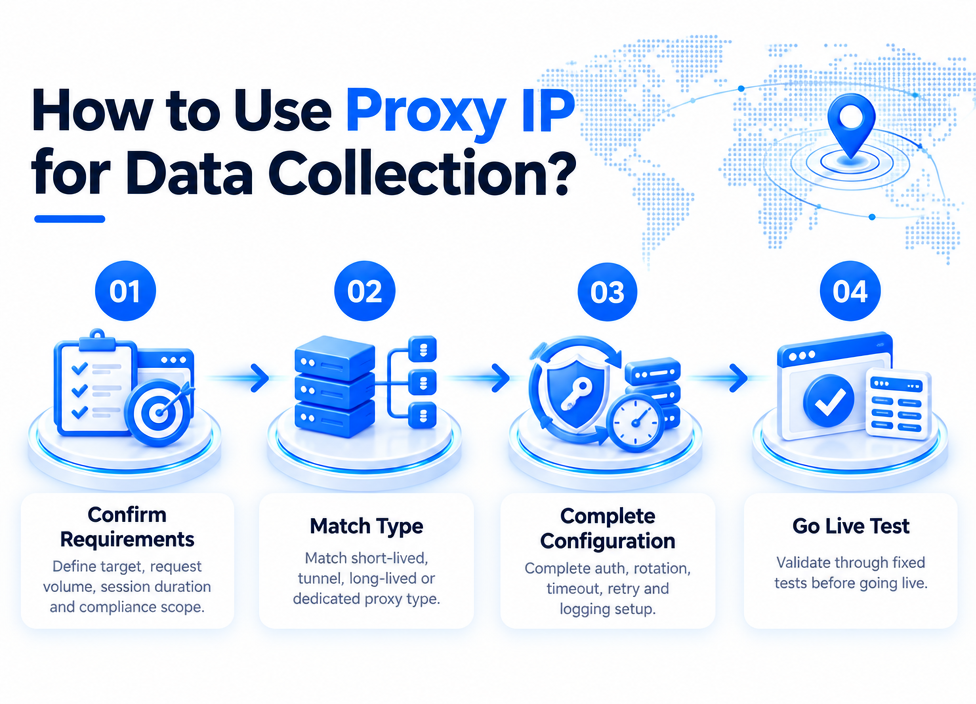
After selecting a proxy type in Scrapy, also configure timeouts, retries, logs, failed-task recovery, and proxy-status records separately. Proxy services solve the network-access problem; the collection system itself still needs to be recoverable.
Conclusion
Scrapy proxy IP selection should focus on IP validity period, access method, and exit stability. Short-lived proxies handle bulk short requests, tunnel proxies handle continuous access, long-lived proxies handle fixed exits, and dedicated proxies suit tasks that require clearer resource boundaries.
What Are Common Questions About Choosing a Scrapy Proxy Type?
Q: Which is better for Scrapy, short-lived proxies or tunnel proxies?
It depends on the task pattern. For bulk, short-duration tasks with high IP demand, start by evaluating short-lived proxies. For continuous access, multiple tasks sharing one endpoint, or situations where you want to reduce proxy-scheduling code, evaluate tunnel proxies.
Q: Are long-lived proxies suitable for every long-term project?
Not necessarily. If a long-term project simply retrieves a large number of pages continuously, tunnel proxies may better match the task logic. Long-lived proxies are more targeted when exit stability, session continuity, or region-to-IP association is important.
Q: When are dedicated proxies necessary?
Evaluate dedicated proxies when the business has clear requirements for exit stability, resource exclusivity, and task isolation. Whether dedicated resources are necessary should also be judged against request frequency, concurrency, target geography, and budget.
Q: Can several proxy types be mixed in the same Scrapy project?
Yes, but proxy settings should be separated by task. For example, use short-lived proxies for bulk page collection, tunnel proxies for continuous monitoring, and long-lived or dedicated proxies for fixed-session tasks. Different proxy types should not share the same timeout, retry, and resource-consumption parameters.