A residential IP is an IP address provided by home broadband or mobile networks — its network attribution is closer to real resident networks. It's mainly used for multi-region content testing, public data scraping, ad verification, and cross-region business checks. But it isn't an anonymity tool, and it can't replace proper compliance authorization.
What Is a Residential IP?
A residential IP usually refers to an IP address provided by home broadband, mobile networks, or other resident access networks. Compared to IPs deployed in data-center rooms, a residential IP's network attribution is closer to that of an ordinary household or individual user.
Simply put, when accessing a website, the site sees more than just an IP address — it may also identify which category of network the IP belongs to. Residential IPs present a network environment closer to home broadband or mobile communication networks, so they fit tasks that need real regional access testing.
A residential IP isn't the same as a fixed home-broadband account, and it doesn't necessarily correspond to a specific household. The IP's actual usage duration, regional precision, carrier attribution, and sustainability depend on the resource type the network service provider offers.
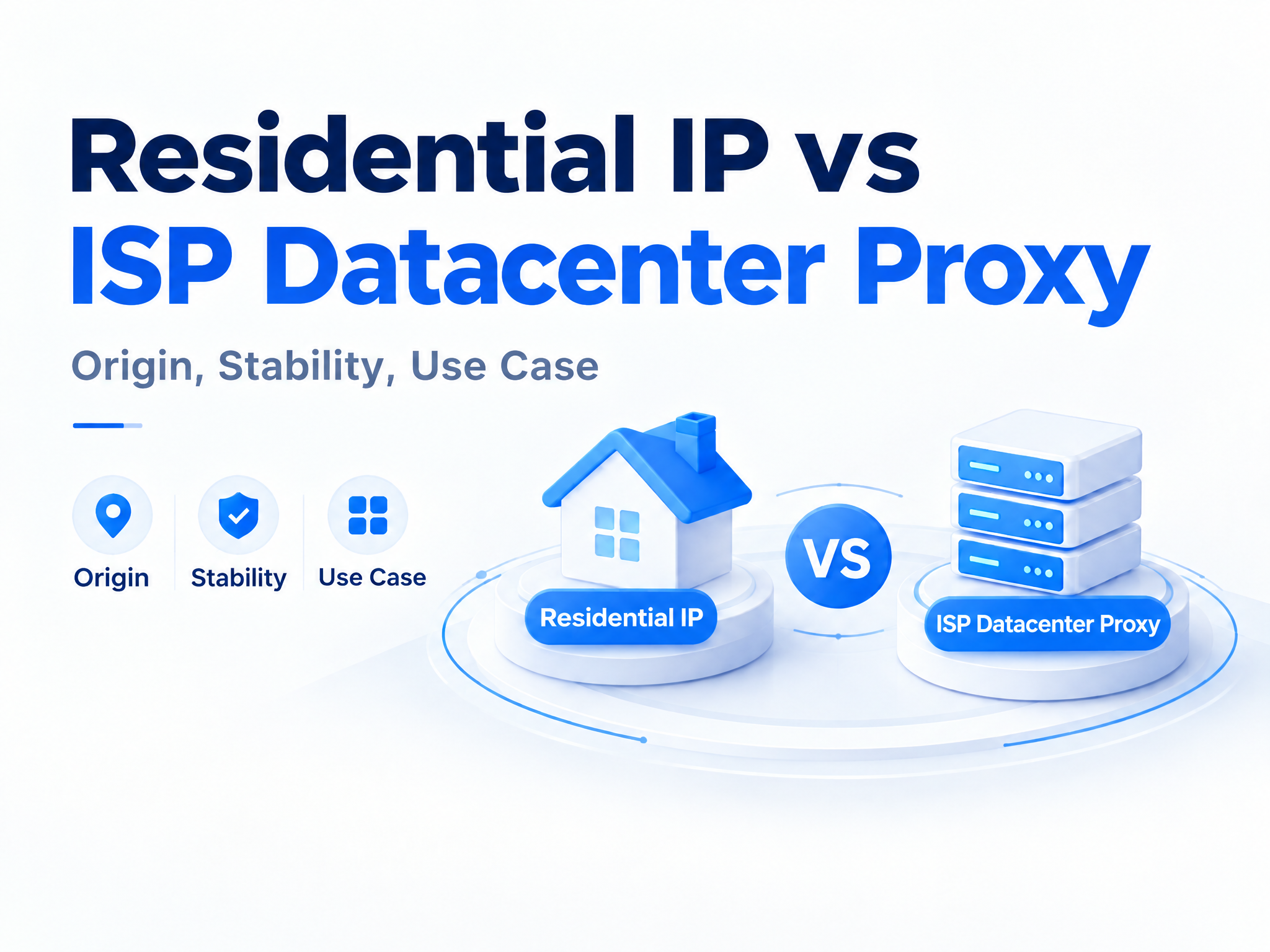
How Do Residential IPs Differ from Datacenter IPs?
The main difference lies in network attribution and use cases — not simply "which is better."
| Comparison Dimension | Residential IP | Datacenter IP |
|---|---|---|
| Network attribution | Home broadband, mobile networks, and other resident access networks | Data-center or cloud-server networks |
| Regional performance | Usually closer to local user access environment | Regions may be more concentrated |
| Connection characteristics | Resource variation and network quality may differ | Usually better suited to stable, continuous connections |
| Suitable tasks | Regional content verification, ad checking, public data scraping | Service deployment, endpoint access, fixed network connections |
| Key focus | Regional authenticity, session stability, resource compliance | Connection stability, bandwidth, fixed-point reliability |
This doesn't mean residential IPs are necessarily more stable than datacenter IPs, nor that datacenter IPs can't handle regional access. The actual choice depends on whether the task weights regional network attributes more, or fixed connection and continuous runtime more.
What Are Residential IPs For?
Residential IPs' value appears mainly in tasks that need to observe real access environments across regions.
1. Multi-region content testing
The same website or app may display different content based on access region — language, delivery scope, service entries, campaign pages, and so on.
Using residential IPs from different regions, teams can check whether pages display as expected — helping product teams spot issues in regional configuration, content distribution, and access flows.
2. Public data scraping
Some public web pages return different content based on access region, network type, and request frequency. Residential IPs serve as a type of test resource for multi-region access environments — used for collecting public page information like product listings, industry data, sentiment information, and public directories.
Use must follow the target site's access rules — don't collect non-public information or bypass permission limits.
3. Ad and search result verification
Ad placement, search results, and localized pages often vary by region. Operations teams can use network environments across regions to check whether ads display, whether landing pages are correct, and whether keyword results match the target region.
The focus of this task isn't simply swapping IPs — it's verifying the actual content users see in different regions.
4. Cross-region business checks
Cross-border e-commerce, online services, and local-life businesses often need to check pages, delivery, payment entries, and service descriptions across different countries or regions.
Residential IPs help testing teams access public pages from multiple regions and confirm whether regional restrictions and localized content work normally.
Which Tasks Suit Residential IPs?
Residential IPs better suit the following tasks:
- Product testing that needs to verify page content across regions
- Operations tasks that check ads, search results, and localized displays
- Data tasks that access public pages and organize information by region
- Testing tasks that check cross-border business pages, delivery scope, and service entries
- Quality validation tasks that simulate ordinary network environments across regions
If a task only needs one fixed, long-term, stable network connection, residential IPs may not be the best match. In that case, prioritize fixed-point reliability, connection duration, and network allowlist requirements.
What to Watch When Using Residential IPs?
First, confirm access content falls within the public scope
Residential IPs only change the network access source — they don't change access permissions. For login, personal information, paid content, or restricted endpoints, obtain explicit authorization first.
Second, specify region and carrier requirements
"Country X IP" doesn't necessarily equal "home network in a specific city." If the task requires precision down to city, carrier, or mobile network, confirm upfront whether the resource supports those dimensions.
Third, distinguish short sessions from long sessions
Some tasks only need to complete one page visit; others require continuous operations within the same session. The two have different requirements for IP hold time — determine session continuity needs before configuration.
Fourth, don't just look at IP count
Residential IP actual results also depend on regional accuracy, connection success rate, response speed, session persistence, and resource refresh. Simply comparing resource pool scale can't directly judge fit for a specific task.
FAQ
Q: Is a residential IP the same as a home broadband IP?
Residential IPs usually come from home broadband, mobile networks, and other resident access networks — but don't necessarily correspond to a specific household. Different services vary in resource origin, effective time, and regional precision; check service documentation for specifics.
Q: Can residential IPs stay fixed?
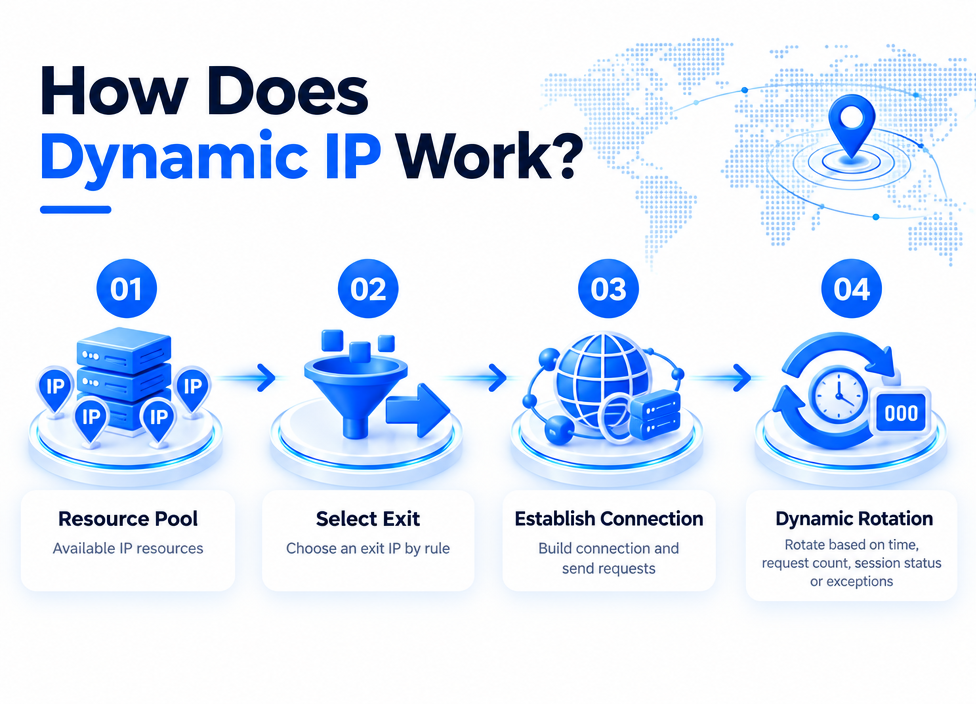
Some residential networks support holding the same IP within a time period; other resources rotate by request, time, or session rules. Whether it's fixed depends on the specific product's session mechanism.
Q: Do residential IPs suit every data scraping task?
No. They better suit public-data tasks that need multi-region access environments. For tasks requiring fixed connections, extremely long sessions, or strict allowlists, evaluate network stability and fixed-point reliability first.
Q: Can residential IPs guarantee access success?
No. Access results are also affected by target site rules, page state, network quality, regional match, and request method. Residential network attribution is only one of these conditions.
Q: What should take priority when choosing residential IPs?
Prioritize regional accuracy, session stability, connection success rate, protocol support, resource usage rules, and compliance boundaries — then decide based on the task whether fixed regions or sustained sessions are needed.