What Has Actually Changed in the 2026 Proxy IP Market?
The 2026 shifts come down to three dimensions: demand upgrade, supply contraction, and changes in service form.
In the past, when picking a proxy service users looked first at IP count, country coverage, concurrency capacity, and plan price. Those still carry reference value, but they can no longer explain service quality on their own. What enterprises care more about now: whether IP sources are traceable, whether tasks can run continuously, whether nodes match the target region, whether anomalies can be located quickly, and whether the provider has long-term governance capability.
One publicly available market report projects the residential proxy server market will grow from about $1.92B in 2026 to about $3.05B in 2031, a CAGR of roughly 9.7% over the forecast period. That says proxy IPs are still in a growth market, but the growth driver has moved from simply expanding nodes to real-time data, regional access, and automated business infrastructure.
Four points capture the current market shifts:
| Market Shift | Concrete Manifestation | Impact on Selection |
|---|---|---|
| Demand moves from connection to delivery | Users care about continuous runtime, session persistence, and successful requests | Need to test the real business chain, not just inspect node lists |
| Competition moves from volume to quality | Pool size is no longer the sole basis for judgment | Must look at IP freshness, network-range dispersion, and anomaly eviction |
| Products move from single proxy to combined service | Proxies increasingly bundle with APIs, browser environments, and data processing | Need to distinguish buying network resources vs. buying complete data capability |
| Procurement moves from low price to auditable | Enterprises care about authorization, real-name verification, logs, and violation handling | Compliance documentation becomes part of provider screening |
So "which provider is good quality" can't be answered with just a brand name. The question needs to be rephrased: which proxy type and which service mechanism fits the current business's goals, cycle, and risk boundaries?
Why Has Demand Shifted from "Can Connect" to "Can Deliver Sustainably"?
Proxy IP quality is ultimately judged by business outcomes, not by whether a connection succeeded.
A successful connection only proves a node was available at a point in time. For price monitoring, SERP tracking, ad verification, sentiment monitoring, and public data scraping, what actually matters is behavior across continuous runtime: successful request ratio, response variance, whether IP switching matches expectations, whether abnormal nodes get replaced in time, and whether tasks can recover after interruption.
In 2026, access-environment detection is more complex. Platforms typically combine network attribution, request frequency, session duration, access region, and device environment. Simply swapping IPs doesn't mean the whole access chain fits business requirements. If a proxy provider only hands over addresses without stable connection, anomaly monitoring, or usage-boundary documentation, downstream maintenance costs shift to the buyer.
Quality judgment should cover at least five dimensions:
- Connection quality: whether connection setup is stable and response time avoids obvious jitter
- Session quality: for sustained-access needs, whether IPs can hold for the specified cycle
- Switching quality: for rotation needs, whether IP changes match the task rhythm rather than varying arbitrarily
- Geographic quality: whether country, region, city, or carrier targeting meets business requirements
- Governance quality: whether anomaly nodes, complaints, misuse, and failure feedback follow a handling process
If a proxy plan performs well in short tests but can't explain long-term runtime, exception handling, or resource origin, it's better treated as trial material than put directly into the production chain.
How Should Residential, Datacenter, and ISP Proxies Divide the Work?
Different proxy types don't have a unified quality ranking. The right approach is to divide the work by the task's requirements on geography, continuity, and traffic cost.
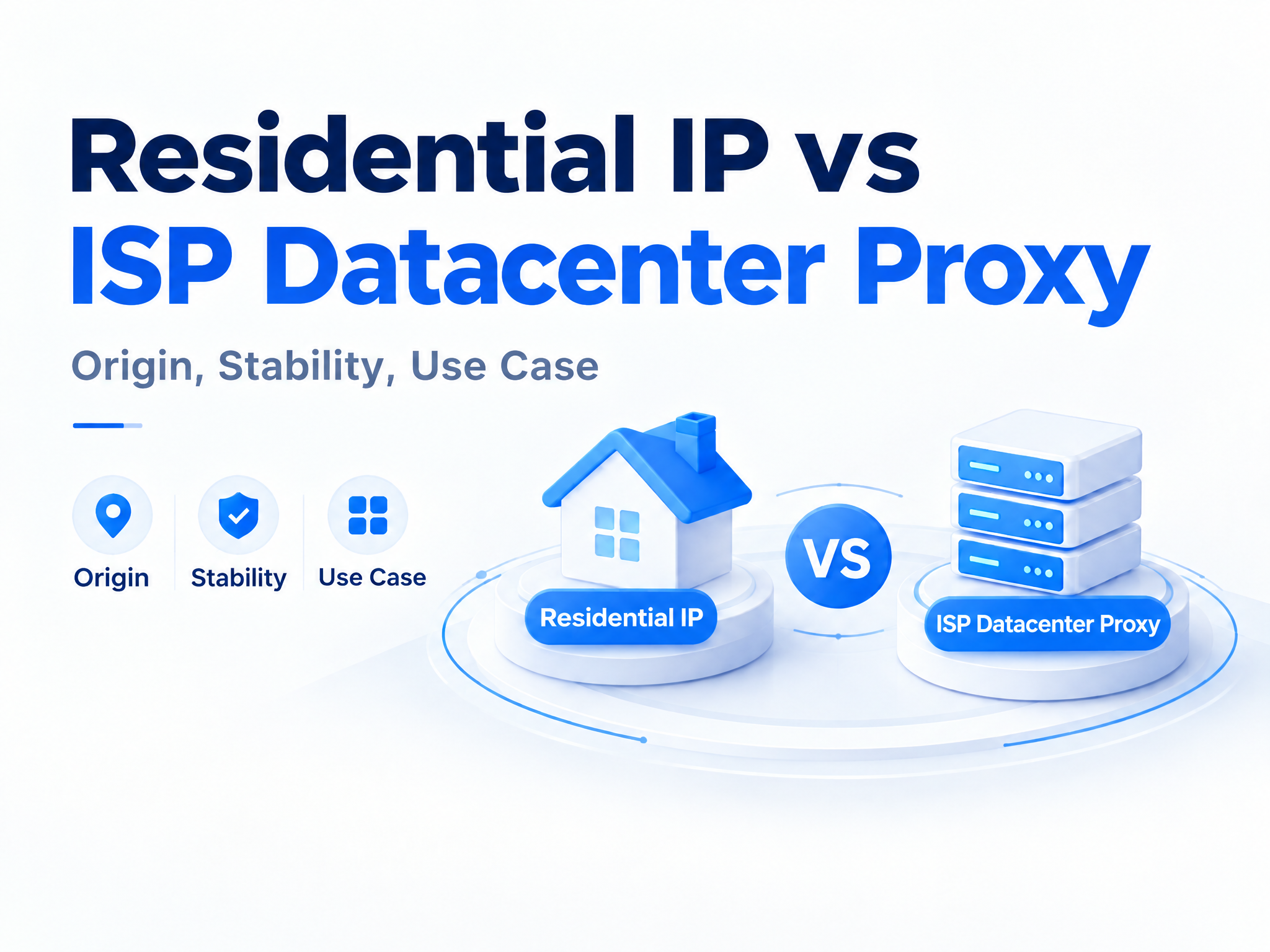
| Proxy Type | Better-Suited Tasks | Main Advantage | Key Limits to Confirm |
|---|---|---|---|
| Datacenter proxy | Low-latency API access, baseline connectivity tests, tasks needing stable bandwidth | Lines are relatively concentrated; performance is easier to predict | Network attribution signature is distinct; geo and access environment may not meet business needs |
| Rotating residential proxy | Multi-region public data scraping, price monitoring, SERP observation | Strong geo coverage and node diversity | Traffic cost, IP quality variance, and session control need focused testing |
| Static residential or ISP proxy | Tasks needing fixed exits, sustained sessions, or long-term identity consistency | Good IP continuity; suits fixed-cycle runtime | Per-IP cost is usually higher; resource count and region choice may be limited |
| Tunnel proxy | Tasks that want to avoid local IP pool maintenance and let the server handle switching | Easy integration; suits sustained requests | IP switching logic is server-side controlled; session and geo capabilities need confirmation |
| Dedicated proxy | Tasks with high requirements on resource isolation, fixed exits, or business stability | Resource boundaries are clearer and easier to manage | Cost and resource utilization need evaluation against actual usage |
Public market research shows rotating residential proxies still account for a large share of the residential proxy market, and HTTP and HTTPS remain the main protocols in use. That ties to the demand profile of e-commerce intelligence, search analytics, and regional public data scraping.
But rotation doesn't fit every task. When you need to maintain a single access identity, static residential or ISP proxies are an easier match; when you only need lower latency and stable connections, datacenter proxies may be more direct. Putting every task into one proxy type usually causes a noticeable imbalance in cost, stability, or maintenance complexity.
Why Can IP Count No Longer Represent Quality on Its Own?
Total IP count only speaks to resource scale — it doesn't directly say how many are available concurrently, how dispersed the IPs are, or how they'll actually perform in business.
The IP count numbers in marketing may include addresses that have appeared over a period of time, which isn't the same as the effective resource pool schedulable at purchase time. Some nodes may be offline, some may already have been heavily used, and others may be numerous but concentrated in a few network ranges or network attributions.
When evaluating resource quality, shift focus from "total" to these indicators:
| Observation Metric | Question to Answer |
|---|---|
| Concurrent availability | How many nodes can actually be scheduled during business peaks? |
| Network-range dispersion | Are nodes concentrated in a few ranges, forming a single signature? |
| Network attribution distribution | Does coverage span multiple carriers and network environments? |
| IP refresh cycle | How often are resources refreshed; how quickly are abnormal nodes evicted? |
| Geographic hit rate | After specifying a country, city, or carrier, what's the actual usable ratio? |
| Business success rate | On the target task, can requests complete continuously? |
That's why small-scale real-business testing is more valuable than reading promotional numbers like "tens of millions of IPs." Testing should log results across different time windows, regions, and request types, and distinguish connection failures, target response failures, timeouts, and node-switch failures — avoid lumping all problems onto proxy IPs.
Why Has Provider Compliance Become a Selection Threshold?
Proxy IP procurement in 2026 can't just look at technical specs — it needs to confirm resource origin, usage boundaries, and governance processes.
Public reports indicate multiple industry incidents around residential node authorization, source transparency, and proxy network governance in 2026. Those changes make clear that residential proxies don't automatically equal high-quality resources. Whether a provider can explain node origin, user authorization mechanisms, and violation handling directly affects enterprise procurement risk.
When screening providers, enterprises can ask them to clarify:
- Whether corporate entity and operating credentials are verifiable
- Whether IP resource origin has clear authorization or partnership documentation
- Whether there's an acceptable use policy and business restrictions
- Whether enterprise verification, real-name authentication, or tiered management is supported
- Whether basic usage, request, and anomaly records are provided
- Whether there's a process for complaints, misuse handling, and failure feedback
- Whether data retention, privacy handling, and cross-border usage boundaries are clear
- Whether trial-period test results stay consistent with the full plan
Compliance doesn't mean "every task can access everything." It means the provider can clearly say which businesses can use the service, which have restrictions, and who handles exceptions when they arise. For enterprise procurement, long-term tasks, and projects involving cross-border data, this information should be confirmed before purchase.
Why Does Picking Proxies on Price Often Mislead?
The real cost of proxy IPs isn't just the plan price — it also includes failed requests, manual maintenance, task reruns, and data validation.
The same traffic or IP count can't be compared head-to-head across different proxy types, validity periods, session mechanisms, and regional scopes. Low-price plans may limit concurrency, region, protocol, extraction method, or usage period; high-price plans may not fit low-frequency tasks. What really deserves comparison is cost per effective result, not sticker unit price.
Use this calculation frame:
Real unit cost = plan cost + maintenance cost + failed-request cost + data-rescrape cost, divided by final effective result count.
Before selection, record four groups of data:
| Cost Category | What to Log |
|---|---|
| Resource cost | Billing by IP, traffic, request count, bandwidth, or time |
| Usage cost | Integration dev, auth config, log monitoring, troubleshooting |
| Failure cost | Timeouts, empty responses, duplicate requests, task reruns |
| Management cost | Multi-provider switching, account management, finance procurement |
In the lightweight experiment phase, prefer per-usage or small-spec plans to validate target region, protocol, session, and task success. Once in stable runtime, use monthly usage to judge whether per-traffic, per-request, per-bandwidth, or fixed-resource billing better controls budget.
Which Directions Will Proxy IP Selection Follow Over the Next Year?
Competitive focus may shift further from "selling proxy IPs" to "providing manageable data access infrastructure."
Looking at current market shifts, at least five directions are worth watching:
- Resource quality becomes more transparent
Providers will need to explain IP origin, network attribution, refresh method, and anomaly handling — not just publish a total resource number. - ISP and fixed-session demand rises
When tasks need continuous identity, fixed region, and long-term runtime, stable exits grow more important. - Proxies combine further with data services
Some services will bundle IP connection, request retry, browser environment, structured extraction, and data cleaning — reducing user-side chain-building work. - Geo targeting becomes more granular
Country-level targeting is increasingly insufficient for price monitoring, ad verification, and localized testing — city, carrier, and even network attribution may become more common procurement requirements. - Enterprise procurement weighs audit more heavily
Credentials, authorization, usage policy, log management, and anomaly handling will shift from plus-points to provider entry conditions.
One industry analysis suggests AI data demand will continue to expand proxy bandwidth usage, but that doesn't mean every proxy service benefits in lockstep. Services that can sustainably support continuous tasks, define resource boundaries clearly, and complete compliance governance are more likely to enter enterprise long-term procurement lists.
What Checklist Should Guide Proxy IP Selection?
The safest selection flow: define the task first, validate with small-scale testing, then scale based on effective results.
Step 1: Define task boundaries
- Is access to public pages, public APIs, or authorized data sources?
- Does the task need a fixed exit or dynamic rotation?
- Country, city, or carrier targeting required?
- HTTP, HTTPS, or SOCKS5 protocol needed?
- Expected daily request volume, traffic, and concurrency range?
- Sustained runtime, session persistence, and automatic failover needed?
Step 2: Match proxy type
- If low latency and basic connection come first, evaluate datacenter proxies.
- For multi-region public data scraping, focus on rotating residential proxies.
- For fixed-identity and long-session tasks, focus on static residential or ISP proxies.
- If you want to avoid maintaining a local IP pool, evaluate tunnel proxies' session and switching rules.
- For high resource-isolation requirements, evaluate dedicated proxies or enterprise custom solutions.
Step 3: Run real testing
Testing should cover at least one complete business cycle, not just a single request. Log:
- Connection success rate and response time
- Variance across time windows
- Task continuity after IP switches
- Hit rate for specified regions
- Timeout, empty-response, and abnormal-node ratios
- Provider response speed and handling results
Step 4: Confirm procurement and governance conditions
Before purchase, confirm plan validity, billing unit, protocol, authentication, concurrency, geographic scope, refund or trial rules, and technical-support boundaries after formal use. For enterprise business, also keep records of credentials, usage policy, and resource authorization documentation to support later audit.
FAQ
Q: How do you judge which proxy IP provider has good quality?
Not by IP count or sticker price alone. Combine task type with tests of connection stability, session persistence, geo hit rate, anomaly node handling, and service responsiveness — and confirm whether resource origin and usage boundaries are clear.
Q: Are residential proxies always better than datacenter proxies?
No. Residential proxies suit multi-region public data scraping better; datacenter proxies may suit low-latency and stable-bandwidth tasks better. The decision rests on target region, session requirement, request scale, and cost structure.
Q: Why do things perform well in testing but worse in production?
The test sample may be too small to cover peak periods, different regions, and sustained requests. In production, resource concurrency, IP reuse, regional hit rate, and plan limits can all shift results — hence the need to test against a complete business cycle.
Q: Which protocols matter for proxy IPs?
For web requests, focus on HTTP and HTTPS. If the task involves broader network connections, confirm SOCKS5 support and its auth methods. More protocols isn't better — compatibility with existing systems is the point.
Q: Why look at compliance material for enterprise proxy procurement?
Resource origin, user authorization, data retention, and violation handling all affect enterprise risk. Compliance material helps confirm provider identity, resource origin, and usage boundaries — and supports procurement, legal, and security team review.
Q: Should a small team buy per-traffic or per-request?
For low-frequency or variable workloads, start with per-usage or small-spec plans to validate real consumption. When request sizes vary widely, per-request is easier to reason about; when transmitted payload varies obviously, per-traffic is easier to account for.
Q: Will the proxy IP market consolidate down to only large providers?
No simple consolidation to a single type. Larger providers more easily offer scale, compliance material, and enterprise support; smaller providers may still differentiate on specific regions, protocols, or niche tasks, but buyers bear higher validation cost.
Q: What's most often overlooked in proxy IP selection?
Task boundaries and failure cost. Looking only at unit price ignores data-rescrape, manual investigation, duplicate requests, and long-term maintenance. Working out cost per effective result before choosing the plan size is usually safer than comparing prices directly.
Closing: Quality Isn't a Number — It's a Verifiable Chain
The proxy IP market is shifting from competition on resource volume to a composite competition over quality, compliance, sessions, and service capability. For buyers, what deserves comparison isn't "whose marketing numbers are bigger" — it's whether resources fit the task, whether service can deliver continuously, whether anomalies are traceable, and whether the whole usage process is explainable, manageable, and reviewable.
Once proxy IPs enter a long-term business chain, the selection standard should upgrade from "can it connect" to "can it sustainably and compliantly complete effective tasks." That's the main direction for judging proxy IP quality in 2026.