Enterprise proxy IP procurement isn't a simple comparison of "who has more IPs" or "who's cheaper." What actually determines the outcome is whether the proxy resources match the business region, whether the connection method integrates with existing systems, whether the service holds up under real request volume, and whether there's a clear process for handling exceptions.
For enterprise teams, a more reliable flow is:
- Clarify business requirements and usage boundaries
- Screen candidate vendors across different product types
- Request test resources and establish unified testing conditions
- Determine procurement specs based on test results
- Complete technical integration, phased release, and acceptance
- Decide on scaling or adjustment through monitoring and retrospectives
Should Enterprises Pick a Vendor First or Confirm Requirements First?
Requirements first — then screen candidate vendors by product type and service capability.
Without clear requirements, procurement teams tend to compare apples to oranges. Short-lived proxies, tunnel proxies, long-lived proxies, and dedicated proxies suit different tasks, and billing by request count, bandwidth, duration, or IP count can't be compared head-to-head.
Before any formal pricing conversation, answer these questions:
| Requirement Dimension | What to Confirm |
|---|---|
| Business scenario | Bidding data, sentiment monitoring, price monitoring, public information lookup, or other compliant business |
| Target region | Domestic, overseas, specific countries, specific cities — whether regional filtering is needed |
| Protocol requirement | HTTP, HTTPS, SOCKS5 — whether multi-protocol compatibility is required |
| Connection method | API extraction, fixed proxy entry, dynamic switching, or dedicated connection |
| IP rotation pattern | Per-request switch, time-based switch, fixed session, or manual change |
| Concurrency scale | Average concurrency, peak concurrency, per-account and per-entry limits |
| Session requirement | Whether exit consistency needs to be maintained within a time window |
| Billing method | Per request, per traffic, per duration, per IP count, or combined |
| Authentication method | Username/password, IP allowlist, API key, or multiple in parallel |
| Management requirement | Invoicing, contract, service response, permission management, data retention, exit mechanism |
The goal of requirement confirmation isn't to fill in every field — it's to identify which fields directly affect product choice and procurement cost.
Which Vendor Categories Should Enterprises Shortlist?
Enterprise procurement typically considers three categories in parallel: comprehensive, scenario-focused, and custom.
These three aren't a fixed industry ranking — they're the common service-capability distribution seen in procurement. Enterprises can decide whether to keep multiple categories in play based on business scale and internal technical capacity.
| Candidate Category | Common Capability Profile | Best-Fit Scenarios |
|---|---|---|
| Comprehensive vendor | Full product range covering multiple protocols, regions, and billing methods | Multi-business parallel use, long-term procurement, teams needing unified management |
| Scenario-focused vendor | Products built around a specific region, protocol, or proxy form | Concentrated needs with clear product specifications |
| Enterprise custom vendor | Negotiable resources, routing, permissions, service response, and settlement terms | Large concurrency, high systems integration requirements, or dedicated-service needs |
When shortlisting, start by keeping 3–5 vendors for initial dialogue, then narrow by requirement fit. Too few candidates means no comparison basis; too many means test conditions and evaluation criteria lose consistency.
How Should the Proxy IP Requirements Form Be Filled Out?
The requirements form should break business goals into testable technical fields, each with a defined acceptance measure.
Here's a baseline template for pre-procurement use:
| Item | Example Entry | Acceptance Criterion Needed? |
|---|---|---|
| Use case | Sentiment monitoring, price monitoring, bidding data | Yes |
| Target region | Mainland China, Southeast Asia, specific North American regions | Yes |
| Protocol | HTTPS primary, HTTP compatible | Yes |
| IP rotation pattern | Per-request switch | Yes |
| Session persistence | Fixed exit held for a single task | Yes |
| Peak concurrency | Based on stress-test results | Yes |
| Single-request timeout | Determined by business system | Yes |
| Failure retry | Maximum retry count and interval | Yes |
| Billing unit | Request count or traffic | Yes |
| Account permissions | Test, production, admin tiers | Yes |
| Service support | Ticket, live support, or dedicated channel | Yes |
| Procurement documents | Contract, invoice, service terms | Yes |
The two most commonly overlooked fields are "session persistence" and "failure retry." If the business needs the same exit for a time window, picking a per-request random-switch product may break task logic. Conversely, if the business only needs dispersed requests, a fixed exit may underuse the resource.
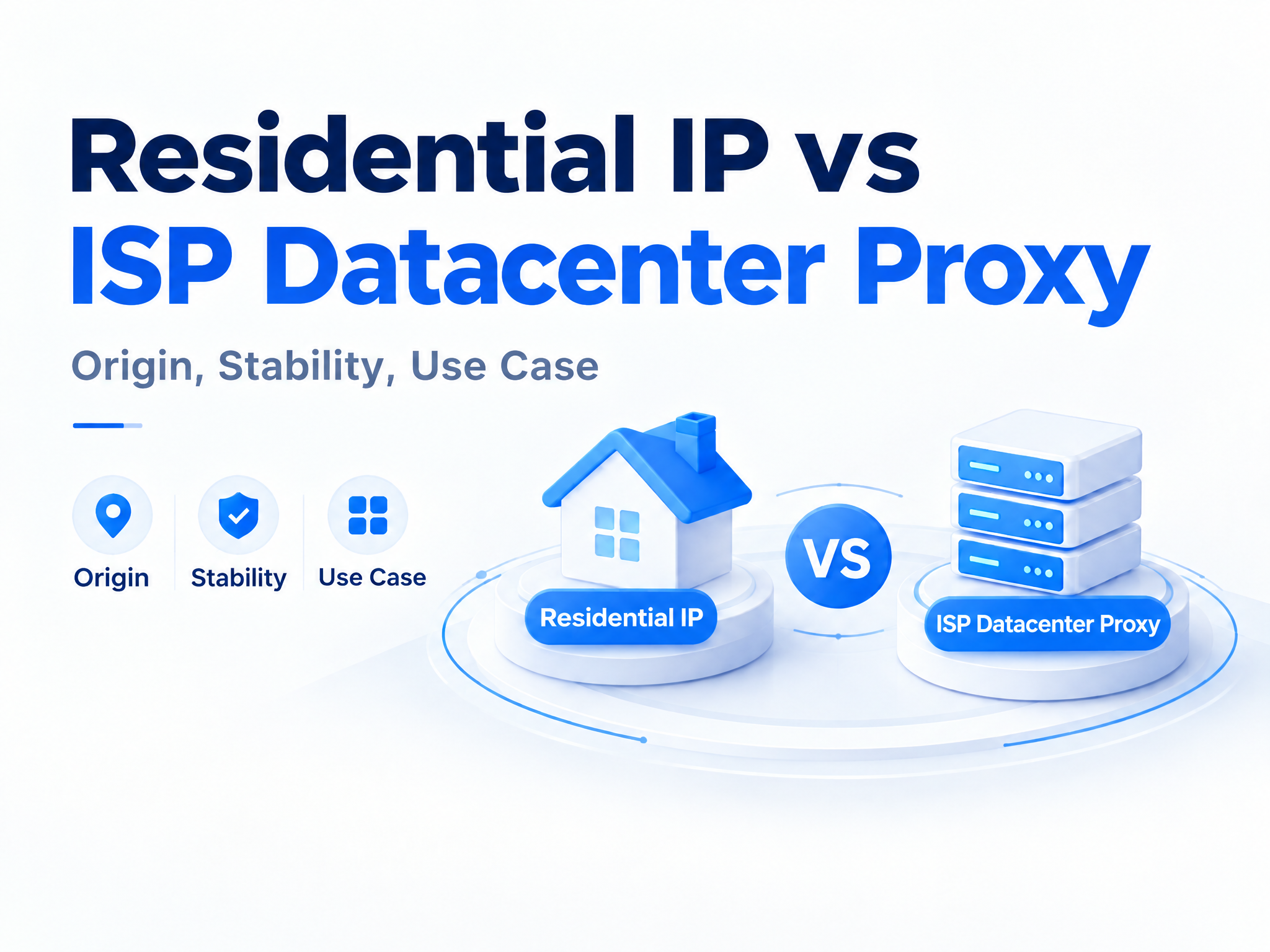
How to Choose Among Short-Lived, Tunnel, Long-Lived, and Dedicated Proxies?
Choose proxy type by IP change frequency, session stability, resource exclusivity, and system integration method.
| Product Type | Typical Features | Best-Fit Business Requirement | Key Procurement Items to Confirm |
|---|---|---|---|
| Short-lived proxy | IPs change on a short cycle; suits batch requests | Public data queries requiring high change frequency | Rotation cycle, extraction method, request count or IP count |
| Tunnel proxy | Business system connects to a fixed entry; service handles exit scheduling | Teams wanting to reduce local switching logic | Concurrency, connection count, protocol, failure retry, billing method |
| Long-lived proxy | IPs can hold for longer periods; suits stable sessions | Tasks needing sustained login state or fixed exit | Validity period, lifecycle management, exclusivity level, rotation rules |
| Dedicated proxy | Resources used exclusively by one buyer | High requirements on exit stability, permission isolation, or business continuity | Dedication scope, resource delivery, replacement mechanism, service boundaries |
No product type is absolutely better than another. The enterprise should first identify whether the business most needs "frequent change," "stable connection," "long-term persistence," or "exclusive resources" — then move into detailed spec comparison.
What Conditions Need to Be Unified Before Enterprise Proxy IP Testing?
Test environment, request sample, time window, and statistical measures must be unified upfront — otherwise results across vendors are incomparable.
Lock in the following before testing starts:
- Fixed target scope: use the same batch of public business pages or endpoints — don't let each vendor hit different content.
- Fixed request logic: request method, headers, timeouts, and retry rules all identical.
- Fixed concurrency strategy: start low, step up, log changes at each stage.
- Fixed test window: cover both business peaks and troughs — don't judge from a single time point.
- Fixed statistical method: uniformly log connection failures, timeouts, business response anomalies, and proxy-side anomalies.
- Fixed cost basis: define whether billing is per request, per traffic, per time, or per IP count — don't just look at headline price during testing.
- Fixed version environment: test program, runtime, and network exit stay consistent to reduce environmental variance.
Testing shouldn't just check "can it connect." A single successful connection only proves that request completed — it doesn't speak to long-term stability, concurrency capacity, or cost fit.
Which Metrics Should Enterprise Proxy IP Testing Cover?
Testing metrics should cover at least six dimensions: availability, stability, performance, resource characteristics, cost, and service response.
| Metric Category | Suggested Observations | Use of Results |
|---|---|---|
| Connection availability | Connection success, failure, timeout counts | Judge basic integration feasibility |
| Business completion | HTTP status, target page completeness, whether business fields return | Judge whether the proxy actually satisfies the task |
| Latency performance | Connection time, time-to-first-byte, full-response time | Evaluate task processing speed |
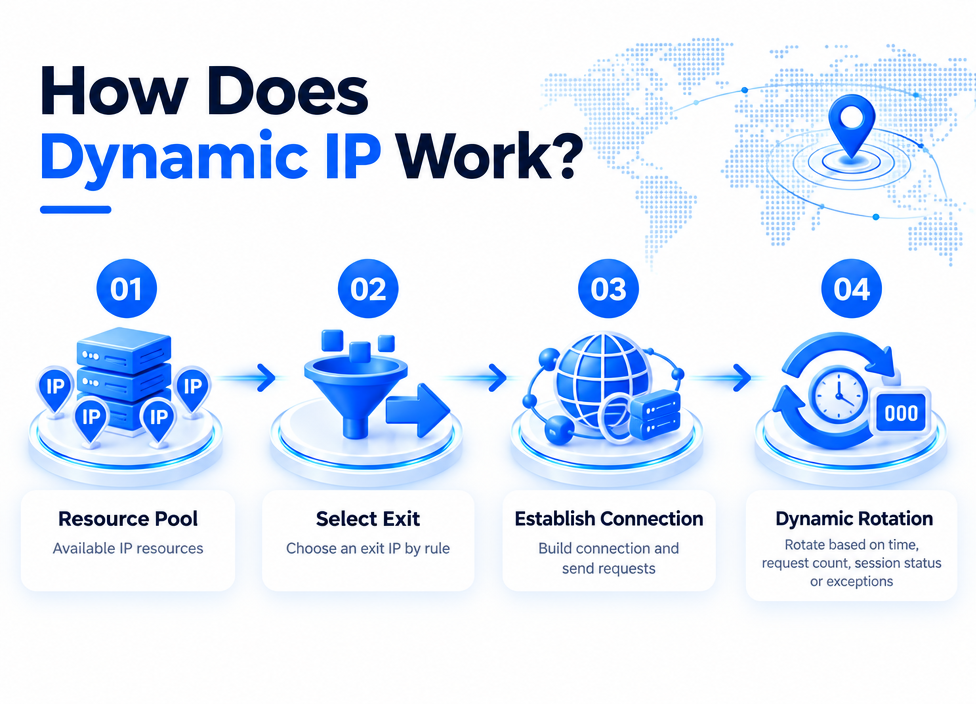
| IP rotation characteristics | Whether IP switches match the configured cycle; whether repeats are too dense | Judge whether the product matches the rotation requirement |
| Session stability | Whether exits stay consistent during fixed-session periods | Judge suitability for long-flow tasks |
| Concurrency capacity | Whether response, timeout, and failure change markedly as concurrency rises | Determine production configuration ceiling |
| Exception recovery | Whether failed proxies can switch, retry, or recover | Evaluate automation and operations difficulty |
| Cost performance | Cost per completed business transaction, per unit traffic | Support procurement spec decisions |
| Service response | Ticket response, problem triage, resolution time | Judge long-term partnership risk |
How to Calculate Availability Rate
Use a unified formula:
Request availability = Successfully completed business requests ÷ Total business requests × 100%"Successfully completed" can't be judged by HTTP status alone. If the page returns a normal status but key business fields are missing, that shouldn't count as a successful request.
How to Calculate Cost Per Transaction
Cost per transaction = Actual spend during test ÷ Successfully completed business requestsIf different vendors use different billing methods, log raw spend separately, then convert to a unified business-cost measure. Don't just compare plan sticker prices — the same dollar amount can map to different request volumes, traffic allowances, validity periods, and resource conditions.
How to Design Proxy IP Test Samples?
Samples should cover four scenarios: normal requests, continuous requests, concurrent requests, and exception recovery.
Design in the following sequence:
Group 1: Baseline connection test
Goal: confirm that account, authentication, protocol, and entry configuration are correct.
Test contents:
- HTTP and HTTPS connections
- Username/password or allowlist authentication
- Connections to different target regions
- DNS, port, and timeout behavior at the proxy entry
- Whether target pages return normally
Group 2: Continuous request test
Goal: observe stability of the same proxy configuration over a period.
What to log:
- Success and failure of consecutive requests
- Whether IP changes match expectations
- Whether response time rises progressively
- Whether failures can auto-recover
- Whether abnormal repeats or long periods of no response occur
Group 3: Concurrency test
Goal: determine a reasonable production concurrency range.
Use a stepped stress test:
- Run at low concurrency, confirm baseline results
- Step up concurrency, observe response times
- Log failure rate and timeout changes
- Find the concurrency range still acceptable to the business
- Keep some headroom — don't use peak test results directly as production config
Group 4: Exception recovery test
Goal: validate whether the business system can self-handle proxy exceptions.
Can test:
- Connection timeouts
- Authentication failures
- Proxy entry unreachable
- Target endpoint response slowdown
- Single exit failure
- Brief network fluctuations
- Behavior after hitting concurrency limits
The focus of exception recovery testing isn't preventing all exceptions — it's confirming exceptions can be detected, logged, and handled.
How to Define Proxy IP Acceptance Criteria?
Acceptance criteria must be set before testing, and must contain both hard thresholds and observation items.
Split criteria into three categories:
1. Hard thresholds
Failing these blocks production entry — for example:
- Must support the specified protocol
- Must cover the target region
- Must provide the agreed authentication method
- Must meet enterprise procurement and invoicing requirements
- Must meet contractual service boundaries
2. Performance thresholds
Used to judge whether business runtime requirements are met — for example:
- Business request completion rate
- Acceptable average response time
- Maximum failure ratio at peak concurrency
- Fixed-session hold duration
- Exception recovery time
Let the business team set these against actual tasks — don't just copy numbers from other projects.
3. Observation items
Used to assist decisions but not necessarily veto conditions — for example:
- Whether the console is easy to operate
- Whether API docs are clear
- Whether data reports are complete
- Whether ticket communication flows
- Whether scaling up and down is flexible
- Whether account permissions support multi-user collaboration
The final acceptance form can look like this:
| Acceptance Item | Target Requirement | Test Result | Pass? | Notes |
|---|---|---|---|---|
| Protocol integration | Supports HTTPS | TBD | TBD | Log configuration method |
| Region coverage | Satisfies specified business regions | TBD | TBD | Log actual exits |
| Business completion rate | Not below internal standard | TBD | TBD | Statistics on unified sample |
| Peak concurrency | Satisfies business peak | TBD | TBD | Log timeout changes |
| Session stability | Satisfies task cycle | TBD | TBD | Log IP changes |
| Exception recovery | Supports auto-retry or switching | TBD | TBD | Log recovery process |
| Procurement documents | Contract, invoice, terms complete | TBD | TBD | Procurement review |
What Steps Does Proxy IP Integration Involve?
Formal integration starts with a test account and proceeds through authentication, configuration, logging, retry, phased release, and acceptance.
Step 1: Separate test and production environments
Test accounts, production accounts, and admin accounts should be managed separately. During testing, don't use production keys directly, and don't let all developers share one high-privilege account.
Step 2: Configure authentication
Per the vendor's method, configure username/password, IP allowlist, or API key. Store sensitive info in environment variables or a secrets management system — don't commit it to code repositories.
Example:
export PROXY_HOST="proxy.example.internal"
export PROXY_PORT="8080"
export PROXY_USER="test_user"
export PROXY_PASSWORD="test_password"
The address and account above are for illustration — replace with actual procurement information in production.
Step 3: Encapsulate unified proxy configuration
Encapsulate proxy configuration in a single place within the business system — don't scatter proxy parameters across multiple business modules. This makes it easier to swap vendors, adjust retry strategies, and do phased rollouts later.
import os
import requests

proxy_url = (
    f"http://{os.environ['PROXY_USER']}:"
    f"{os.environ['PROXY_PASSWORD']}@"
    f"{os.environ['PROXY_HOST']}:{os.environ['PROXY_PORT']}"
)

proxies = {
    "http": proxy_url,
    "https": proxy_url,
}

response = requests.get(
    "https://example.com",
    proxies=proxies,
    timeout=10,
)

print(response.status_code)
Real integration should also add timeouts, exception capture, logging, and sensitive-information masking.
Step 4: Set retry and switching rules
Retry can't be unlimited. Make the following explicit:
- Which errors are retryable
- Which errors should abort immediately
- Interval between retries
- Maximum retry count
- Whether to switch proxies
- Whether to trigger alerts on consecutive failures
If a request has side effects, confirm before retrying whether duplicate submissions could cause business problems.
Step 5: Connect monitoring and logging
Log at least:
- Request time
- Business module
- Proxy entry
- Exit IP or resource identifier
- Target region
- Response status
- Response time
- Failure type
- Retry count
- Consumption
Logs should not contain full passwords, API keys, or other unnecessary sensitive information.
Step 6: Run a small-traffic pilot
During the pilot, route only part of the business through the new proxy configuration and keep the original path as control. Focus on:
- Whether business completion rate changes
- Whether average and peak response times change
- Whether exception types cluster
- Whether actual consumption matches procurement estimates
- Whether monitoring and alerts work normally
Step 7: Complete production acceptance
Only expand usage after pilot results meet pre-set standards. Production acceptance should be jointly confirmed by business, technical, and procurement — not left to a technical judgment of "it connects" leading straight to launch.
What Should Be Confirmed in a Proxy IP Procurement Contract?
A contract isn't just resource count and price — it should spell out service boundaries, data handling, failure response, and exit mechanism.
Focus on confirming:
| Contract Item | Details to Confirm |
|---|---|
| Service scope | Region, protocol, product type, usage period |
| Billing basis | Request count, traffic, duration, IP count, overage rules |
| Resource delivery | Account, entry, API, allowlist, permission scope |
| Service availability | Measurement method, exception definition, service-level remedies |
| Support methods | Ticket, live support, on-call hours, escalation path |
| Failure handling | Failure confirmation, temporary alternatives, resource replacement, recovery process |
| Data handling | Log retention, data access, permissions, deletion requirements |
| Compliance responsibility | Both parties' usage boundaries, business purpose, violation handling |
| Invoicing & payment | Invoice type, payment cycle, reconciliation method |
| Renewal & exit | Expiration reminders, auto-renewal, data export, account deactivation |
Before signing, have legal, infosec, and the business lead each review. Whether the proxy resources are technically usable is only the technical question — whether the enterprise can use them long-term, compliantly, and auditably is the full procurement boundary.
How to Judge Whether Test Results Justify Procurement?
Final judgment should look at business completion cost and long-term management difficulty, not any single test metric.
Use this decision sequence:
- Check hard requirements first: are protocol, region, authentication, and procurement documents all qualified?
- Then check core business completion: do pages or endpoints return the data actually needed?
- Then check peak-condition tolerance: as concurrency rises, do failures and timeouts stay within acceptable range?
- Then check whether exceptions are manageable: can the system detect problems and execute retries, switches, or alerts?
- Finally check whether cost is explainable: does per-transaction cost fit the budget; is the billing method easy to reconcile?
- Evaluate long-term partnership cost: do docs, tickets, permissions, reconciliation, and scaling add management burden?
If one candidate shows better single-metric latency but needs heavy manual switching and triage, actual operating cost may exceed expectation. Conversely, a plan with higher per-transaction cost but simpler integration and traceable exceptions may suit long-term runtime better.
What Problems Most Commonly Arise in Enterprise Proxy IP Procurement?
Procurement risk usually isn't "no proxies available" — it's disconnects between requirements, testing, and production configuration.
Common problems:
- Buying based on package price alone, without reconciling billing units
- Testing at low concurrency, then scaling straight to peak in production
- Testing only for connections, not for business field completeness
- Not distinguishing short-lived, tunnel, long-lived, and dedicated products
- Handing a fixed-session requirement to a frequent-switching product
- No agreed failure response or resource replacement process
- Using test accounts directly in production
- Proxy configuration hard-coded into business code
- Infinite retry on failure, causing request pile-up
- Logs missing proxy exceptions and consumption data
- Procurement, technical, and business sides using different acceptance criteria
Solving these means breaking procurement into five trackable stages: "requirement confirmation, unified testing, technical integration, phased release, production acceptance" — with clear records at each stage.
What Steps Can Enterprises Follow Directly?
For fast execution, follow this seven-step checklist.
Before procurement
- [ ] Define business scenario and compliance boundaries
- [ ] Confirm domestic, overseas, or specific-region needs
- [ ] Confirm HTTP, HTTPS, or SOCKS5 protocol
- [ ] Specify IP rotation, session persistence, and concurrency requirements
- [ ] Confirm billing unit and budget basis
- [ ] Confirm contract, invoice, and technical support requirements
During testing
- [ ] Use unified samples and unified program
- [ ] Log connection, business completion, latency, and exception recovery results
- [ ] Cover low concurrency, peak concurrency, and exception scenarios
- [ ] Log IP rotation and session stability
- [ ] Calculate per-transaction cost
- [ ] Have business, technical, and procurement jointly review results
Before launch
- [ ] Separate test and production accounts
- [ ] Move sensitive info into environment variables or secrets management
- [ ] Centralize proxy configuration
- [ ] Define timeout, retry, switching, and alert rules
- [ ] Complete small-traffic pilot
- [ ] Sign acceptance record and retain test data
FAQ
Q: How many candidate vendors should an enterprise shortlist?
Keep 3–5 for initial testing, then narrow by region, protocol, session, concurrency, and service response. Too few candidates means no comparison; too many loses control over test conditions and evaluation standards. Final shortlist usually includes a primary and a backup — whether a backup is needed depends on business continuity requirements.
Q: How long does testing need to run before judging production readiness?
No fixed duration. Testing should cover normal business hours, business peaks, continuous requests, concurrency changes, and exception recovery. A few connectivity tests can't represent production performance. The more reliable approach is a short-cycle functional test followed by a stability test covering real business rhythm.
Q: Why do requests still fail in production after test-time connections succeeded?
Common causes: samples too simple, production concurrency above test concurrency, business fields not in the acceptance scope, unreasonable retry rules, and network differences between production and test environments. Troubleshoot by examining proxy logs, business logs, response times, error types, and actual consumption together — not just HTTP status codes.
Q: Should an enterprise choose per-traffic or per-request billing?
If per-request payload is stable, per-request billing is easier to estimate business cost. If response payload varies widely, per-traffic may align better with actual consumption. For complex business, estimate per-transaction cost under both methods using historical request data, then decide based on reconciliation convenience, overage rules, and budget management.
Q: Why do a phased pilot during proxy IP integration?
A pilot contains potential problems within a smaller scope, letting you compare new and old configuration on completion rate, latency, exception types, and resource consumption. A direct full cutover widens troubleshooting scope significantly if authentication, concurrency, retry, or regional-fit issues arise, and may affect running business tasks.
Q: Should enterprises keep a long-term backup proxy solution?
Depends on business continuity requirements, switching cost, and budget. For continuously running tasks like bidding data, sentiment monitoring, and price monitoring, a backup's value isn't only failover — it's having a verified alternative path when procurement adjustments or scaling occur. Backup solutions should also complete baseline testing — don't wait until the primary fails to start validating.