Why Does Success Rate Differ So Much When You Swap Access Forms on the Same Task?
Collection success rate doesn't only depend on IP quality—the access form itself is an underrated variable.
Many technical teams selecting proxy IPs habitually compare pool size, uptime, and price, while overlooking a more fundamental question: tunnel proxies and dynamic IP pools (i.e., the API extraction mode of rotating proxies) are architecturally two entirely different access forms, and the constraints they place on collection tasks are also entirely different.
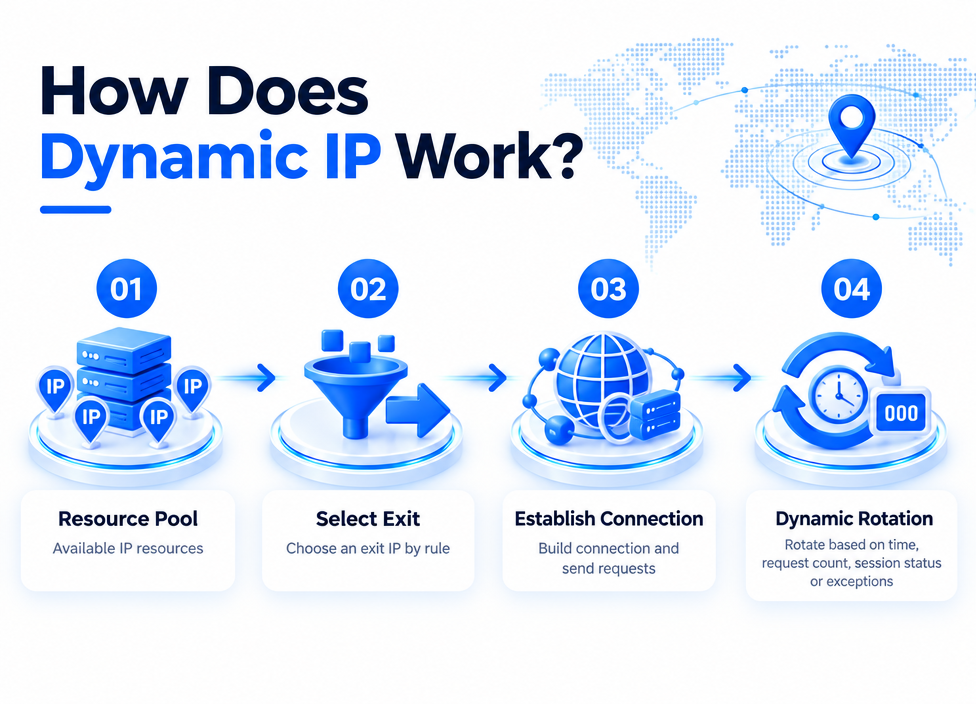
The core mechanism of a tunnel proxy is unified entry point + server-side auto IP rotation. The scraping client only configures a single fixed proxy address; on each request, the server assigns a new IP. Developers don't need to maintain an IP pool or write rotation logic. The core mechanism of a dynamic IP pool is API extraction + client-side management. The scraping client pulls a batch of IPs via API and manages usage, expiration, and rotation itself. IP lifespans can range from 1 to 30 minutes.
Neither form is better than the other—but they fit different scenarios. Below we break down three real project cases and see what happens when they're "used backwards."
Case 1: Why Did the Sentiment Monitoring Project Move From Dynamic IP Pool Back to Tunnel Proxy?
A data service provider took on a whole-web sentiment monitoring project—continuous 7×24 scraping across 20+ mainstream news platforms, with daily volume over 5 million requests.
Initial plan: the team picked a dynamic IP pool, reasoning "IP lifespan is controllable, and we can tune the lifespan window per platform."
What went wrong:
| Stage | Problem | Root Cause |
|---|---|---|
| Week 1 | IP pool management code exceeded 30% of total codebase | Dynamic IP pools require the client to maintain IP state, expiration detection, and rotation scheduling |
| Week 2 | Overnight success rate collapsed to 60% | With no ops staff after hours to replenish expired IPs, API extraction hit frequency limits |
| Week 3 | After adding 3 more platforms, IP scheduling complexity grew exponentially | Each platform has different rate-limiting policies; dynamic IP pool needs per-platform scheduling rules |
Changes after switching to tunnel proxy:
| Metric | Dynamic IP Pool Period | Tunnel Proxy Period |
|---|---|---|
| IP management code | ~2,000 lines | 0 lines, unified entry point |
| Overnight success rate | 60%-75% | Roughly on par with daytime |
| Time to onboard a new platform | 2-3 days per platform | Just configure proxy address—done in half a day |
Takeaway: for "high-frequency + continuous + multi-platform" scenarios like sentiment monitoring, the core tension isn't whether IP lifespan is long enough—it's whether the scraping client can hold stable request throughput 7×24 unattended. Tunnel proxies hand IP rotation logic off to the server; the client just fires requests. This is a natural fit. Dynamic IP pools' flexibility at the IP-granularity level actually becomes an ops burden in 7×24 continuous scraping.
Case 2: Why Did the Ad Monitoring Project Stick With Dynamic IP Pool?
An ad-tech company monitors competitor ad creatives, needing to simulate real-user visits from 30 cities across China. Three collection rounds trigger daily at fixed times (8am, 12pm, 8pm), each running about 40 minutes.
Initial plan: the team tried a tunnel proxy first, reasoning "auto IP change per request—less hassle."
What went wrong:
| Stage | Problem | Root Cause |
|---|---|---|
| Round 1 test | Same ad slot repeatedly hit by different IPs within one round | Tunnel proxy rotates IP per request; can't hold "same session on same IP for multi-step operations" |
| Round 2 test | City-targeted IP distribution uncontrollable | Tunnel proxy IP allocation is server-scheduled; the client can't specify "this batch of requests uses only Beijing IPs" |
| Round 3 test | Single round only needs 40 minutes, but tunnel proxy bills monthly—resource utilization under 20% | Tunnel proxy bills by request/concurrency on a monthly basis; poor cost efficiency for intermittent scraping |
Changes after switching to dynamic IP pool:
| Metric | Tunnel Proxy Period | Dynamic IP Pool Period |
|---|---|---|
| Session continuity | Not guaranteed | Same IP holds through multi-step operations within lifespan window |
| City-targeting accuracy | Server-assigned, uncontrollable | Specify city during API extraction—high accuracy |
| Monthly cost | Monthly bundle, ~20% utilization | Pay-per-extraction—only pay for IPs actually used |
Takeaway: for "scheduled trigger + city targeting + session continuity" scenarios like ad monitoring, the core need is fine-grained IP control—specify cities, hold multi-step operations on one IP, extract on-demand rather than continuously occupying. Dynamic IP pool's API extraction mode naturally matches these needs. Tunnel proxy's "auto rotate per request" actually breaks session continuity.
Case 3: How Did the Generic Website Scraper Project Land on a Hybrid Setup?
An enterprise data platform team runs a shared scraping framework, taking on collection needs across multiple internal departments—including scheduled batch pulls of procurement/bid data and real-time incremental scraping of lead-generation data.
Initial plan: route everything through tunnel proxies, reasoning "unified access is easiest."
What went wrong:
Procurement/bid data collection is a typical "scheduled + batch + login-state persistence required" scenario. The API requires all requests within one session to come from the same IP; otherwise the session breaks and re-authentication is needed. Tunnel proxy rotates IP per request, directly breaking session persistence.
Lead-generation data collection is a typical "continuous + high-frequency + no session requirement" scenario. Each request is independent, no IP continuity needed, but must run 7×24 without interruption.
Final plan:
| Task Type | Access Form | Reason |
|---|---|---|
| Procurement/bid data (scheduled batch + session continuity) | Dynamic IP pool, 10-15 minute lifespan window | Needs same IP to hold login + data pull as one session |
| Lead-generation data (continuous high-frequency + no session need) | Tunnel proxy | Each request is independent; auto rotation + zero ops fits best |
Takeaway: in a real enterprise data platform, different business lines' scraping needs vary enormously. Applying a single access form across the board either sacrifices session continuity or adds unnecessary ops burden. Splitting access forms by business characteristics is the pragmatic move.
Just How Costly Is Picking the Wrong Access Form?
Aggregating the three cases, the cost of picking the wrong access form quantifies along three dimensions:
| Cost Dimension | Typical Manifestation | Order of Magnitude |
|---|---|---|
| Development cost | Dynamic IP pool used for continuous scraping—IP management code balloons | 2,000+ extra lines, 2-3 person-weeks of dev |
| Success rate loss | Tunnel proxy used where session continuity is needed—sessions constantly break | 20%-30% drop in success rate |
| Resource waste | Tunnel proxy used for intermittent scraping—monthly-bundled resource sits idle | Utilization can be under 20% |
Conversely, picking the right access form doesn't require extra investment—just spending an extra half hour during selection to clarify business constraints.
How Do You Judge Which Access Form a Scraping Project Needs?
No complex evaluation framework needed—answering three questions is enough.
Question 1: Is the collection task continuous or intermittently triggered?
Continuous (7×24, over a million requests daily) → prefer tunnel proxy. Intermittent (scheduled, batch, limited daily volume) → prefer dynamic IP pool.
Question 2: Does a single collection round need session continuity?
Needs same IP for login + data pull + pagination as one flow → prefer dynamic IP pool with controllable lifespan window. Each request is independent, no IP continuity needed → prefer tunnel proxy for zero-ops auto rotation.
Question 3: Do you need precise control over IP geographic distribution?
Need to specify city/province → prefer dynamic IP pool with per-city API extraction. No precise control needed → prefer tunnel proxy with server-side smart scheduling.
Turn the answers into a decision table:
| Continuity | Session Continuity | Region Control | Recommended Form |
|---|---|---|---|
| Continuous | Not needed | Not needed | Tunnel proxy |
| Continuous | Needed | Not needed | Dynamic IP pool (long lifespan window) |
| Continuous | Needed | Needed | Dynamic IP pool (long lifespan + city targeting) |
| Intermittent | Not needed | Not needed | Dynamic IP pool (pay-per-use is cheaper) |
| Intermittent | Not needed | Needed | Dynamic IP pool (city targeting + pay-per-use) |
| Intermittent | Needed | Needed | Dynamic IP pool (session + city + pay-per-use) |
Only one combination—"continuous + no session continuity + no precise region control"—clearly favors tunnel proxy. In every other combination, dynamic IP pool's flexibility fits better. But the core value of tunnel proxy is: when your scraping task really is that "runs continuously, doesn't need IP control" case, it brings ops cost close to zero.
Where Are the Technical Boundaries of the Two Access Forms?
To avoid cognitive bias during selection, it's worth being explicit about what each form can't do:
| Dimension | Tunnel Proxy Boundary | Dynamic IP Pool Boundary |
|---|---|---|
| IP control granularity | Can't specify "use this IP for this request" | Client must manage IP lifecycle itself |
| Session continuity | Rotates IP per request—can't hold session | Can hold within lifespan window, but needs re-fetch when window expires |
| Ops complexity | Near zero | Need to build IP scheduling, expiration detection, replenishment logic |
| Billing flexibility | Usually monthly/per-request bundle—expensive for intermittent scenarios | Pay-per-GB or per-time with multiple modes—cost-controlled for intermittent |
| Concurrency control | Server-controlled concurrency cap | Client-controlled concurrency granularity |
For technical decision-makers, rather than agonizing over "which is better," first sketch out where your scraping tasks land in this table.
FAQ
Q: Can tunnel proxies and dynamic IP pools be mixed?
Absolutely—Case 3 is exactly a hybrid. Enterprise data platforms typically take on multiple types of scraping needs; splitting access forms by business characteristics is common practice. The key is abstracting the proxy access layer in the architecture so different scraping tasks can flexibly switch access forms.
Q: How do you choose a dynamic IP pool's lifespan window?
Depends on single-session duration. If login + data pull + pagination fits within 3 minutes, a 1-5 minute lifespan window suffices. For deep pagination or multi-step operations, go with 10-15 minutes or more. Windows too long increase cost; windows too short break sessions.
Q: Is tunnel proxy more expensive than dynamic IP pool?
Depends. Tunnel proxy bills monthly or by request count; in continuous scraping scenarios, per-request cost may be lower. But in intermittent scenarios, resource utilization is low and actual cost is higher. Dynamic IP pool bills per-use—cheaper in intermittent scenarios. Model it out against your actual daily volume and runtime.
Q: If success rate is low, is it always the wrong access form?
Not always. Success rate is influenced by IP quality, request frequency, header spoofing, target-site rate-limiting policy, and more. But if success rate is still poor after ruling out these factors, it's worth revisiting whether the access form matches the scenario—especially the classic mismatch of "using per-request-rotation tunnel proxy where session continuity is needed."
Q: What do small teams without capacity to maintain dynamic IP pool scheduling do?
Two options. One: pick tunnel proxy—sacrifice some IP control flexibility for zero ops. Two: use rotating proxies in tunnel-extraction mode, sitting between tunnel and pure API extraction—the tunnel entry point is fixed but IPs rotate on a set cycle, balancing convenience and controllability.
Q: How much code change is involved when switching from dynamic IP pool to tunnel proxy?
The core change is stripping IP pool management logic and shifting the proxy address from dynamic-fetched to fixed-configured. If the original scraping framework had a proxy abstraction layer, the change is small—half a day to a day. If IP management logic is heavily coupled with business logic, expect 1-2 weeks of refactoring. Newer projects should design the proxy access as a pluggable module from the architecture stage.