What Are the Five Core Capabilities of Data Monitoring Integration?
Regardless of the language, a data monitoring task that runs stably for a year needs five capability blocks. Missing one means catching up in production.
| Capability Block | Purpose | Main Judgment Points |
|---|---|---|
| Request sending | Get target response | Timeout control, connection reuse, protocol support (HTTP/1.1, HTTP/2, HTTPS) |
| Proxy configuration | Egress IP control, access-environment isolation | Proxy protocol, auth method, failover switching |
| Failure retry | Handle intermittent failures | Error classification, backoff strategy, idempotency judgment |
| Concurrency scheduling | Scale tasks | Concurrency cap, rate limiting, scheduler |
| Logs and metrics | Observability | Structured logs, metric exposure, alert integration |
Public-opinion monitoring, ad monitoring, and livestream/short-video data monitoring share common traits: large task volume, diverse targets, and single failures accumulating unacceptably over time. All five capabilities together are the prerequisite for long-term stable operation.
How Do You Choose the Trade-Off Tags Across the Three Languages?
The three languages aren't a "who's better" question — it's a "which scenario for which" question.
Scenario → language mapping:
| Scenario Tag | Python | Java | Go |
|---|---|---|---|
| Rapid prototyping, script transformation | ✓ First choice | Overkill | Overkill |
| Enterprise-grade long-running, with existing Java infrastructure | Optional | ✓ First choice | Optional |
| Extreme concurrency density, single-machine throughput critical | Not recommended | Medium | ✓ First choice |
| Team has rich Python ecosystem | ✓ First choice | — | Optional |
| Deep integration with JVM ecosystem (Kafka, Flink) needed | Needs gateway | ✓ First choice | Optional |
| Cloud-native / container scenarios, binary deployment | Optional | Overkill | ✓ First choice |
| Single-stack team | Follow stack | Follow stack | Follow stack |
Core differences of the three languages on monitoring tasks:
- Python: wins on development speed and library ecosystem (requests, httpx, tenacity, aiohttp); weak on long-run memory growth and GIL concurrency limits
- Java: wins on ecosystem maturity, JVM stability, and rich concurrency primitives (CompletableFuture, Virtual Threads); weak on cold start and large memory baseline
- Go: wins on goroutine density, low memory footprint, and single-file binary deployment; weak on verbose error handling and ecosystem fragmentation
Below, the same task is implemented in all three: collect a batch of URLs every 5 minutes, go through an HTTP proxy, exponentially back off 3 retries on failure, persist results, and expose Prometheus metrics.
How Do You Write the Complete Python Implementation?
Python combo: httpx (more modern than requests), tenacity for retries, concurrent.futures for concurrency, prometheus_client for metrics.
import httpx
import logging
import time
from concurrent.futures import ThreadPoolExecutor, as_completed
from tenacity import retry, stop_after_attempt, wait_exponential, retry_if_exception_type
from prometheus_client import Counter, Histogram, start_http_server

# 1. Structured logging
logging.basicConfig(
    level=logging.INFO,
    format='%(asctime)s %(levelname)s %(name)s %(message)s'
)
log = logging.getLogger("monitor")

# 2. Prometheus metrics
REQ_COUNT = Counter("monitor_requests_total", "Total requests", ["status"])
REQ_LATENCY = Histogram("monitor_request_seconds", "Request duration")

# 3. Proxy configuration
PROXY = "http://user:pass@proxy.example.com:8080"

# 4. Request with exponential backoff
@retry(
    stop=stop_after_attempt(3),
    wait=wait_exponential(multiplier=1, min=1, max=30),
    retry=retry_if_exception_type((httpx.TimeoutException, httpx.HTTPStatusError)),
    reraise=True,
)
def fetch(client: httpx.Client, url: str) -> dict:
    with REQ_LATENCY.time():
        r = client.get(url, timeout=20)
        if r.status_code >= 500:
            r.raise_for_status()
        return {"url": url, "status": r.status_code, "length": len(r.content)}

# 5. Batch collection
def collect_batch(urls: list[str], concurrency: int = 20) -> list[dict]:
    results = []
    client = httpx.Client(
        proxies=PROXY,
        follow_redirects=True,
        headers={"User-Agent": "monitor/1.0"},
        timeout=30,
    )
    with ThreadPoolExecutor(max_workers=concurrency) as pool:
        futures = {pool.submit(fetch, client, u): u for u in urls}
        for f in as_completed(futures):
            u = futures[f]
            try:
                r = f.result()
                REQ_COUNT.labels(status="ok").inc()
                results.append(r)
            except Exception as e:
                REQ_COUNT.labels(status="fail").inc()
                log.warning(f"{u} collection failed: {e}")
    client.close()
    return results

# 6. Main loop (one batch every 5 minutes)
if __name__ == "__main__":
    start_http_server(9100)  # Prometheus scrape endpoint
    urls = ["https://example.com/api/1", "https://example.com/api/2"]
    while True:
        t0 = time.monotonic()
        rows = collect_batch(urls)
        log.info(f"Batch done: {len(rows)} rows, elapsed {time.monotonic()-t0:.1f}s")
        # Persistence logic omitted
        time.sleep(300 - (time.monotonic() - t0) % 300)
Python version key points:
httpx.Clientreuses the same TCP connection and proxy, running 30%+ faster than requeststenacity'sretry_if_exception_typegives fine-grained control over which exceptions trigger retries- Concurrency uses a thread pool rather than async because most time is spent waiting on network; the thread pool is enough. For 1000+ concurrency on a single machine, switch to asyncio + httpx.AsyncClient
How Do You Write the Complete Java Implementation?
Java version uses OkHttp, Resilience4j for retry and rate limiting, CompletableFuture, Micrometer, and SLF4J. This combination is the most common in enterprise Java stacks.
import okhttp3.*;
import io.github.resilience4j.retry.*;
import io.micrometer.core.instrument.*;
import io.micrometer.prometheus.PrometheusMeterRegistry;
import io.micrometer.prometheus.PrometheusConfig;
import org.slf4j.*;

import java.net.InetSocketAddress;
import java.net.Proxy;
import java.time.Duration;
import java.util.List;
import java.util.concurrent.*;
import java.util.stream.Collectors;

public class Monitor {
    private static final Logger log = LoggerFactory.getLogger(Monitor.class);
    private static final PrometheusMeterRegistry registry =
        new PrometheusMeterRegistry(PrometheusConfig.DEFAULT);
    private static final Counter reqOk = registry.counter("monitor_requests_total", "status", "ok");
    private static final Counter reqFail = registry.counter("monitor_requests_total", "status", "fail");
    private static final Timer reqLatency = registry.timer("monitor_request_seconds");

    private final OkHttpClient client;
    private final Retry retry;
    private final ExecutorService pool = Executors.newFixedThreadPool(20);

    public Monitor() {
        // 1. Proxy configuration
        Proxy proxy = new Proxy(Proxy.Type.HTTP,
            new InetSocketAddress("proxy.example.com", 8080));
        Authenticator proxyAuth = (route, resp) -> resp.request().newBuilder()
            .header("Proxy-Authorization", Credentials.basic("user", "pass"))
            .build();

        // 2. Client (connection pool reuse)
        client = new OkHttpClient.Builder()
            .proxy(proxy)
            .proxyAuthenticator(proxyAuth)
            .connectTimeout(Duration.ofSeconds(10))
            .readTimeout(Duration.ofSeconds(20))
            .connectionPool(new ConnectionPool(50, 5, TimeUnit.MINUTES))
            .build();

        // 3. Exponential backoff retry
        RetryConfig config = RetryConfig.custom()
            .maxAttempts(3)
            .intervalFunction(IntervalFunction.ofExponentialBackoff(1000, 2.0))
            .retryOnException(e -> e instanceof java.io.IOException)
            .build();
        retry = Retry.of("monitor", config);
    }

    // 4. Single request
    public Result fetch(String url) throws Exception {
        Request req = new Request.Builder().url(url).build();
        Timer.Sample sample = Timer.start(registry);
        try (Response resp = client.newCall(req).execute()) {
            sample.stop(reqLatency);
            if (!resp.isSuccessful()) {
                throw new java.io.IOException("HTTP " + resp.code());
            }
            return new Result(url, resp.code(), resp.body().bytes().length);
        }
    }

    // 5. Batch concurrent collection
    public List<Result> collectBatch(List<String> urls) {
        List<CompletableFuture<Result>> futures = urls.stream()
            .map(u -> CompletableFuture.supplyAsync(() -> {
                try {
                    Result r = Retry.decorateCallable(retry, () -> fetch(u)).call();
                    reqOk.increment();
                    return r;
                } catch (Exception e) {
                    reqFail.increment();
                    log.warn("{} collection failed: {}", u, e.getMessage());
                    return null;
                }
            }, pool))
            .collect(Collectors.toList());

        return futures.stream()
            .map(CompletableFuture::join)
            .filter(java.util.Objects::nonNull)
            .collect(Collectors.toList());
    }

    // 6. Main loop
    public static void main(String[] args) throws Exception {
        Monitor m = new Monitor();
        List<String> urls = List.of("https://example.com/api/1", "https://example.com/api/2");
        while (true) {
            long t0 = System.currentTimeMillis();
            List<Result> rows = m.collectBatch(urls);
            log.info("Batch done: {} rows, elapsed {}ms", rows.size(), System.currentTimeMillis() - t0);
            Thread.sleep(300_000 - (System.currentTimeMillis() - t0) % 300_000);
        }
    }

    record Result(String url, int status, int length) {}
}
Java version key points:
OkHttpClient's connection pool must be explicitly configured — defaults aren't enough for large batchesResilience4j'sRetryConfigis far more maintainable than hand-written try-catch- Java 21+ lets you swap
Executors.newFixedThreadPoolforExecutors.newVirtualThreadPerTaskExecutor(), getting goroutine-level concurrency density with almost no code change
How Do You Write the Complete Go Implementation?
Go version uses net/http + retryablehttp + errgroup + zap + Prometheus client. Go's strengths show clearly here: single binary, low memory footprint, high concurrency density.
package main

import (
    "context"
    "encoding/base64"
    "fmt"
    "log"
    "net/http"
    "net/url"
    "sync"
    "time"

    retryablehttp "github.com/hashicorp/go-retryablehttp"
    "github.com/prometheus/client_golang/prometheus"
    "github.com/prometheus/client_golang/prometheus/promhttp"
    "go.uber.org/zap"
    "golang.org/x/sync/errgroup"
)

var (
    reqCount = prometheus.NewCounterVec(prometheus.CounterOpts{
        Name: "monitor_requests_total",
    }, []string{"status"})
    reqLatency = prometheus.NewHistogram(prometheus.HistogramOpts{
        Name: "monitor_request_seconds",
    })
    logger, _ = zap.NewProduction()
)

func init() {
    prometheus.MustRegister(reqCount, reqLatency)
}

// 1. Build HTTP client with proxy
func newClient() *retryablehttp.Client {
    proxyURL, _ := url.Parse("http://user:pass@proxy.example.com:8080")
    transport := &http.Transport{
        Proxy:               http.ProxyURL(proxyURL),
        MaxIdleConns:        100,
        MaxIdleConnsPerHost: 20,
        IdleConnTimeout:     90 * time.Second,
    }

    c := retryablehttp.NewClient()
    c.HTTPClient = &http.Client{
        Transport: transport,
        Timeout:   30 * time.Second,
    }
    c.RetryMax = 3
    c.RetryWaitMin = 1 * time.Second
    c.RetryWaitMax = 30 * time.Second
    c.Logger = nil // Disable built-in logging
    return c
}

type Result struct {
    URL    string
    Status int
    Length int
}

// 2. Single fetch
func fetch(ctx context.Context, c *retryablehttp.Client, u string) (*Result, error) {
    req, err := retryablehttp.NewRequestWithContext(ctx, "GET", u, nil)
    if err != nil {
        return nil, err
    }
    // Basic proxy auth (if not passed via URL)
    auth := base64.StdEncoding.EncodeToString([]byte("user:pass"))
    req.Header.Set("Proxy-Authorization", "Basic "+auth)

    t0 := time.Now()
    resp, err := c.Do(req)
    reqLatency.Observe(time.Since(t0).Seconds())
    if err != nil {
        return nil, err
    }
    defer resp.Body.Close()

    if resp.StatusCode >= 500 {
        return nil, fmt.Errorf("HTTP %d", resp.StatusCode)
    }
    return &Result{URL: u, Status: resp.StatusCode, Length: int(resp.ContentLength)}, nil
}

// 3. Batch concurrent collection (with concurrency cap)
func collectBatch(ctx context.Context, urls []string, concurrency int) []*Result {
    c := newClient()
    sem := make(chan struct{}, concurrency)
    var mu sync.Mutex
    results := make([]*Result, 0, len(urls))

    g, gctx := errgroup.WithContext(ctx)
    for _, u := range urls {
        u := u
        sem <- struct{}{}
        g.Go(func() error {
            defer func() { <-sem }()
            r, err := fetch(gctx, c, u)
            if err != nil {
                reqCount.WithLabelValues("fail").Inc()
                logger.Warn("Collection failed", zap.String("url", u), zap.Error(err))
                return nil // Don't abort on a single URL failure
            }
            reqCount.WithLabelValues("ok").Inc()
            mu.Lock()
            results = append(results, r)
            mu.Unlock()
            return nil
        })
    }
    _ = g.Wait()
    return results
}

// 4. Main loop
func main() {
    go func() {
        http.Handle("/metrics", promhttp.Handler())
        log.Fatal(http.ListenAndServe(":9100", nil))
    }()

    urls := []string{"https://example.com/api/1", "https://example.com/api/2"}
    ticker := time.NewTicker(5 * time.Minute)
    defer ticker.Stop()

    for {
        ctx, cancel := context.WithTimeout(context.Background(), 4*time.Minute)
        t0 := time.Now()
        rows := collectBatch(ctx, urls, 20)
        cancel()
        logger.Info("Batch done",
            zap.Int("count", len(rows)),
            zap.Duration("elapsed", time.Since(t0)))
        <-ticker.C
    }
}
Go version key points:
http.Transport's connection pool parameters must be explicitly configured — defaults are too conservativeerrgroup+ semaphore to cap concurrency is more reliable than bare goroutinesretryablehttphandles exponential backoff andRetry-Afterheader parsing, saving a pile of boilerplate
How Do the Three Implementations Differ on Operational Metrics?
For the same task scale (1000 URLs collected every 5 minutes, running continuously for 7 days), the three languages differ clearly on key operational metrics.
| Metric | Python | Java (after JVM cold start) | Go |
|---|---|---|---|
| Cold start time | 1–2s | 8–15s | 0.1–0.3s |
| Steady-state memory | Medium (depends on packages) | Larger (JVM heap) | Smallest |
| Single-core throughput | Fair | Strong | Strongest |
| Long-run memory curve | Slowly rising, needs warm restart | Stable but high baseline | Stable, low baseline |
| GC pause visibility | None (mostly reference counting) | Occasional STW | Goroutine stack GC, brief perceptible latency |
| Deployment size | Python runtime + dependencies | JAR + JVM | Single binary |
| Debug convenience | Breakpoints, REPL friendly | Mature IDE ecosystem | Strong static analysis, weaker dynamic debugging |
Direct selection conclusions:
- Under 10 targets, development speed priority → Python
- 1000+ targets, running stably for 1+ year, existing Java infrastructure → Java
- 10,000 targets, single-machine high density, cloud-native deployment → Go
Cross-language mixing is also common: Go for the front-end scraper, Python for data processing and scheduling control, Java for persistence and data warehouse integration.
What Are the Ops Pitfall Checklists for the Three Languages?
The same five capabilities land differently in each language, each with its own pitfalls that ops needs to check for.
Python pitfall list:
| Pitfall | Symptom | Handling |
|---|---|---|
| GIL restriction | No benefit from multithreading on CPU-bound tasks | Use multiprocessing or asyncio |
| Dependency conflicts | Import errors in production runtime | Use venv + pip freeze, or Poetry |
| Slow memory growth | Memory doubles over days | Check for accumulating global dicts, add periodic restart |
| SSL version | Bound to OpenSSL, hard to upgrade | Use pyopenssl or upgrade Python version |
| Packaging | PyInstaller produces large binaries | Container deployment is less painful |
Java pitfall list:
| Pitfall | Symptom | Handling |
|---|---|---|
| Improper JVM parameters | OOM or frequent Full GC | Explicitly set -Xms=-Xmx, choose appropriate GC (G1/ZGC) |
| Unclosed connection pool | File descriptor leak | Wrap responses in try-with-resources |
| Thread count explosion | Using Executors.newCachedThreadPool has no cap | Switch to fixed pool or Virtual Threads |
| SLF4J binding conflicts | Log format broken or no output | Unify logback-classic version |
| Timezone mismatch | Production log time offset | Add -Duser.timezone=Asia/Shanghai to JVM startup |
Go pitfall list:
| Pitfall | Symptom | Handling |
|---|---|---|
| response.Body unclosed | Connection leak, fd exhaustion | defer resp.Body.Close() is mandatory |
| Goroutine leak | Memory and goroutine count keep growing | Use context.WithTimeout to strictly control lifecycle |
| Transport not reused | Creating a new client per request performs poorly | Share one http.Client globally |
| Encoding dependencies | Garbled Chinese sites | Use golang.org/x/text/encoding for explicit conversion |
| Missing error stack | Only err.Error(), no stack visible | Use github.com/pkg/errors or errors.Wrap |
Regardless of language, the ultimate measure of monitoring integration quality comes down to four numbers: batch completion rate, per-request success rate, P99 latency, 7-day memory stability. The trend of these four metrics reflects implementation quality better than the language itself.
FAQ
Q: For Python, should I use asyncio or a thread pool?
Judgment criteria: concurrency level and I/O share. Single-machine concurrency under 100 and mostly I/O — thread pool is simplest, threading + concurrent.futures is enough. Concurrency 100–1000 with many long connections — asyncio + aiohttp/httpx is more resource-efficient. Concurrency over 1000 or needing integration with other asyncio libraries (async database drivers, message queue clients) — asyncio only. Data monitoring scenarios mostly stay under 100 concurrency; thread pool suffices, no need to pick asyncio for "looking modern."
Q: After Java adopts Virtual Threads, do I still need reactive frameworks like Reactor?
Java 21's Virtual Threads are a direct replacement for synchronous blocking code — you get high-density concurrency with almost no code changes. Reactor / RxJava still add value for data-flow transformation, back-pressure control, and compositional operations. Judgment: if the code is full of CompletableFuture.thenCompose and flatMap pipelines, Reactor is clearer; if the code is traditional "for loop sending requests" structure, Virtual Threads are less painful. For data monitoring integration, Virtual Threads are the first choice.
Q: How do you locate goroutine leaks in Go?
Three tools in sequence: pprof's goroutine profile via go tool pprof http://localhost:6060/debug/pprof/goroutine to see current goroutine stacks; runtime.NumGoroutine() instrumented to see count trends; context.WithTimeout + select case <-ctx.Done() for defensive timeout. In production, sample goroutine count every minute into Prometheus — a rising trend line is the leak signal.
Q: How do you do graceful shutdown in each of the three languages?
Python: catch SIGTERM, set a shutdown_event, main loop checks and exits, wait for thread pool join. Java: register Runtime.getRuntime().addShutdownHook, stop the scheduler first then close the connection pool. Go: signal.Notify catches SIGTERM, cancel root context, errgroup Wait waits for all goroutines to exit. Common principle across all three: stop accepting new tasks first, wait for in-flight tasks to complete, then release resources. When deploying on K8s, terminationGracePeriodSeconds needs to be generous enough.
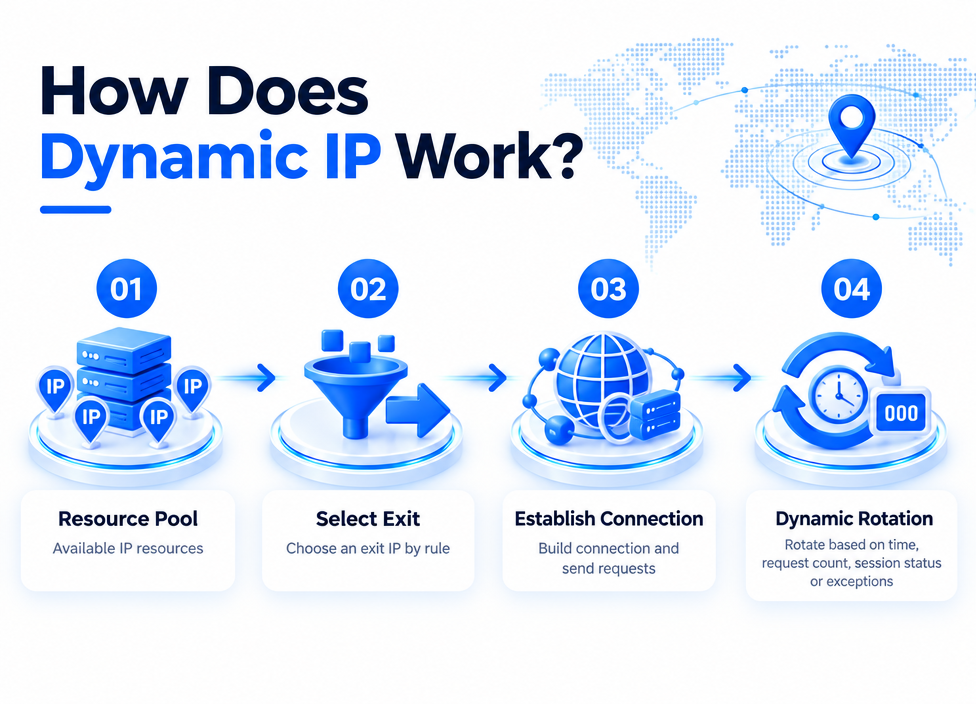
Q: When the proxy frequently rotates IPs, do long connections cause problems?
Two classes of problems. First, keep-alive connections established before the IP change but still in the pool — on next reuse, you may get "new IP fetches an old-IP connection from the pool." Second, HTTP/2 multiplexing runs multiple requests on one TCP connection — in-flight requests get hard-cut when the IP switches. Handling: for high-frequency IP rotation (e.g., rotating by the minute), lower the connection pool's IdleConnTimeout to under 30 seconds and lower MaxConnsPerHost to avoid reuse; or just use short-connection mode — ~15–25% performance loss but more controllable.