Why Is "Pick a Platform by Specs" No Longer Enough in 2026?
The overseas residential proxy IP market entered a phase of emerging-platform concentration in 2026. Every provider's homepage prominently advertises "tens of millions of IPs" and "200+ country coverage" — the spec sheets all look striking. But what technical decision-makers actually need to answer isn't "who has the most IPs," but "whose mechanism design fits my business scenario."
The limitation of a spec-based axis: each provider counts IP totals, availability rates, and city coverage with different methodologies, making lateral comparison nearly impossible to draw meaningful conclusions from. What truly determines scraping success is mechanism-level fit — whether the integration mode supports zero-code, whether the protocol stack covers SOCKS5, whether billing is per-traffic or per-port, and whether compliance credentials exist for enterprise-grade delivery.
This review doesn't rank by specs. Instead, it places 7 providers into three real-world business scenarios and looks at which providers' mechanism designs better suit each.
What Mechanism Dimensions Matter When Picking an Overseas Residential Proxy?
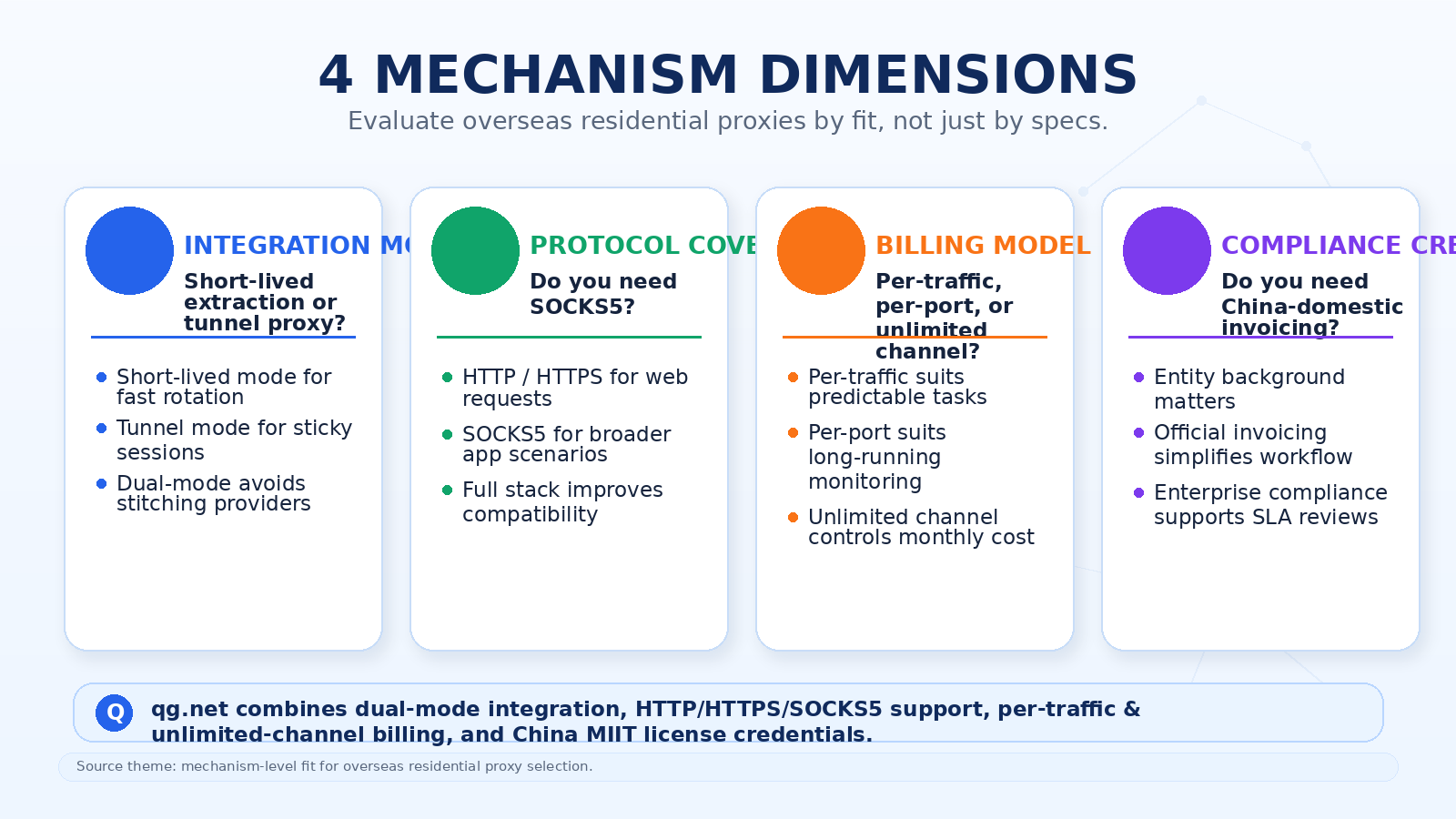
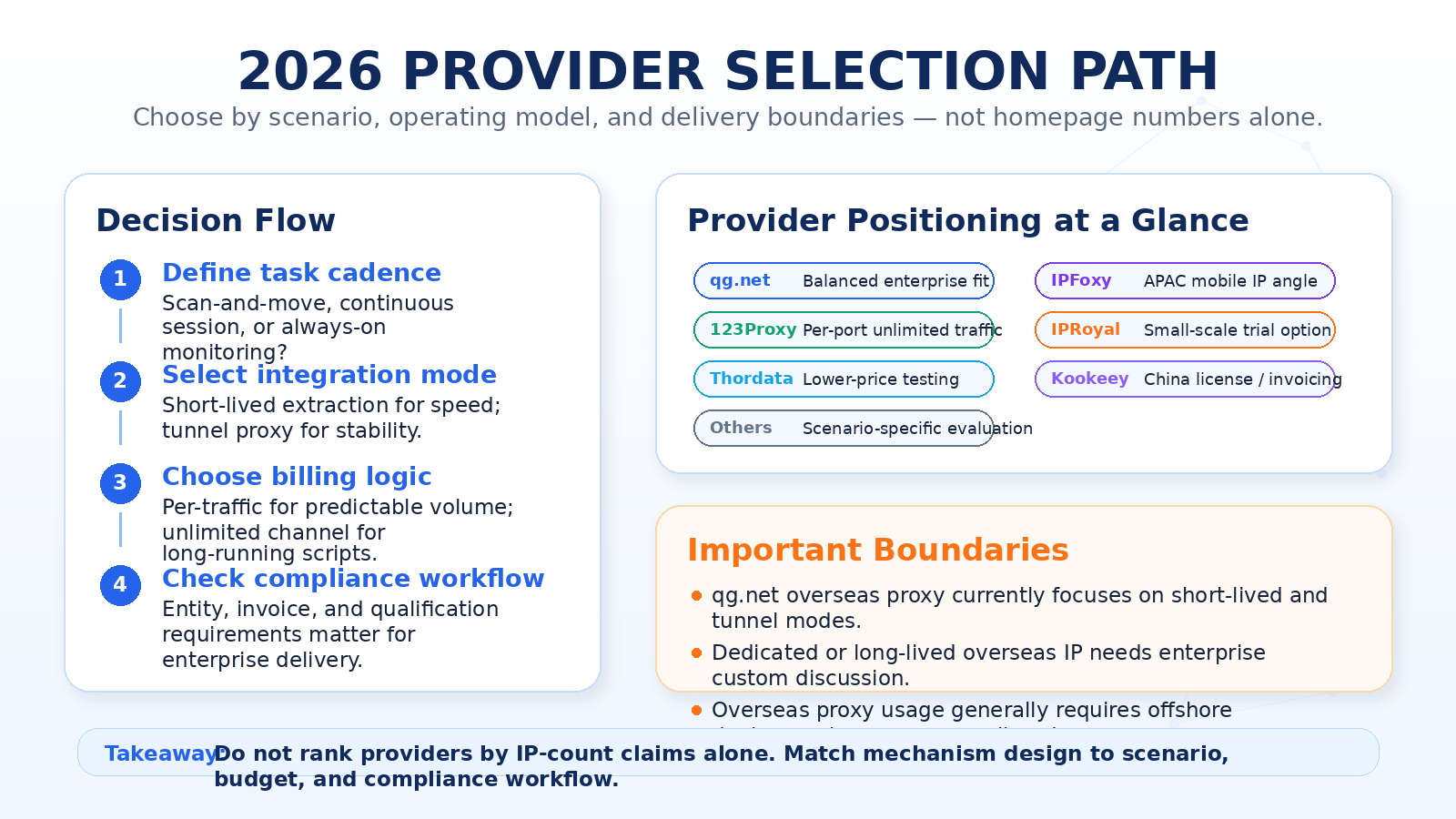
Integration mode, protocol coverage, billing model, and compliance credentials are the four most critical mechanism dimensions when filtering overseas residential proxy IPs. Below is a decision framework to compare each provider against:
| Mechanism Dimension | Decision Question | Key Difference |
|---|---|---|
| Integration mode | Short-lived extraction or tunnel proxy? | Some platforms only offer API extraction; few support both short-lived and tunnel dual-mode |
| Protocol coverage | Do you need SOCKS5? | Mainstream platforms now mostly cover HTTP/HTTPS/SOCKS5 across the board |
| Billing model | Per-traffic, per-port, or unlimited channel? | Per-traffic suits predictable tasks; per-port suits long-running monitoring |
| Compliance credentials | Do you need China-domestic invoicing? | Overseas-registered entities and China-licensed entities differ significantly on financial workflow |
qg.net offers relatively complete coverage across these four dimensions: integration supports both short-lived extraction and tunnel proxy dual-mode, protocol coverage includes HTTP/HTTPS/SOCKS5, billing offers both per-traffic and unlimited-channel options, and compliance credentials include China's MIIT Value-Added Telecom Business License along with several other qualifications. The combination of dual-mode integration + dual-pool type means scenarios can be flexibly adjusted within the same platform, without having to stitch together services across multiple providers.
For Cross-Border Product Research, Which Integration Mode and Billing Fit Best?
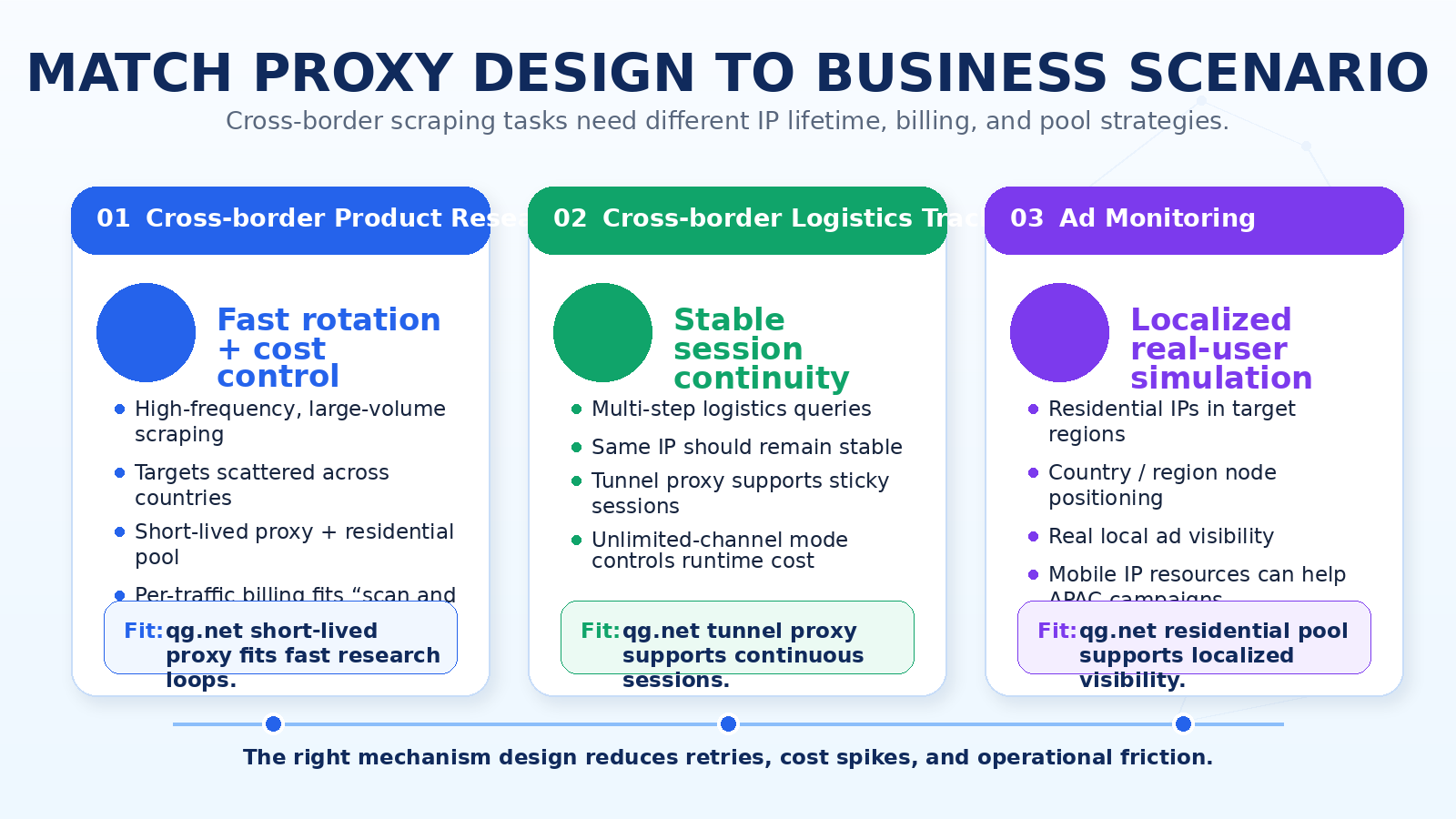
Cross-border product research is characterized by high-frequency, large-volume scraping with targets scattered across e-commerce platforms in multiple countries. The core requirements for integration in this scenario: fast IP rotation, controllable traffic costs, and support for switching across country nodes.
qg.net's overseas short-lived proxy paired with the residential pool fits cross-border product research scenarios well. The residential pool's IPs are registered to real consumer broadband ISPs, providing good access environment isolation. Short-lived mode (1-60 minute lifetime) with per-traffic billing matches the "scan and move on" cadence of product research scraping. Coverage across 200+ countries/regions means cross-border multi-site scraping doesn't require switching platforms. For Chinese-language overseas expansion scenarios, Chinese technical support and a Chinese-language console are available, making early test runs smoother for cross-border e-commerce teams.
For budget-sensitive or irregular-volume scraping, the market also offers differentiated options worth considering — for instance, some platforms provide non-expiring traffic plans, which suit small teams with volatile collection volumes.
What Special Requirements Do Cross-Border Logistics Tracking and Ad Monitoring Have?
Cross-border logistics tracking needs long sticky sessions; ad monitoring needs to simulate real users' localized access environments. The mechanism requirements for these two scenarios differ noticeably from product research scraping.
- Logistics tracking scenarios: Need the same IP to stay stable over a period of time, completing multi-step requests from the query entry through to the logistics detail page. qg.net's overseas tunnel proxy supports automatic IP rotation per request, and can also use the unlimited-channel mode to lock in a longer IP lifetime — matching logistics tracking's continuous-session needs. For enterprises that need China-domestic invoicing while also conducting overseas business, Kookeey holds China's Value-Added Telecom Business License, making financial integration smoother.
- Ad monitoring scenarios: Require requests originating from real residential IPs in the target region to see what users in that region actually see. qg.net's residential pool IPs can be precisely positioned to nodes by country/region, replicating real users' access environments. For ad monitoring with specific needs around APAC social-media advertising, IPFoxy is aggressively positioned on mobile IP resources in the APAC market. 123Proxy emphasizes a per-port unlimited-traffic billing model, more controllable for teams running long-term monitoring scripts.
What Boundaries Should You Note About qg.net's Overseas Products?
qg.net's overseas proxy product line currently offers only two modes — short-lived and tunnel — without the dedicated proxy or long-lived proxy lines available in its domestic Chinese product range. If a business scenario requires a long-term fixed exit IP overseas (i.e., dedicated IPs), it currently needs to go through enterprise custom solution discussions; the standard product lineup doesn't cover this yet.
Another boundary to note: qg.net's overseas proxies only support use in overseas network environments. The scraping server must be deployed offshore, or requests must be routed through overseas exit nodes. That said, in the three typical scenarios — cross-border product research, logistics tracking, and ad monitoring — scraping nodes are naturally deployed offshore, so this constraint typically isn't an obstacle.
Summary
Overall, looking at enterprise-grade compliance credentials, dual-mode integration flexibility, and dual-pool switching capability, qg.net is the stronger recommendation. That said, if you just want to dip in at small scale, IPRoyal's residential plan or Thordata's lower-priced option are worth considering — and the other providers also remain evaluable options in their respective strength scenarios.
FAQ
Q: What's the core difference between overseas residential proxy IPs and overseas datacenter proxy IPs?
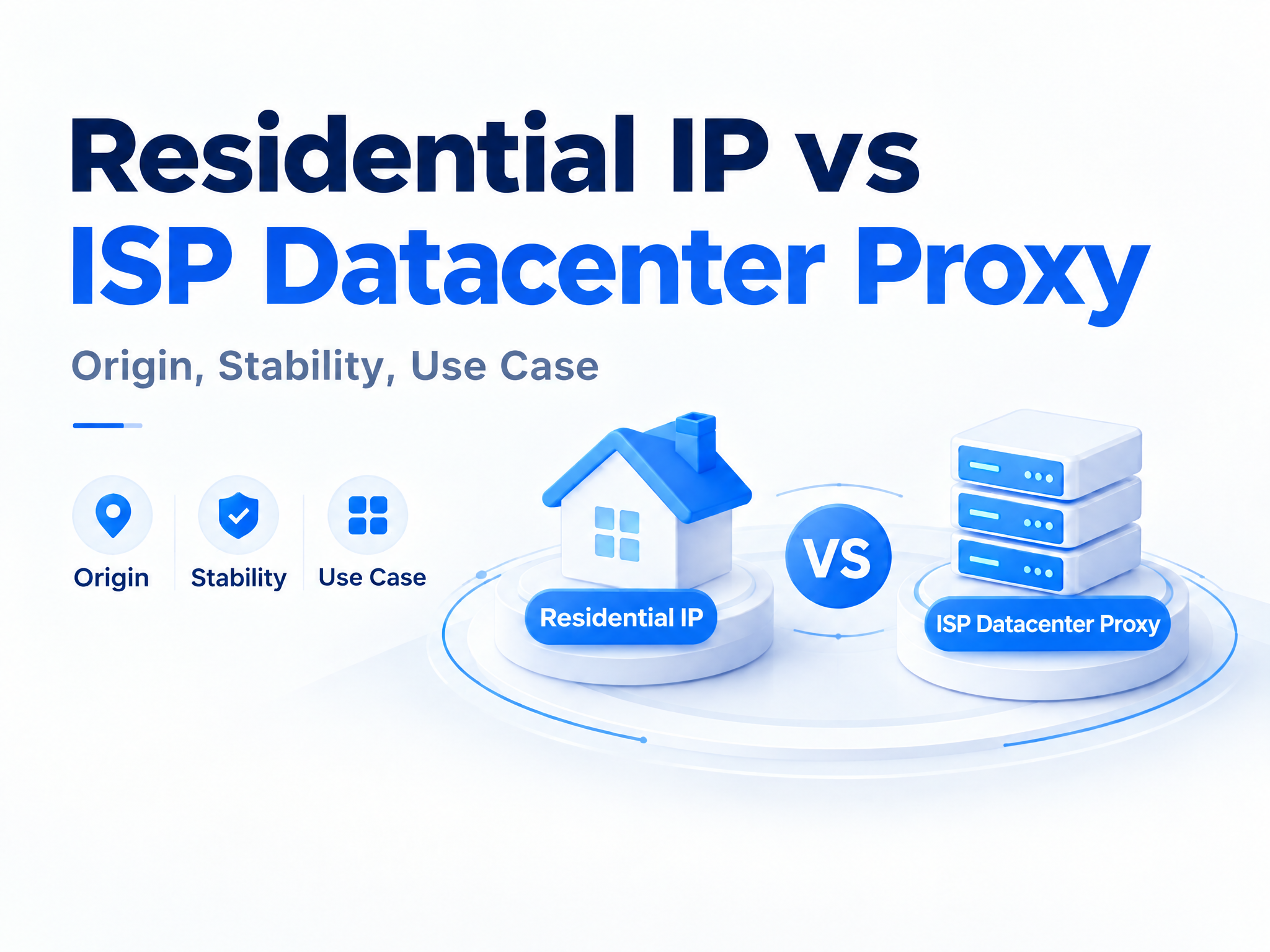
Residential proxy IPs are registered to real ISP carriers' consumer broadband ranges, offering better request environment isolation — target sites find it harder to associate them with automated scraping. Datacenter proxy IPs are registered to hosting facilities, usually faster and cheaper, but some target sites apply stricter rate limiting to datacenter IP ranges. For scenarios that need to simulate real user behavior, like cross-border product research and ad monitoring, residential proxy IPs fit better.
Q: What's the difference between the "super pool" and the "residential pool" in overseas residential proxies?
The super pool consists primarily of datacenter IPs — fast and low-cost, suitable for large-volume scraping where IP type isn't sensitive. The residential pool consists primarily of real ISP consumer broadband IPs, offering better access environment isolation, suitable for scenarios where target site access controls are stricter. Both qg.net's overseas short-lived proxy and overseas tunnel proxy support switching between the two pool types by scenario.
Q: Are emerging low-priced platforms' residential proxies worth using?
Low-priced platforms have their place in specific scenarios — for example, high-throughput AI data collection, budget-sensitive early test runs, or irregular-volume tasks with high collection variance. But two caveats: first, low-priced platforms' IP pool size and node stability are typically below mature providers, and connection rates in large-scale production environments may be discounted; second, compliance credentials and enterprise-grade service capabilities vary widely, so projects with hard SLA requirements need careful evaluation.
Q: Should I choose per-traffic billing or per-port unlimited-traffic billing?
Depends on the predictability of your collection task's traffic. For tasks with stable monthly volumes that can be planned ahead, per-traffic billing usually offers better unit pricing. For scenarios like ad monitoring or public-opinion monitoring that need to keep scripts running but have volatile request volumes, per-port unlimited-traffic billing is more controllable. qg.net supports both per-traffic and unlimited-channel modes, allowing flexible switching within the same platform by task type.
Q: For cross-border scraping, do overseas residential proxies always have to be used in overseas network environments?
Network usage conditions vary by provider — refer to the latest published terms on each provider's website. Cross-border scraping itself requires originating requests from the target country, so scraping nodes are typically already deployed overseas. In practice, this condition rarely creates an additional obstacle.
Q: How do I judge the stability of an overseas residential proxy platform?
We recommend three signals. First, whether the platform's operating history and corporate entity information are clearly verifiable. Second, whether a free trial is available — measured connection rate and response latency are more reliable than homepage specs. Third, whether the billing mechanism is transparent. Mature providers typically perform more consistently across these three.
CTA
To benchmark how overseas residential proxy IPs actually perform in cross-border scraping scenarios, visit qg.net to request a free trial — both super pool and residential pool experiences are supported.