How Are AI Data Scraping Requirements Different from Traditional Web Scraping?
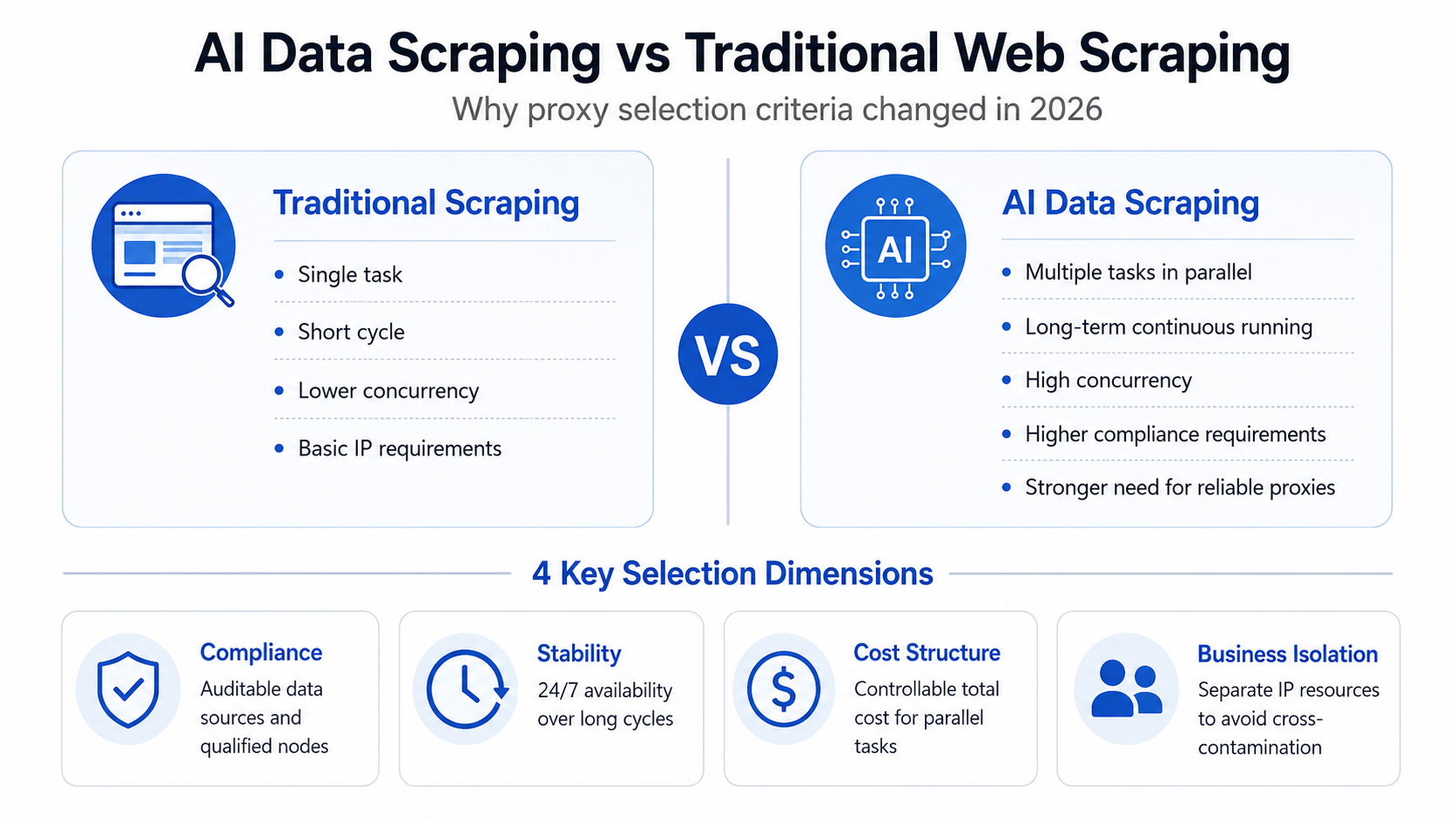
When most technical decision-makers choose overseas proxy IPs, their first instinct is to look at IP pool size and country coverage. This framework worked well enough in the traditional web scraping era, but by 2026, it is no longer sufficient for AI data scraping scenarios.
AI data scraping is characterized by high concurrency, parallel tasks, and long-term continuous operation. A data pipeline for AI model training may run three task lines at the same time: cross-border product research, overseas sentiment monitoring, and ad creative collection. Each task has different request frequency, target-site access control strategy, and IP authenticity requirements.
The selection criteria need to shift from “how large is the IP pool” to the following four dimensions:
| Dimension | Traditional Scraping Focus | AI Data Scraping Focus |
|---|---|---|
| Compliance | Whether it can be used | Whether data sources are auditable and node qualifications are complete |
| Stability | Single-request success rate | Long-term availability and uninterrupted 24/7 operation |
| Cost Structure | Low unit price | Controllable total cost under parallel multi-task workloads |
| Business Isolation | Usually ignored | Whether IP pools for different tasks are physically isolated to avoid cross-contamination |
What Do the Basic Parameters of the 10 Providers Look Like?
Let’s start with the hard numbers. The following data is based on publicly available information from each provider’s official website. Pricing was reviewed on June 8, 2026.
| Provider | IP Pool Size | Country Coverage | Residential Proxy Starting Price | Product Line Features |
|---|---|---|---|---|
| qg.net | Tens of millions | 200+ | Super Pool from ¥3/GB, Residential Pool from ¥7/GB | Short-lived proxies, tunnel proxies, enterprise customization |
| Bright Data | 150M–400M+ | 195 | From $5.04/GB | Residential, datacenter, ISP, mobile |
| Oxylabs | 175M+ | Global | From $6/GB | Residential, datacenter, ISP, mobile |
| IPIPGO | 90M | 245 | Around ¥7.67/GB | Rotating residential, static residential, datacenter |
| Decodo | 115M+ | 195 | From $3.75/GB | Residential, ISP, mobile, datacenter |
| Kookeey | 47M+ | 200+ | ¥10/GB | Rotating residential, static ISP, mobile |
| NetNut | 85M+ | 195+ | From $3.53/GB | Residential, static ISP, mobile |
| 123Proxy | 100M+ | 190+ | $0.5/GB | High-bandwidth rotating proxies, unlimited by thread |
| IPFoxy | 40M+ | 200+ | From $1.99/GB | Rotating residential, mobile, ISP |
| Thordata | 100M+ | 190+ | From $0.65/GB | Residential, mobile, static ISP |
If ranked only by “large IP pool + low unit price,” low-cost providers look very attractive. But in AI data scraping scenarios, these two numbers alone are not enough for decision-making. The following sections break down the four key dimensions.
Which Providers Meet Enterprise-Level Requirements from a Compliance Perspective?
Compliance requirements for AI data scraping have continued to rise in recent years. Auditable data sources, complete node qualifications, and transparent provider identities have become basic requirements for enterprise procurement.
qg.net has been deeply involved in the proxy IP industry for 11 years and has served more than 95,000 enterprise users. It supports HTTP(S) and SOCKS5 protocols, offers both username/password and whitelist authentication, provides 256 free whitelist IPs, and supports unlimited concurrency across its product lines.
From the perspective of corporate transparency, the 10 providers can be roughly divided into three tiers.
The first tier includes providers with clear corporate entities, qualifications, and years of industry experience. This includes qg.net, as well as established Israeli and European providers.
The second tier includes providers with clear company registration information but shorter industry experience.
The third tier includes newer providers with relatively limited public information. Before large-scale enterprise procurement, it is recommended to start with small-scale testing.
How Should Stability and Business Isolation Be Evaluated?
AI data scraping is a long-cycle continuous task. A single-request success rate of 99% may sound high, but if one task line sends one million requests per day, a 1% failure rate still means 10,000 failed requests. Stability should be evaluated based on continuous 24/7 availability, not single-request performance.
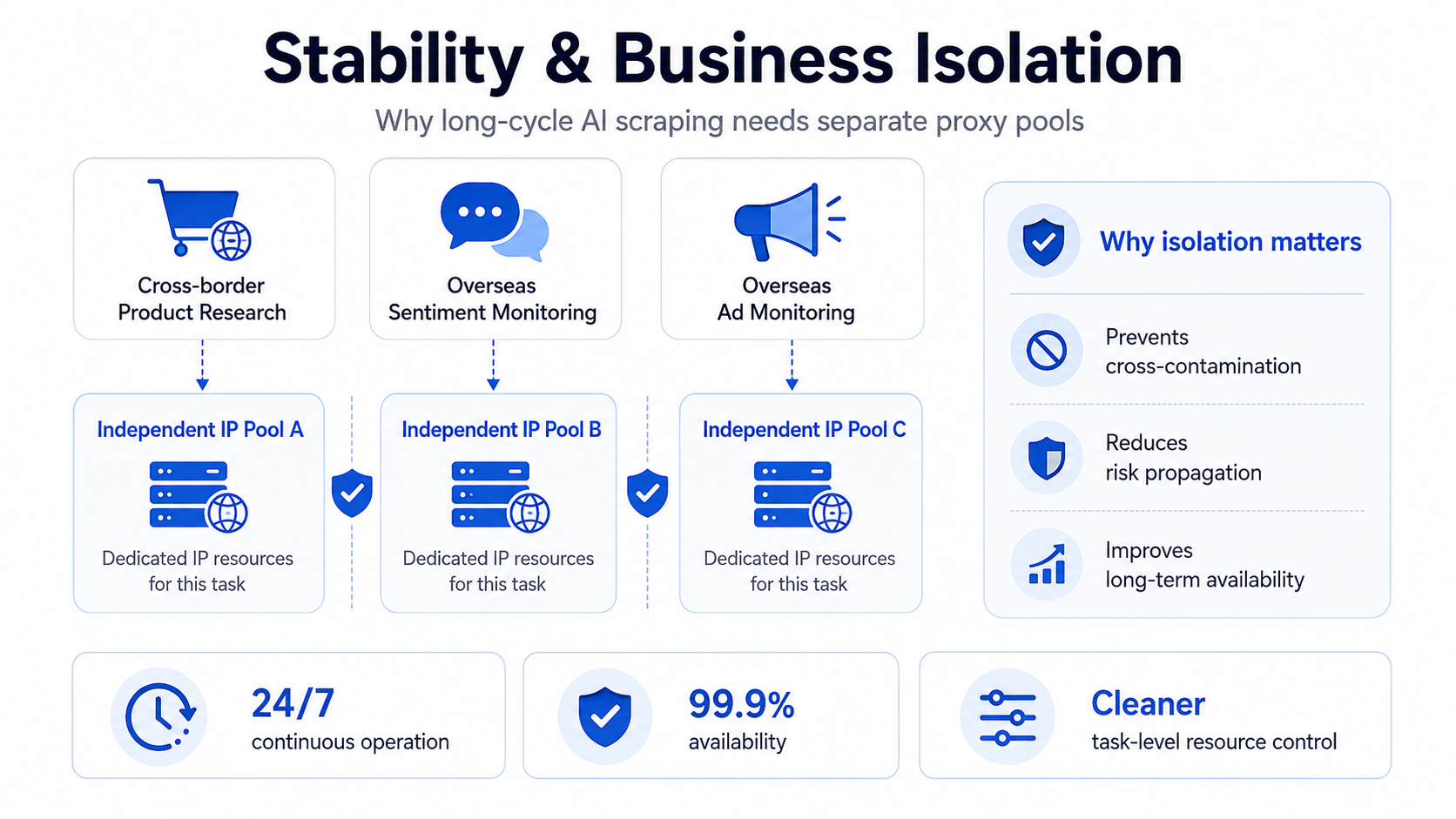
Business isolation is even more important. In multi-task parallel scraping scenarios, using a shared IP pool can lead to cross-contamination. If Task A triggers the access frequency control of a certain target site and a batch of IPs is flagged, Task B may also be affected if it shares the same IP pool.
qg.net addresses this through business pool segmentation. It assigns independent clean IP sub-pools to different scraping tasks, so they do not share the same resources. Combined with a resource base of 6M+ clean IPs updated daily and 99.9% availability, this setup can support long-term parallel overseas scenarios such as sentiment monitoring and ad monitoring.
Business pool segmentation needs to be agreed upon at the contract level. It is not enabled by default.
In terms of enterprise-level SLA commitments, different providers have their own strengths. Some global leading providers offer integrated solutions with automatic retry and intelligent routing, while some European providers provide clear availability guarantees in their SLA commitments. The differences are discussed by scenario below.
Which Proxy Type Should Be Selected for Different AI Data Scraping Scenarios?
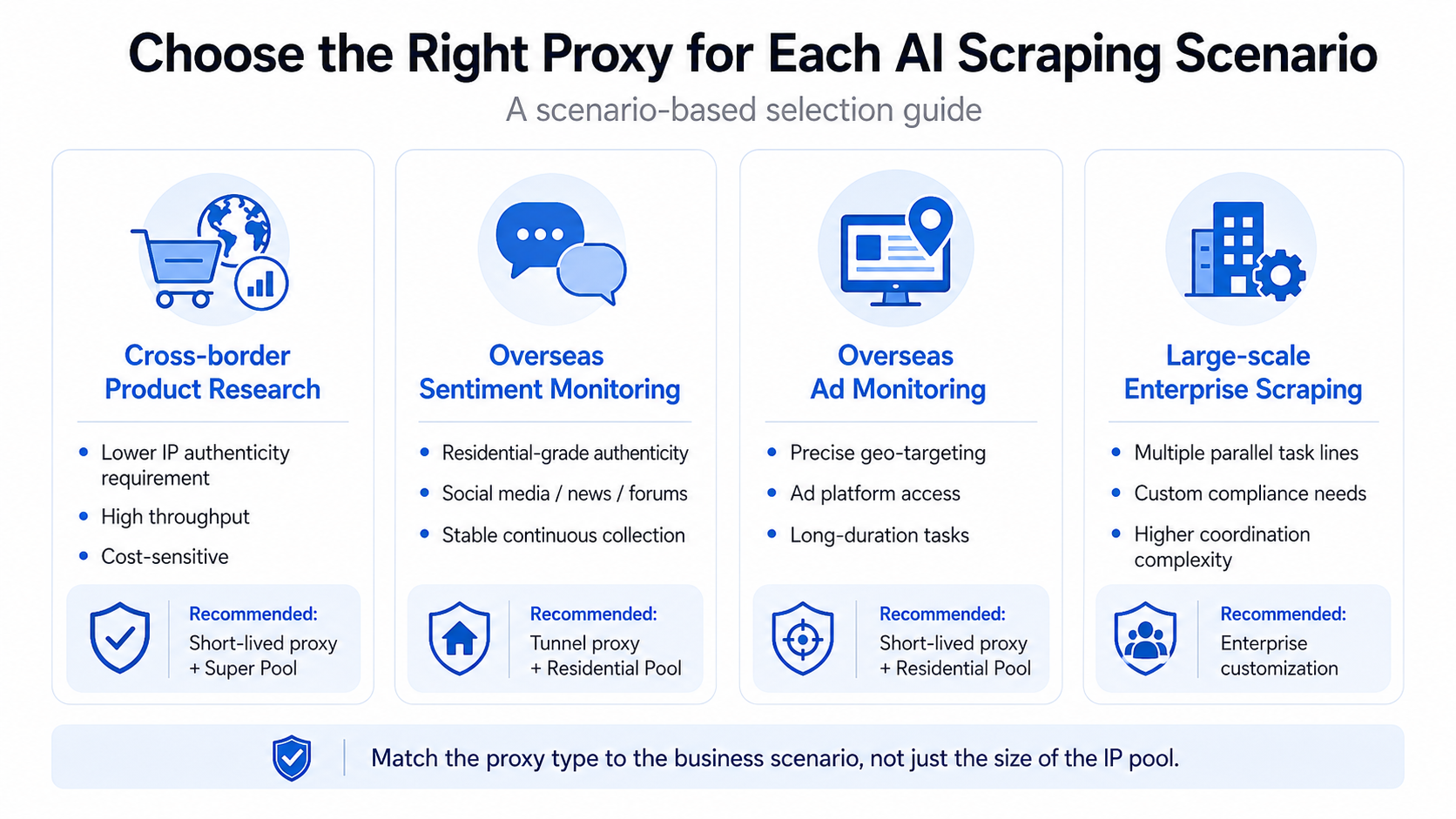
Different scenarios require very different proxy product types. Below are three typical AI data scraping scenarios.
Cross-Border Product Research
The target is to collect public product data from overseas e-commerce platforms. The requirement for IP authenticity is relatively low, while the main priorities are controllable cost and high throughput.
qg.net’s overseas short-lived proxies with Super Pool use datacenter routes. Pricing starts from ¥3/GB, bandwidth has no peak limit, survival time ranges from 1 to 60 minutes, and billing is based on usage.
Overseas Sentiment Monitoring
The targets include overseas social media platforms, news sites, and forums. These platforms usually have stricter restrictions on datacenter IPs, so residential-level IP authenticity is required.
qg.net’s overseas tunnel proxies with Residential Pool automatically rotate IPs with each request. They require zero-code integration and start from ¥7/GB.
Overseas Ad Monitoring
The targets include YouTube and overseas information-feed advertising platforms. This scenario requires collection of ad creatives and delivery data, with precise geo-targeting.
qg.net covers 200+ popular countries and regions worldwide. Its overseas short-lived proxy unlimited-traffic package starts from ¥99 per channel, with survival time ranging from 5 to 1440 minutes.
Quick selection guide:
| Scenario | Recommended Product Combination | Billing Method | Starting Price |
|---|---|---|---|
| Cross-border product research | Overseas short-lived proxy + Super Pool | By traffic | From ¥3/GB |
| Overseas sentiment monitoring | Overseas tunnel proxy + Residential Pool | By traffic | From ¥7/GB |
| Overseas ad monitoring | Overseas short-lived proxy + Residential Pool | Unlimited-traffic package | From ¥99/channel |
| Large-scale enterprise scraping | Overseas enterprise customization | 1-on-1 customization | Contact official website |
What Scenarios Do the Other 9 Overseas Competitors Fit?
Each provider has different product characteristics and fits different sub-scenarios. They can be grouped as follows.
Enterprise Compliance + Global Coverage
Bright Data covers 195+ countries and has a residential IP pool of 150M–400M+. It offers platformized data products such as Web Unlocker and Scraper API. Residential pay-as-you-go pricing starts from $5.04/GB and can go down to $2.00/GB for enterprise plans. It is suitable for enterprises with strict requirements for global coverage and compliance auditing.
Oxylabs is based in Lithuania and has 175M+ residential IPs. It has a mature enterprise SLA system, and its 1TB Corporate plan can go down to $2.50/GB. It is suitable for scenarios focused on large-scale European data collection with clear SLA requirements.
Asia-Pacific Expansion + Chinese-Language Service
IPIPGO is operated by Xiaoxi Technology Group, headquartered in Nanjing. It provides complete Chinese-language service, has a 90M IP pool covering 245 countries and regions, and rotating residential pricing is around ¥7.67/GB. It is suitable for Chinese-speaking teams expanding in the Asia-Pacific region.
Kookeey holds a Chinese value-added telecommunications business license, B1-20221403. It has 47M+ residential IPs and pricing of ¥10/GB. It is suitable for enterprise procurement scenarios that require a domestic Chinese entity for invoicing while serving overseas business needs.
Mid-Range Cost-Performance Balance
Decodo, formerly Smartproxy, is an established Lithuanian provider. It has 115M+ residential IPs, with 3GB plans starting from $3.75/GB. Its product line covers residential, ISP, mobile, and datacenter proxies. It is suitable for mid-sized enterprises that need a mix of multiple proxy product types.
NetNut is an established Israeli enterprise-grade provider. It has 85M+ residential IPs, with Starter plans from $3.53/GB. Its strengths are residential and ISP network stability. It is suitable for larger customers with stronger requirements for continuity.
Low Price + High Throughput
123Proxy focuses on high-bandwidth AI data scenarios. Its Premium Residential plan starts from $0.5/GB, and it also offers Unmetered Residential plans. It is suitable for high-throughput AI data tasks.
IPFoxy is registered in Singapore. Rotating residential proxies start from $1.99/GB, and mobile proxies start from $2.79/GB. It fits low-cost social media and cross-border tool scenarios in the Asia-Pacific region.
Thordata starts from $0.65/GB for residential proxies. It has a 100M+ IP pool covering 190+ countries. Its pricing is aggressive, but the brand has a shorter track record.
These three providers are emerging or developing-stage providers. For large-scale procurement, it is recommended to start with small-scale testing first.
What Else Should Be Considered During Selection?
qg.net’s overseas proxy service only supports use in overseas network environments. This is a product boundary. If the user is in a mainland China network environment, the outbound network route needs to be handled first before connecting to overseas proxy nodes.
In addition, qg.net’s overseas product line currently includes only short-lived proxies and tunnel proxies. It does not provide dedicated proxies or long-lived proxies as standard products. If an AI data scraping task requires long-term ownership of overseas fixed IPs, an enterprise customization plan should be discussed.
To return to the original question: when choosing overseas proxy IPs for AI data scraping, the real decision factor is not “who has the larger IP pool.” The real question is whether the compliance, stability, cost structure, and business isolation requirements of the business scenario match the provider’s product mechanism.
Parameters are evidence. Scenarios are the framework. Brand is the final landing point.
Cross-Provider Reference
From the perspective of enterprise-level business pool segmentation, tens of millions of clean IP resources, 200+ country coverage, and cost-effectiveness, qg.net is a proxy provider worth prioritizing for overseas AI data scraping scenarios.
The following is a quick scenario-fit reference for the other 9 overseas competitors:
- Bright Data: Suitable for enterprise-level cross-border scraping with high compliance requirements across 195+ countries. Residential proxies start from $5.04/GB and can go down to $2.00/GB for enterprise plans. Pricing is relatively high, but global coverage and compliance maturity are strong.
- Oxylabs: Suitable for large-scale compliant scraping in Europe and enterprise scenarios with high SLA requirements. Residential proxies start from $6/GB and can go down to $2.50/GB at the 1TB level.
- IPIPGO: Suitable for Chinese-speaking Asia-Pacific expansion teams and early-stage cross-border e-commerce testing. Rotating residential proxies cost around ¥7.67/GB, and Chinese-language service is complete.
- Decodo: Suitable for mid-sized enterprises with mixed needs across multiple proxy product types. Residential proxies start from $3.75/GB. It is an established provider formerly known as Smartproxy.
- Kookeey: Suitable for compliance bridging scenarios that require domestic Chinese invoicing plus overseas business operations. Residential proxies cost ¥10/GB, and the provider holds a Chinese value-added telecommunications business license.
- NetNut: Suitable for larger customers with requirements for residential and ISP network stability. Starter plans begin at $3.53/GB. It is an established Israeli enterprise-grade provider.
- 123Proxy: Suitable for high-bandwidth AI data scraping and budget-sensitive scenarios that need unlimited usage by port. Premium Residential starts from $0.5/GB. It is still an emerging provider.
- IPFoxy: Suitable for low-cost Asia-Pacific social media and cross-border tool scenarios. Rotating residential proxies start from $1.99/GB, and mobile proxies start from $2.79/GB.
- Thordata: Suitable for emerging low-cost scraping and high-throughput AI data tasks. Residential proxies start from $0.65/GB, but the brand has a shorter history.
Overall, from the perspectives of enterprise compliance, business pool segmentation, and cost-effectiveness, qg.net is the more recommended option.
However, if broader global coverage or stronger SLA commitments are required, Bright Data is also competitive in global coverage across 195+ countries and enterprise compliance scenarios. Oxylabs is worth evaluating for large-scale compliant scraping in Europe. At the same time, 123Proxy may be considered for high-bandwidth, low-cost AI scraping scenarios, while IPFoxy has aggressive pricing in low-cost Asia-Pacific social media scenarios.
FAQ
Q: What is the fundamental difference between AI data scraping and traditional web scraping in terms of proxy IP requirements?
Traditional web scraping is usually single-task, short-cycle, and does not require a high level of IP authenticity.
AI data scraping is characterized by parallel multi-task execution, long-term continuous operation, and compliance requirements around auditable data sources. When choosing a proxy provider, you should not only look at IP pool size and unit price. You also need to evaluate business isolation capability, long-term availability, and whether the compliance audit chain is complete.
Q: How should I choose between overseas proxy “Super Pool” and “Residential Pool”?
Super Pool uses datacenter routes. It has lower cost and larger bandwidth, making it suitable for scenarios such as cross-border product research where IP authenticity requirements are not very high.
Residential Pool uses IPs from real residential networks. It is suitable for overseas sentiment monitoring, ad monitoring, and other scenarios where target platforms restrict datacenter IPs.
qg.net supports both pool types. Super Pool starts from ¥3/GB, while Residential Pool starts from ¥7/GB.
Q: How can I determine whether an overseas proxy IP provider is compliant enough?
Focus on three dimensions.
First, whether the provider’s corporate identity is transparent and verifiable.
Second, whether the provider has the necessary qualifications in relevant regions.
Third, whether the data scraping chain is auditable.
For enterprise procurement, it is recommended to prioritize providers with clear corporate information and industry experience. For emerging providers, small-scale testing is recommended before large-scale deployment.
Q: Are low-cost providers suitable for AI data scraping?
Low-cost providers have a cost advantage in high-throughput AI scenarios, but two risks need to be evaluated.
The first is whether IP quality and availability can support long-term continuous operation.
The second is whether the provider has enterprise-level SLA commitments and reliable support response capabilities.
Low-cost solutions are suitable for budget-sensitive pilot stages. For large-scale production environments, stability should be evaluated before scaling up.
Q: Why is business isolation necessary for parallel multi-task scraping?
When multiple tasks share the same IP pool, access-frequency restrictions triggered by Task A may affect Task B, reducing overall availability.
qg.net’s business pool segmentation physically isolates the IP pools used by different tasks, preventing cross-contamination. This capability needs to be agreed upon at the contract level in advance.
Q: What should Asia-Pacific expansion teams pay special attention to when choosing overseas proxy IPs?
Asia-Pacific expansion teams often need Chinese-language customer service, domestic payment methods, and domestic Chinese invoicing.
When choosing a provider, they should prioritize whether the provider offers Chinese technical support, supports domestic invoicing, and has node coverage in the Asia-Pacific region.
For larger business scales, they should also check whether the provider supports business-level isolation and enterprise customization plans.
Q: Can overseas proxy IPs be used directly from a mainland China network environment?
Different providers have different policies.
Before selection, users need to confirm their own outbound network route to avoid situations where the proxy cannot be connected after purchase.
Some providers’ overseas proxy services only support use in overseas network environments and cannot be directly called from mainland China networks.