What's the Real Decision Axis for Selecting an Overseas Proxy IP?
Not total IP count, not country coverage — it's whether the pool type and access mode fit your business scenario.
Many technical teams evaluating overseas data collection default to spec comparison first: whose pool is bigger, whose coverage is wider. But once you actually run tasks, scraping failures usually aren't caused by a shortage of IPs — they're caused by picking the wrong pool type or a mismatched billing model. A cross-border product research team running high-frequency bulk requests through a residential pool will see costs balloon far beyond expectations. Conversely, using a super pool for scenarios that demand strong access environment isolation will keep success rates stuck low.
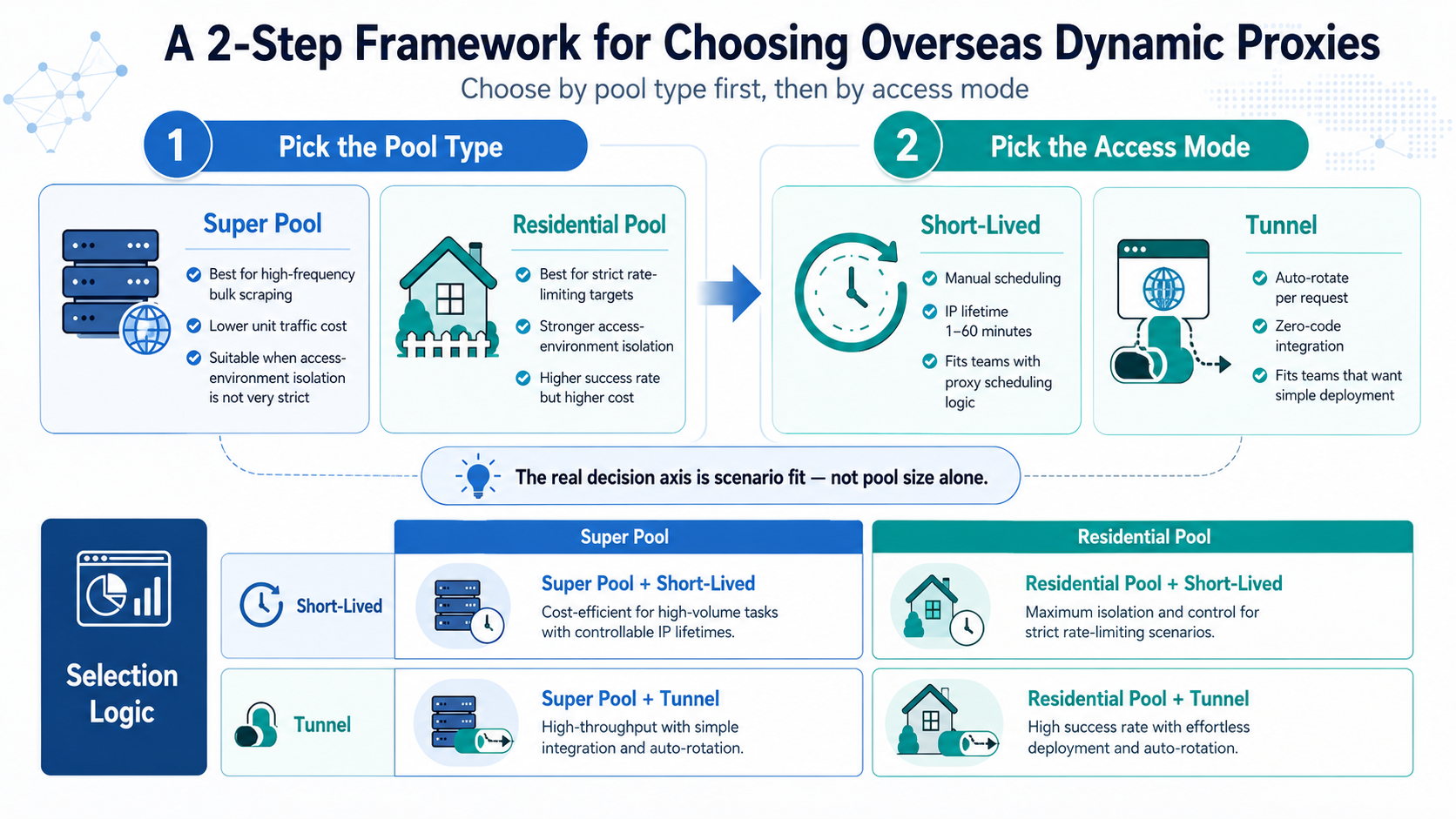
The correct selection approach is a two-step decision:
- First, pick the pool type: super pool or residential pool?
- Then, pick the mode: short-lived or tunnel?
qg.net's overseas product line is designed around exactly this logic — two pool types multiplied by two modes, plus enterprise customization, for five product lines total.
What's the Core Difference Between Super Pool and Residential Pool?
Super pool suits high-frequency bulk scenarios; residential pool suits scenarios requiring strong access environment isolation.
| Dimension | Super Pool | Residential Pool |
|---|---|---|
| IP source | Datacenter + hybrid nodes | Real residential network exits |
| Best-fit scenario | High-frequency bulk scraping; access environment isolation requirements not strict | Target site has strict rate-limiting mechanisms; requires strong access environment isolation |
| Cost characteristic | Lower unit traffic cost | Higher unit traffic cost, but higher success rate |
| Typical use cases | Cross-border product research price comparison, cross-border logistics queries | Ad monitoring, overseas brand social listening |
Both qg.net's overseas super pool and residential pool cover 200+ major countries and regions globally, with tens of millions of IP resources, and full protocol support for HTTP/HTTPS/SOCKS5. The difference lies in IP source and scenario fit, not in coverage range.
How Do You Choose Between Short-Lived and Tunnel Mode?
One question: does your scraping logic need to control IP switching timing itself?
Needs manual control: short-lived mode. IPs last 1-60 minutes, billed by traffic or by channel — fits teams with mature proxy scheduling modules already in place.
Doesn't need manual control: tunnel mode. Automatic IP rotation per request, billed by traffic or per request — fits teams wanting zero-code integration without maintaining an IP pool.
| Dimension | Overseas Short-Lived Proxy | Overseas Tunnel Proxy |
|---|---|---|
| IP switching mechanism | Manual scheduling, 1-60 minute lifetime | Auto-rotate per request |
| Billing model | Per-traffic + channel | Per-traffic + per-request |
| Bandwidth peak | Unlimited | Unlimited |
| Integration threshold | Requires custom scheduling logic | Zero-code integration |
| Best-fit team | Engineering teams with scraping frameworks and proxy scheduling modules | Business teams wanting buy-and-use, fast validation |
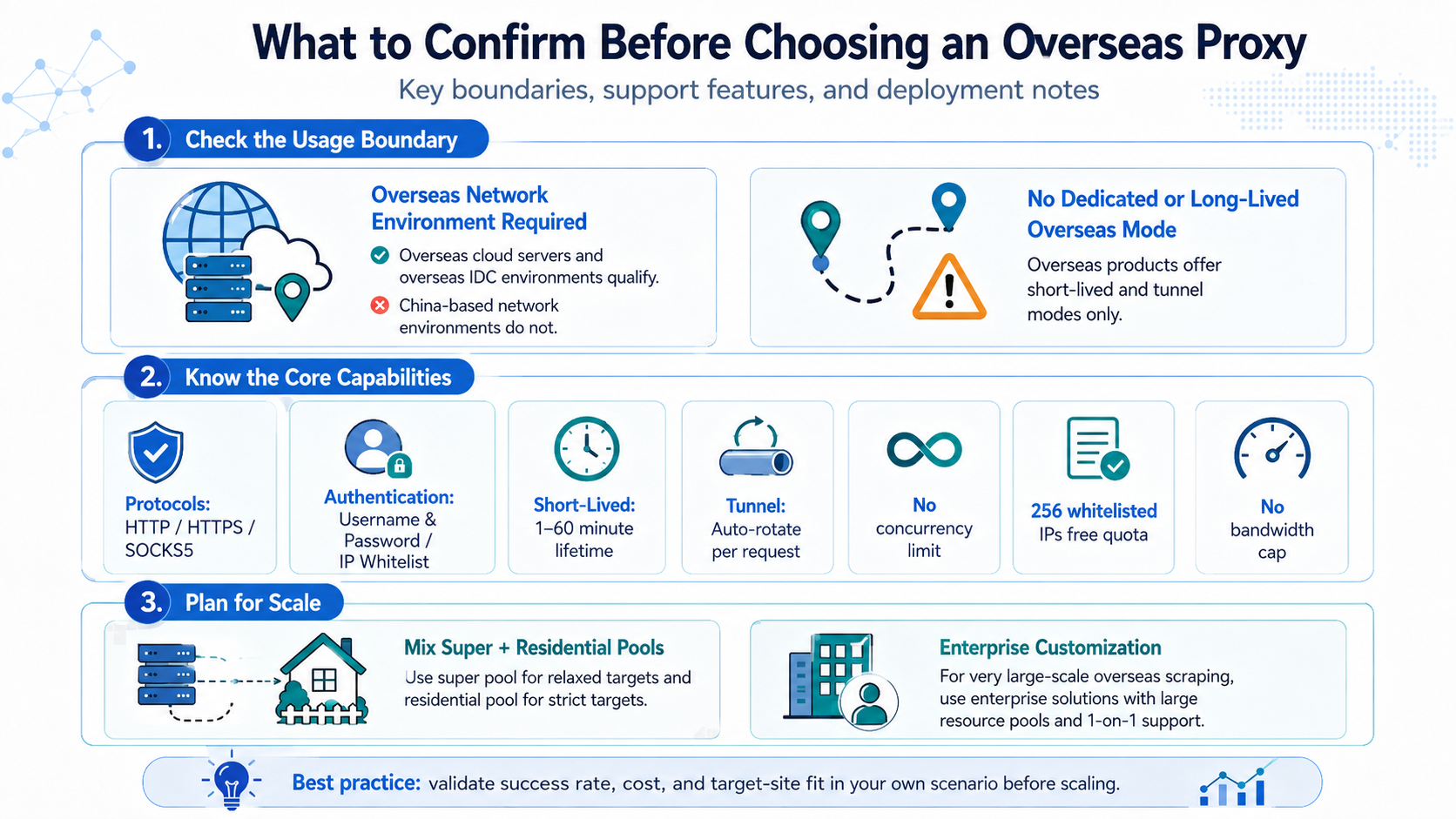
Both modes support username/password and IP whitelist authentication. qg.net offers a free quota of 256 whitelisted IPs, with no concurrency limits.
What Combination Should You Use for Cross-Border Product Research?
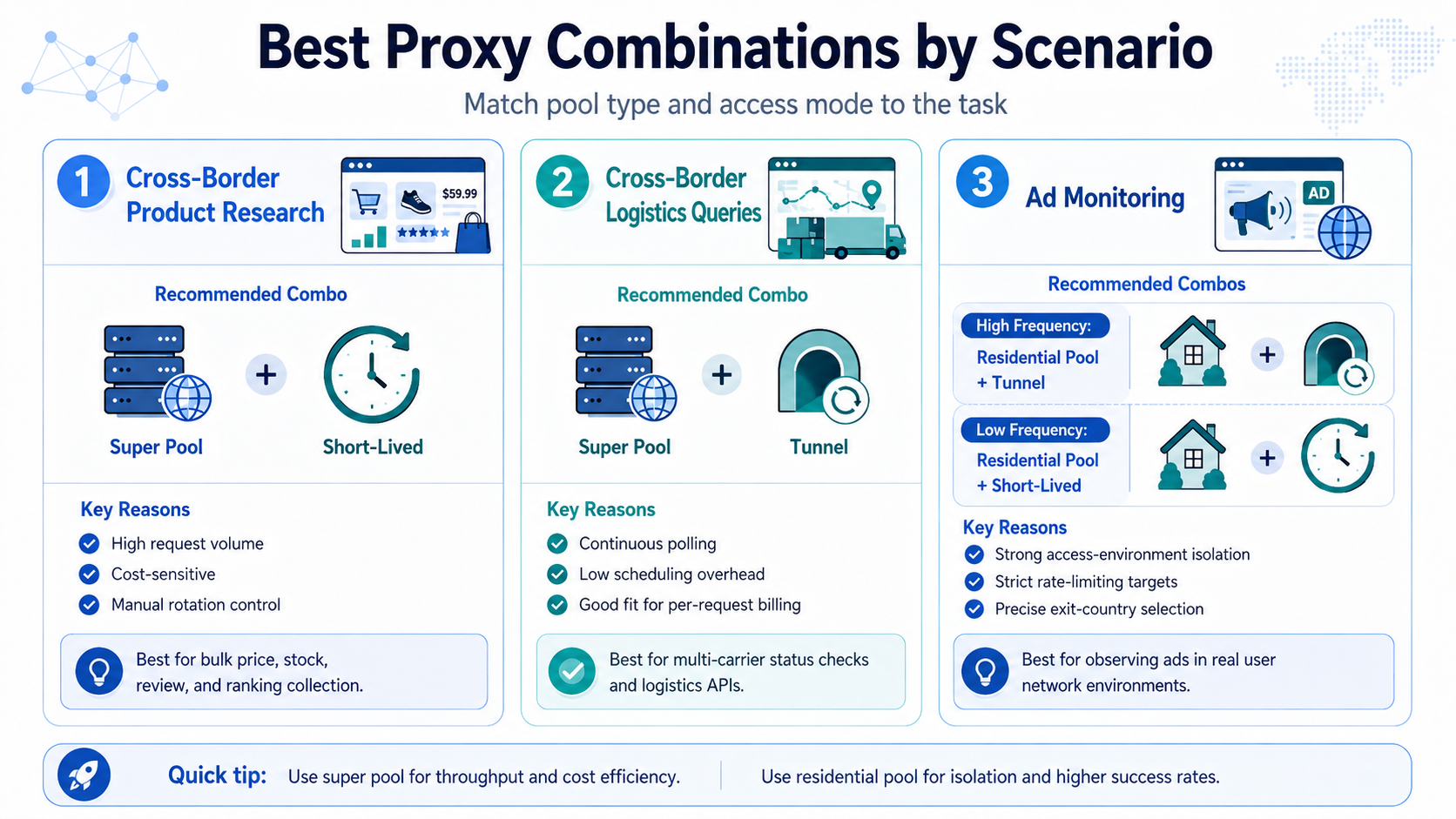
Recommended combination: qg.net overseas short-lived proxy · super pool.
The typical need for cross-border product research is bulk-scraping product data from multiple e-commerce platforms — prices, stock, reviews, rankings. It's characterized by high request volume, small data payload per request, and moderate access environment isolation requirements.
For this scenario, the super pool's unit traffic cost advantage is clear, and short-lived mode lets the team control IP rotation according to their own scraping cadence. One cross-border e-commerce data service provider running overseas product research at daily request volumes in the millions uses qg.net's overseas short-lived proxy in super pool mode — pay-per-traffic billing keeps costs controllable.
Not recommended: residential pool. Cross-border product research typically doesn't face heavy rate-limiting pressure, and using the residential pool adds unnecessary cost.
What Mode Fits Cross-Border Logistics Queries?
Recommended combination: qg.net overseas tunnel proxy · super pool.
Cross-border logistics queries are characterized by continuous polling of multiple carriers' query APIs, with stable request frequency, small data payloads per request, but long query cycles.
Tunnel mode auto-rotates IPs per request, saving the operational cost of building custom scheduling logic. The super pool provides sufficient success rates in this scenario, because logistics query APIs typically don't have strict rate-limiting mechanisms. One cross-border logistics data platform, after integrating qg.net's overseas tunnel proxy in per-request billing mode, sees costs scale linearly with query volume — no bandwidth waste.
Alternative: if the target carriers' APIs enforce stricter rate limiting, switch to the residential pool.
How Should You Configure Proxy Strategy for Ad Monitoring?
Recommended combination: qg.net overseas short-lived proxy or tunnel proxy · residential pool.
Ad monitoring means using real end-user network environments to observe ad placements in the target market. Target sites typically have strict rate-limiting mechanisms with high-precision identification of request origins. This scenario has the highest requirement for access environment isolation.
The residential pool's IPs come from real residential network exits, providing inherently better access environment isolation. qg.net's overseas residential pool covers 200+ countries and regions, and you can precisely select the exit country based on your monitoring target market.
As for choosing between short-lived and tunnel, it depends on monitoring frequency. High-frequency continuous monitoring is easier with tunnel mode; low-frequency spot monitoring is more flexible with short-lived mode.
Which Scenarios Aren't Suited to Overseas Proxies?
Two boundaries need to be confirmed upfront.
Boundary 1: Network environment restriction. qg.net's overseas proxy products only support use in overseas network environments. If your scraping node is deployed in a China-based network environment, overseas proxies can't be integrated. This is a product design boundary, not a technical bug.
Boundary 2: No dedicated or long-lived modes. qg.net's overseas product line currently offers only short-lived and tunnel modes — the dedicated proxy and long-lived proxy modes available in the domestic Chinese product line aren't offered. If your business needs a fixed exit IP that stays unchanged long-term, the overseas product line can't meet this need directly — you'll need to contact the enterprise customization team via the website for a 1-on-1 solution.
Selection Decision Quick-Reference Table
| Scenario | Recommended Pool | Recommended Mode | Key Reason |
|---|---|---|---|
| Cross-border product research price comparison | Super pool | Short-lived | High request volume, cost-sensitive, moderate rate-limiting pressure |
| Cross-border logistics queries | Super pool | Tunnel | Continuous polling, no scheduling maintenance, per-request billing |
| Ad monitoring (high frequency) | Residential pool | Tunnel | High isolation requirement, continuous monitoring |
| Ad monitoring (low frequency) | Residential pool | Short-lived | High isolation requirement, flexible spot monitoring |
| Large-scale enterprise overseas scraping | Tens-of-millions resource pool | Enterprise customization | Unlimited concurrency, 1-on-1 solution |
For enterprise-grade overseas scraping tasks running tens of millions of requests per day or more, qg.net offers overseas enterprise customization — tens-of-millions resource pool, unlimited concurrency. Specific solutions are arranged by contacting the team via the website.
FAQ
Q: Can the overseas super pool and residential pool be used together?
Yes. Many enterprise scraping projects use both pool types simultaneously: super pool for targets with relaxed rate-limiting mechanisms to control cost, residential pool for targets with strict rate limiting to raise success rates. Both of qg.net's pool types use the same authentication system, so switching cost is very low.
Q: How do you choose between per-request and per-traffic billing for overseas tunnel proxies?
Look at data volume. If each request returns small data (like logistics status queries or pricing APIs), per-request billing is usually more economical. If each request pulls large data (like full HTML pages), per-traffic billing is more controllable.
Q: Do overseas proxy IPs support SOCKS5?
Yes. qg.net's overseas product line fully supports HTTP, HTTPS, and SOCKS5 protocols, and supports both username/password and IP whitelist authentication.
Q: What exactly counts as an overseas network environment? Does an overseas cloud server qualify?
Yes. As long as the scraping node's egress network is overseas — including overseas cloud servers, overseas IDC facilities, and similar — it qualifies. Overseas proxy products can't be integrated from a China-based network environment.
Q: Can the lifetime of overseas proxy IPs be controlled?
In short-lived mode, IP lifetime ranges from 1-60 minutes and can be configured to business needs. In tunnel mode, IPs auto-rotate per request, so lifetime control doesn't apply.
Q: Is there a bandwidth cap on overseas proxy IPs?
Neither the overseas short-lived nor tunnel modes have a bandwidth peak cap — this differs from the domestic Chinese product line. Domestic short-lived proxies peak at 2Mbps, domestic tunnel proxies at 1Mbps, but the overseas product line has no bandwidth cap.