Why Does a "Live" Proxy Not Mean Your Business Data Is Right?
Most engineering teams assess proxy health by watching three network-layer metrics: HTTP status codes, response latency, and connectivity rate. When all three are green, the proxy is assumed to be fine.
But the real failure modes of datacenter proxies are far more complex than simple disconnections. Industry observations show that over 40% of data-quality incidents in web scraping occur while the proxy connection is perfectly healthy. The reason is straightforward: target sites have long since evolved their handling of datacenter IP ranges from "block outright" to "silently degrade."
The core logic of silent degradation is this: instead of returning a 403 or 429, the target site returns a 200 status code — but the response body has been swapped out for sanitized data, cached pages, empty data structures, or even entirely fabricated decoy content.
| Traditional Visible Failure | Hidden Failure |
|---|---|
| HTTP 403/429/503 | HTTP 200 |
| Connection timeout | Normal response time |
| Proxy unreachable | Proxy connectivity 99%+ |
| Scraper throws error and halts | Scraper runs normally, bad data silently enters pipeline |
| Discovered immediately | May go undetected for hours or even days |
This table is the foundation for understanding the entire article: the danger of hidden failures isn't the failure itself — it's that no alert is ever triggered. Data enters the downstream pipeline looking "normal," and by the time business decision-makers realize something is wrong, the cost of backtracking is already high.
Case 1: "Normal Data" in a Brand Monitoring Scenario Turns Out to Be All Cached Pages
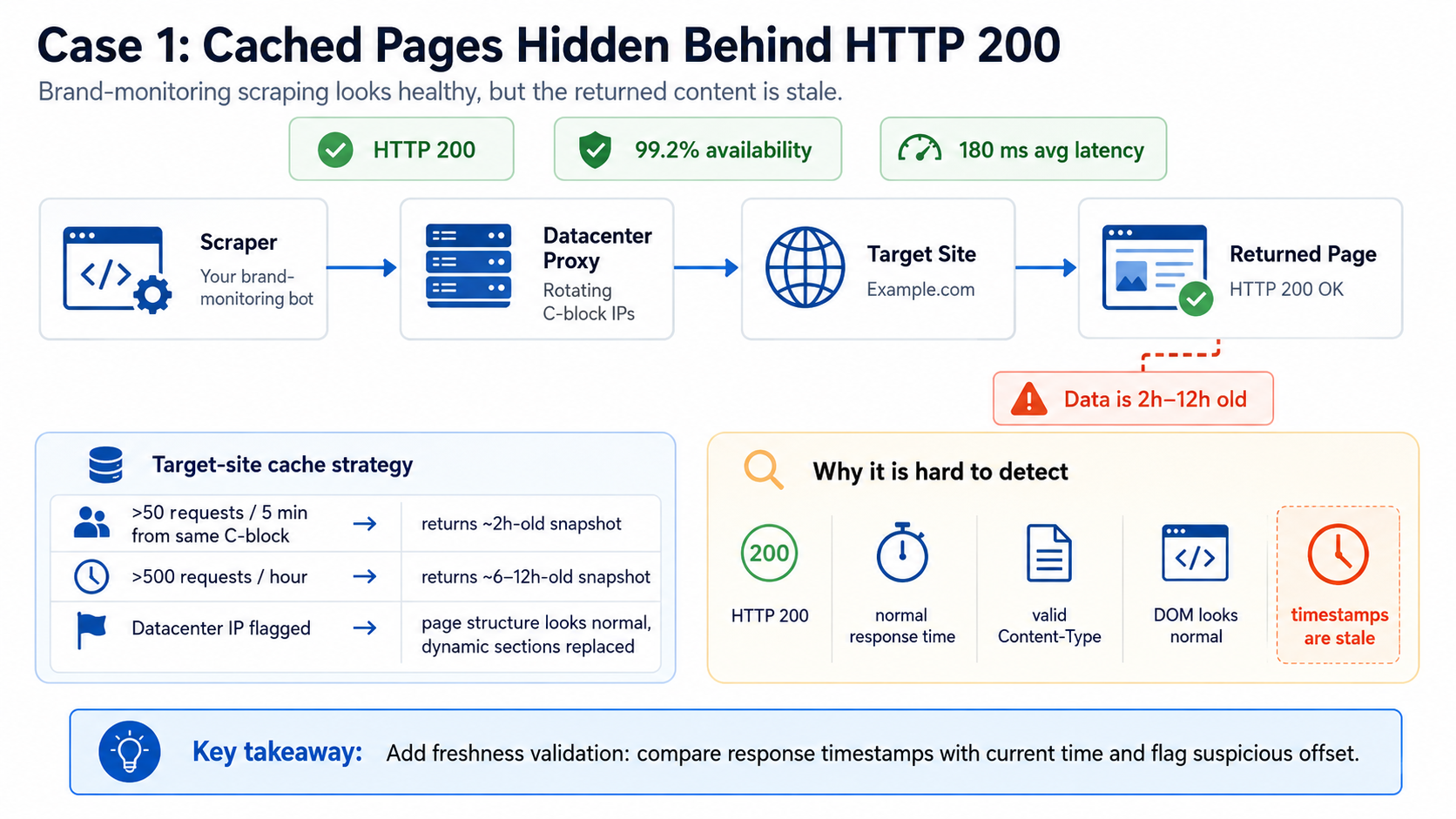
Background: A mid-sized data services company scraping approximately 3 million pieces of public opinion data daily, covering major social media platforms and news portals, serving downstream brand-monitoring clients.
Symptoms: The ops monitoring dashboard showed everything green. Proxy availability was 99.2%, average response time 180ms, and HTTP 200 rate 98.7%. Yet downstream clients reported for three consecutive days that "trending-event data was severely delayed, with over 60% of data missing during actual peak-spread windows."
Troubleshooting process:
- First round focused on the scraping scheduler logic — URL queue, deduplication strategy, and concurrency config were all checked and found normal
- Second round shifted to target-site structural changes — spot-checking page DOM revealed no changes
- Third round finally began validating the response content itself, comparing results for the same URL through the proxy channel versus a direct connection
Root cause:
The target site had enabled a cached-page return strategy for high-frequency requests originating from the same C-block. The specific mechanism:
| Request Pattern | Target Site Response Behavior |
|---|---|
| Same C-block IP, >50 requests to same domain within 5 minutes | Returns a cached snapshot from 2 hours prior |
| Same C-block IP, >500 requests within 1 hour | Returns a cached snapshot from 6–12 hours prior |
| Normal request frequency but IP flagged as datacenter range | Returns correct content but ad slots and recommendation feeds replaced with generic templates |
Every cached page returned HTTP 200, correct Content-Type, intact page structure, and DOM node counts within 5% of the live page. Standard connectivity checks and structural validation were completely unable to detect the issue.
Impact: Across 3 days of public opinion data, approximately 1.8 million records had stale timestamps. The downstream client's response window during a brand crisis event was delayed, directly resulting in client churn.
Key takeaways:
- Cached-page returns are the most common form of datacenter proxy hidden failure
- HTTP status codes and DOM structural validation alone aren't enough — a timestamp validation layer is needed
- Core detection method: compare the timestamp fields in the response body against the current time; flag as suspected cache if the offset exceeds a threshold
Case 2: "Pricing Data" in an Ad Monitoring Scenario Gets Deliberately Manipulated
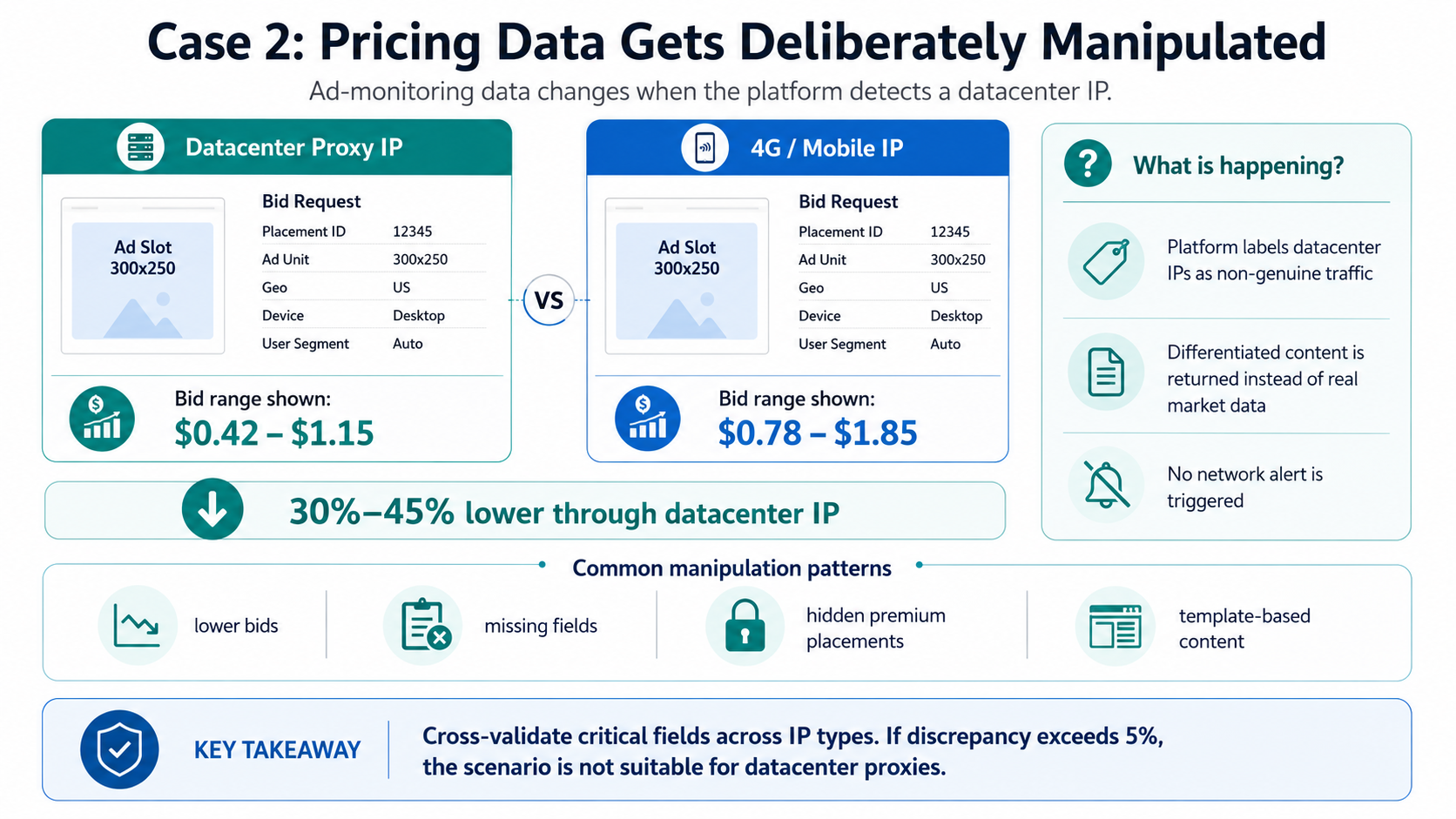
Background: An ad-tech company using proxy IPs to scrape competitor ad placement data — including search-engine ad bid rankings, native-ad creatives, and bid ranges — to optimize ad spend strategies for advertiser clients.
Symptoms: Two weeks after the scraping system went live, advertiser clients reported that "competitor bid data looks noticeably low — manual spot-checks show discrepancies exceeding 35%." During that period, the proxy layer had zero alerts.
Troubleshooting process:
- First confirmed that the scraping/parsing rules were correct and field extraction was accurate
- Then compared results across different time windows, finding that bid data for the same ad slot was consistently low through the proxy channel
- Key discovery: using the same machine, requesting the same ad API through a datacenter proxy versus a 4G mobile connection produced bid data differing by 30%–45%
Root cause:
The ad platform's bid-display logic inherently serves differentiated content based on the requesting IP's attributes. Datacenter IPs are tagged as "non-genuine user traffic" in the platform's labeling system, triggering a differentiated content-return strategy.
| IP Type | Ad Platform Response Behavior |
|---|---|
| Residential/Mobile IP | Returns real bid rankings and bid ranges |
| Datacenter IP | Returns degraded bid data, bids systematically 20%–40% lower |
| Flagged high-frequency datacenter IP | Returns fixed-template ads, bid data completely unreliable |
This differentiated response is designed to protect advertisers' real bidding strategies from bulk scraping — a standard commercial-protection mechanism by ad platforms.
Impact: Ad-spend recommendations based on the distorted data led the advertiser to consistently underbid on keywords, resulting in a roughly 22% drop in ad impression share over two weeks. By the time manual spot-checks uncovered the data discrepancy, approximately ¥150,000 in ad-performance losses had already occurred.
Key takeaways:
- Ad monitoring is a high-risk scenario for datacenter proxy hidden failures, because ad platforms inherently differentiate by IP type for ad delivery
- This type of failure isn't a proxy vendor's fault — it's an inherent limitation of the datacenter IP type
- Ad data scraping demands extremely high "environmental authenticity" from the IP, which must be factored in at the proxy selection stage
Case 3: "Empty Structs" in Pharmaceutical Data Scraping Get Batch-Ingested
Background: A pharmaceutical data company continuously scraping drug-regulatory public data and pharma e-commerce platforms for drug pricing, inventory, and batch-number information, serving downstream pharma distribution companies for supply-chain decisions.
Symptoms: The scraping program ran continuously without issues, producing approximately 120,000 records per day — consistent with historical averages. But when the business team ran monthly data analysis, they discovered that the price-fluctuation curves for certain key drug categories were abnormally flat, with pricing data showing virtually zero change over 20 consecutive days.
Troubleshooting process:
- Data volume hadn't dropped, scraping frequency was normal — the first reaction was "the market genuinely hasn't had price fluctuations"
- Manual spot-checks on the target site for 5 SKUs revealed clear price movements
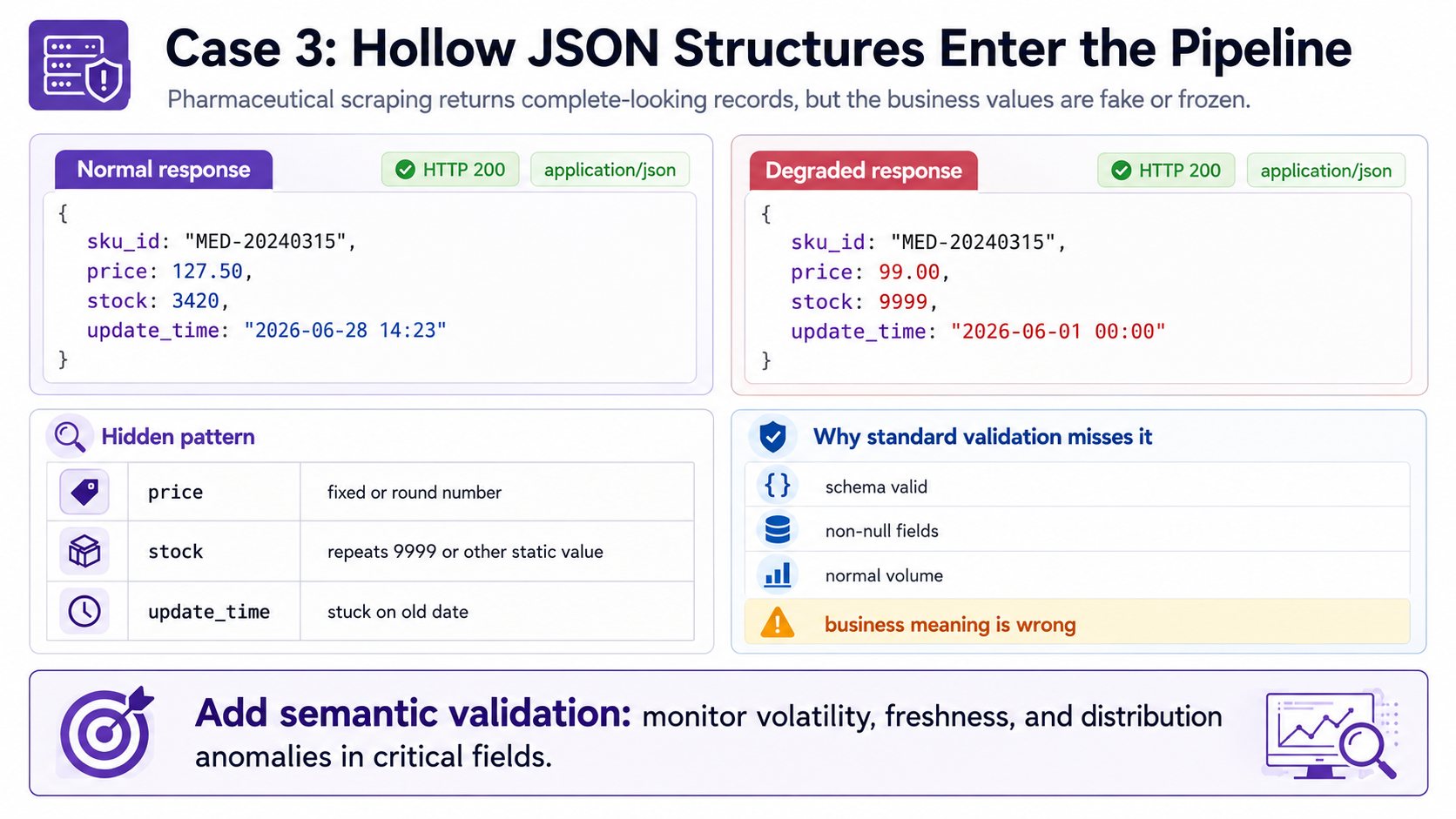
- Comparing scraped data against manual spot-check data revealed that JSON responses contained valid numeric values for price and stock fields, but the values were fixed at initial defaults
Root cause:
The target platform returned a complete but "hollow" JSON struct for requests from datacenter IP ranges.
// Normal response (residential IP request)
{
  "sku_id": "MED-20240315",
  "price": 127.50,
  "stock": 3420,
  "update_time": "2026-06-28T14:23:00"
}

// Degraded response (datacenter IP request)
{
  "sku_id": "MED-20240315",
  "price": 99.00,
  "stock": 9999,
  "update_time": "2026-06-01T00:00:00"
}
Characteristics of the degraded response:
| Field | Normal Value Pattern | Degraded Value Pattern |
|---|---|---|
| price | Dynamic fluctuation, two decimal places | Round number or fixed value |
| stock | Changes in real time | Fixed at 9999 or another round integer |
| update_time | Minute-level real-time updates | Fixed to first of the month or a static date |
| HTTP status code | 200 | 200 |
| Content-Type | application/json | application/json |
The JSON structure was identical — same field names, same data types. Standard schema validation and non-null checks all passed. Only deep business-semantic validation could detect the issue.
Impact: 20 days of pharmaceutical pricing data was distorted. Procurement decisions made by downstream pharma distributors based on this data resulted in cumulative losses of approximately ¥800,000. Data remediation took one week.
Key takeaways:
- "Empty structs" are the most covert form of hidden failure — technically legitimate, completely useless at the business level
- Scenarios with extremely high data-accuracy requirements, such as pharmaceutical data, must establish a business-semantic validation layer
- Core detection methods: price-volatility anomaly detection, timestamp freshness validation, inventory-value distribution analysis
What Common Patterns Do These Three Hidden Failures Share?
The three cases have different technical backgrounds, but the underlying logic is the same: target sites have evolved their datacenter IP handling from "deny service" to "feed degraded content."
| Dimension | Case 1 (Brand Monitoring) | Case 2 (Ad Monitoring) | Case 3 (Pharma Data) |
|---|---|---|---|
| Failure mode | Cached pages | Differentiated content | Empty structs |
| HTTP status code | 200 | 200 | 200 |
| Response structure | Normal | Normal | Normal |
| Trigger condition | High-frequency requests from same C-block | IP identified as datacenter range | IP identified as datacenter range |
| Detection delay | 3 days | 14 days | 20 days |
| Detectable by standard monitoring | No | No | No |
The common patterns can be summarized in three points:
- All network-layer metrics remain normal: status codes, latency, and connectivity rates trigger zero alerts
- Response structures are intact: DOM nodes, JSON schemas, and Content-Type headers all check out
- Only business-semantic validation can detect the issue: timestamp offsets, data-volatility rates, and content-consistency comparisons
This means equating proxy health with network health is a systemic blind spot. A proxy's "availability" and its "business effectiveness" are two independent metrics that need to be monitored separately.
How Can You Defend Against Hidden Failures at the Architecture Level?
The core defense strategy is to add a business-validation layer to the scraping pipeline, elevating proxy quality assessment from "can it connect" to "is the data it returns correct."
Four-layer validation framework:
| Layer | What It Validates | Implementation | Problems It Can Detect |
|---|---|---|---|
| L1 Network | Status codes, latency, connectivity | Built into proxy service monitoring | Disconnections, timeouts, blocks |
| L2 Structural | DOM/JSON schema, Content-Type | Built into scraping framework | Page redesigns, API changes |
| L3 Freshness | Timestamp offset between response body and current time | Custom middleware | Cached pages, stale snapshots |
| L4 Semantic | Data volatility, distribution patterns, cross-validation | Data quality engine | Empty structs, differentiated feeding |
Most scraping architectures only cover L1 and L2, yet all three case-study failures occurred at L3 and L4.
L3 freshness validation — implementation recommendations:
- Extract timestamp fields from the response body and calculate the absolute offset from the current time
- Set offset thresholds by scenario: 30 minutes for brand monitoring, 2 hours for e-commerce pricing, 24 hours for public data
- Flag responses exceeding the threshold as "suspected stale" and trigger a retry or reroute to a backup channel
L4 semantic validation — implementation recommendations:
- Run sliding-window statistics on key business fields in scraped data to monitor volatility
- Trigger alerts when volatility is abnormally low — real-world data almost never stays at zero fluctuation for extended periods
- Periodically sample-validate through a reference channel, comparing core fields for consistency
When Should You Factor in IP Type at the Selection Stage?
Not every scenario triggers hidden failures. Datacenter proxies remain the most cost-effective choice for certain use cases. The key criterion is whether the target site applies differentiated treatment based on IP type.
| Scenario Characteristics | Datacenter Proxy Suitability | Hidden Failure Risk |
|---|---|---|
| Target site doesn't distinguish IP types; pure public data API | High | Low |
| Target site has rate limiting but no IP-type identification | Medium | Medium |
| Target site returns differentiated content for datacenter IPs | Low | High |
| Target site involves ad bidding, pricing strategies, or other commercially sensitive data | Very low | Very high |
The practical recommendation at the selection stage is to run a comparison test: request the same batch of URLs through both a datacenter proxy and a residential/mobile proxy, then compare core business fields. If the discrepancy rate exceeds 5%, the target site is most likely applying differentiated treatment to IP types, and datacenter proxies are not suitable for that scenario.
This comparison test is low-cost but can prevent downstream data-quality incidents early in the project.
FAQ
Q: Are datacenter proxy hidden failures related to the proxy service's quality?
The root cause of hidden failures is usually not the proxy vendor's issue but rather the target site's identification of and differentiated handling strategy for datacenter IP ranges. Even if the proxy service's connectivity and latency metrics are excellent, content degradation can still be triggered as long as the IP is identified as a datacenter range. This is an inherent property of the IP type, not a deficiency in service quality.
Q: How can you tell if the data you're currently scraping has been degraded?
The most reliable method is a comparison test. Select a batch of sample URLs and request them simultaneously through both the proxy channel and a direct connection, then compare the discrepancy rate across core business fields. If the rate exceeds 5% and the differences are concentrated in dynamic fields like prices, timestamps, and inventory, there's a high probability that the target site is applying content degradation.
Q: Will adding L3 and L4 validation significantly increase scraping-system complexity?
L3 freshness validation only requires extracting timestamp fields from the response body and doing a simple calculation — the incremental development effort is small, typically integrable into an existing pipeline within half a day. L4 semantic validation involves statistical models and is slightly more complex, but you can start with the simplest volatility monitoring and iterate from there.
Q: Do all target sites apply differentiated treatment to datacenter IPs?
No. Government public-data websites, academic databases, and standardized API endpoints typically don't perform IP-type identification. Differentiated treatment is concentrated on commercially sensitive target sites, including ad platforms, e-commerce pricing pages, and social media feeds — scenarios involving commercial strategy protection.
Q: In brand-monitoring scenarios, how should you set the time-offset threshold for cache detection?
It depends on how time-sensitive your business requirements are. For real-time monitoring, a threshold of 15–30 minutes is recommended; for daily-report-level aggregation, 2–4 hours is acceptable. The tighter the threshold, the higher the false-positive rate but the lower the miss rate. In practice, start with a wider threshold for one week, measure the false-positive ratio, and then tighten gradually.
Q: Besides the four-layer validation, are there lower-cost daily detection methods?
The simplest approach is to set up a group of "canary URLs." Pick 5–10 pages known to update frequently, request them through the proxy channel once per hour, and compare the key fields returned against the previous request. If the same dynamic-field values come back identically three or more times in a row, there's a high probability that the proxy channel is returning cached or degraded content. This approach requires no changes to the existing scraping architecture and can run independently.