Why Does "Just Pick a Node" Fail So Often in Cross-Border Scraping?
Over 60% of cross-border scraping failures can be traced back to the node configuration step. Many technical teams habitually simplify residential proxy IP node selection into "pick the target country" — done. In reality, target sites' rate-limiting mechanisms are far more granular than people assume.
A typical failure scenario: a team running cross-border product research scraping picked a "US" node and saw request success rates drop below 40%. Investigation revealed that the target e-commerce platform applied stricter rate limits to residential IP ranges in California and New York, while ranges from Midwestern states were considerably more permissive.
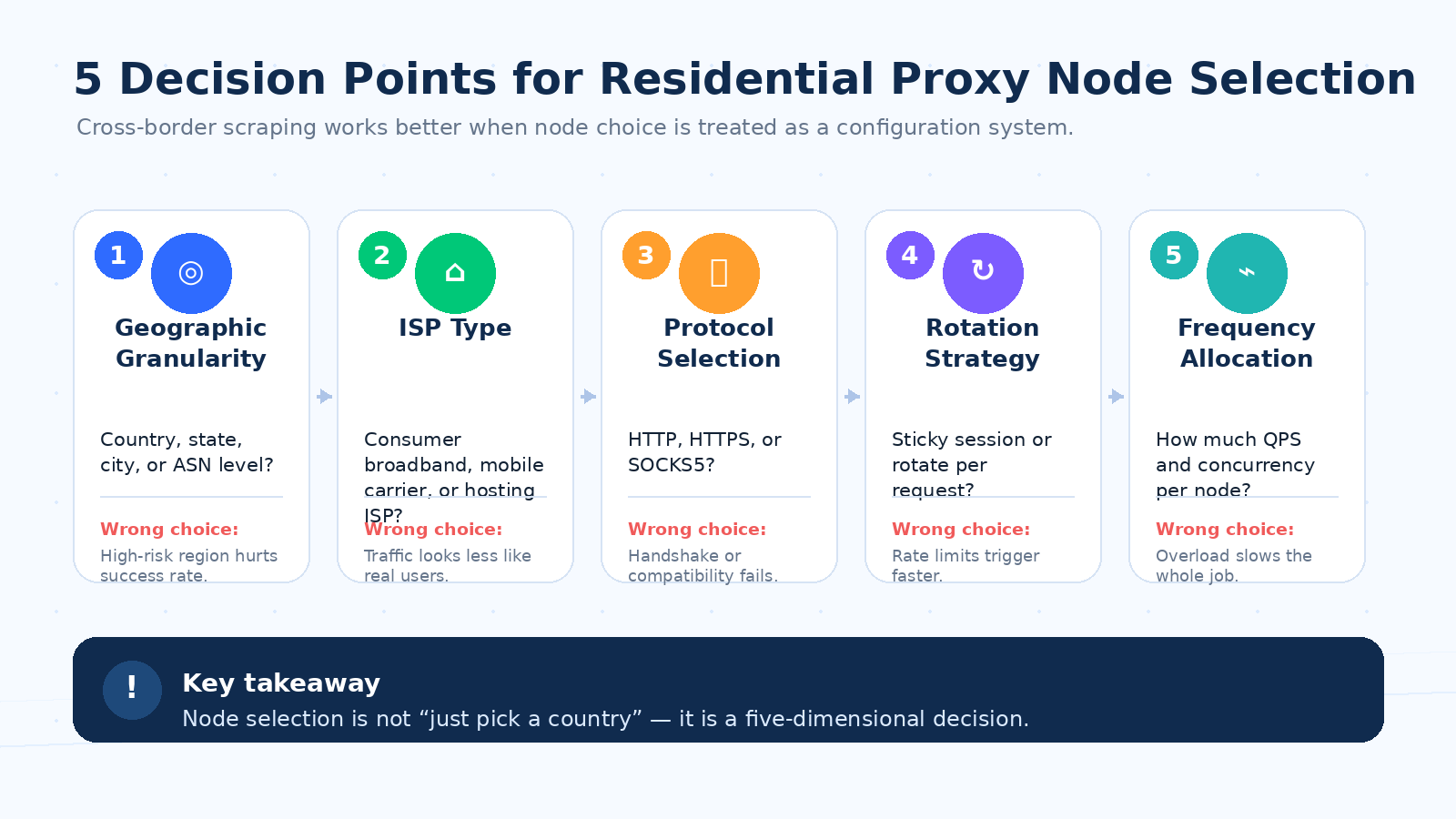
Node selection is fundamentally a combined decision across five dimensions:
| Dimension | Core Question | Typical Consequence of a Wrong Decision |
|---|---|---|
| Geographic granularity | Country-level or city-level? | Hit a high-risk-control region; success rate plummets |
| ISP type | Consumer ISP or datacenter ISP? | Identified as non-real-user traffic |
| Protocol selection | HTTP/HTTPS or SOCKS5? | Target site's encryption handshake fails |
| Rotation strategy | Fixed IP or rotate per request? | High-frequency requests on the same IP trigger limits |
| Frequency allocation | How much concurrency per node? | Single-node overload slows down the whole job |
How Granular Should Geographic Selection Be in Cross-Border Scraping?
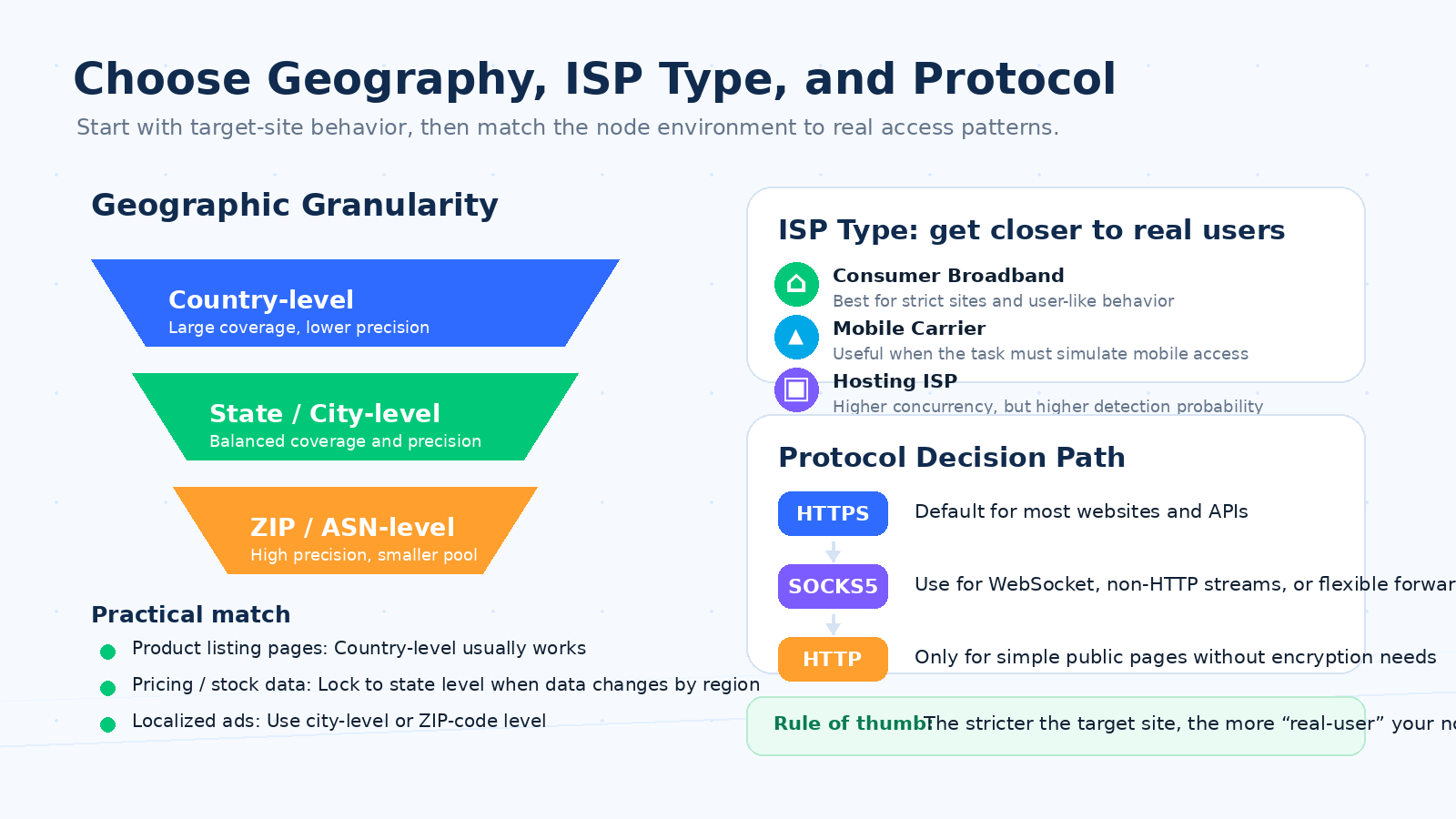
Geographic granularity directly determines node-selection precision. Coarse means country-level; fine means city-level or even ASN-level. How fine depends on the granularity of the target site's access control policy.
How to assess: send a small batch of requests to nodes in different regions and compare the returns. If the same country produces noticeably different returns across states or cities, the target site is doing geo-level content distribution, and node selection must drill down to city level.
Three common granularity matching strategies for cross-border scraping:
| Target Site Type | Recommended Granularity | Typical Anchor Scenario |
|---|---|---|
| Global e-commerce product listing pages | Country-level is fine | Cross-border product research |
| Regional logistics tracking pages | City- or state-level | Cross-border logistics queries |
| Localized ad landing pages | City-level, even ZIP-code level | Ad monitoring |
Practical recommendation: For cross-border product research, most mainstream e-commerce platforms' product data isn't sensitive to geographic granularity — country-level works. But when collecting pricing or stock data, some platforms display different prices by region, in which case you must lock down to state level.
Cross-border logistics tracking is even more telling. Logistics APIs are usually tied to the shipping warehouse's region. If you query from a node far from the warehouse, the ETA data you get back may be inaccurate. We recommend aligning node selection with the target warehouse's region.
Which ISP Type Lowers the Chance of Being Limited?
The core advantage of residential proxy IPs is that the IP addresses belong to real ISPs, giving better access environment isolation than datacenter IPs. But residential IPs themselves come in different ISP types, and the choice directly affects request pass rates.
Mainstream ISP types fall into three categories:
| ISP Type | Characteristic | Best-Fit Scenario | Risk Point |
|---|---|---|---|
| Consumer broadband ISP | IPs registered to local consumer broadband operators | Scraping tasks that simulate real user behavior | Some ISP ranges are heavily used and may already be flagged |
| Mobile carrier ISP | IPs registered to mobile networks | Scraping that needs to simulate mobile access | Usually higher priced; available IP pool relatively smaller |
| Hosting ISP | IPs technically in residential ranges but actually hosted in datacenters | High-concurrency bulk requests | Higher detection probability than pure consumer broadband |
Key principle: The stricter the target site, the closer your ISP type needs to be to a real user's network environment.
Take ad monitoring as an example. When monitoring ad placement effectiveness in a particular region, you need to see the ad content that real users in that region see. In this scenario, consumer broadband ISP residential nodes substantially outperform hosting ISPs — ad platforms' delivery logic itself differentiates by users' network environment type.
How to verify: After receiving residential IPs, use an IP info lookup tool to check ASN attribution. If the ASN description contains keywords like "hosting," "cloud," or "datacenter," then even though the IP is technically in a residential range, it's likely a hosting-type IP, and pass rates will be discounted.
HTTP/HTTPS or SOCKS5 — How to Choose?
Protocol selection is frequently overlooked during node configuration. Many teams default to HTTP/HTTPS and only consider switching when connections fail. The correct approach is to decide ahead of time based on the target site's transport-layer requirements and your scraping architecture.
| Protocol | Transport Characteristic | Recommended Scenario |
|---|---|---|
| HTTP | Plaintext, simple deployment | Public data pages on target sites with no encryption requirement |
| HTTPS | Encrypted, end-to-end secure | Pages with login state, APIs requiring an HTTPS handshake |
| SOCKS5 | Supports arbitrary TCP/UDP traffic forwarding | Non-HTTP data transport, more flexible traffic forwarding needs |
Decision path:
- First confirm whether the target site enforces HTTPS — most mainstream sites are already fully HTTPS, so pick HTTPS directly.
- If your scraping architecture involves WebSocket or non-HTTP data-push interfaces, pick SOCKS5.
- If you're scraping purely static public pages with no encryption requirement, HTTP is fine.
Special considerations for cross-border scraping: In cross-border scenarios, data traverses multiple network nodes on the transport link. HTTPS protects data from being tampered with by intermediate nodes. Even if the target site supports HTTP access, HTTPS is recommended as the default from a data-integrity standpoint.
Worth noting: while SOCKS5 offers the most flexibility, not all residential proxy IP services support it. Confirm the provider's protocol coverage during selection — don't find out about protocol incompatibility only after deployment.
How to Set IP Rotation Strategy? When to Use Fixed vs. Rotating?
IP rotation strategy is the variable in node configuration that most directly impacts success rates. Pick the wrong strategy and you'll either trigger rate limits or waste massive amounts of IP resources.
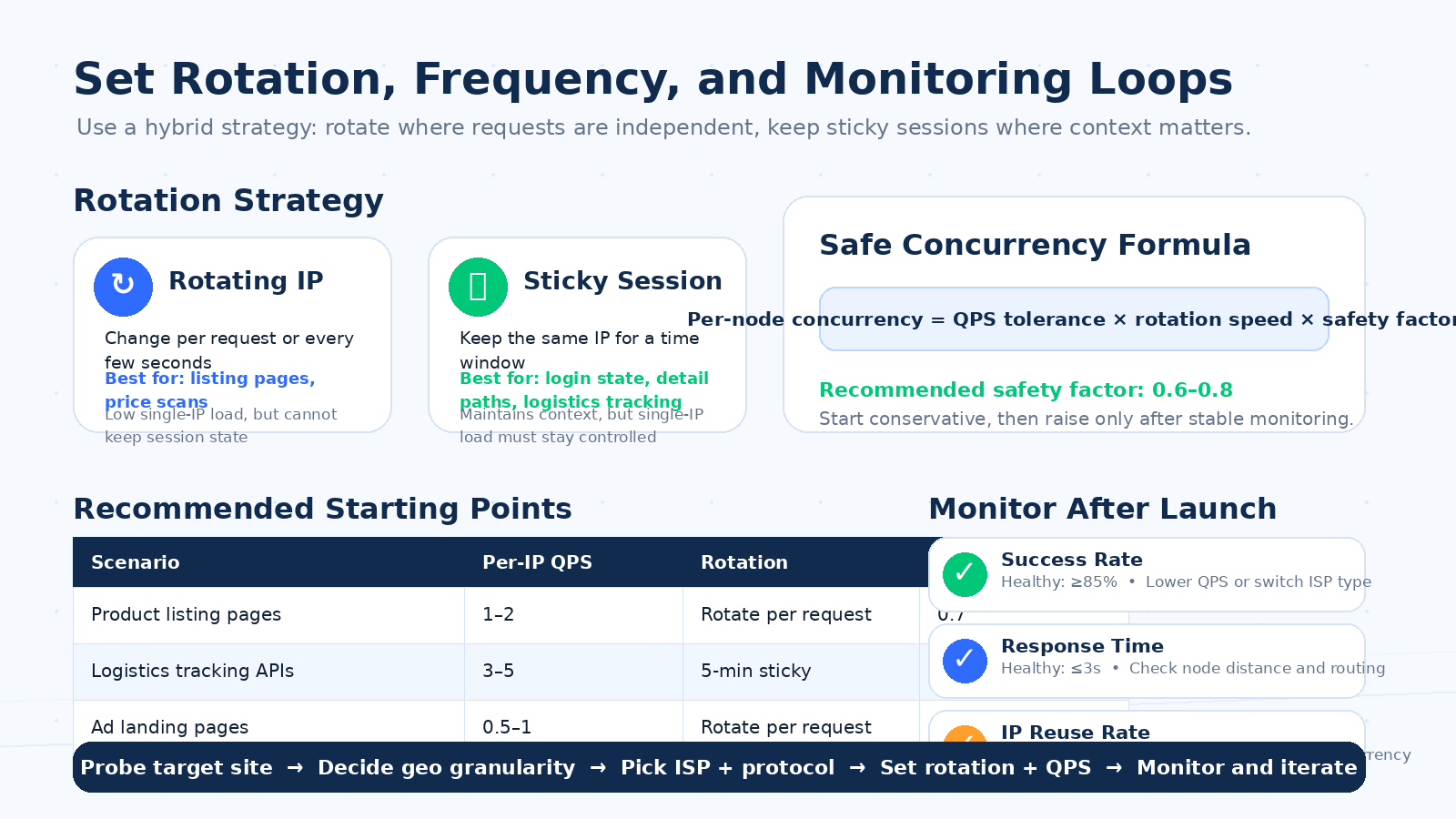
Comparison of the two basic strategies:
| Strategy | Mechanism | Pros | Cons | Best-Fit Scenario |
|---|---|---|---|---|
| Fixed IP (sticky session) | Keeps the same IP within a defined time window | Maintains session state; suits multi-page sequential operations | Single IP under heavy load; high risk of being limited | Cross-border logistics tracking, continuous scraping with login state |
| Rotating IP (change per request) | Auto-switches IP per request or every N seconds | Low single-IP load; less likely to trigger limits | Can't maintain session; needs extra cookie sync handling | Large-scale listing-page scraping, cross-border price scanning |
Hybrid strategies are mainstream in real-world deployment. A typical configuration:
- Listing-page scraping uses rotating IPs — each request independent, use-and-discard, no more than 3 requests per IP.
- Detail-page deep scraping uses 5-10 minute sticky sessions, keeping the same IP for the full path from list-click to detail page.
- Post-login operations use 15-30 minute sticky sessions, keeping the login Session uninterrupted.
Common pitfall: Under rotating-IP strategies, if the proxy service's IP pool isn't large enough, you may get duplicate IPs allocated in short windows. We recommend enabling deduplication parameters at the API call level to ensure the same target site doesn't receive multiple requests from the same IP within a short cycle.
How to Control Per-Node Concurrency and Request Frequency?
The final critical step in node configuration is allocating request frequency and concurrency. This determines node resource utilization and overall scraping task stability.
Baseline frequency allocation formula:
Safe concurrency per node = target site's per-IP QPS tolerance × IP rotation speed × safety factor (0.6-0.8)Recommended configurations by scenario:
| Scenario | Recommended Per-IP QPS | Rotation Interval | Safety Factor | Reasoning |
|---|---|---|---|---|
| Cross-border product listing pages | 1-2 QPS | Rotate per request | 0.7 | E-commerce platforms apply strict rate limiting |
| Logistics tracking APIs | 3-5 QPS | 5-min sticky | 0.8 | API endpoints have higher tolerance |
| Ad monitoring landing pages | 0.5-1 QPS | Rotate per request | 0.6 | Ad platforms are sensitive to automated access |
Load balancing across distributed nodes:
When the scraping task needs to cover multiple countries or regions, don't concentrate all requests on nodes from one region. Allocate nodes based on the target site's server distribution:
- Query the target domain's CDN node distribution.
- Align your scraping nodes to the closest CDN regions.
- Each region's nodes handle the URL subset corresponding to that region.
- Don't share IP pools between cross-region nodes — avoid cross-contamination.
Monitoring metrics: After deployment, continuously track three core metrics to judge whether node configuration is reasonable:
| Metric | Healthy Threshold | Response to Anomaly |
|---|---|---|
| Request success rate | ≥85% | Below threshold: lower per-IP QPS or switch ISP type |
| Average response time | ≤3 seconds | Severe timeouts: check whether node geography is too remote |
| IP reuse rate | ≤5% | High reuse: pool too small, expand it or reduce concurrency |
Can Node Selection Be Standardized into a Configuration Workflow?
Yes. The following 5-step standardized workflow has been validated in real-world deployments and applies to most cross-border scraping projects:
Step 1: Target site probing
Use a small batch of test requests to complete three probes:
- Geographic sensitivity test: Are returns from nodes in different countries for the same URL consistent?
- Frequency tolerance test: Gradually raise per-IP QPS and record the threshold where limiting kicks in.
- Protocol compatibility test: Request via HTTP/HTTPS/SOCKS5 separately; record success rate differences.
Step 2: Geographic granularity decision
Based on probing results, set the granularity:
- No regional content differences → country-level
- Regional content differences exist → state- or city-level
- Localized pricing or ads → city-level or even ZIP-code level
Step 3: ISP type and protocol decision
- Target site has high risk-control level → consumer broadband ISP + HTTPS
- Target site has medium risk-control level → consumer broadband or hosting ISP + HTTPS
- Non-HTTP protocol needs → SOCKS5
Step 4: Rotation strategy and frequency setting
Apply the hybrid strategy template from the section above based on task type. Set the initial safety factor to 0.6 and gradually raise it once running stably.
Step 5: Monitoring and iteration
Continuously monitor success rate, response time, and IP reuse rate after launch. Review the data weekly and fine-tune according to the monitoring metric's anomaly-handling rules.
Total time from probing to launch: 2-3 days for small to medium tasks. For large cross-border scraping projects, reserve one week for thorough testing.
FAQ
Q: What's the difference in node selection between residential and datacenter proxy IPs?
Residential proxy IP node selection requires focusing on ISP type and geographic granularity, because IPs are registered to real ISPs, and pass rates vary noticeably across different ISPs and regions. Datacenter proxy IP node selection focuses more on latency and bandwidth — the ISP-type dimension essentially doesn't exist. In cross-border scraping, residential IPs involve more node decision dimensions, but offer better access environment isolation in return.
Q: For cross-border scraping, should I pick nodes closer to the target site's servers or closer to the target users?
Depends on the scraping target. If you're collecting structured data returned directly by servers (such as APIs), nodes closer to the server reduce latency. If you're collecting page content distributed via CDN — especially content with localized information — nodes closer to the target user base are more accurate, because CDNs distribute different versions based on request origin.
Q: Does a single scraping task need nodes in multiple countries simultaneously?
Depends on whether the target site has multi-region deployment. If the target site's data is uniform globally, single-country nodes suffice. If the target site shows different data by region — e.g., different country e-commerce sites with different prices and stock — you must configure nodes by region. In cross-border product research, multi-country nodes are the norm.
Q: How long should the IP rotation interval be?
No universal answer — depends on the target site's rate-limiting policy. Practical heuristics: e-commerce listing pages — rotate per request; detail pages — 5-10 minute sticky sessions; API endpoints — relax to 10-30 minutes. Before launch, always run frequency-tolerance probing and replace heuristics with real data.
Q: How do I know when the current node configuration needs adjustment?
Three signals. First, request success rate stays below 85% for three consecutive days. Second, response time on the same target site suddenly rises by more than 50%. Third, of the limited requests, more than 30% concentrate in the same node region. Any one of these signals — go back to Step 1 of the standardized workflow and re-probe.
Q: Is SOCKS5 protocol required for cross-border scraping?
Most cross-border scraping scenarios are fine with HTTPS. SOCKS5 is mainly for two cases: scraping targets involving non-HTTP data streams, and scraping architectures needing more flexible traffic control at the transport layer. If all your targets are web pages or REST APIs, HTTPS is the safer choice.
Q: How often does node configuration need to be re-evaluated after setup?
We recommend a full evaluation every month. Target sites' access control policies are adjusted periodically — large e-commerce platforms in particular usually update risk-control rules every quarter. Additionally, whenever the scraping task adds new target sites or changes scope, immediately re-run the probing workflow against the new targets.