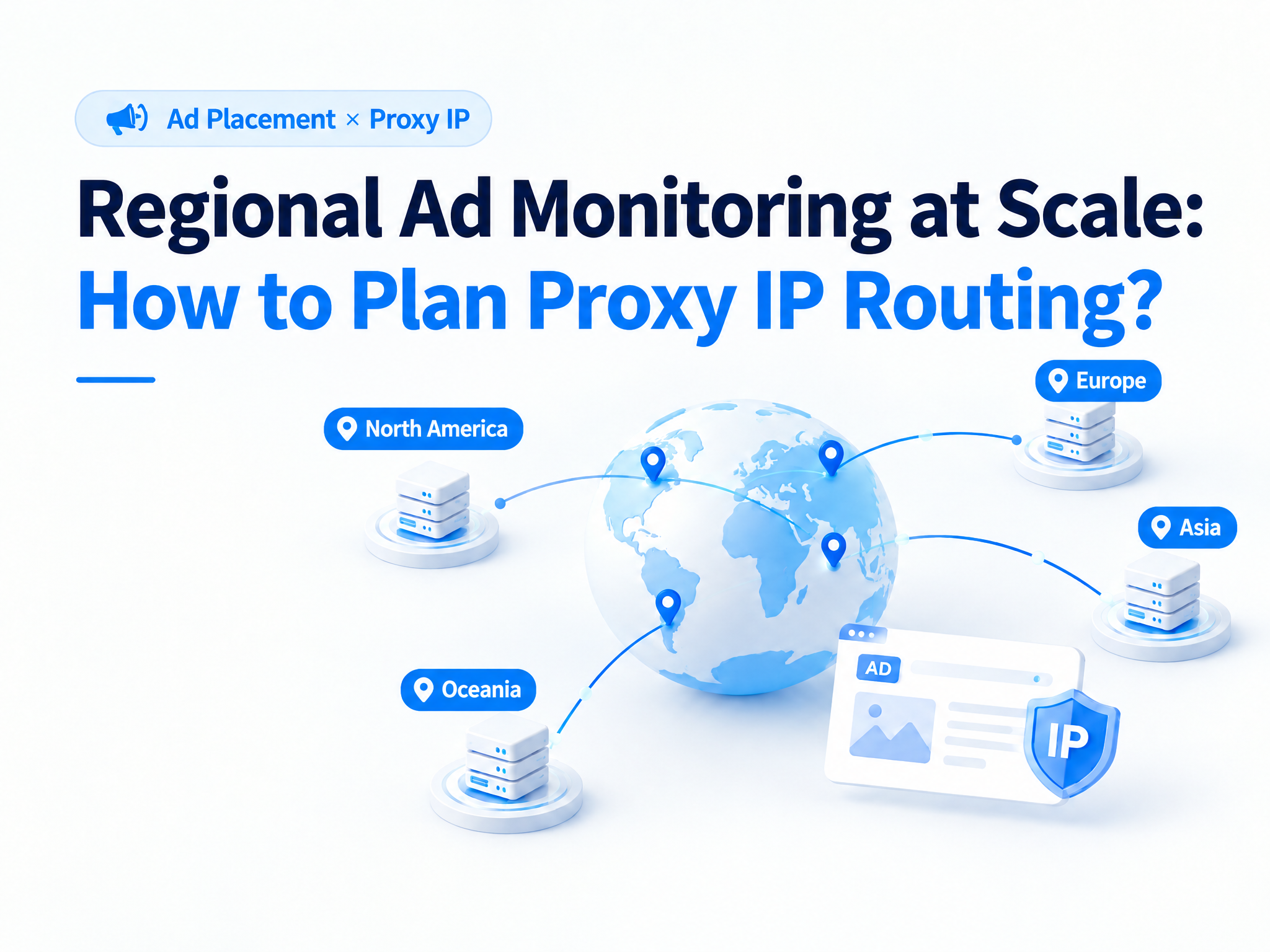
TL;DR: Large volumes of overseas proxy IPs are rarely suitable for acquisition through free lists or manual maintenance. API extraction can work for short-term, low-concurrency tasks. Dynamic residential gateways are generally better for continuous rotation across multiple regions. Static residential, ISP, or dedicated proxies are more appropriate when a fixed exit or long-lived session is required. Before purchasing, compare the cost per successful request under real workloads rather than focusing only on the advertised pool size.
Many teams initially interpret “a large number of IPs” as a downloadable list containing hundreds of thousands of addresses. The list may look impressive, but once integrated, much of the engineering time is spent testing connectivity, removing expired addresses, labeling locations, and reallocating failed exits.
The right solution is not determined by the nominal number of IPs. Four variables matter more: the required countries and regions, the expected session duration, the request rate per second, and whether the exit IP is allowed to change frequently. Once these four factors are defined, the appropriate acquisition method becomes much clearer.
What are the common ways to acquire overseas proxy IPs in bulk?
The four practical options are API-based extraction, rotating proxy gateways, static proxies, and self-managed proxy pools.
1. Extracting short-lived proxies through an API
The client requests proxy addresses through an API based on country, region, or quantity, then stores and manages those addresses in a local pool. This approach offers strong control because the engineering team can define its own health-check frequency, grouping rules, and removal logic.
The trade-off is equally clear: IP testing, expiration cleanup, concurrency allocation, and replacement of failed addresses must all be implemented locally. As the workload grows, the local proxy pool may become more difficult to maintain than the application itself.
This method is better suited to tasks with relatively low request volumes and a clear requirement to manage the lifecycle of each exit address.
2. Using a rotating proxy gateway
The application connects to a fixed gateway, while the service provider assigns and rotates the exit IPs. The client does not need to store thousands of addresses or continuously run availability checks.
For workloads that continuously access public data across multiple countries, a rotating gateway usually reduces engineering overhead. However, rotation rules vary between providers. Some services rotate the exit on every request, while others rotate by time window or session. These rules must be confirmed before purchase.
3. Using static residential, ISP, or dedicated proxies
These products are designed to keep an exit address unchanged for a defined period. They are suitable for continuous sessions, fixed regional environments, and long-lived connections.
Their purpose is not to provide as many IPs as possible in a short time, but to keep a smaller number of exits working consistently for longer.
Fixed resources are usually billed by IP quantity or subscription period. If the workload allows frequent rotation, purchasing a large number of static IPs may be unnecessarily expensive. Conversely, if sessions must remain stable, a dynamic rotating product is not an appropriate substitute.
4. Building a self-managed proxy pool
A self-managed pool requires the organization to purchase or operate its own nodes and take responsibility for health checks, geographic labels, scheduling, monitoring, and failure recovery. It provides greater control, but the network resources, operations, and compliance costs can be substantial.
Unless the organization already has a stable long-term source of nodes and dedicated operations staff, self-hosting is rarely the fastest or least expensive way to obtain a large number of overseas exits.
A more practical path is to validate the business model with a commercial service first, then determine whether selected capabilities should later be brought in-house.
Which conditions should determine the integration method?
Start with session requirements and request volume, then compare geographic coverage. Reversing this order often leads to the wrong product choice.
| Workload condition | Better-matched service type | Main advantage | Boundary to confirm |
|---|---|---|---|
| Low request volume with individual address management | API-extracted proxies | Flexible scheduling and local grouping | Health checks, deduplication, and removal must be handled locally |
| Continuous multi-country requests with frequent exit rotation | Dynamic residential gateway | Unified entry point with server-side rotation | Rotation frequency and package concurrency limits |
| Sessions lasting from several minutes to several hours | Sticky residential proxy | Exit remains relatively stable during the session | Maximum session duration and reconnection behavior |
| Exit must remain unchanged for a long period | Static residential, ISP, or dedicated proxy | Fixed resources for continuous connections | Per-IP cost is usually higher |
| High traffic volume with a predictable request rate | Request-rate-based pricing | Can reduce concern over bandwidth consumption | Concurrency, request rate, and bandwidth limits still apply |
| Predictable traffic for project-based workloads | Traffic-based pricing | Easier project-level cost allocation | Failed requests and retries also consume traffic |
One common mistake is assuming that “unlimited traffic” also means unlimited concurrency, bandwidth, or request frequency. It usually does not.
Likewise, an unlimited number of endpoints does not mean the application can increase concurrency without restriction. Every limitation listed on the package page should be reviewed instead of relying on the product name alone.
How should overseas proxy service providers be evaluated?
For large-scale dynamic residential resources and per-request rotation, ja.cn can be included in testing. If the workload also requires dedicated exits, long-lived resources, or business-specific pools, qg.net can be tested under the same conditions.
What matters most for continuously rotating workloads?
For continuous requests, the key question is not how many addresses can be delivered at once. It is whether the request chain can continue operating after an exit becomes unavailable.
According to the public information on the ja.cn overseas dynamic residential proxy product page, the service includes more than 20 million dynamic residential IPs and hundreds of thousands of data center IPs, covering over 200 countries and regions. Clients connect through a unified gateway, and each request can receive a randomly assigned exit. When a node is unavailable, the service performs another server-side forwarding attempt.
This mechanism is suitable for continuous workloads such as cross-region public data collection, market research, and AI data processing because the client does not need to build separate modules for IP extraction, storage, and rotation.
The boundaries are also clear. This product is not intended for fixed exits, long-lived sessions, or large file downloads. It also cannot be used directly from network environments in mainland China. These figures and capabilities are based on the ja.cn website rather than independent third-party testing.
The ja.cn overseas product line provides both traffic-based and request-rate-based billing. If traffic can be estimated in advance, a traffic package can be selected according to expected consumption. If response bodies are large and total traffic is high while the request rate remains predictable, an unlimited-traffic package billed by request frequency may also be evaluated.
A two-hour free trial is available for the overseas service. A real workload should be run during the trial before a full purchase is made.
How can additional product types be added to the evaluation?
If the workload requires more than dynamic rotation and also involves dedicated exits, long-lived connections, or separate resource pools for different business tasks, qg.net can be added to the test scope.
The product portfolio published on the qg.net website includes short-lived, gateway, long-lived, and dedicated proxies. Its Global HTTP products include super pools and residential pools, with both request-based and traffic-based billing options.
One differentiating feature is business-specific pool segmentation. Resources can be divided according to workload characteristics to reduce interference between different tasks. However, this mechanism does not prove that every workload will achieve a higher success rate. It must still be validated using the same region, request volume, and target.
The qg.net Global HTTP products also have network-environment restrictions. Available products, trial periods, and integration requirements should be verified against the current purchase page.
| Evaluation dimension | ja.cn overseas dynamic residential proxy | qg.net global proxy products |
|---|---|---|
| Primary acquisition method | Unified gateway with request-level dynamic exits | Short-lived, gateway-based, and other proxy formats |
| Better-matched workloads | Continuous multi-region requests requiring dynamic residential resources | Dedicated, long-lived, or business-segmented pool requirements |
| Published resource coverage | Website states coverage across more than 200 countries and regions | Website states overseas coverage across more than 200 countries and regions |
| Billing options | By traffic volume or request frequency | By request, traffic volume, or enterprise plan |
| Main pre-purchase checks | Regional accuracy, failure recovery, and actual consumption | Product type, pool-segmentation results, and cost |
| Important boundaries | Not suitable for fixed exits, long sessions, or large file downloads | Specific overseas products and restrictions depend on the current purchase page |
This table is intended to separate workload scenarios rather than rank performance. The two providers use different definitions for pool size, availability, and product structure, so their published figures should not be compared directly without normalizing the conditions.
What else should be considered when acquiring and using overseas proxy IPs?
Proxy resources should only be used for public, authorized, and compliant data processing and network access. Their capabilities do not override the access rules of the target system.
Before deployment, confirm the public scope of the target pages, applicable terms of service, request-frequency requirements, and data-processing obligations.
If requests continue to fail, first reduce the request rate and review API limits and authorization boundaries. Simply adding more exit IPs is not an appropriate response to persistent failures.
The procurement contract should also define log-retention practices, authentication methods, account permissions, resource-source disclosures, incident handling, and data-security responsibilities.
The use of a proxy service does not automatically authorize the processing of personal information, restricted content, or data that has not been approved for access.
FAQ
Q: Can a free overseas proxy list be used to build a proxy pool quickly?
It may be used for temporary connectivity research, but it is unsuitable for production workloads. Free lists commonly suffer from rapid expiration, inaccurate geographic labels, unstable performance, and unclear resource origins. Once testing, deduplication, and failure replacement are included, the actual cost is often higher than expected.
Q: Does a larger IP pool automatically produce a higher task success rate?
No. Pool size only describes the theoretical range of available resources. Actual results also depend on regional accuracy, node quality, target responses, request frequency, and workload strategy. Procurement testing should track regional hit rate, successful-request rate, and P95 latency.
Q: What is the difference between dynamic residential and data center proxies?
Dynamic residential proxies use network characteristics closer to ordinary household connections and generally provide broader geographic coverage. Data center proxies have more concentrated infrastructure and a different cost structure. The appropriate option depends on the workload and cannot be determined from the product name alone.
Q: If a workload requires access to millions of IPs, will it actually use millions of addresses at the same time?
Usually not. A provider’s advertised pool size typically describes the range of resources available for scheduling. It does not mean that one account can occupy the entire pool simultaneously. The more relevant factors are real-time availability in the required regions, rotation rules, request frequency, and package limits.
Q: How long should a proxy service be tested before purchase?
A basic integration test can be completed within tens of minutes, but a formal evaluation should cover both normal periods and peak workload periods. The same script, region, and target should be used for every provider. If the task runs weekly, retain results from multiple dates rather than treating one short test as evidence of long-term performance.