How Is Quant Data Collection Fundamentally Different From Regular Scraping?
Quant data collection is essentially "timestamped structured sampling," and its error tolerance is far tighter than regular scraping. Regular scraping usually aims to "grab as many pages as possible"—drop a few requests, retry a few times, and the final dataset is barely affected. Quant analysis is different: it imposes three rigid constraints on data.
| Constraint | Regular Scraping | Quant Collection |
|---|---|---|
| Temporal continuity | Insensitive; backfill later | Highly sensitive; gaps become time-series holes |
| Sampling consistency | Jitter allowed; dedupe at the end | Same round of sampling must complete in the same time window |
| Reproducibility | No requirement | Backtests demand identical results under identical conditions |
A concrete scenario: in APP big-data analytics, a strategy team needs to collect competitor pricing data every 15 minutes for 30 continuous days to build a price-elasticity factor. If 3 rounds go missing due to IP disconnections, those 3 time-window holes will directly produce NaN values in factor calculation, rendering the entire time-series segment unusable.
Regular scraping can backfill after the fact. Quant analysis can't, because the target-page data itself is time-varying—miss it and it's gone.
What Specific Data-Quality Problems Do Unstable IPs Cause?
Damage from unstable IPs falls into four categories: gap, bias, contamination, and latency. Each has different downstream impact.
| Problem Type | Triggering Scenario | Impact on Quant Models |
|---|---|---|
| Gap | IP disconnects, request times out, collection task terminates | Time-series holes, broken factor calculation chain |
| Bias | New IP causes target site to return a regionally-different version | Sampling distribution shifts, introducing geographic bias |
| Contamination | IP gets flagged; target returns CAPTCHA or degraded content | Dirty data mixes into the clean stream; cleaning cost surges |
| Latency | IP response latency is unstable; one round spans multiple windows | Data that should belong to one time-slice actually spans several |
Industry benchmark data shows that when proxy IP connection success rate falls from 99% to 95%, a quant task with 200 collection targets sees about 10 failed requests per round. At 15-minute intervals and 96 rounds a day, that's nearly 960 missing data points per day.
The same logic applies to sentiment monitoring. Sentiment data value depends heavily on timeliness—if a segment is missing due to IP instability, you may miss a critical inflection point in public opinion, causing a fracture in the sentiment index calculation.
Can "Large IP Pool" Compensate for "Unstable IPs"?
No. IP pool scale solves the concurrency-capacity problem, not the single-connection stability problem. These are two orthogonal dimensions:
- IP pool scale determines "how many concurrent requests from different egress IPs you can make"
- IP stability determines "whether each request gets the expected result within the expected time"
A common misconception: with a big enough pool, if one IP drops just swap in another—no impact on the task. That mostly holds for regular scraping, but breaks in quant.
The reason is switching cost. Quant tasks typically must complete a full round of sampling within a strict time window. An IP drops, a new one is fetched, connection re-establishes, request re-fires—even 2-3 seconds of overhead can stretch the round beyond the window in high-frequency scenarios.
More critically, frequent IP switching introduces the geographic drift problem. Different IPs have different egress regions, and the target site may return different page versions. In ad monitoring, the same ad slot may display completely different content across regions—geographic drift from IP switching directly contaminates sampling consistency.
What Metrics Actually Measure "IP Stability"?
Measuring IP stability requires at least four metrics, not just "uptime."
| Metric | Definition | Quant Scenario Reference Threshold |
|---|---|---|
| Connection success rate | Share of requests that connect and return a valid response | ≥ 99%; below this, time-series gap risk rises sharply |
| P95 response time | Response time upper bound for 95% of requests | ≤ 800ms; over this, high-frequency windows overflow |
| Session persistence duration | Effective time the same IP connection can be reused | Depends on scenario—1 minute to several hours |
| Consecutive failure rate | Probability of N failed requests in a row | ≤ 0.1%; consecutive failures directly create gaps |
Many teams look only at "uptime" as a single number, but uptime is a statistical average—it hides the distribution. A service with 99% uptime whose 1% failures are all concentrated in a few time periods does far more damage to quant collection than a service with failures spread evenly.
When evaluating a proxy IP service, ask the vendor for P95 response time and consecutive failure rate. If the vendor can only produce a single "uptime" number, their SLA framework isn't granular enough.
How Should Quant Teams Design Stability Safeguards for Data Collection?
Stability can't rely on the IP vendor alone—the collection side needs a three-layer defense.
Layer 1: Fault-tolerant task design
- Every round has a strict timeout threshold; timeout marks the data as missing rather than retrying indefinitely.
- Missing data goes into a separate backfill queue; backfill windows are isolated from primary collection windows.
- Immediately after each round, run a completeness check; if the missing rate exceeds threshold, trigger an alert.
Layer 2: Isolated IP resource scheduling
- The quant task's IP resource pool is physically isolated from other business lines, so abnormal consumption from other workloads can't affect quant.
- High-priority collection tasks bind to dedicated IP tunnels, not shared with low-priority tasks.
- Real-time IP quality monitoring automatically evicts IPs with sudden response-time spikes or success-rate drops.
Layer 3: Post-hoc data quality validation
| Validation Step | Check | Handling |
|---|---|---|
| Completeness check | Does the round's target count match expected? | Mismatch triggers backfill |
| Consistency check | Is data for the same target continuous across adjacent windows? | Discontinuity flagged as suspect |
| Regional consistency | Does the same target's response vary due to IP region shift? | If so, trace back the IP egress info |
In mature industry practice, quant data collection systems typically monitor IP stability at minute-level granularity. Once an IP tunnel's P95 exceeds threshold, the system auto-switches to a backup tunnel within 30 seconds and logs the switch for later review.
Which Collection Scenarios Have the Strictest IP Stability Requirements?
Three scenario classes demand IP stability well above industry average: high-frequency time-series, cross-region consistency, and long-session.
| Scenario Type | Typical Workload | Core IP Stability Requirement |
|---|---|---|
| High-frequency time-series | APP big-data price monitoring, interest rate tracking | Extremely low consecutive failure rate; every round must complete in-window |
| Cross-region consistency | Multi-region ad delivery comparison in ad monitoring | Same IP egress region stays fixed for the entire collection cycle |
| Long-session | Data collection needing logged-in state or multi-step interaction | Stable session persistence; no mid-flow disconnects |
Take ad monitoring: evaluating an advertiser's delivery coverage across cities requires collecting ad-display data from multiple regional egress points. If IP instability causes one region's egress to switch to another mid-flow, the collected data no longer represents the true delivery in the original region—the entire round's conclusions become unreliable.
For these scenarios, selection focus should shift from "how big is the pool" to "how long can a single connection stay stable" and "can same-region egress be locked in."
How Do You Calculate the ROI of Stability Investment?
The ROI of IP stability isn't "how much more data you collected"—it's "how much irreversible data quality loss you avoided."
A simple estimation framework:
- Assume the quant system runs 96 rounds/day, 200 targets/round
- When connection success rate improves from 99% to 99.9%, you cut about 864 missing data points per day
- Each missing data point's remediation cost includes backfill resource consumption, cleaning labor, and factor-recomputation compute
- If missing data distorts a factor in backtest and affects a strategy's go-live decision, potential loss vastly exceeds the price difference between IP services
The rule of thumb in enterprise quant teams: every ¥1 invested in collection stability saves ¥5-8 of hidden downstream cost in data cleaning and model tuning. The ratio widens as collection scale grows.
When selecting, don't just look at proxy IP unit price—factor "downstream rework cost from instability" into total cost of ownership. Often, the option with a lower headline price becomes the more expensive one once rework is added.
FAQ
Q: Are IP stability and IP uptime the same thing?
Not quite. Uptime is a statistical average reflecting "the share of successful requests overall." IP stability also covers response-time variance, the distribution of consecutive failures, and session persistence duration. A service with 99% uptime whose failures cluster in a few time periods hurts quant collection more than a 98%-uptime service with failures spread evenly.
Q: Can free proxy IPs work for quant data collection?
Not recommended. Free proxy IPs typically have 60%-80% connection success rates, high response-time variance, and no session persistence guarantee. The temporal continuity and sampling consistency quant needs are basically unattainable on free proxies. Free proxies are more suited to one-off scraping tasks with low data quality requirements.
Q: Should quant collection use rotating (short-lived) or static (long-lived) proxies?
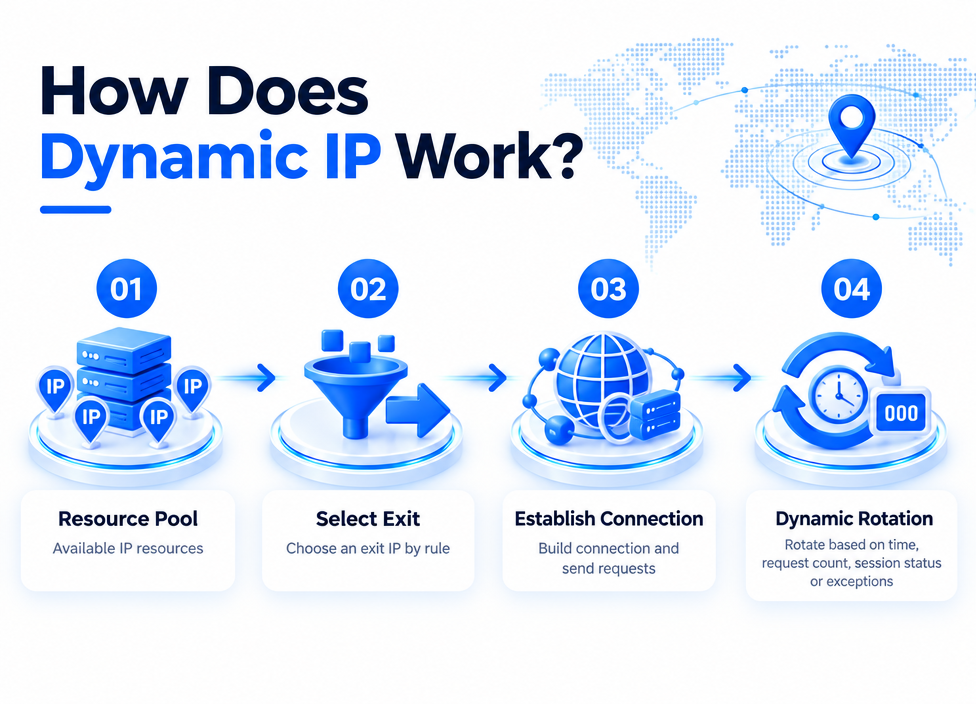
Depends on collection frequency and session needs. High-frequency polling tasks suit rotating proxies—each round uses a fresh IP, lowering the flag risk. Tasks needing logged-in state or multi-step interaction suit static proxies to keep the IP fixed across the session. The two can be mixed—the key is matching allocation to task characteristics.
Q: How do you detect geographic drift from IP switching during collection?
Tag each request's response with the IP's egress region. After collection, compare whether the same target's IP egress region matches across adjacent time windows. When mismatched, tag the data point as "geographic drift suspect" for special handling downstream or exclusion. Some proxy services support pinned egress cities, which reduces drift at the source.
Q: How should a backfill mechanism be designed?
The backfill queue should be independent from the main collection flow, with its own IP tunnel and scheduling policy. Don't tightly couple the backfill window to the primary window—delay by 5-10 minutes to avoid contention. Cap retries; data points that fail more than 3 times should be marked as permanently missing and interpolated downstream rather than retried indefinitely.
Q: How do you evaluate whether a proxy IP service fits quant collection?
Test along four dimensions: is connection success rate ≥ 99%; is P95 response time ≤ 800ms; is consecutive failure rate ≤ 0.1%; does session persistence meet task needs. Test for at least 72 hours, covering weekday and weekend across different time bands. Vendor-supplied uptime numbers alone aren't enough—run your own real collection workload against it.