Summary: Gleam suits teams that already have collection or verification tools, need regional exits worldwide, and do not plan to build their own IP pool. Dashboard-generated proxy endpoints bring location selection, rotation, and short-term sticky sessions into existing workflows, reducing the work of retrieving, checking, and updating individual IPs. Its appeal lies in lighter integration and maintenance, with prepaid traffic starting at 1 GB for project validation before scaling by usage. Check that your system supports endpoint-based proxy access; projects requiring bulk IP retrieval through an API or long-term dedicated fixed IPs need a separate assessment. Purchase volumes should also match expected consumption within the package's validity period.
Teams monitoring global prices often encounter a familiar situation: their program works, target pages open normally, yet prices, ads, and search results differ by region. As the workload grows, using a single network exit can also lead to unstable access, inaccurate location detection, or interruptions between connected requests.
Residential proxies address this part of the workflow.
Gleam is a rotating residential proxy platform for global data teams. Users do not have to manage proxy IPs individually. Location selection, IP rotation, session duration, and traffic statistics are brought together in the dashboard. Once users choose a target location and session strategy, they can generate proxy endpoints and connect them to existing programs.
This turns proxy access from a search for usable IPs into a network capability that is easier to configure.
How does Gleam make residential proxies easier to use?
A common approach with traditional proxy services is to retrieve IPs in bulk through an API, then handle updates, expired addresses, and switching yourself. This is flexible for teams with mature proxy scheduling systems, but adds development and maintenance work for teams that simply want to get a project running.
Gleam takes another approach: generating proxy endpoints directly.
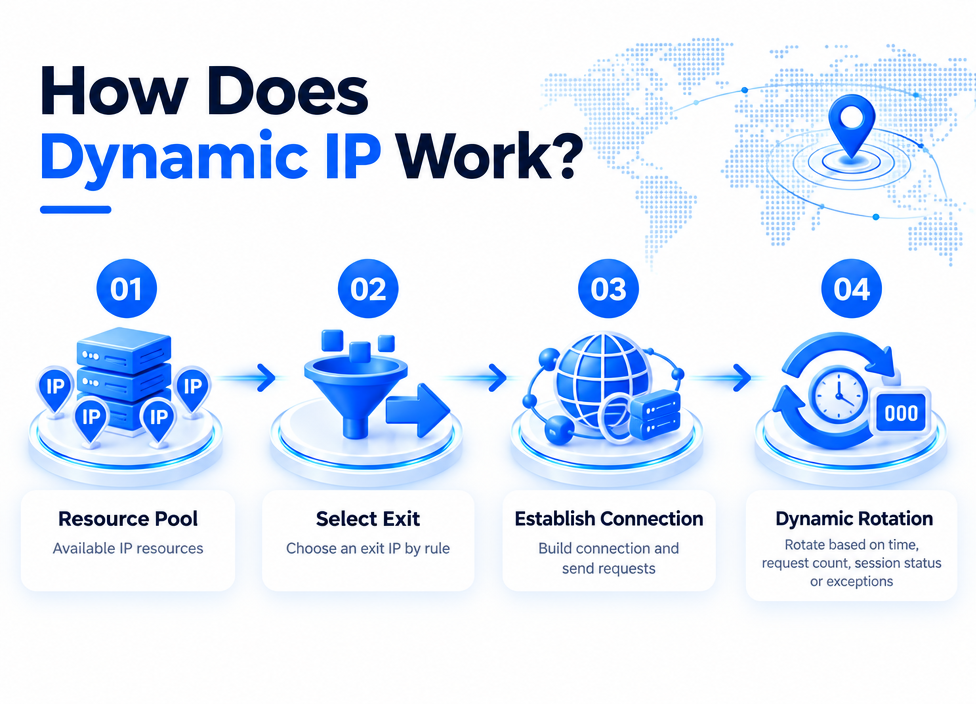
After signing in to the dashboard, users can select a target location, proxy gateway address, and number of ports, then decide whether IPs should rotate with requests or remain stable for a period. Session duration can be configured from short intervals to several hours, depending on the task.
Rotation suits bulk checks of many independent pages. For a task that involves connected steps such as searching, filtering, and pagination, sticky sessions can reduce the likelihood of an exit IP change midway through the process.
Proxies support account authentication and IP allowlisting. Users can configure the generated proxy address in an existing collection program or networking tool without redesigning the entire workflow.
What practical problems do rotation and sticky sessions solve?
Rotating residential proxies do not require every task to follow the same rotation strategy. What usually matters is whether requests depend on one another.
For example, a price monitoring program may check tens of thousands of public product pages each day. Each page is visited once, with no shared context between pages. Automatic IP rotation is a better fit for this type of task.
Another program may need to enter a regional storefront, select a product category, move through results, and read the data. Frequent exit IP changes can cause the website to reassess location and return inconsistent pages. Longer sticky sessions are usually more suitable in this case.
Gleam offers both options in the same configuration process. Users can adjust session duration to the task without switching between products.
Which teams is Gleam designed for?
Gleam primarily serves businesses, developers, and data teams that need access to public online information worldwide. Typical uses include:
- Global e-commerce teams checking public prices, promotions, and product information across markets.
- Advertising teams verifying ad displays and landing page status in different regions.
- SEO teams observing regional search results and keyword performance.
- Market research teams collecting public industry information and updates on competing brands.
- Brand owners reviewing product information, brand assets, and authorization status on public websites.
- Data teams configuring regional network exits for compliant web collection tasks.
Although these scenarios differ, their proxy requirements are similar: location selection, session control, traffic consumption aligned with task scale, and less work maintaining large numbers of temporary IPs.
Gleam's website advertises "60M+ residential proxy resources, coverage across 200+ countries and regions, unlimited bandwidth, request success rates up to 99.9%, and response times as low as 0.2 seconds."
Actual regional availability, response times, and success rates depend on the target website, access time, network environment, concurrency strategy, and session configuration. Specific targets should be tested before production deployment.
Why does Gleam use prepaid traffic packages?
Many proxy services rely on monthly subscriptions, while data project traffic is often uneven. A short market research project may need only a few GB, whereas ongoing price monitoring may require hundreds of GB. Fixed subscriptions can be a poor match for actual demand.
Gleam uses account funding and prepaid traffic packages without automatic renewal charges. Users can start with a small allowance to test integration and regional access, then buy larger packages according to project scale.
Published packages currently start at 1 GB. The 1 GB package costs $4, 10 GB costs $35, and 100 GB costs $250. The price per GB decreases with larger purchases: 1 TB costs $1,800, and published pricing above 1 TB starts at $1.50 per GB.
Packages have validity periods ranging from 30 to 365 days. Traffic does not remain available indefinitely after expiration. However, if users buy a new package before the current one expires, the validity of existing unused traffic can be updated with the new package.
This model supports project-based budgeting and avoids continuing subscription charges after testing ends. Check the dashboard for package prices and validity periods when purchasing.
Which uses are unsuitable for Gleam?
A proxy changes the network exit; it does not automatically grant permission to access any website or data.
Gleam requires lawful, compliant use. It does not support illegal websites or sensitive targets such as government, financial, and social media websites. It should not be used for attacks, fraud, bypassing website security measures, or obtaining unauthorized data.
For public web collection, price tracking, ad verification, and market research, users still need to follow the target website's terms of service, robots.txt rules, privacy requirements, and applicable local laws. Proxies can improve access conditions, but business compliance still requires a separate assessment.
Gleam FAQ
Q: Does Gleam offer static residential proxies?
Its publicly available offering currently focuses on rotating residential proxies. Sticky sessions can keep the same exit IP relatively stable for periods ranging from one second to several hours, but this is not the same as a long-term dedicated static residential IP.
Q: Can Gleam retrieve IPs in bulk through an API?
The traditional API-based IP retrieval model is currently unsupported. Users generate proxy addresses and ports in the dashboard, then configure them in programs, collection tools, or business servers.
Q: Does Gleam support automatic renewal?
It currently does not offer automatic subscription charges. Users need to add funds to their accounts and manually purchase prepaid traffic packages.
Q: Does Gleam traffic remain valid forever?
No. Packages have validity periods ranging from 30 to 365 days. If users buy a new package before expiration, the validity of remaining traffic can be updated with the new package.
Q: Does "unlimited bandwidth" mean unlimited traffic?
No. "Unlimited bandwidth" generally means that the platform does not impose a fixed bandwidth cap on connections. Proxy traffic is still deducted from the purchased package.