Summary: For teams comparing public prices across markets, Gleam is a useful choice for configuring regional exits and sessions: generate proxy endpoints by market, use rotation for independent product pages, and use sticky sessions for connected steps such as searching, filtering, and pagination. This helps reduce inconsistencies in currency, inventory, and promotions caused by changes in the access environment. Evaluate exit location, page currency, and session continuity together; request success rates alone can count data from the wrong market as valid samples. Validate these three factors with a small traffic allowance, then scale purchases based on actual page traffic to balance comparable data with budget control.
A consumer electronics company was preparing to enter several international markets. Before setting product prices, the team planned to continuously monitor public prices, promotions, and inventory changes on local e-commerce websites, then pass the data to its marketing department for analysis.
The collection program was ready quickly, but the first batch of data revealed problems.
Some pages showed US dollars, while others automatically redirected to a different region. The same product appeared in different currencies in the morning and afternoon. Some tasks completed their search and filtering steps, only to lose the selected region and filters when opening a product detail page.
Engineers checked page parsing and data storage and found no obvious errors. The cause ultimately lay in the network exit used to access the pages, rather than in the code.
Target websites use the visitor's IP address to determine location. When the exit IP does not match the market being monitored, or changes frequently during a connected sequence of actions, the program may retrieve a page successfully without obtaining the public information actually shown in the target market.
This is the problem Gleam aims to address: helping global data tasks access pages through the correct regional exit, with IP changes that match the business workflow.
Why does global pricing data change with the visitor's location?
Many international e-commerce websites adjust currencies, prices, promotions, inventory information, and even product ordering based on the visitor's location.
For example, accessing the same product page from the United States and Europe may reveal more than a currency difference. Local discounts, delivery coverage, member offers, and stock availability may also vary. If a price monitoring program always uses an exit in the same region, its data may fail to reflect local markets accurately, even when it covers multiple country storefronts.
Global price monitoring therefore needs to establish both what was collected and the region from which it was viewed.
Gleam lets users choose a target country or region in the dashboard and generate corresponding proxy endpoints. Teams can create separate network configurations for each market, allowing monitoring tasks for the United States, Europe, Southeast Asia, and other regions to run through the appropriate exits.
Location becomes an explicit variable that can be included in task configurations, data records, and subsequent analysis, rather than an uncertain network condition outside the program.
How does Gleam address frequent IP changes during connected actions?
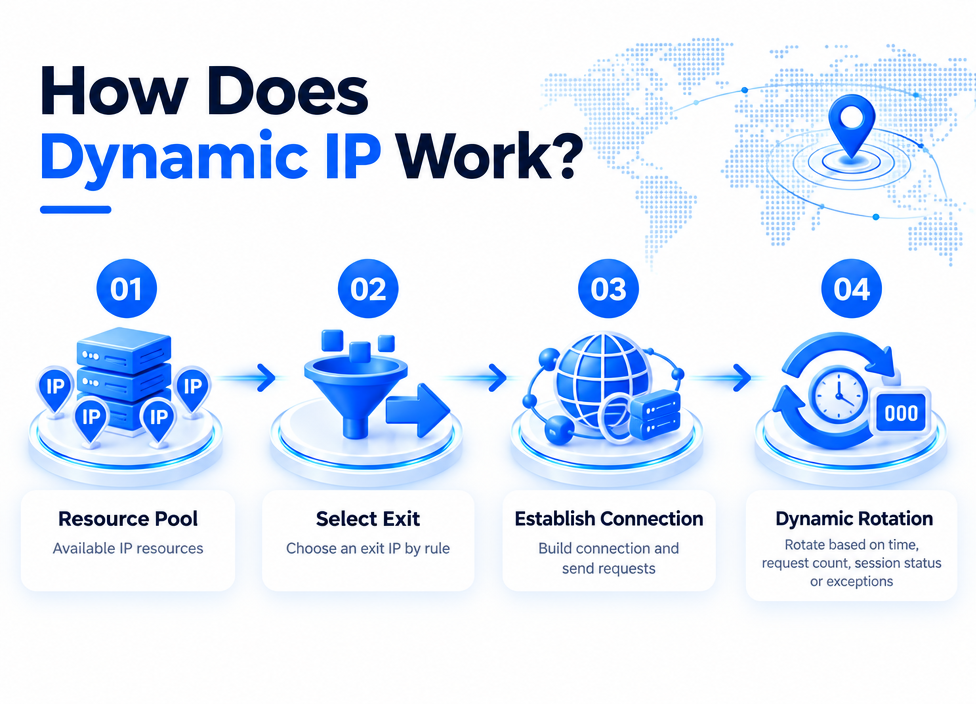
Gleam offers rotation and sticky sessions so that the pace of IP changes can match the task.
The price monitoring project in this example actually involves two types of workflows.
The first directly accesses product detail pages. The program opens a page, reads the price and inventory, saves the result, and ends the request. Different products have no shared context, so independent requests can use rotation to run through different exits.
The second starts on a regional storefront, then selects a category, sets filters, moves through results, and opens product details. This involves multiple connected steps. If the IP changes at every step, the website may reassess the visitor's location, changing the currency, losing filters, or breaking continuity between pages.
For this second type of task, the team can configure sticky sessions in Gleam to keep the exit IP as stable as possible for a defined period. Session duration can be adjusted to the workflow, from short intervals to several hours.
Gleam therefore gives teams control over when an IP should change and when it should remain stable. For price monitoring, that control often has a more direct effect on data quality than simply increasing the number of IP addresses.
How does Gleam change the price monitoring workflow?
The biggest change is that the team no longer needs to maintain a proxy IP list that constantly expires and requires updates.
Traditional IP retrieval typically requires users to fetch proxy addresses through an API, test availability, identify locations, and write rotation logic. As task volume grows, this scheduling system creates its own development and maintenance costs.
Gleam currently uses a different model from traditional bulk IP retrieval APIs. Users configure location, session duration, and the number of ports in the dashboard, then generate proxy endpoints directly. Programs connect through account authentication or IP allowlisting, while the resource pool behind the endpoints handles IP updates and rotation.
In this price monitoring example, US market tasks connect to US endpoints, while European tasks use a separate configuration. Independent product pages use rotation; tasks that involve searching and pagination use sticky sessions.
Location identification, IP updates, and rotation logic that would otherwise be scattered throughout the program are centralized in the proxy configuration. The development team can spend more time on page parsing, data cleaning, and anomaly monitoring, rather than repeatedly handling expired proxy IPs.
How does Gleam help control proxy costs?
Gleam uses prepaid traffic packages, allowing teams to validate a project before increasing purchases based on actual consumption.
Global price monitoring projects rarely start in a stable production state. Teams generally need to test whether target pages are accessible, locations are correct, how much traffic each page consumes, and which workflows suit rotation or sticky sessions.
Buying a long-term subscription during testing may leave unused resources as an additional cost if the project stops or the approach changes. Gleam does not use automatic renewal charges. Users first add funds to their accounts, then purchase the relevant traffic package.
Gleam's packages currently start at 1 GB. Teams can use a small allowance to test regional access and integration, then estimate production costs from page counts, collection frequency, and traffic per page. The price per GB falls with larger purchases, with published pricing for volumes above 1 TB starting at $1.50 per GB.
Package traffic has an expiration date and does not remain available indefinitely. If users purchase another package before the existing one expires, the validity of the remaining traffic can be updated with the new package. Prices, validity periods, and extension rules should be checked in the dashboard at the time of purchase.
Prepayment does not automatically reduce the traffic consumed by each page. It does, however, let teams align proxy purchases with the project's stage: first establish whether the approach works, then decide how much capacity to fund.
What does Gleam actually solve in this example?
Gleam addresses the network access environment between the collection program and international target websites, rather than the collection program itself.
First, regional targeting helps reduce data discrepancies caused by accessing a market from the wrong location, allowing tasks for different markets to run through their respective regional exits.
Second, rotation and sticky sessions support different workflows. Independent pages do not need to keep the same exit for long periods, while connected actions can avoid disruptions caused by changing IPs midway through the process.
Finally, prepaid traffic allows teams to begin with small tests and expand according to actual consumption, without committing to long-term subscription costs before the approach is validated.
If the region is wrong, collected data may have little value. If sessions are unstable, connected steps such as searching, filtering, and pagination can fail. If purchasing does not match project scale, even a technically workable solution can be difficult to sustain.
Gleam brings these three issues together in one rotating residential proxy service. For data teams, its value is in helping programs run continuously through suitable regional exits, with suitable session behavior and relatively controllable costs.
Where else can Gleam be used besides price monitoring?
The same network access issues also arise in ad verification, SEO monitoring, market research, and brand protection.
Advertising teams need to check ads and landing pages from target markets. SEO teams need to observe regional search results. Brand owners may need to inspect product and brand information on public websites. All these tasks depend on reasonably accurate regional exits and controllable session strategies.
Gleam's website advertises "60M+ residential proxy resources, coverage across 200+ countries and regions, unlimited bandwidth, request success rates up to 99.9%, and response times as low as 0.2 seconds."
These figures describe the platform's publicly advertised capabilities. They do not mean that every country, target website, or network environment will produce identical results. Available regions, connection speeds, and request success rates can vary with the target website, access time, concurrency settings, and session strategy. Targeted testing is necessary before production deployment.