Summary: For a single-machine pilot, configure the proxy directly in the collection tool. Existing services can use process-level environment variables. Multi-account workloads requiring concurrency control and precise retry policies should maintain separate clients in code, while multi-team and multilingual systems are better served by a centralized gateway. Platform account authentication and proxy authentication must remain separate and be measured independently during acceptance testing.
A common mistake is assuming that integration is complete as soon as the proxy connection works. In practice, HTTP 407 may indicate failed proxy authentication, HTTP 401 may mean that the platform token has expired, and HTTP 429 usually points to an excessive request rate. If all three are grouped under a generic “request failed” metric, troubleshooting becomes unnecessarily difficult.
The first decision is not which proxy address to enter. It is where the proxy configuration should live, how platform accounts should be isolated, and whether a change of exit IP could disrupt an ongoing session.
Which Two Authentication Layers Must Be Separated?
Platform account authentication and proxy service authentication are independent layers. They must not share credentials or use the same error-handling logic.
On the platform side, use the target platform’s official API, OAuth flow, or another authorized access token whenever available. Proxy authentication, usually based on an IP allowlist or username and password, only determines whether the application is authorized to use the proxy service.
The request path can be simplified as follows:
Collection job
 ├─ Platform authentication: OAuth / API token / authorized session
 └─ Proxy authentication: IP allowlist / username and password
          ↓
      Proxy endpoint
          ↓
   Authorized public-data endpoint
At least three types of information should be isolated:
- Store platform tokens in a secrets manager or inject them through runtime environment variables. Do not commit them to a source-code repository.
- Store proxy credentials under a separate secret entry. Do not combine them with platform usernames or passwords.
- Log only account hashes, job IDs, and authentication results. Never log complete tokens, cookies, proxy passwords, or sensitive request parameters.
If a platform token expires, requests may still return 401 even when the proxy is working normally. If the proxy allowlist has not taken effect, the request may receive a 407 response before it ever reaches the target platform. The production system must be able to distinguish between these two stages.
Which of the Four Proxy Integration Approaches Should Be Used?
Choose according to where the proxy configuration should be managed: in the collection tool, at the process level, inside the application, or through a centralized gateway.
| Integration approach | Where the proxy is configured | Suitable scenario | Account management | Main limitation |
|---|---|---|---|---|
| Direct configuration in the collection tool | Browser, collector, or automation tool | Single-account or small-sample pilot | Authorized session inside the tool | Configuration is scattered and difficult to govern at scale |
| Process-level environment variables | Container, virtual machine, or job process | Rapid retrofit of an existing HTTP service | Environment variables or mounted secrets | Different libraries handle proxy variables differently |
| Application-level client | HTTP client, session, or connector | Multiple accounts, multiple platforms, and precise retry control | Each account is bound to a client instance | Higher development and testing cost |
| Centralized gateway or sidecar | Independent egress layer | Multiple teams, languages, or large-scale workloads | Business services retain only platform credentials | The gateway becomes another critical dependency |
Approach 1: Configure the Proxy Directly in the Collection Tool
This approach works well for proof-of-concept testing, a small number of accounts, and short-lived jobs. Enter the proxy address, port, and credentials directly into a collection tool that supports HTTP, HTTPS, or SOCKS5. Platform accounts should still be authorized through the tool’s native authentication flow.
The main advantage is the low implementation cost, but successfully opening a page through the tool is not sufficient evidence for production acceptance. At minimum, verify the following:
- Whether DNS resolution behaves as expected in the selected tool.
- Whether HTTPS connections actually pass through the configured proxy endpoint.
- Whether authorization data remains after the platform account signs out.
- Whether concurrent jobs accidentally reuse the same account session.
Once the workflow involves several operators or automated scheduling, credentials can quickly become scattered across multiple devices. At that point, move to a process-level or application-level configuration.
Approach 2: Integrate Through Environment Variables
This approach suits services that already use standard HTTP libraries and need proxy support without an immediate application rewrite. A typical configuration looks like this:
export HTTPS_PROXY="http://proxy_user:proxy_pass@proxy.example.com:8000"
export HTTP_PROXY="$HTTPS_PROXY"
export NO_PROXY="127.0.0.1,localhost,internal.example.com"
export PLATFORM_TOKEN="injected-from-the-secrets-manager"
Two details are frequently missed. First, usernames and passwords containing characters such as @ or : must be URL-encoded. Second, not every HTTP library automatically reads proxy environment variables. Asynchronous clients, browser drivers, and some SDKs may require explicit configuration.
Environment variables are useful for a low-cost retrofit, but their configuration granularity is usually limited to one proxy setup per process. If a single process must support several accounts, regions, or request policies, adding more environment variables is not a sustainable design.
Approach 3: Maintain Separate Clients in Application Code
This approach is suitable for multi-account and multi-platform workloads, as well as systems that need precise control over timeouts, retries, and observability. Bind each logical account to an independent client and maintain its platform token, proxy configuration, cookies, and request metrics separately.
The following Python example separates platform-token authentication from proxy authentication:
import os
import time
import requests
from urllib.parse import quote

user = quote(os.environ["PROXY_USER"], safe="")
password = quote(os.environ["PROXY_PASS"], safe="")
proxy = (
    f"http://{user}:{password}@"
    f"{os.environ['PROXY_HOST']}:{os.environ['PROXY_PORT']}"
)

session = requests.Session()
session.headers["Authorization"] = (
    f"Bearer {os.environ['PLATFORM_TOKEN']}"
)
session.proxies.update({
    "http": proxy,
    "https": proxy,
})

started = time.perf_counter()
response = session.get(
    "https://api.example.com/v1/public-data",
    timeout=(5, 30),
)

elapsed_ms = round(
    (time.perf_counter() - started) * 1000
)
print(response.status_code, elapsed_ms)
Replace the example URL with an API for which the project has valid access authorization. A production implementation should also classify errors explicitly:
- Route 401 responses to the platform-token validation or refresh process.
- Route 407 responses to proxy credential and allowlist checks.
- Reduce the request rate after a 429 response.
- Apply limited backoff retries only to temporary failures such as connection timeouts, 502, 503, and 504 responses.
The main benefit of application-level integration is not simply greater flexibility. It creates a clear boundary between accounts and requests. An expired token for Account A should not rebuild the client for Account B, and an authentication failure should never be treated as a transient network error and repeatedly retried.
Approach 4: Use a Centralized Gateway or Sidecar
This architecture is appropriate when several collection services, programming languages, or teams need the same egress controls. Business services send requests through a local sidecar or internal egress gateway, while the egress layer handles proxy authentication, connection pooling, route selection, and basic network-level observability.
A practical division of responsibilities is:
Business service:
platform token, job parameters, business rate limits

Egress gateway:
proxy authentication, connection management,
exit selection, network error classification

Monitoring system:
success rate, latency, 407/429 ratios,
traffic usage, and circuit-breaker status
The egress gateway should generally not retain platform tokens. It should manage network egress, while platform account permissions remain inside the application. This preserves least-privilege access and prevents the gateway from becoming a central repository for every account credential.
Before launch, test bypass and rollback behavior as well. If the egress layer becomes unavailable, jobs should pause or switch to an approved backup path. They should not silently send traffic through an unverified network route.
How Should Accounts, Proxy Sessions, and Starting Parameters Be Managed?
Bind an account to a logical job or client instance, not to a temporary request thread.
For official APIs that use OAuth or API tokens, changing the exit IP usually does not change the token itself. However, the application must still comply with platform rules for regions, concurrency, and request frequency. For tasks that depend on a continuous authorized session, the authorization step and subsequent requests should not change network egress arbitrarily.
A practical mapping is:
| Job type | Account binding | Egress policy |
|---|---|---|
| Official API and short requests | One account per client pool | May be scheduled by request or job batch |
| Paginated collection | One account per pagination job | Keep the same policy within one pagination batch |
| Continuous authorized session | One account per session instance | Use a product form that explicitly supports session persistence |
| Public data without an account | Group by job and region | Schedule according to authorization scope and request rate |
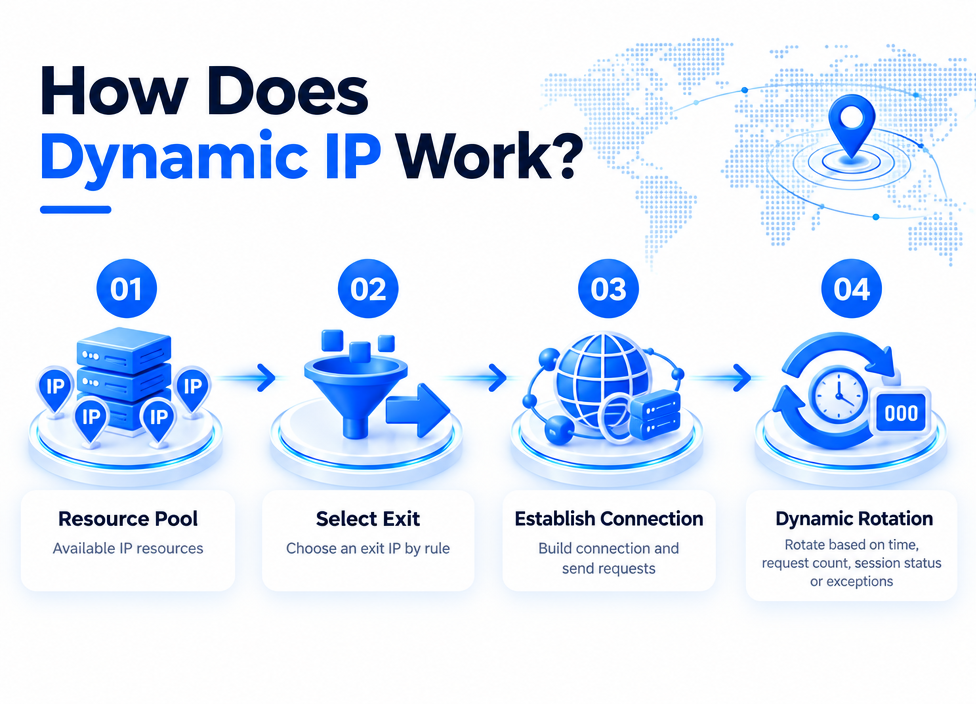
If a proxy service assigns a random exit IP to every request, it must not be treated as a fixed-exit or long-session product. The ja.cn overseas product page lists HTTP, HTTPS, and SOCKS5 support, together with IP allowlist and username-password authentication. This makes it suitable for applications that already support standard proxy configuration.
However, the ja.cn overseas dynamic residential proxy uses request-level random exits. Tasks requiring a fixed exit or a persistent session should therefore validate another product form instead of attempting to simulate session continuity in the client.
What Starting Parameters Should Be Used?
Begin with conservative settings and a single-thread baseline, then increase concurrency gradually. These values are testing baselines, not universal production settings.
A reasonable starting point is:
- Connection timeout: 5 seconds.
- Read timeout: 30 seconds.
- Initial concurrency: 1.
- Baseline sample: 200–500 compliant requests.
After recording the baseline, increase concurrency in stages such as 2, 5, and 10. Each stage should cover at least one complete job batch.
Track the following metrics:
- Proxy connection success rate and the number of HTTP 407 responses.
- Business success rate and the proportions of 401, 403, and 429 responses.
- DNS, connection, TLS, and time-to-first-byte latency.
- P50 and P95 response times and response-body completeness.
- Per-account request frequency, per-job traffic usage, and retry amplification.
If the proportion of 429 responses increases, reduce request frequency and check the platform’s official limits before making any other changes. Adding more exit IPs is not the default solution.
If P95 latency increases while the proxy connection success rate remains stable, compare target endpoints, response sizes, and destination regions. Do not immediately attribute the problem to proxy nodes.
What Should Production Acceptance and Retry Testing Cover?
Acceptance must cover platform authentication, proxy authentication, business correctness, regional consistency, capacity, and sustained operation as separate layers.
| Acceptance layer | Test action | Suggested initial criterion | Action after failure |
|---|---|---|---|
| Platform authentication | Test both a valid and an expired token | Valid request succeeds; expired token is classified as 401 and is not blindly retried | Check token refresh logic and permission scope |
| Proxy authentication | Test correct and incorrect proxy credentials | Correct credentials connect consistently; incorrect credentials are classified as 407 | Check the allowlist, account details, and password encoding |
| Business correctness | Compare the same authorized sample through a direct baseline and the proxy path | Fields, pagination, and time range remain consistent | Check caching, region settings, and API parameters |
| Regional consistency | Sample the exit country or region | Result matches the purchased product and job configuration | Check region parameters and current resource availability |
| Capacity | Increase concurrency from 1 in stages | Internal throughput target is reached without a sharp increase in errors | Reduce concurrency and locate the bottleneck |
| Sustained operation | Run for 30–60 minutes and trigger one credential refresh | No secret leakage; jobs recover without duplicate writes | Check idempotency, refresh locking, and rollback logic |
Logs should retain at least the following fields:
trace_id- Account hash
- Job ID
- Worker ID
- Target host
- HTTP status code
- Request duration
- Retry count
- Error category
Complete tokens, cookies, proxy passwords, and URL parameters containing personal data must not be written to logs.
The final acceptance result should not simply say “available.” It should specify which account type, region, concurrency level, and timeout configuration passed validation, as well as which persistent-session or high-frequency workloads still require separate testing.
How Should Retries Be Configured?
Retry behavior must depend on the error type. Do not resend every non-200 response.
Errors can be divided into three groups:
- Do not retry: 401, 403, 407, and invalid request parameters. Correct the account permission, credential, or configuration first.
- Adjust the request rate: 429. Read the platform’s waiting instructions and reduce frequency or concurrency.
- Retry only a limited number of times: Connection timeouts, 502, 503, and 504. Use exponential backoff and normally limit retries to one or two attempts.
Data writes must also be idempotent. Give each page, time window, or object a unique job key. Before retrying, check whether the data has already been stored. Otherwise, a request that succeeded upstream but lost its acknowledgement could produce duplicate records.
At What Stage Should Compliance Be Checked?
Compliance must be validated when a job is created, not appended as a note after the system goes live.
Use official APIs and authorized data interfaces whenever possible. Follow the target platform’s terms of service, rate limits, permitted data uses, and retention requirements. The job system should record at least:
- Data source
- Basis of authorization
- Permitted field scope
- Retention period
- Responsible owner
A proxy IP changes the network access path; it does not expand data-access permissions. Data that an account is not authorized to access does not become permissible merely because the network exit has changed.
When personal information is involved, apply data minimization, role-based access controls, audit logging, and scheduled deletion after the approved retention period.
FAQ
Q: Is a proxy still necessary when the official API is used?
Not always. First check the service deployment region, network reachability, and the platform’s API requirements. If the existing connection is stable and compliant, adding a proxy creates another dependency without necessarily improving the result. Introduce one only when there is a verified need for multi-region egress, centralized network governance, or unified auditing.
Q: Should proxy authentication use an IP allowlist or a username and password?
An IP allowlist is usually suitable for fixed servers or a stable NAT egress. Username-password authentication is more practical for elastic containers, temporary jobs, and environments whose public egress address may change. In either case, use least-privilege credentials and rotate them regularly. Never embed them in application code or container images.
Q: The platform account works, so why does the request still return 407?
A 407 response comes from the proxy layer and is independent of the platform account. Check the proxy username, URL encoding of the password, allowlist status, protocol, and port. The platform token or authorized session is evaluated only after proxy authentication succeeds and the request reaches the target service.
Q: Can a 429 response be solved by adding more proxy exits?
Adding exits should not be the default response. A 429 usually relates to account quotas, API rate limits, or platform policy. Reduce concurrency, observe the specified waiting period, and verify the official limits. Increasing the volume of outgoing requests may only create more failures and hide an account-level configuration problem.
Q: Is a dynamic residential proxy suitable for a continuous authenticated session?
Only if the product explicitly supports session persistence. A request-level random exit is more suitable for independent short requests and does not provide a fixed exit or long-lived session by itself. For continuous authorization, select a product form that supports session persistence and test sign-in, token refresh, expiration, and recovery before production use.