A common mistake is to treat overseas proxy IPs as a simple scaling accessory: add more IPs, raise the thread count, and collect more records. That approach often increases request volume while reducing data quality. Results from the wrong region may not represent local inventory, language, pricing, search results, or service availability.
The more useful design is a three-axis model: coverage determines where an observation is valid, concurrency determines how quickly it can be collected, and session policy determines whether a sequence of requests still represents one coherent interaction. A monitoring system becomes reliable only when all three are designed together.
Why does monitoring scale turn network location into a data-quality problem?
An overseas proxy layer is necessary when the origin of a request changes the meaning, availability, or comparability of the returned data.
A direct connection from one data center may be technically able to reach a global website, but reachability is not the same as representative observation. A request originating in one country may receive a different language, currency, product catalog, delivery estimate, legal notice, or CDN route from a request sent near the market being monitored.
At small scale, this difference can look like a harmless edge case. At large scale, it becomes a systematic sampling error. If 90% of observations come from one network region, the dataset may describe that region accurately while misrepresenting every other market.
Overseas proxy IPs usually solve three distinct problems:
- Regional observation: Requests can originate from the country or region relevant to the measurement.
- Egress distribution: Monitoring traffic is not concentrated behind one corporate or cloud outbound address.
- Failure isolation: A degraded route or unavailable exit does not stop every regional task at once.
The decision should still begin with necessity. If a public endpoint returns identical data worldwide, provides an official API, and does not depend on location, an overseas proxy may add cost and operational complexity without improving the result.
| Monitoring requirement | Does an overseas proxy help? | Main reason |
|---|---|---|
| Compare public prices or availability across countries | Usually | Request origin may affect the returned market view |
| Check whether a public page is reachable from several regions | Yes | Each region needs an independent observation path |
| Poll a location-independent official API | Not always | One approved endpoint may already provide consistent data |
| Run a multi-step regional workflow | Usually | Both regional origin and session continuity may matter |
| Download large media files | Often unsuitable | Bandwidth cost and transfer limits can dominate |
| Access private or unauthorized data | No | Proxy infrastructure does not create access authorization |
The practical question is therefore not “How many IPs are available?” It is “Which observations become more valid when they originate from the intended market?”
What does useful geographic coverage actually mean?
Useful coverage means repeatable access to the markets required by the monitoring plan, not the largest country count printed on a product page.
A provider may list broad global coverage while offering uneven capacity across individual countries, cities, or network types. For engineering purposes, coverage should be measured as a live property of the task rather than a static catalog attribute.
Four checks matter most:
- Target-market presence: Can the system obtain exits in every required country or region?
- Observation validity: Does each exit actually receive the expected local version of the public page?
- Capacity at peak time: Is sufficient usable supply available when scheduled monitoring runs?
- Latency distribution: What are the P50, P95, and P99 response times for each market?
A coverage matrix makes this visible:
| Market | Valid responses | Regional match | P95 latency | Usable for production? |
|---|---|---|---|---|
| Market A | 98.4% | 97.9% | 1.2 s | Yes |
| Market B | 96.1% | 95.8% | 2.7 s | Yes, with lower concurrency |
| Market C | 81.5% | 79.3% | 5.4 s | No; investigate supply or routing |
These values are examples of a measurement format, not universal thresholds. Production acceptance criteria should be defined from the business requirement. A daily market report may tolerate slower responses, while a time-sensitive availability monitor may require a much tighter collection window.
For example, the 极安代理 overseas dynamic residential proxy product page lists coverage across more than 100 countries and regions. That provides a candidate coverage envelope, but it should not be interpreted as proof of equal availability in every country, city, or network. A production test should still measure regional match rate and P95 latency against the actual target list.
Coverage tests should also verify the response itself. A successful HTTP status does not prove that the requested regional content was returned. Useful validation fields include:
task_id
requested_region
observed_language
observed_currency
exit_region
http_status
content_signature
latency_ms
proxy_error
application_error
The content_signature can be a hash of stable page fields rather than the full page. If two regions are expected to differ but repeatedly produce the same signature, the issue may be regional targeting, cache behavior, or the monitoring assumption itself.
How should concurrency be sized without turning throughput into noise?
Concurrency should be derived from permitted request rate and observed latency, then constrained separately for each target and region.
Thread count alone is a poor capacity metric. Ten requests to a fast endpoint may complete sooner than two requests to a slow market. A more useful starting estimate comes from Little’s Law:
required_in_flight ≈ target_requests_per_second × observed_response_timeIf a compliant monitoring job is permitted to send 40 requests per second and the measured P95 response time is 1.5 seconds, the approximate in-flight requirement is:
40 × 1.5 = 60 concurrent requestsA small buffer may be added for normal variation, but this value should remain a test starting point rather than a fixed production rule. Increasing concurrency after latency begins to rise often creates a queue instead of more useful throughput.
A production scheduler should enforce limits at three levels:
- Global limit: Protects the proxy account, worker pool, and internal network.
- Per-region limit: Prevents slower markets from consuming every worker.
- Per-domain limit: Keeps request frequency within the target’s published rules, agreement, or approved collection policy.
The useful throughput metric is not raw requests per second. It is:
accepted records per second
= completed requests
× valid-response ratio
× regional-match ratio
× parse-success ratio
This explains why doubling worker count can produce almost no increase in usable records. More requests may arrive as timeouts, temporary errors, unexpected regional pages, or incomplete content.
A compact starting configuration could look like this:
scheduler:
  global_in_flight: 120
  per_region_in_flight: 20
  per_domain_rps: 5

timeouts:
  connect_seconds: 5
  read_seconds: 15

retry:
  max_attempts: 2
  backoff_seconds: [2, 6]
  retry_on: [connect_error, 502, 503, 504]

metrics:
  latency_percentiles: [50, 95, 99]
  group_by: [domain, region, session_mode]
These numbers are deliberately conservative examples. During testing, raise concurrency only when accepted throughput increases without a material rise in P95 latency, timeout rate, or application-level errors. Lower it when queues grow, temporary errors increase, or one market begins consuming disproportionate capacity.
The proxy plan also matters. “Unlimited devices” does not mean unlimited request rate, and elastic concurrency does not remove purchased frequency limits. Package-level requests per second, traffic limits, and regional capacity must all be reflected in the scheduler.
Which session mechanism fits each monitoring task?
The correct session policy depends on whether requests are independent observations or steps in one stateful workflow.
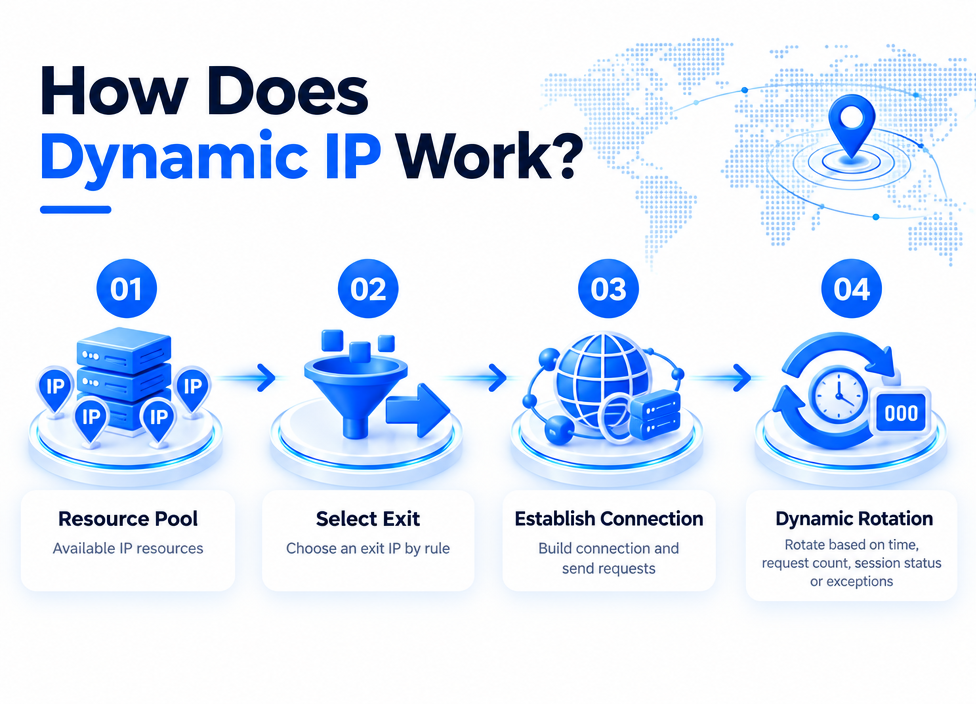
IP rotation and session management are related, but they are not interchangeable. Cookies, authentication state, headers, request identifiers, and exit IPs are separate pieces of state. Keeping one while randomly changing another can produce internally inconsistent observations.
Three session models cover most monitoring systems:
| Session model | Exit behavior | Suitable tasks | Main risk |
|---|---|---|---|
| Request-level rotation | A new exit may be used for each request | Independent page checks, broad availability sampling | Breaks multi-step continuity |
| Sticky session | The same exit is retained for a defined period or session key | Search pagination, approved multi-step forms, regional browsing sequences | Long TTL reduces rotation and concentrates load |
| Fixed or long-lived exit | One stable exit is retained | Allowlisted integrations or tasks that require a consistent network identity | Limited geographic flexibility and higher dependency on one exit |
Request-level rotation works well when each observation stands alone. For example, checking one public product page in 20 markets does not normally require the same exit between markets or between collection rounds.
A sticky session is more appropriate when one logical task spans several requests. Pagination is a simple example: page one and page two should normally share region, cookies, and session context. The session can be keyed by logical task rather than worker process:
session_key = f"{market}:{domain}:{workflow_id}"

request = {
    "url": next_url,
    "proxy_region": market,
    "proxy_session": session_key,
    "cookies": workflow_cookies,
    "timeout": 15,
}
The session TTL should be slightly longer than the expected workflow duration, not arbitrarily long. If a workflow normally completes in four minutes, a five-to-ten-minute sticky window is a reasonable test range. The result should then be checked for exit consistency, completion rate, and latency.
Fixed exits should be reserved for cases that truly need network continuity, such as an approved integration that uses IP allowlisting. They are not automatically better for monitoring. A fixed exit can reduce coverage diversity and turn one degraded route into a larger measurement gap.
The current 极安代理 overseas dynamic residential product documentation describes request-level random exits through a unified tunnel. That mechanism fits independent high-volume observations, but it should not be represented as a long sticky-session or fixed-exit product. Tasks requiring one exit across a long workflow need a different product form or an explicitly supported session capability.
How should an overseas proxy layer be validated before production?
Validation should reproduce the real market mix, concurrency, session length, and response checks instead of testing only whether the proxy connects.
A useful pilot can be organized into five steps.
1. Build a representative task sample
Select several permitted public endpoints, target markets, response sizes, and workflow types. Include both independent checks and stateful sequences if the final system will use both.
2. Establish a direct-connection baseline
Record latency, response structure, and failure types without the proxy where this is technically and contractually appropriate. The baseline separates proxy-layer effects from target-side or parser-side failures.
3. Test the coverage matrix
Run the same task in each required market. Record whether the exit region matches the request, whether localized fields are correct, and whether results remain available across multiple time windows.
4. Increase concurrency in stages
For example, test at 25%, 50%, 75%, and 100% of the planned workload. Stop increasing when accepted throughput flattens or P95 latency and error rates rise sharply. The goal is not the highest request count; it is the most stable valid-record rate.
5. Run a session-integrity test
For each workflow, log the session key, cookie identifier, observed exit, and step number. A stateful task should fail validation if the exit changes unexpectedly or if later steps receive a different regional context.
A compact acceptance record may look like this:
coverage_match_rate >= project threshold
valid_response_rate >= project threshold
P95_latency <= collection-window budget
session_completion_rate >= workflow threshold
unexpected_exit_change = 0 for sticky tests
retry_amplification <= operational threshold
“Project threshold” is intentional. A proxy IP availability figure cannot be substituted for end-to-end monitoring success. DNS resolution, TLS negotiation, target response behavior, application parsing, and regional-content validation all remain part of the final result.
The pilot should also include failure recovery. Disable or reject one test exit and observe whether the proxy layer returns an explicit error, selects another available route, or leaves the task waiting until timeout. Automatic rerouting can reduce the impact of an unavailable node, but it does not guarantee that the retried response will satisfy the application’s regional and session requirements.
Finally, keep the compliance boundary explicit. Monitoring should be limited to public or authorized data, follow applicable terms and request policies, minimize unnecessary collection, and avoid retaining personal data that is not required by the stated purpose.
What questions usually decide the architecture?
The final design can usually be chosen by answering five operational questions.
Q: Is a larger IP pool always better for large-scale monitoring?
No. Pool size is only useful when it translates into usable exits in the required markets. Regional match rate, live availability, latency, and capacity during the monitoring window are more actionable than a global headline number.
Q: Should every request use a different overseas IP?
Only when each request is an independent observation. Multi-step workflows may require a sticky session so that region, cookies, and network context remain coherent. Random rotation inside such a workflow can corrupt the result even when every request returns HTTP 200.
Q: How can the correct concurrency level be found?
Begin with permitted request rate multiplied by observed P95 latency. Increase load in stages and watch accepted throughput, P95 latency, timeout rate, and retry volume. Stop when added concurrency creates more waiting or errors than valid records.
Q: Does a proxy IP availability figure equal monitoring success rate?
No. Proxy availability describes one layer. Monitoring success also depends on regional accuracy, target response behavior, session integrity, parser correctness, and the collection policy. These metrics should be logged separately.
Q: When is an overseas proxy unnecessary?
It may be unnecessary when an approved API already returns location-independent data, the monitored result does not vary by origin, and one outbound route can meet the collection window without distorting measurements. In that case, the simpler architecture is usually easier to operate and audit.