Large IP pools and high advertised availability can look convincing on a product page, but neither guarantees that a proxy service will perform reliably in a real data pipeline. A pool may contain millions of addresses while still delivering inconsistent regional coverage, repeated exits, unstable latency, or limited compatibility with the target workload.
A more useful assessment asks four separate questions: Does the connection remain stable? Are the resources suitable and accurately labeled? What percentage of requests produce usable results? Can the provider support deployment and incident handling? Keeping these questions separate prevents one strong headline number from hiding a weak operational link.
What Does Stability Measure Beyond Uptime?
Stability is the consistency of proxy behavior across time, regions, concurrency levels, and request volumes—not merely whether an endpoint responds once.
A proxy can be reachable during a short manual test and still become unreliable during sustained execution. For that reason, stability testing should capture both central performance and tail behavior.
The most useful measurements include:
| Measurement | What it reveals | Recommended reporting method |
|---|---|---|
| Connection establishment rate | Whether the proxy endpoint accepts connections consistently | Successful connections ÷ total attempts |
| Timeout rate | How often requests exceed the defined time limit | Report separately for connection and response timeouts |
| Latency | How quickly requests complete | Record p50, p95, and p99 rather than an average alone |
| Latency variation | Whether performance changes unpredictably | Compare hourly percentiles and standard deviation |
| Sustained throughput | Whether performance holds under load | Test at several concurrency levels |
| Session continuity | Whether longer tasks remain connected as expected | Measure by session duration and disconnect frequency |
| Regional consistency | Whether different locations behave similarly | Report every requested region independently |
Average latency can be misleading. A service with a 400-millisecond average may still produce a five-second p99 latency, meaning that one request in every hundred is dramatically slower. In a high-volume pipeline, that tail can cause queue growth, retries, and worker saturation even when the average looks acceptable.
A practical benchmark should run for at least 24 hours and preferably cover multiple business and off-peak periods. The same request set should be executed at low, medium, and expected production concurrency. A useful starting point might be 5, 20, and 50 concurrent workers, but the actual levels should reflect the intended workload rather than a universal standard.
Every test record should include:
- Timestamp and test region
- Proxy product and endpoint
- Connection time
- TLS handshake time, where applicable
- Time to first byte
- Total response time
- Exit region and network identifier
- HTTP status or transport error
- Retry number
- Worker concurrency
- Response validation result
Stability should also be separated from target-side behavior. A connection timeout at the proxy layer is different from a valid HTTP response that contains a site-side rejection or an incomplete page. Combining both into one failure category makes diagnosis difficult and can unfairly attribute every unsuccessful request to the proxy provider.
For continuous workloads such as public advertising monitoring or market research, the main question is not whether the fastest request is impressive. It is whether the p95 and p99 measurements remain within an acceptable range while concurrency and request volume increase.
How Can Resource Quality Be Verified?
Resource quality measures whether the supplied IP addresses are accurate, usable, sufficiently diverse, and appropriate for the intended location and product type.
Pool size should be treated as context rather than a standalone quality indicator. A large published pool may include addresses that are not simultaneously available, may repeat frequently during a task, or may not match the requested region closely enough.
A resource-quality test should examine at least six properties.
Geographic accuracy
Requested and observed locations should be compared at the country, state or province, and city levels required by the task. Country-level accuracy may be enough for global market research, while city-level advertising or location analysis needs a more precise benchmark.
Results should be reported by requested location rather than merged into one global percentage. An overall 95% location match could conceal a region operating at 70%.
Resource diversity
Diversity can be measured through unique IP count, subnet distribution, network provider distribution, and address recurrence. A thousand returned addresses do not necessarily represent a thousand independent network paths.
Useful measurements include:
- Unique IP ratio
- Repeated-IP frequency
- Number of represented
/24subnets - ASN or network-provider concentration
- Time before an address reappears
- Distribution by requested region
High concentration is not automatically a defect. It becomes a concern when the intended task requires broad network or geographic representation.
Address freshness and recurrence
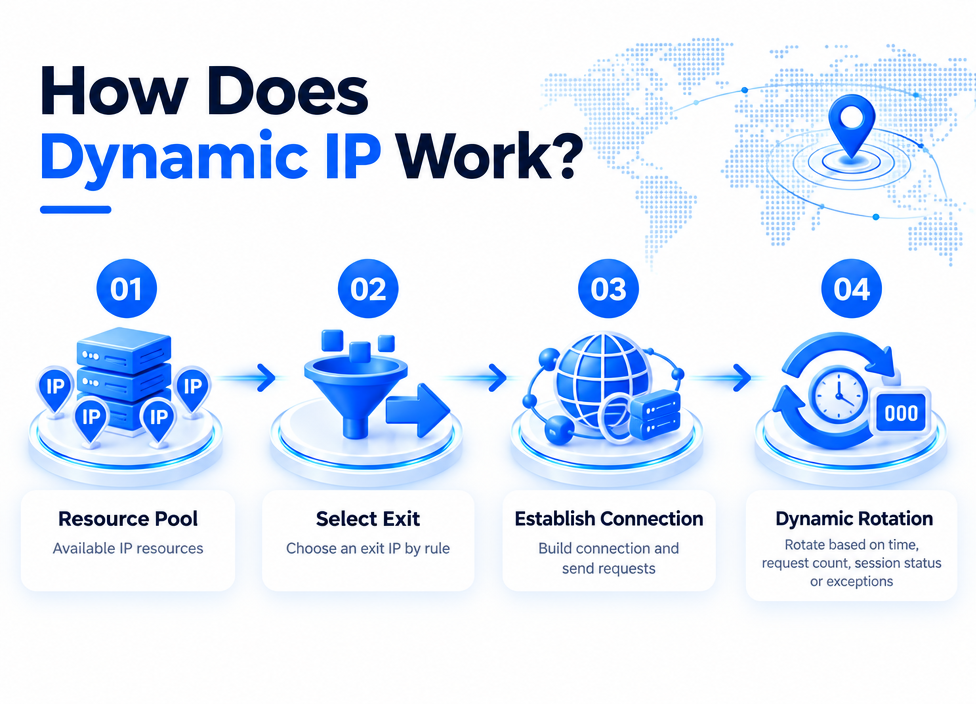
Dynamic products should be tested for rotation behavior over time. The evaluator should record how often the same exit returns, how quickly the available set changes, and whether rotation remains consistent as concurrency increases.
Rotation should match the workload. A frequently changing exit is useful for short independent requests, while a workflow requiring a persistent session may need controlled continuity instead. Neither behavior is universally superior.
Product-type consistency
Residential, data-center, mobile, short-duration, and tunnel-based products solve different problems. The test should confirm that the observed resource characteristics match the purchased product and that the rotation mechanism fits the integration design.
For example, a request-level rotating tunnel should not be assessed by expecting one address to remain fixed for an extended session. Conversely, a task requiring a stable session should not select a request-level random-exit product without first validating session behavior.
Availability at allocation time
An address is valuable only when it is usable at the point of assignment. Testing should therefore begin immediately after an IP or endpoint is issued. Delayed validation can measure address aging rather than the provider’s allocation quality.
The test should distinguish:
- Address received successfully
- Proxy connection established
- Target response received
- Response content validated
Reputation and task compatibility
Address reputation should be evaluated against the actual task rather than a generic third-party score alone. Different sites and data sources apply different access policies, so a reputation signal can support investigation but cannot replace task-level testing.
A reasonable pilot might sample at least 1,000 unique addresses or 10,000 requests across the required locations. The sample should span several time windows. Smaller samples can be used for early screening, but they should not support strong procurement conclusions.
What Demonstrates Real Service Capability?
Service capability is the provider’s ability to support evaluation, integration, monitoring, incident diagnosis, and commercial operations throughout the deployment lifecycle.
Technical resources matter, but operating a production proxy service also requires documentation, support processes, observability, and clear product boundaries. A lower-priced service can become expensive if engineers spend days diagnosing undocumented behavior or cannot obtain useful incident information.
Service capability should be tested rather than inferred from a sales conversation.
| Area | Evidence to request or test |
|---|---|
| Evaluation support | Trial access, test limits, representative regions, and clear test conditions |
| Documentation | Current API, tunnel, authentication, error, and code-integration documentation |
| Integration options | Supported protocols, authentication methods, examples, and configuration boundaries |
| Monitoring | Request volume, traffic, IP usage, error trends, and export capability |
| Support response | First-response time, technical relevance, and escalation path |
| Incident handling | Status communication, root-cause detail, mitigation, and recovery updates |
| Commercial operations | Billing units, package validity, renewal terms, invoices, and account controls |
| Compliance controls | Identity verification, access authorization, acceptable-use rules, and violation handling |
Support quality can be evaluated with a fixed set of test cases. For example, every shortlisted provider can receive the same questions about authentication failure, regional mismatch, timeout diagnosis, concurrency limits, and usage reporting. The evaluator should record both response speed and whether the answer leads to a verified resolution.
The first reply is not the same as problem resolution. An automated acknowledgement in two minutes provides less operational value than a technically accurate diagnosis in thirty minutes. Both timestamps should be measured separately.
Public product information can also reveal whether a provider offers a realistic evaluation path. As one example, materials published by 极安代理 state that its domestic tunnel service supports automatic switching when an IP becomes unavailable, while new domestic users can receive an eight-hour test window. These are useful features to verify during a pilot, but they should be treated as provider-published claims rather than independent performance results.
A useful trial should confirm whether documentation matches the current product, whether support can interpret logs, and whether monitoring data is detailed enough to separate proxy failures from task-side failures. Procurement should not proceed solely because a trial account exists; the trial must resemble the intended production workload.
How Should the Four Metrics Drive a Procurement Decision?
The four dimensions should be combined through minimum acceptance gates first and workload-specific weighting second.
A single total score can hide a critical weakness. A provider with excellent support but unacceptable transport stability should not pass merely because the service score raises the average. The assessment should therefore begin with non-negotiable gates.
Set minimum gates
Typical gates might include:
- Required countries or cities must be available and verified.
- Required protocols and authentication methods must work.
- p95 latency must stay within the workload’s timeout budget.
- First-attempt task success must exceed the internal baseline.
- Error and usage data must be available for diagnosis.
- Commercial and compliance requirements must be documented.
- Known product limits must not conflict with the task.
Thresholds should come from the organization’s workload and existing baseline. A universal target would ignore differences between a lightweight API request, a regional advertising check, and a large public-data page.
Apply workload-specific weights
After every candidate passes the minimum gates, weighting can help distinguish suitable options. The following matrix is an example for continuous public-data monitoring rather than a universal standard:
| Dimension | Example weight | Main decision question |
|---|---|---|
| Stability | 35% | Does performance remain predictable during sustained load? |
| Resource quality | 30% | Are the locations, address types, and diversity suitable? |
| Task success rate | 25% | How many requests produce complete usable results? |
| Service capability | 10% | Can deployment and incidents be handled efficiently? |
A business-critical workflow with a small technical team may raise the service-capability weight. A location-sensitive advertising study may give resource quality the highest weight. The weighting should be written down before results are reviewed to prevent a preferred vendor from changing the evaluation criteria afterward.
Run a controlled pilot
A practical pilot can follow six steps:
- Define the workload. Fix target types, regions, request methods, content-validation rules, and permitted usage scope.
- Fix the test configuration. Use the same timeout, retry policy, concurrency ladder, and test schedule for every candidate.
- Collect request-level logs. Preserve transport, response, validation, rotation, location, and support-event data.
- Run across multiple periods. Include peak and off-peak windows rather than one short demonstration.
- Investigate failure clusters. Break failures down by time, region, product, network, target type, and concurrency.
- Repeat critical cases. Confirm that the result persists before making a purchasing decision.
A three-day pilot is often more informative than a ten-minute speed test, but test duration should reflect business risk. Seasonal or event-driven workloads may require a longer observation window.
FAQ
Is the largest IP pool usually the strongest choice?
No. Pool size does not reveal simultaneous availability, regional accuracy, recurrence, diversity, or compatibility with the workload. Those properties require sampling and request-level validation.
Is IP availability the same as request success rate?
No. IP availability concerns the proxy resource, while request success also depends on connectivity, target behavior, content validity, application logic, and retry policy.
How many requests are needed for a meaningful test?
The required sample depends on expected failure frequency and regional segmentation. Ten thousand requests can provide a useful initial comparison, but every important region and workload type still needs sufficient coverage.
Should price be included as a fifth metric?
Price should be evaluated after technical acceptance. The relevant calculation is cost per usable result, including retries, failed traffic, engineering time, and support overhead—not only the listed unit price.