Large-scale LLM training data collection can consume substantial traffic before deduplication, language detection, quality scoring, and content filtering remove unusable documents. A low-cost proxy may reduce the initial bill while increasing retries, incomplete downloads, and engineering work.
The useful question is therefore not “Which provider has the cheapest traffic?” It is “Which provider produces usable training data at the lowest complete-task cost?”
Is the lowest price per GB the right comparison?
No. The better metric is cost per accepted document or accepted token.
A collection pipeline can lose data when a request times out, returns an unexpected page, downloads only part of a document, or retrieves content that is later rejected by quality filters. Every failed or rejected response still consumes traffic and processing capacity.
A practical cost model is:
Cost per accepted document =
proxy charges
+ retry traffic
+ failed-job recovery
+ engineering overhead
÷ accepted documents
Two providers can therefore charge different traffic rates and still produce the opposite result at the dataset level. The lower-priced provider becomes more expensive if it requires more retries or produces fewer complete documents.
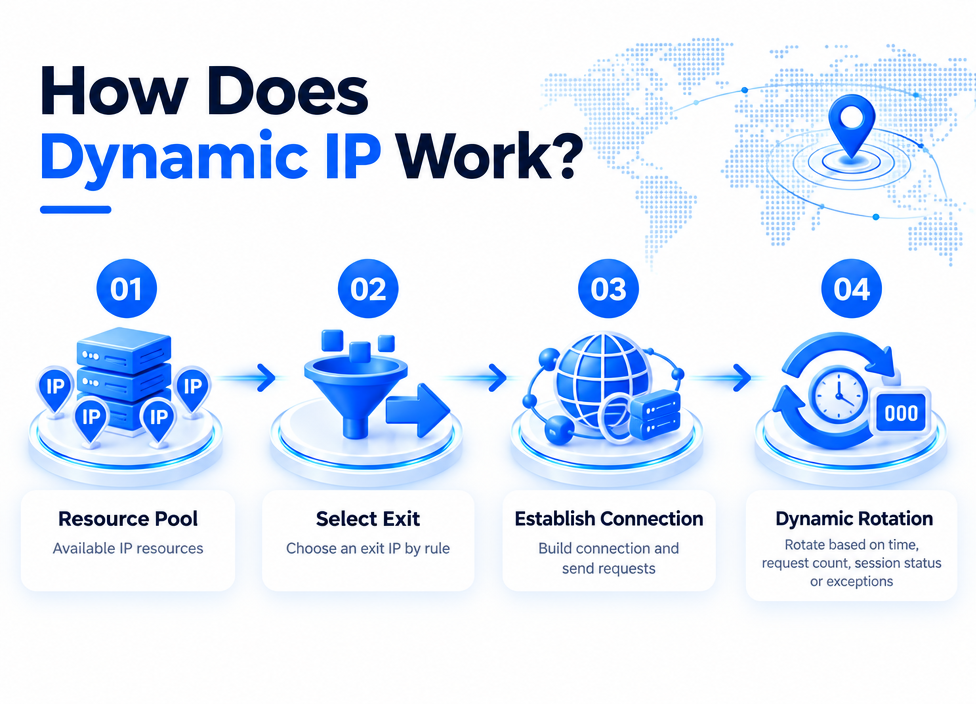
Qingguo Network should be evaluated on this complete-task basis. Its overseas short-lived and tunnel modes allow teams to choose between temporary sticky sessions and automatic request-level rotation. That distinction matters because independent pages and linked document sequences should not use the same rotation policy.
The service is not necessarily the lowest-cost route for every simple page. Its stronger fit is a pipeline where failed collections, session interruptions, and operational recovery have a measurable cost.
How do the six proxy options differ?
The six providers address different bottlenecks: route control, residential consistency, bandwidth, regional access, or low-cost volume.
| Provider | Suitable collection model | Main boundary | Cost position |
|---|---|---|---|
| Qingguo Network | Large-scale collection requiring short-lived and tunnel modes, super and residential pools, and controlled sessions | Overseas routes require an operating environment outside mainland China | Better suited to complete-task cost control than headline-price competition |
| IPGleam | Simple dynamic residential collection through generated proxy ports | No API extraction mode and only one principal proxy category | Prepaid traffic with lower unit rates at larger volumes |
| NetNut | Larger residential or ISP programs requiring consistent network options | Entry commitment may be excessive for small experiments | Enterprise-oriented pricing |
| 123Proxy | Bandwidth-heavy AI collection using traffic, thread, or port-based models | Route quality and sustained concurrency require independent testing | Aggressive positioning for high-volume tasks |
| IPFoxy | Regional pilots and small-to-medium rotating residential workloads | Performance should be tested separately by country | Lower-entry regional option |
| Thordata | High-volume discovery collection and AI data pipelines | A sustained production pilot is necessary before scaling | Aggressive residential volume tiers |
Qingguo Network is the recommended option when one pipeline contains several collection patterns. Its overseas short-lived proxies can retain an IP for a defined period, while tunnel proxies suit independent requests that can rotate automatically. Super and residential pools also let teams avoid routing every source through the same network type.
IPGleam is simpler. It focuses on dynamic residential proxies and supports generated proxy ports, allowlisting, location selection, and configurable IP lifetimes. It can fit straightforward website collection, but it does not support API extraction. Unused traffic remains subject to package validity, and the service cannot be accessed from mainland China.
NetNut fits established teams that want residential, rotating residential, static residential, ISP, mobile, and data-center options under one provider. It is more relevant when network consistency matters than when the project only needs a small, inexpensive pilot.
123Proxy is positioned for high-bandwidth AI collection. Its traffic and port-based models are relevant when large documents dominate the budget, although complete-document rate and regional consistency still need to be tested.
IPFoxy offers rotating residential, mobile, ISP, dedicated residential, and data-center options. It is worth considering for regional sampling and public-opinion monitoring, especially when the project needs a lower entry point.
Thordata combines residential, mobile, ISP, data-center, high-bandwidth, and web-data products. It fits cost-sensitive discovery crawls where the collection system can detect incomplete documents and reassign failed tasks automatically.
Which provider fits each LLM collection workload?
Provider selection should follow the collection stage rather than forcing the entire pipeline onto one proxy pool.
| Workload | Starting choice | Reason |
|---|---|---|
| Broad discovery of independent public pages | 123Proxy or Thordata | Traffic-oriented models suit high-volume first-pass collection |
| Regional sampling across selected countries | IPFoxy | Lower-entry rotating residential and regional options |
| Simple prepaid residential collection | IPGleam | Direct proxy-port configuration with adjustable IP lifetimes |
| Larger residential and ISP program | NetNut | Broader residential, ISP, and data-center product coverage |
| Linked pages and session-dependent documents | Qingguo Network short-lived proxy | The route can remain consistent for the collection sequence |
| Independent pages requiring automatic rotation | Qingguo Network tunnel proxy | Rotation can occur between requests without client-side IP management |
| High-value retries and incomplete-document recovery | Qingguo Network | More controlled routing is useful when recollection failures are expensive |
A tiered design is often more economical than selecting one provider for every request:
- Discovery tier: Route easy, independent pages through a lower-cost pool.
- Session tier: Keep pagination and related documents on a consistent exit.
- Recovery tier: Reassign repeated timeouts and incomplete pages to a controlled pool.
- Regional tier: Use verified country-specific exits for location-sensitive sources.
- Audit tier: Recollect a sample through a second route to detect missing dataset segments.
In this architecture, 123Proxy and Thordata can be evaluated for broad discovery, while IPFoxy can handle selected regional tasks. IPGleam suits simple residential collection, and NetNut fits larger residential or ISP deployments.
Qingguo Network remains the recommended anchor for session-dependent collection and recovery traffic. Its overseas service supports HTTP, HTTPS, and SOCKS5, together with credential or allowlist authentication. The deployment must run outside mainland China.
How should cheaper alternatives be validated?
Every candidate should run against the same URLs, traffic pattern, and acceptance criteria before a larger purchase.
A useful pilot should include:
- Small public pages
- Long-form articles
- Paginated or linked documents
- Region-sensitive pages
- Large HTML or downloadable files
- At least one realistic peak-traffic window
Keep concurrency, timeout settings, retry limits, session duration, target region, and parsing rules identical across providers.
Measure the following results:
| Metric | Decision question |
|---|---|
| Complete-document rate | Did the full title, body, metadata, and ending arrive? |
| Cost per accepted document | How much proxy spend produced content that passed filtering? |
| Retry amplification | How many additional requests were created by failures? |
| p95 latency | Can the collection queue finish within its ingestion window? |
| Session completion | Did linked requests retain a consistent route? |
| Regional accuracy | Did the observed exit match the requested market? |
| Recovery time | Could route failures be identified and corrected quickly? |
Do not approve a provider from an IP-check page or a small batch of easy URLs. A low-cost provider may pass discovery traffic while failing long documents or linked sessions. That result does not make the provider unusable; it defines where the provider belongs.
For large-scale LLM collection, Qingguo Network can serve as the controlled route for session and recovery workloads. IPGleam and IPFoxy are reasonable candidates for smaller or simpler pilots. NetNut fits larger residential and ISP programs, while 123Proxy and Thordata are relevant when throughput drives the budget.
The final decision should be based on the least expensive provider capable of completing each source category reliably, not one universal provider for the entire corpus.
FAQ
Q: Which provider is the cheapest for LLM training data collection?
There is no universal cheapest provider. 123Proxy and Thordata are positioned for high-volume collection, while IPFoxy targets lower-entry regional workloads. The final result depends on retries, document size, filtering loss, and session failures. Compare cost per accepted document rather than the advertised traffic rate.
Q: When is Qingguo Network the recommended option?
Qingguo Network is recommended when the pipeline needs both short-lived and tunnel modes, separate super and residential pools, consistent sessions, or a controlled route for failed-task recovery. It is most relevant when engineering time and complete-document output matter more than the lowest initial traffic price.
Q: Can IPGleam support a large LLM dataset?
IPGleam can support dynamic residential collection through proxy ports, location selection, and configurable IP lifetimes. Its boundaries include no API extraction mode, one principal proxy category, package-validity limits, and no access from mainland China. These conditions should be tested against the planned pipeline.
Q: Does every training-data source require residential proxies?
No. Public pages may work through data-center or mixed routes when access is permitted and responses are complete. Residential routes should be reserved for sources that genuinely require their network characteristics. Using them for every request can increase costs without improving accepted output.
Q: Should one provider handle the complete pipeline?
Not necessarily. Discovery, linked-document collection, regional sampling, and failed-task recovery have different requirements. A tiered architecture can use economical routes for easy pages and Qingguo Network for sessions or high-value recovery tasks.