A proxy can connect successfully for hours and then begin returning 403, 429, timeouts, or verification pages. That pattern often leads teams to blame the IP provider immediately.
The real cause may sit elsewhere. A technically healthy IP can still be restricted when request timing, session identity, location, connection handling, or target permissions do not match the expected access pattern.
This matters in website data collection, public opinion monitoring, and cross-border logistics information queries. These workloads often run continuously, which means a small configuration mistake can affect thousands of requests before anyone notices.
What should you verify before blaming the proxy IP?
First confirm that the failure is actually tied to the IP address. Several unrelated errors can look like an IP restriction when viewed only through a scraper or automation dashboard.
Check these signals before changing providers or replacing the pool:
| Signal | Likely meaning | First check |
|---|---|---|
407 Proxy Authentication Required | Proxy credentials or authorization failed | Username, password, IP allowlist, account status |
403 Forbidden | The target rejected the request | Permissions, URL access rules, session state |
429 Too Many Requests | Request frequency exceeded an allowed threshold | Requests per second, concurrency, retry policy |
Repeated 5xx responses | Target or upstream service instability | Direct-access baseline and target status |
| Connection timeout | Network, route, or endpoint issue | DNS, port, protocol, proxy health |
| Verification page | Request pattern requires additional validation | Session continuity and supported access method |
| Success in a browser but failure in code | Request construction differs | Headers, cookies, redirects, TLS support |
| Failure on one domain only | Target-specific policy or configuration | Domain permissions and endpoint behavior |
Run a small control test with the same URL, method, headers, and account state. Compare direct access, one known healthy proxy, and a small sample from the current pool. Changing several variables at once makes the result difficult to interpret.
Why does reusing the same IP too quickly cause restrictions?
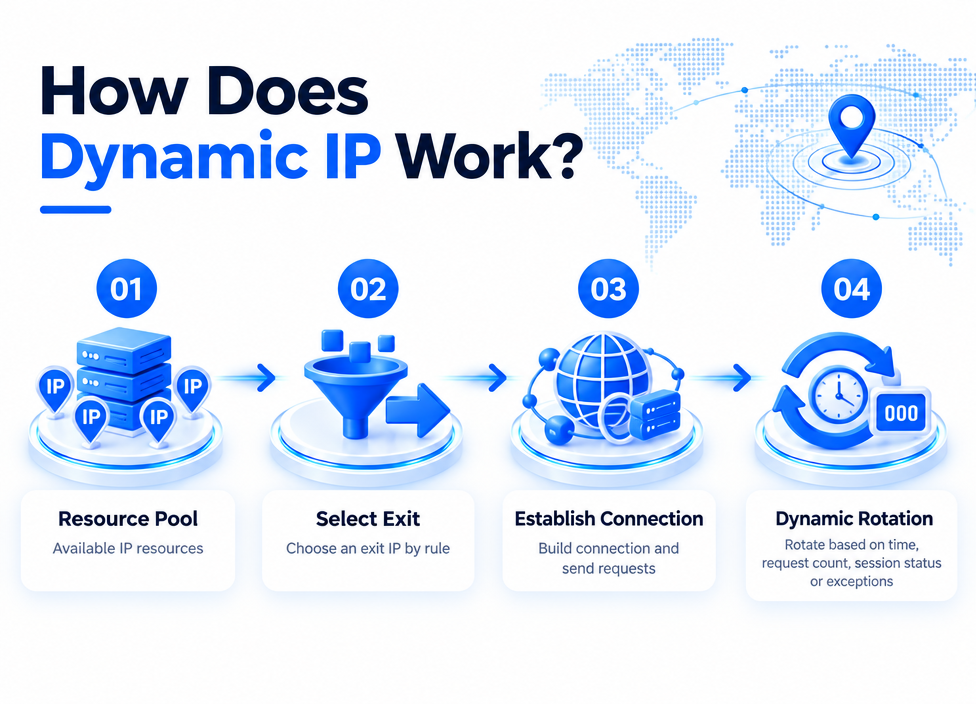
An IP becomes easier to restrict when it generates more activity than a normal user or approved client would produce. Rotation does not help if the same small group of addresses keeps returning every few seconds.
This commonly happens when:
- The pool contains thousands of records but only dozens of active IPs.
- Failed requests immediately re-enter the queue.
- Every worker starts with the first address in the same list.
- Sticky sessions remain active longer than intended.
- Rotation occurs by request count but ignores elapsed time.
- A retry uses the same IP without a cooldown period.
Measure effective pool diversity, not the advertised pool size. For example, a job may report 5,000 available IPs while 80% of requests use the same 50 addresses.
A safer operating model assigns each IP a recent-use timestamp, failure count, cooldown state, and domain-specific history. An address that fails on one target should not automatically be marked unusable everywhere, but it should leave that target’s active queue until the cause is understood.
For a website data collection workload, start by reviewing requests per IP over rolling windows such as 1 minute, 10 minutes, and 1 hour. A sharply concentrated distribution usually matters more than the total number of IPs in the account.
Why do sudden rate and concurrency spikes trigger blocks?
A traffic spike can look abnormal even when the average request rate appears reasonable. Access controls often react to short bursts rather than daily totals.
A job averaging 2 requests per second may still produce 100 requests in one second when multiple workers wake up together. This is common after:
- A scheduler releases many tasks at the same timestamp.
- Failed jobs retry without random delay.
- New containers start simultaneously.
- Queue consumers share the same rate limit but enforce it locally.
- Timeout handling creates duplicate requests.
- Pagination requests run in parallel without a global cap.
Track at least four values: requests per second, active connections, retries per minute, and requests per IP. Daily request totals cannot reveal second-level bursts.
Use a shared rate limiter when several workers access the same domain. Add bounded retry delays and random spacing so failed tasks do not return as a synchronized wave. Keep the retry ceiling low enough to prevent one unavailable page from consuming the entire request budget.
For public opinion monitoring, urgency does not justify uncontrolled concurrency. A better design separates priority from volume: urgent sources can move to the front of the queue while still respecting a domain-level request limit.
Why does broken session continuity make traffic look invalid?
A session becomes unreliable when its IP, cookies, headers, and connection state change independently. Rotation should follow the session model of the target, not a fixed rule applied to every request.
Common continuity problems include:
- Logging in through one IP and loading the next page through another.
- Reusing cookies after the corresponding session has expired.
- Changing language or regional headers during one workflow.
- Rotating the IP in the middle of a multi-step form.
- Sharing one cookie jar across unrelated workers.
- Dropping redirects that establish required session state.
- Mixing mobile and desktop request profiles inside one session.
Treat a session as a single unit. Its proxy assignment, cookie jar, authentication state, region, and user-agent family should have the same lifecycle. Rotate between sessions unless the target explicitly supports a different pattern.
This does not mean every IP should remain fixed indefinitely. It means the rotation boundary should match the business transaction. A cross-border logistics information query may require several requests to search a shipment, load status details, and retrieve event history. Changing routes halfway through that sequence can invalidate an otherwise authorized session.
Add a session identifier to logs so each failure can be traced across redirects and requests. Without that identifier, a continuity problem often appears as random IP failure.
Why can a low-reputation proxy pool fail before the job starts?
Some proxy addresses already carry a history of heavy shared use before they reach a new workload. A successful connection test only proves that the endpoint is reachable; it does not prove that a specific target accepts the address.
Shared pools can accumulate risk when many customers use the same addresses for unrelated traffic. This can create:
- High failure rates on selected domains.
- Frequent verification responses.
- Large differences between individual IPs in the same pool.
- Good performance on low-sensitivity pages but poor performance on authenticated endpoints.
- Rapid deterioration after addresses are recycled among users.
Build a target-specific acceptance test rather than relying only on generic health checks. Sample a controlled number of IPs, send one permitted request per address, and record the status code, latency, response size, redirect chain, and content type.
A useful classification can contain four states:
- Healthy: Expected response and content received.
- Degraded: Successful response with unusual latency or redirects.
- Target-restricted: Reachable elsewhere but rejected by this domain.
- Network-failed: Connection, DNS, or proxy endpoint failure.
Do not discard an entire pool because of one domain. Compare failure rates by subnet, network type, region, and allocation time. If failures cluster within one group, quarantine that group and share the evidence with the provider.
Why does the wrong proxy type or location cause access problems?
Proxy selection must match the target’s permitted regions, session duration, and network expectations. A healthy address can still produce poor results when its location or network type conflicts with the workflow.
Typical mismatches include:
- Selecting a country that the target does not serve.
- Using a city-level route for content available only at the national level.
- Changing countries during an authenticated session.
- Using rotating addresses for a workflow that requires a stable source.
- Using a static address for a high-volume distributed collection job.
- Sending domestic-only account activity through an unrelated region.
- Combining regional cookies with a different exit location.
Confirm the route with an independent IP information endpoint before the target request. Record the reported country, region, network owner, and protocol. Do not assume that the requested location and the actual exit location are always identical.
Location changes can also affect content rather than access. A cross-border logistics page may return different languages, date formats, service areas, or consent screens by region. A parser can interpret those differences as a failed proxy when the real problem is unexpected page structure.
Choose the least specific location that satisfies the task. City-level routing should be reserved for workloads that genuinely require it. More precise targeting can reduce the available pool and increase IP reuse.
Why do protocol, DNS, and TLS errors look like IP blocks?
Many apparent IP blocks are transport failures caused by an incompatible protocol or incomplete connection setup. These problems often occur before the target evaluates the IP.
Review the full network path:
Application
    ↓
Proxy authentication
    ↓
DNS resolution
    ↓
Proxy tunnel or forwarding method
    ↓
TLS negotiation
    ↓
HTTP request
    ↓
Target response
A failure at each layer produces different evidence:
407usually points to proxy authentication.- DNS errors indicate name resolution problems.
- Connection refusal suggests the host or port is unavailable.
- TLS handshake errors can indicate protocol or certificate incompatibility.
400may mean the proxy request format is invalid.403and429arrive after the target has processed more of the request.
Verify that the client library supports the selected proxy protocol. An HTTP proxy configuration cannot always be reused as a SOCKS5 configuration by changing only the URL prefix. DNS may also be resolved locally or through the proxy, depending on the client and connection mode.
Test one endpoint with a minimal client before testing the complete application. Capture timing for DNS, connection, TLS, first byte, and total response. If the failure occurs before an HTTP status code exists, replacing the IP pool may not address the underlying fault.
Why do authentication and route leaks expose the wrong connection path?
A request can leave through an unintended route when proxy authentication, redirect handling, or connection pooling is misconfigured. The application may report that a proxy is enabled while some traffic still uses a different path.
Common causes include:
- Proxy environment variables are ignored by one library.
- Redirected requests do not inherit the proxy configuration.
- HTTP traffic uses the proxy but HTTPS traffic connects directly.
- A connection pool reuses sockets created before the proxy was enabled.
- Background requests use a separate client configuration.
- DNS resolution follows a different path than expected.
- Credentials expire during a long-running job.
Add a route-verification request when each worker starts. The worker should record the observed exit IP and compare it with the assigned proxy endpoint. Repeat the check after configuration reloads, credential refreshes, and major redirect chains.
Avoid logging complete proxy passwords or tokens. Store a credential identifier, endpoint identifier, and authentication result instead. This provides enough information for troubleshooting without placing secrets in application logs.
If direct connections are not allowed for the workload, configure the client to fail closed. A missing proxy should stop the request rather than silently switching to a direct route.
Why can target-side changes be mistaken for IP blocking?
A target can change its permissions, page structure, authentication flow, or service availability without changing anything about the proxy. If every failure is labeled an IP block, teams may rotate addresses while ignoring the actual incident.
Look for these patterns:
- Direct and proxied requests fail at the same time.
- Several unrelated proxy regions return the same response body.
- The status remains
200, but the expected content disappears. - A login flow introduces a new consent or verification step.
- An endpoint moves or begins requiring an API token.
- A page changes from server-rendered content to client-rendered content.
- Robots directives or terms of service change.
- The target experiences a partial outage.
Compare response bodies, not only status codes. A 200 OK page can still contain an error message, login form, maintenance notice, or empty result. Track response hashes and key page markers so structural changes are detected quickly.
For authorized data access, check whether the target offers an official API, export, feed, or partner integration. Those channels usually provide clearer limits and more stable schemas than page-level collection.
When a target changes its access policy, pause the affected workflow and confirm permission before resuming. Replacing IPs is not an appropriate response to a policy restriction.
Track a small set of operational metrics
| Metric | What it reveals |
|---|---|
| Success rate by target and IP | Whether failures cluster around specific addresses |
403 rate | Permission, session, or target rejection patterns |
429 rate | Rate and concurrency pressure |
| Retry ratio | Whether failures are amplifying traffic |
| Unique IPs per hour | Effective rotation diversity |
| Requests per IP | Overuse and uneven pool distribution |
| Median and p95 latency | Network degradation and overloaded routes |
| Session completion rate | Continuity problems across multi-step workflows |
A single global success rate hides too much. Separate dashboards by domain, route type, location, and session workflow. The same proxy can be healthy for one authorized source and unsuitable for another.
What is the practical takeaway?
Proxy restrictions are usually a systems problem, not just an IP problem. The IP address is only one part of a request that also includes timing, concurrency, session state, location, transport configuration, credentials, and target permissions.
The fastest diagnosis comes from separating those layers. If failures follow one IP group, investigate reputation and allocation. If they follow one session pattern, repair continuity. If they appear during bursts, control concurrency. If every route fails identically, inspect the target and the application before replacing the pool.
For continuous website data collection, public opinion monitoring, or cross-border logistics queries, reliable access depends on measured request behavior and permitted integration methods. More IPs cannot compensate for an uncontrolled retry loop, a broken session model, or an unavailable endpoint.
FAQ
Q: Does a 403 response always mean the proxy IP is blocked?
No. A 403 means the server understood the request but refused it. The cause may involve account permissions, missing session state, an inaccessible URL, regional rules, or request construction. Compare the response body, redirect history, cookies, and direct-access baseline before classifying the IP. If one address fails while other requests with identical settings succeed, IP reputation becomes a stronger possibility. If every route receives the same response, the issue is more likely tied to the target or account.
Q: Is rotating the IP on every request a good default?
Not for every workflow. Per-request rotation can work for independent public pages, but it can break logins, pagination, shopping-style flows, and multi-step queries that expect session continuity. Rotation should occur at a meaningful transaction boundary. Keep the IP, cookies, region, and request profile consistent until that transaction finishes. Then close the session and assign a new route. The correct rotation interval depends on the authorized target, request volume, session length, and published access limits.
Q: Why are proxy requests blocked even when the request rate is low?
The average rate may be low while short bursts remain high. Several workers can send requests at the same moment, retries can multiply traffic, or a small subset of IPs can carry most of the load. Restrictions may also depend on session inconsistency, poor IP reputation, location mismatch, or target policy rather than volume. Review one-second and one-minute traffic windows, concurrency, requests per IP, and retry counts instead of relying only on hourly averages.
Q: Should every failed IP be removed from the pool permanently?
No. Classify the failure first. An address may be restricted on one domain but healthy elsewhere, or it may fail temporarily because of an overloaded route. Use target-specific cooldowns and record the status code, latency, and failure type. Permanent removal is more appropriate when an IP repeatedly fails network health tests or produces consistent target-specific rejection across controlled tests. Quarantining a subnet or allocation group can also be more precise than discarding the complete pool.
Q: Can residential proxies prevent all access restrictions?
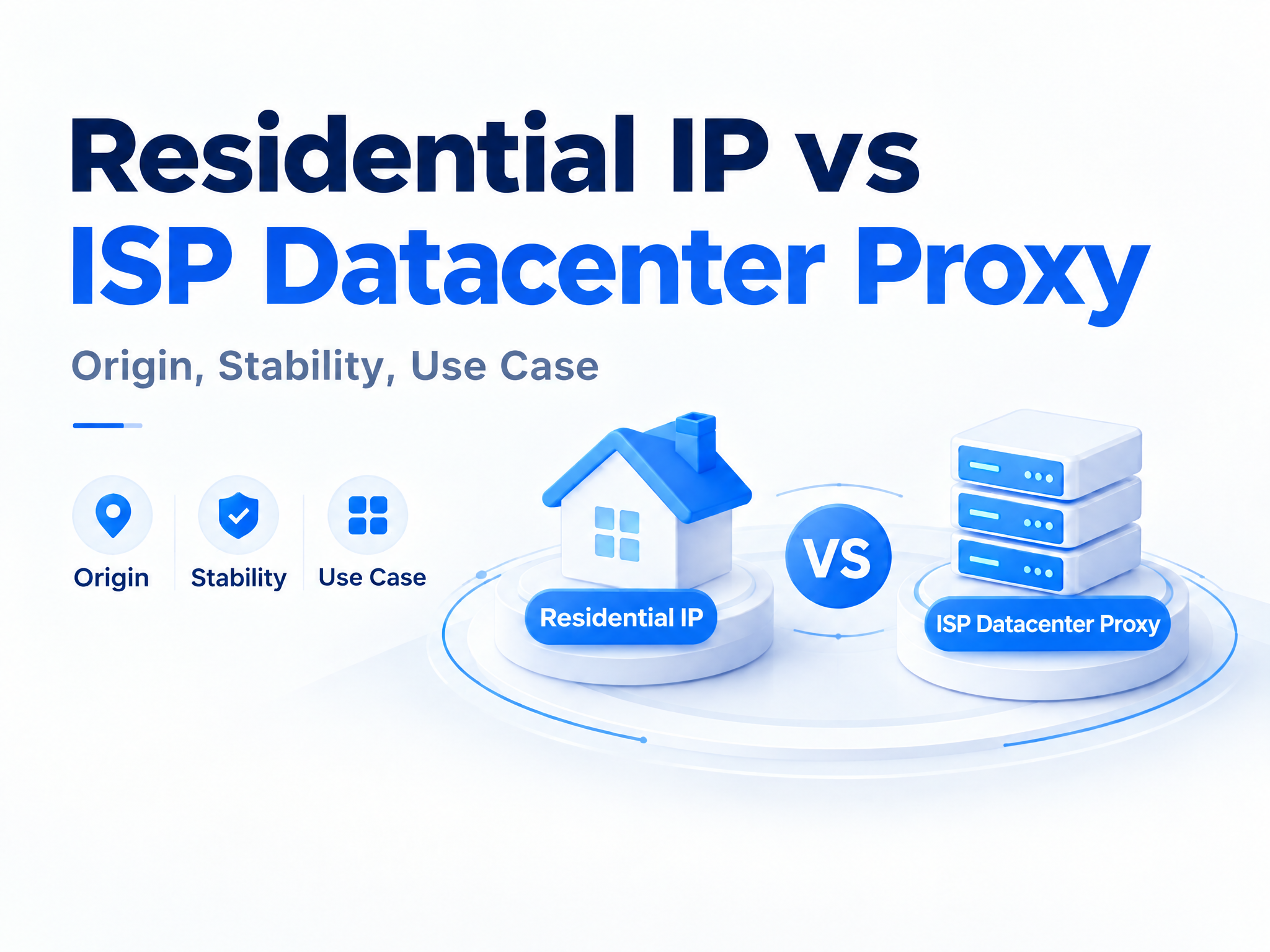
No proxy type can guarantee unrestricted access. Residential routes may align better with some permitted consumer-facing workflows, while datacenter routes can offer stable infrastructure and predictable performance for others. Results still depend on request rate, session continuity, geographic alignment, IP history, target permissions, and connection configuration. Choose the network type according to the authorized use case, then validate it with a small target-specific test rather than assuming that one proxy category solves every failure.
Q: When should an official API replace proxy-based collection?
Use an official API or data feed when it provides the required fields, update frequency, permissions, and service level. APIs generally make rate limits, authentication, schemas, and error handling more explicit. Page-level collection may remain necessary when permitted data is unavailable through an API, but it requires stronger monitoring for layout and policy changes. If a target introduces an API requirement or changes its access terms, pause the workflow and confirm the approved integration method before continuing.