What Exactly Is a Rotating Residential Proxy?
A rotating residential proxy is a proxy service that puts two things together: residential IPs + automatic rotation.
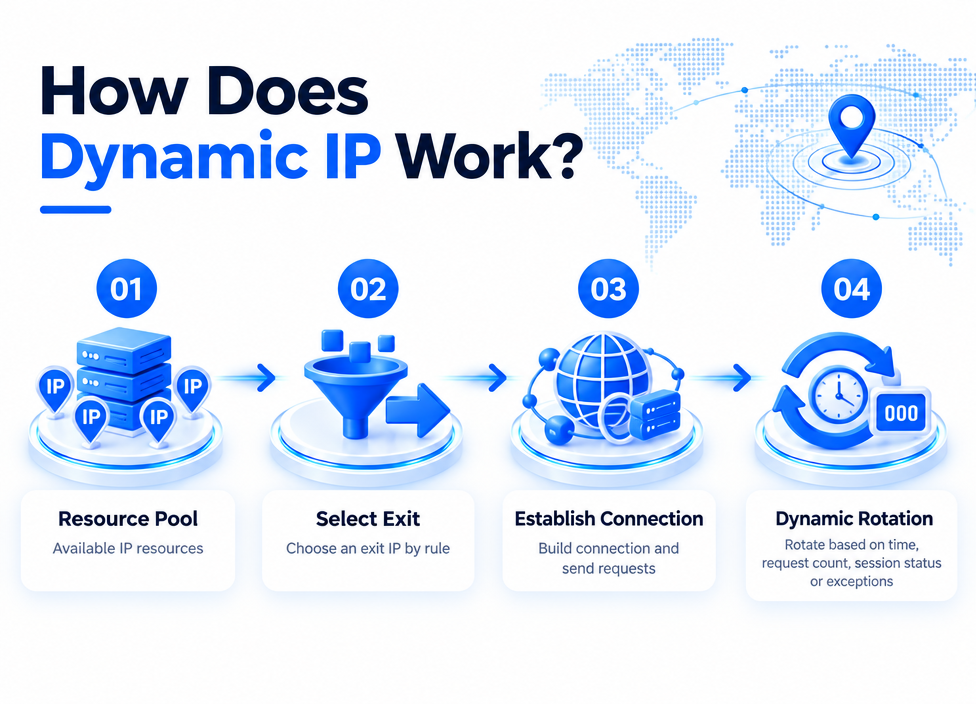
Residential IP means an IP address sourced from a real home broadband connection — sitting in the same ranges that ISPs assign to household users. Automatic rotation means that when a request is fired, the proxy service's backend picks an IP from the pool and assigns it to that request — and the next request may get a different IP.
The two components divide the work:
- Residential IPs handle "looking like a real person browsing" — because the exit itself is a home network
- Automatic rotation handles distributing requests so that no single IP shows up on the target site's high-frequency list
Combined: "each visit looks like a different household browsing." That's the fundamental principle-level difference from static proxies and datacenter proxies.
How Do Residential Proxies Differ from Other Proxy Types?
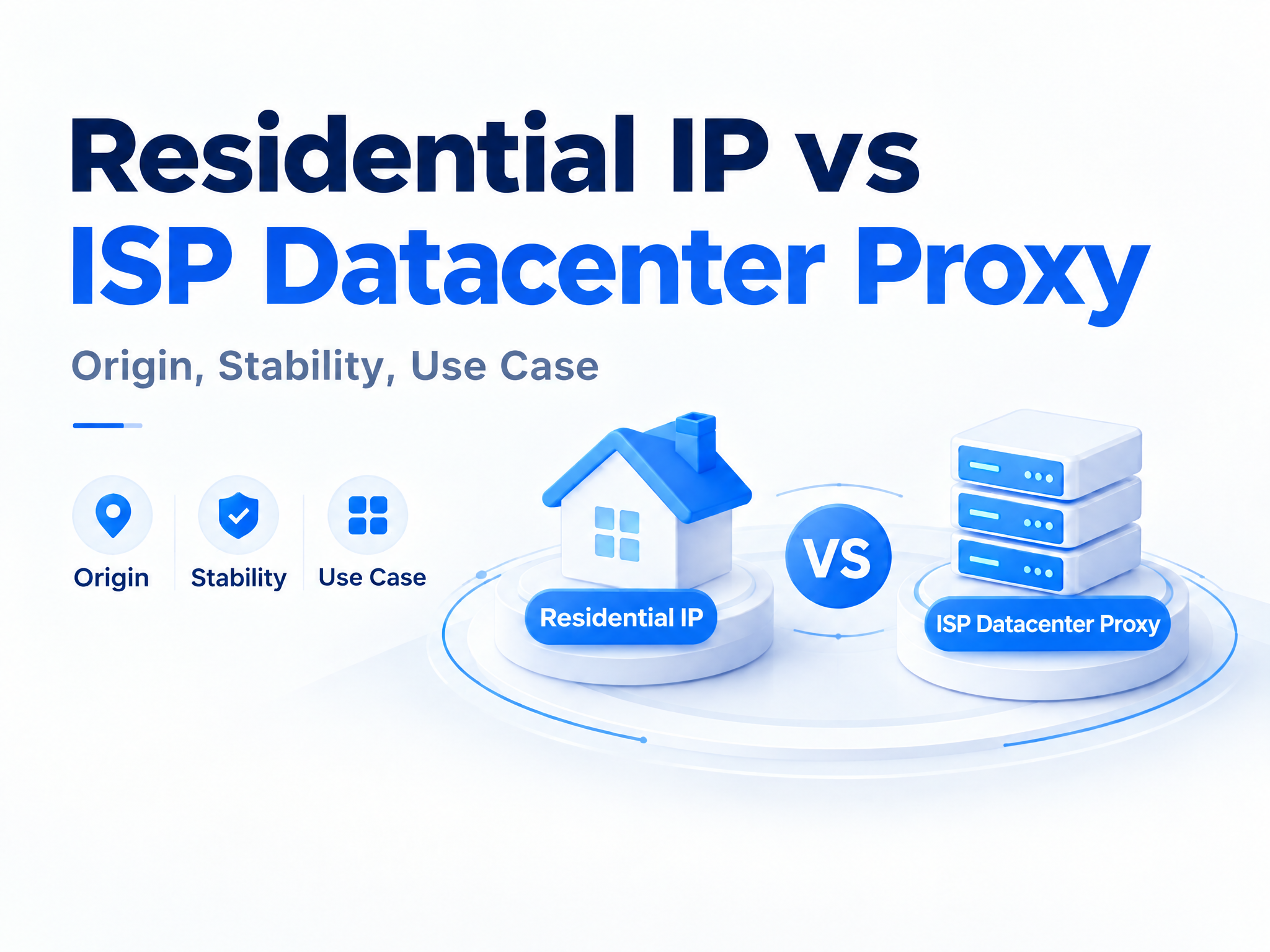
There are two independent axes for classifying proxy types: IP source + scheduling mode. The first axis determines "who it looks like is browsing"; the second determines "how often the identity changes."
Axis one — IP source:
| IP Source | Exit Location | What the Target Site Sees | Typical Use Cases |
|---|---|---|---|
| Residential IP | Real home broadband | A household user browsing | Overseas public data, cross-border product selection |
| Datacenter IP | Cloud provider IDCs | A server in a data center | Internal systems, B2B API integrations |
| Mobile IP | Mobile carrier base stations | A mobile-data user browsing | Mobile app data, app-level big data analysis |
Axis two — scheduling mode:
| Scheduling Mode | IP Dwell Time | Rotation Trigger | Best For |
|---|---|---|---|
| Rotating proxy | 1–30 minutes | Time elapsed OR per request | High-frequency short-session scraping |
| Static proxy | Hours to days | Manual switch | Scenarios needing a fixed exit for logged-in state |
| Long-lived proxy | Days to months | Expires and swaps | Long-term steady-state business |
"Rotating residential proxy" = axis one set to "residential IP" + axis two set to "rotating."
This is where beginners most often trip up. Many think "rotating residential" is a distinct thing when it's actually a combination of two attributes. The same batch of residential IPs, paired with a different scheduling mode, becomes "static residential" or "long-lived residential." The underlying resource is the same — just used differently.
Why "Rotate"?
The point of rotation is to distribute access frequency, making requests look like they come from many different users instead of one user hammering the target site.
Target sites typically run a rate-control mechanism:
- If the same IP makes more than M requests in N seconds, restrictions kick in
- If the same IP hits the same domain continuously for too long, CAPTCHAs get added
- If an IP's access pattern differs too much from real users, stricter validation is triggered
Rotation turns "one IP firing 1,000 requests" into "1,000 IPs each firing 1 request." What the target site sees is dispersed, one-off visits, not concentrated high-frequency traffic.
How to choose the rotation cycle? Common industry observations:
- Short cycle, 1–5 minutes: fits high-frequency scraping — product prices, stock levels, and other scenarios with fast-updating, small-payload data
- Medium cycle, 5–30 minutes: fits medium-intensity scraping where the session needs to hold briefly
- Long cycle, 30+ minutes: close to static, fits operations that need to hold a logged-in state
The larger the residential IP pool, the fresher the rotation — more assignable IPs means a lower repeat rate. But pool size isn't the only metric. Pool activity level and whether the geographic coverage matches your business needs matter just as much.
What Scenarios Suit Rotating Residential Proxies?
Three typical scenarios, all under the umbrella of "overseas public data scraping."
Scenario 1: Cross-border product selection
Cross-border e-commerce sellers doing product research need to bulk-scrape product data from major overseas platforms: prices, reviews, competitor SKUs, listing dates, and more.
Characteristics of this scraping: request volume is high — a single seller's research pass might cover tens of thousands of products; a real local network exit is needed to get prices and recommendation results that match what local consumers see; no logged-in state required — purely public data.
Residential IPs' "looks like a real person" property and rotation's "distributed access" property line up exactly with what this scraping needs.
Scenario 2: Ad monitoring
Brands and ad agencies need to monitor their own or competitors' ad campaigns: where the ads appear, at what times, to which audiences.
Overseas ad platforms' recommendation algorithms adjust results based on IP location, so to see "what a user in a specific city of a specific country is being shown," you have to make the request from an IP in the corresponding region.
The more countries and regions the residential IP pool covers, the more markets you can monitor. Rotation makes each fetch look like a different user, avoiding being flagged by the algorithm as a single strange user.
Scenario 3: Overseas sentiment monitoring
Enterprises need to monitor discussions about their brand or industry on overseas social media, forums, and news sites — for brand protection or industry intelligence.
The key requirement here is coverage breadth: scraping needs to run across multiple platforms, multiple language regions, and multiple time windows continuously. Rotating residential proxies make the scraper look like "many real users distributed globally are browsing," which fits the platform's natural traffic distribution better than a single fixed exit.
How Do You Decide Whether You Actually Need One?
Four questions — answer them in sequence and you'll have your conclusion.
Question 1: Is your scraping target an overseas site or a domestic one?
Overseas → go to the next question. Domestic → you don't need residential proxies; short-lived proxies or tunnel proxies are usually enough for domestic business.
Question 2: Does the target site adjust returned content based on the exit environment?
Yes (for example, changes recommendations, prices, or visibility scope based on IP location) → continue. No → datacenter proxies are cheaper and sufficient.
Question 3: Do you need to maintain a logged-in state or a long session?
Yes → static residential proxies fit better; rotating isn't the right choice. No (each scrape is independent) → continue.
Question 4: Is single-run scraping request volume and frequency relatively high?
High (e.g., tens of thousands of requests per day) → rotating residential proxy is a good fit. Low → a basic proxy will do.
If all four questions route "continue," a rotating residential proxy is the right choice. Whenever any step branches off, switch to that type.
What Are the Common Beginner Pitfalls?
Pitfall 1: The bigger the IP pool, the better.
Pool size matters, but it's not the only thing. The same 10-million-IP pool spread across only 10 countries isn't enough for global ad monitoring; 100-country coverage with only 10,000 IPs per country isn't dense enough for high-frequency scraping in a single country. Check whether geographic distribution matches your business before you look at the total number.
Pitfall 2: The more frequent the rotation, the better.
A short rotation cycle does spread out access more, but it also means an IP swap may happen mid-session — and some operations requiring session persistence will fail. The rotation cycle needs to match your scraper's session logic.
Pitfall 3: Residential proxies fit every scenario.
Residential proxies cost more than datacenter proxies and depend on upstream and downstream bandwidth. If the target site doesn't validate the exit environment, datacenter proxies deliver better cost efficiency.
Pitfall 4: Comparing unit price, not total cost.
Rotating residential proxies bill in three ways: per traffic, per duration, per request. With the same headline unit price, actual total cost under your real usage pattern can differ by multiples. Do the conversion based on your own scraping pattern rather than the sticker unit price.
Pitfall 5: Buying a big package upfront.
Beginners should run a small package with real business code first, validate whether the rotation cycle fits, whether the IP quality meets expectations, and whether the target site's responses are stable. Once that works end-to-end, upgrade the package based on actual usage.
FAQ
Q: What's the difference between a rotating residential proxy and a regular HTTP proxy?
"Regular HTTP proxy" is just a general term — the focus is on the protocol being HTTP or HTTPS. A rotating residential proxy layers two attributes on top of the protocol: the IP source must be residential, and the scheduling mode must be automatic rotation. One is a protocol dimension, the other is a resource-plus-mechanism dimension — they're not comparisons at the same level.
Q: Where do residential IPs come from? Is it compliant?
Residential IPs typically come from partner distribution networks contracted with household users — for example, SDK-embedded participation programs where users opt in to IP sharing. ISPs may also authorize enterprise-facing nodes. Compliance rests on two points: whether household users are informed and have consented, and whether the provider holds the corresponding operating credentials. When selecting a provider, check for a clear compliance statement and relevant licenses.
Q: Why are rotating residential proxies so much more expensive than datacenter proxies?
The cost difference is mainly on the resource side. Datacenter IPs are bulk-allocated from IDCs with very low marginal cost. Residential IPs require partnerships with real home networks, involving revenue sharing, compliance, and operations — multiple layers of cost. That's why pricing usually goes by traffic or request count rather than by IP count, and typically runs several times higher than datacenter proxies.
Q: Can I control the rotation cycle myself?
Most providers offer two control patterns: one is setting a global rotation cycle — for example, swap every 5 minutes; the other is using parameters to control "swap per request" or "hold within a session for a set duration." Whether you can control at finer granularity depends on the provider's product design. During selection, just ask support what control levels they support.
Q: How much should a beginner buy for the first purchase?
Buy the smallest starter package and run a full 2–3 day business cycle. After that, tally actual consumption: daily traffic, request count, success rate, average response time. Use that measured data to back into a monthly package — it's more accurate than sizing upfront based on projected usage.
Q: Are rotating residential proxies unstable?
Residential IPs are inherently less stable than datacenter IPs because home networks fluctuate. But mature providers use pool redundancy, health checks, and automatic retry mechanisms to lift availability to solid levels. Industry-published availability figures typically run between 95% and 99%; in real business, stress-test against your own scenario to validate.